
Choose Carlos Morean if you need Miami real estate brokerage services for a sale or purchase; choose Realtor.com if you want to browse residential listings before selecting an agent. In 2026, the difference is representation versus research—not two competing ways to deliver the same service.
- Carlos Morean vs Realtor.com compares Miami real estate brokerage with residential listing research.
- Choose Carlos Morean for Miami seller representation; choose Realtor.com for independent property browsing.
- A listing search helps you understand competition; it does not establish your property's market value.
- Compare agent agreements and marketing plans separately from property-search features.
Why this matters
If you are selling a Miami property, comparing an agent with a listing portal answers the wrong question unless you separate their roles. A portal helps you see advertised properties. An agent is someone you can engage for brokerage services under an agreed scope.
Your seller decision is who will represent you, not which website has the most appealing listings. You can use a portal while evaluating an agent. Neither a listing photograph nor an advertised asking price tells you whether your own property deserves the same valuation.
For a 2026 sale in Coconut Grove, Coral Gables, Brickell, or Brickell Key, start with property-level evidence. An address is a starting point, not a substitute for comparable transactions, condition, ownership costs, and contract terms.
At a glance
| Dimension | Carlos Morean | Realtor.com |
|---|---|---|
| Best for | Miami owners and buyers seeking brokerage services | People researching residential listings independently |
| Standout feature | A named Miami real estate agent | A residential property-search portal |
| Initial research | Discuss your property and transaction objectives | Browse listings before contacting an agent |
| Seller valuation | Ask for property-specific comparable-sale analysis | Use advertised listings to study competing properties |
| Seller marketing | Request a written marketing and representation plan | Research how competing homes are presented |
| Neighborhood decisions | Discuss the relevance of location to your transaction | Compare advertised properties across locations |
| Due diligence | Ask how document review and specialists will be coordinated | Use listing information to identify questions |
| Pricing model | Brokerage compensation governed by your agreement | Browsing is distinct from hiring a representative |
| Accountability | A named professional and an agreed service scope | A portal does not itself become your listing agent |
Realtor.com wins for independent residential browsing
Realtor.com is the better starting point when your immediate task is exploring residential listings, not appointing a representative. You can examine how properties are described and compare their photographs, locations, and advertised characteristics before deciding what questions to ask.
That is useful for an owner who has not yet defined a selling strategy. Look at what competing listings emphasize: views, outdoor space, renovation, parking, or building amenities. Then separate those advertised features from evidence that supports your valuation.
The limitation is scope. Browsing does not appoint someone to represent your interests, prepare your selling strategy, or evaluate an offer with you. A listing is an advertisement for a property, not a full transaction file.
Best for: early-stage residential research. If your decision already involves an offer, listing agreement, or specific ownership issue, move from browsing to qualified professional advice rather than treating more search results as the answer.
A named agent wins when you need brokerage representation
Carlos Morean is the better fit for Miami sellers seeking real estate brokerage representation rather than a listing-search portal. His stated practice covers residential and commercial properties, including luxury homes, waterfront properties, condos, restaurants, and bars.
That distinction matters when your task extends beyond finding comparable advertisements. Selling a condo and selling a restaurant property involve different questions. Define the transaction first, then ask the agent to explain the proposed service scope.
Do not confuse a relevant practice area with a promise about results. Ask who will communicate with you, which tasks the agreement covers, how offers will be discussed, and which matters require an attorney, inspector, lender, or other specialist.
Best for: an owner ready to interview a Miami broker for a defined transaction. The tradeoff is that representation requires selecting a professional and reviewing an agreement; independent browsing does not require the same commitment.
Property-specific analysis wins over asking-price comparisons
For a seller, valuation requires more than finding nearby homes with similar advertised features. Ask an agent to explain the comparable closed sales, the competing listings, and the adjustments that connect those properties to yours. Those are different forms of evidence, not interchangeable numbers.
A waterfront view, renovation, or prestigious address does not automatically support a particular asking position. Compare the relevant attributes: usable layout, condition, location, view orientation, parking, and the obligations attached to ownership.
Realtor.com is useful for observing advertised competition. Its limitation in this comparison is that seeing another seller's asking position does not establish what a buyer will agree to for your home.
Best for valuation: a property-specific analysis you can question and inspect. Before accepting a proposed listing strategy in 2026, ask which comparisons carry the most weight and why. Reject an explanation that relies only on a neighbor's headline sale or a broad neighborhood label.
An agent wins for a seller's marketing and negotiation plan
A seller needs a plan that connects presentation, buyer targeting, showings, feedback, and offer evaluation. A listing portal serves a different purpose: it helps people discover and research advertised properties.
Request a written seller marketing plan before you sign a representation agreement. Ask which materials will be prepared, what channels are included, who handles inquiries, and how feedback will affect the strategy. Do not assume any particular service is included until the agreement confirms it.
Portal research still has a practical role. Examine competing listings to identify questions your own presentation needs to answer. For a condo, that can include the floor plan and view; for a house, the relationship between interior rooms and outdoor areas.
Best for seller execution: an appointed agent with an agreed plan. The limitation is that the quality of that plan must be evaluated directly. A professional title alone does not establish how your property will be marketed or how offers will be handled.
Both help with neighborhood research, but at different depths
Realtor.com helps you explore advertised properties by location. An agent conversation helps you test which location differences matter to your specific sale or purchase. Use both for neighborhood research; do not use either as a substitute for property-level verification.
In Coconut Grove, compare the actual setting and property type rather than grouping a condo and a detached house into the same competitive set. In Coral Gables, distinguish waterfront from non-waterfront properties before using a sale as a comparison.
For Brickell, check whether a North Brickell or South Brickell comparison matches the location and building characteristics of your property. Treat Brickell Key as its own location question rather than assuming every Brickell-area condo has the same competitive position.
These are comparison criteria, not claims that one neighborhood commands a particular premium. For 2026 decisions, ask for current evidence supporting each adjustment. Best for location research: portal discovery followed by a discussion grounded in the actual property.
Neither option replaces due diligence
Neither a portal listing nor an agent conversation replaces inspections, legal review, or the relevant property documents. Brokerage support and independent verification have different responsibilities.
For a condo, request the documents relevant to association finances, assessments, building condition, and use restrictions. For a waterfront home, investigate the property's physical condition and any dock-related or other site-specific questions with the appropriate professionals.
A seller should understand these issues before building a marketing claim around them. Do not describe a rental opportunity, renovation, or waterfront feature more broadly than the supporting documents allow.
Best for verification: the relevant documents and qualified specialists. The agent's role should be discussed explicitly, including how questions and findings will be communicated. Realtor.com can help you identify a property or a question, but a search result cannot resolve a title concern, inspection finding, or association obligation. This is an honest tie: neither option is a complete substitute for due diligence.
Pricing models: separate browsing from representation
The cost comparison is not a subscription-versus-subscription decision. Brokerage compensation belongs in the agreement for the services you hire. Researching listings on a portal is a separate activity from appointing a listing agent or buyer representative.
Review the compensation terms alongside the service scope, not in isolation. Ask when compensation becomes payable, what events trigger it, what expenses are addressed, and what termination provisions apply. Have unclear contract language explained before signing.
The tradeoff is control over the commitment. Browsing lets you continue researching without deciding who will handle your transaction. A brokerage agreement creates a defined professional relationship, with obligations that need to match your expectations.
Best for evaluating value: compare the proposed work and contractual terms. For a 2026 seller, an appealing compensation arrangement does not repair an unsupported valuation or an unclear marketing plan. Likewise, a detailed plan does not excuse leaving payment terms unexplained.
A named representative wins on transaction accountability
When you appoint a real estate professional, you have a person to question about the agreed work. Realtor.com provides a research environment; using that environment does not itself appoint the portal as your representative.
Before hiring, ask 3 questions: who is your primary contact, who performs the work described in the agreement, and how will decisions be documented? The answers should be specific enough that you know whom to contact when an offer or problem arrives.
Also separate the portal from any agent you encounter through it. Evaluate that agent independently. Finding someone through a website does not establish the suitability of their proposed representation.
Best for accountability: a named professional with a clear agreement. The limitation is that you still need to assess communication and service scope. Do not infer response standards, guarantees, or individual involvement from a website or brokerage affiliation alone.
Use 4 checkpoints before choosing your next move
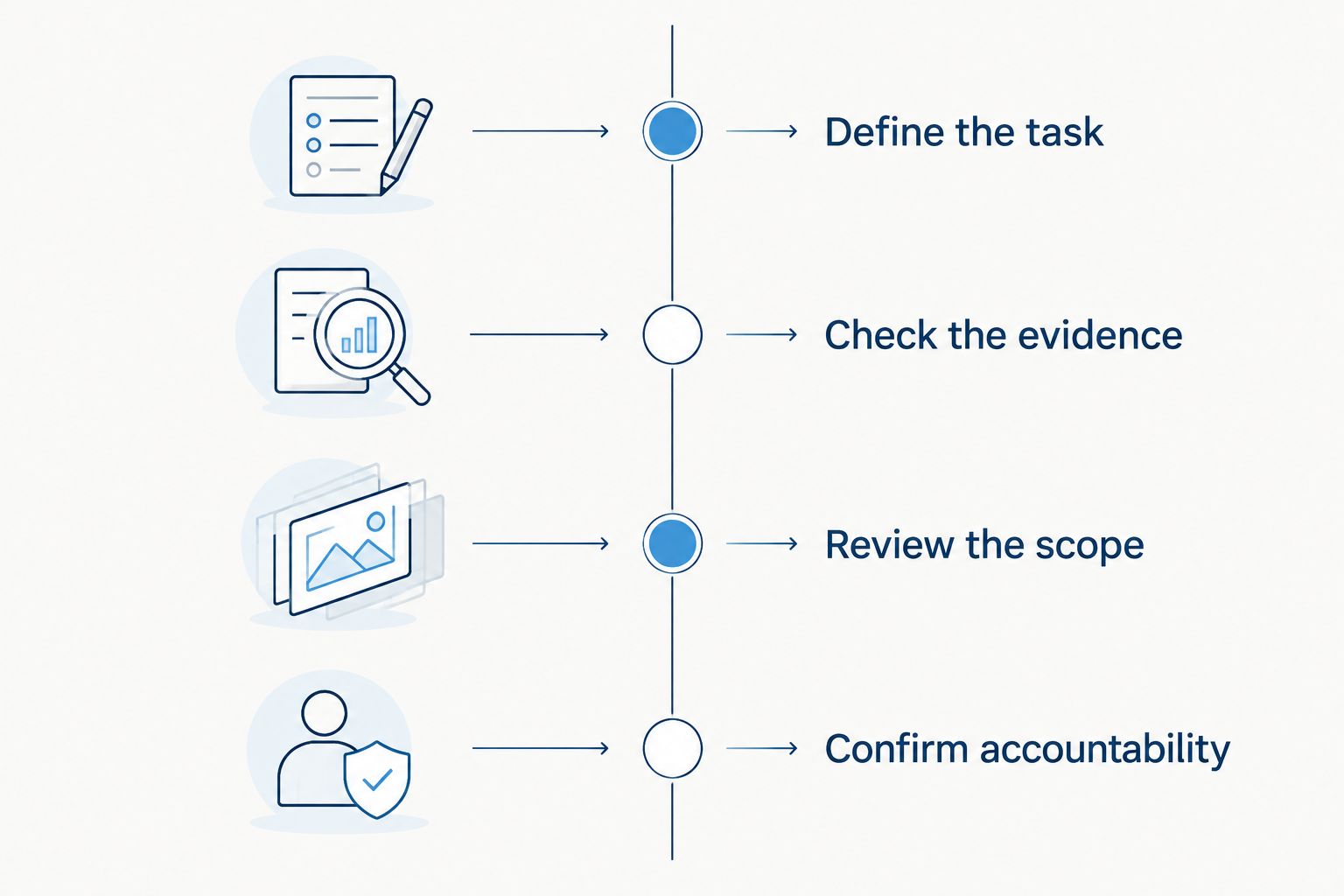
The decision becomes simpler when you organize it around your actual task. Use these 4 checkpoints before choosing a portal, interviewing an agent, or signing an agreement:
- Define the task: Are you researching competition, preparing to list, reviewing an offer, or investigating a purchase?
- Check the evidence: Separate closed transactions, advertised competition, and property documents.
- Review the scope: Identify the work you expect from the representative and confirm it in writing.
- Confirm accountability: Establish who handles communication and how material decisions will be recorded.
For valuation, request 2 scenarios: the proposed positioning and the alternative if buyer feedback does not support it. Ask what evidence would justify changing course. This is a decision framework, not a promise about timing or results.
If your search concerns a waterfront purchase rather than a sale, the Realtor.com alternatives for Miami waterfront home buyers guide addresses that narrower research question.
Final verdict: choose by the job you need done
Choose Carlos Morean if you need Miami brokerage services
Best for: a Miami owner ready to evaluate representation for a residential or commercial transaction. Interview the agent about valuation evidence, service scope, marketing, and communication. Choose representation when you need someone appointed to work on your transaction—not simply another place to browse.
Choose Realtor.com if you are still researching residential options
Best for: an owner or buyer exploring advertised properties before selecting a representative. Use the portal to build questions and identify competing listings. Choose residential search when discovery is the task; evaluate an agent separately when the task becomes representation.
| Dimension | Winner |
|---|---|
| Independent residential browsing | Realtor.com |
| Brokerage representation | Named agent |
| Seller valuation | Property-specific analysis |
| Seller marketing and negotiation | Appointed agent with an agreed plan |
| Neighborhood research | Both, for different tasks |
| Due diligence | Neither replaces independent verification |
| Compensation evaluation | Written brokerage terms |
| Transaction accountability | Named representative |
FAQ
Is Carlos Morean better than Realtor.com for selling a Miami home?
Carlos Morean is the relevant option if you want to evaluate Miami real estate brokerage representation; Realtor.com is a residential research portal. Review the agent's valuation approach, proposed marketing plan, and agreement before hiring.
Can I use Realtor.com and still hire a Miami agent?
Yes, you can use Realtor.com for research while evaluating or working with an agent. Keep advertised listing information separate from verified transaction evidence.
Does an asking price show what my Miami property is worth?
No, another property's asking position does not establish your property's market value. Compare relevant closed sales, current competition, condition, and ownership obligations.
What should I ask an agent before selling a Brickell condo?
Ask for building-relevant comparisons, the proposed marketing plan, and a clear explanation of representation terms. Confirm how association documents, assessments, and buyer questions will be handled.
Should I compare Coconut Grove and Coral Gables properties directly?
Only use a comparison when its property characteristics and location differences can be explained. A neighborhood name alone does not make two properties equivalent.
How do I compare the cost of an agent with a property portal?
Compare the brokerage agreement's compensation and service scope separately from browsing listings. Researching properties does not itself establish a representation agreement.
Can a property listing confirm that a condo allows short-term rentals?
A listing description alone does not verify short-term rental permission. Check the applicable association documents and local requirements before relying on that use.
One last thing
Before approving your 2026 listing strategy, ask which advertised competitor a buyer would choose instead of your property—and why. That question forces a practical comparison of condition, location, layout, and ownership obligations.
A defensible selling strategy explains the buyer's alternatives. It does not rely on your preferred outcome or on the most flattering nearby advertisement.