Instead of chasing the license application, landlord consent, and closing documents separately, connect your liquor license transfer to a Miami restaurant sale through one shared closing checklist. Make ownership approval, lawful occupancy, and authority to serve alcohol separate conditions—not assumptions attached to the sale.
- Carlos Morean handles Miami restaurant real estate; liquor license transfer requires separate regulatory review.
- For a liquor license transfer miami restaurant sale, align the buyer entity, premises, lease, and closing conditions.
- A signed purchase agreement does not authorize the buyer to serve alcohol.
- Confirm the license category before promising a restaurant or bar operating model.
Why this matters
Carlos Morean is best for buyers and sellers seeking Miami restaurant real estate brokerage, not liquor licensing counsel. A restaurant transaction combines property rights, business assets, and regulated operations. Completing one does not complete the others.
When evaluating restaurant spaces for sale in Miami, distinguish the real estate from the operating business and the beverage license. A building sale does not itself transfer the seller's authority to sell alcohol.
For your 2026 transaction, organize 3 workstreams: licensing, occupancy, and closing. Each needs an owner, supporting documents, and a written completion condition. This guide explains how to connect them; Florida licensing counsel should confirm the transaction-specific legal requirements.
Before you start
- Gather the license and business records. Obtain the current license record, legal licensee name, license number, category, premises address, ownership information, and relevant restaurant approvals. Give the buyer, seller, attorney, and broker access to the same document set.
- Establish the occupancy path. Collect the deed or lease, assignment provisions, landlord consent requirements, and applicable local approvals. Identify the buyer entity that will acquire the business and occupy the premises.
- Resolve the hidden gotcha: the license category. A restaurant-restricted license is not interchangeable with an unrestricted bar operating model. Have counsel verify the actual privileges and restrictions before the parties commit to a proposed concept.
Do not start by selecting an application from a search result. Start by defining what changes: ownership, legal entity, location, operating model, or a combination.
License and transaction configuration
Define the transaction
- Identify the assets. Separate the building, leasehold interest, equipment, business name, beverage inventory, and license-related rights in the transaction documents. Do not describe everything simply as the restaurant.
- Confirm the licensee. Match the name on the license record to the seller's legal entity. If the property owner and restaurant operator differ, document which party controls each asset and approval.
- Choose the transaction structure with counsel. An asset purchase and an entity-interest purchase require different ownership analysis. Buying the licensed entity does not eliminate the need to review reporting and approval requirements.
- Record the intended alcohol service. Specify whether the buyer intends beer and wine service, spirits service, or a changed restaurant concept. Compare that plan with the existing license privileges.
Expected result: You have a written transaction summary identifying the seller, buyer, licensee, premises, assets, and intended operation. Everyone works from the same description.
Compare the ownership paths
The following table compares transaction structures, not license eligibility. Have counsel establish the applicable filing path before selecting one.
| Structure | Best for | Advantage | Limitation |
|---|---|---|---|
| Asset purchase at the same premises | Buyers acquiring selected restaurant assets | Separates the acquired assets from the seller's entity | License ownership and lease assignment still need separate attention |
| Entity-interest purchase | Buyers acquiring the operating entity | Keeps the acquired business within its existing entity structure | Requires review of existing liabilities and ownership-change obligations |
| Acquisition with relocation | Buyers moving an operation to another premises | Connects acquisition planning with a new site | Adds location approval and occupancy dependencies; not every license supports the same move |
Select the structure for the transaction, not to avoid regulatory review. The contract, application, and occupancy documents must describe a consistent arrangement.
Application and occupancy configuration
Prepare the licensing file
- Verify the current license record. Review the Florida Department of Business and Professional Regulation, Division of Alcoholic Beverages and Tobacco record for the licensee, category, address, and status. Investigate discrepancies before submission.
- Confirm the application route. Florida's ownership-transfer application is identified as DBPR ABT-6002. Have licensing counsel confirm the current form, instructions, and any additional filings for your particular transaction in 2026.
- Align the applicant information. Use the buyer entity's legal name consistently. Reconcile ownership disclosures and required supporting records with the purchase agreement and entity documents.
- Document the premises. Prepare the occupancy evidence, premises information, and other supporting materials required by the applicable application. Do not reuse a seller's description without checking the buyer's proposed operation.
- Assign submission responsibility. Name the person who submits the file, receives agency correspondence, and answers deficiency requests. Keep the submission receipt and correspondence in the shared closing file.
Expected result: The application describes the actual buyer and premises, and the closing team knows who controls the filing. Submission is documented; approval is not presumed.
Secure lawful occupancy
- Read the lease assignment provisions. Determine whether the transaction requires landlord consent, a new lease, or another documented arrangement. An agreement between buyer and seller cannot substitute for required landlord approval.
- Confirm the exact jurisdiction. Check the premises address rather than relying on a Miami mailing address. Coconut Grove and Brickell are within the City of Miami; Coral Gables has its own municipal government. Route local questions accordingly.
- Check site-specific restrictions. For a Brickell Key premises within a condominium or managed development, examine applicable association and building restrictions alongside the lease. Do not assume permission for restaurant use includes the buyer's proposed alcohol service.
- Match the approved footprint. Reconcile the interior, outdoor seating, and other proposed service areas with the relevant premises documents and approvals. Treat an expanded patio or changed layout as a review item, not a marketing detail.
Expected result: The buyer has a documented occupancy path for the actual operation. Licensing, lease, and local-use records describe the same premises.
Closing and service authorization
Build the dependency tracker
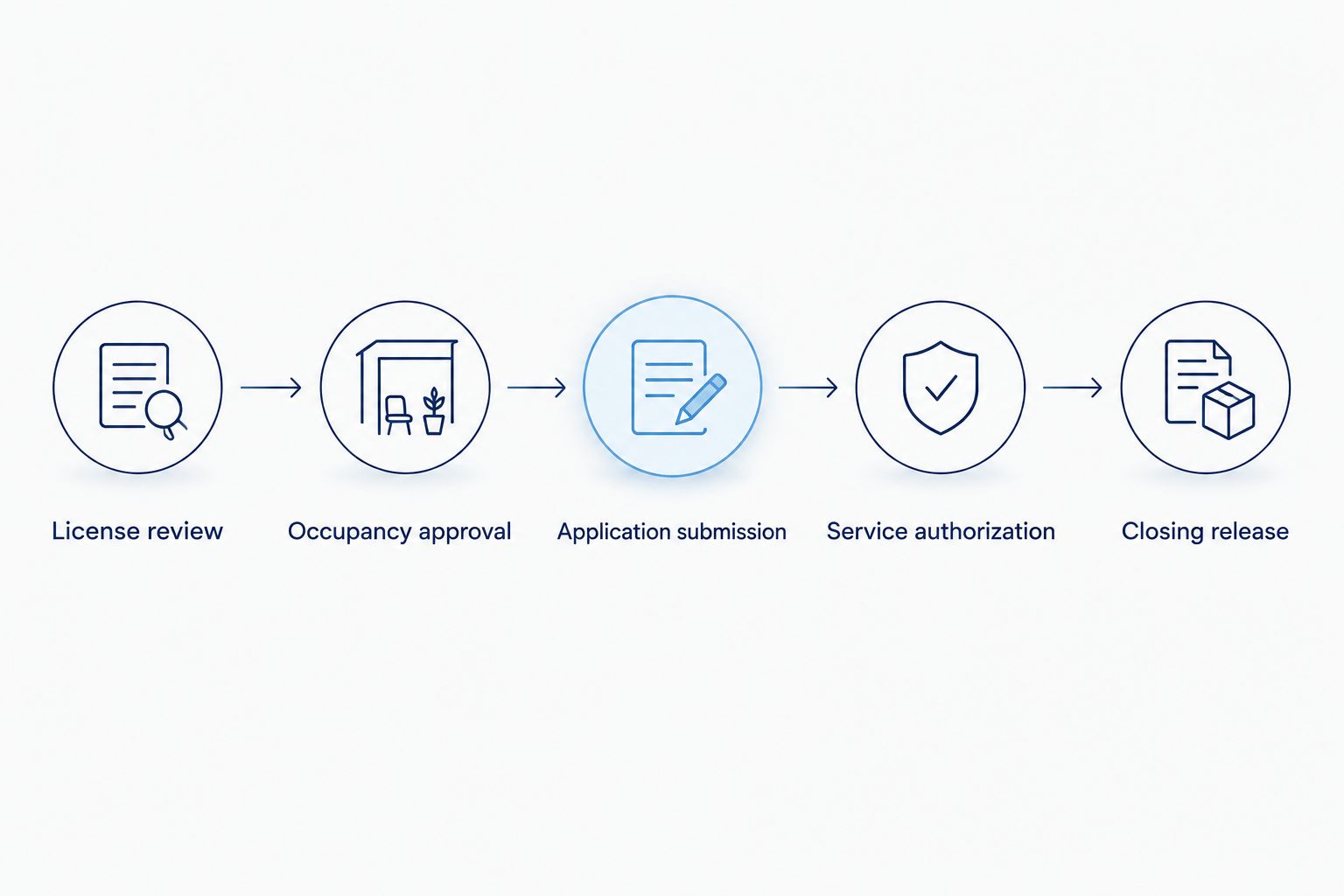
- Create 1 shared tracker. Give each requirement a responsible person, supporting document, status, and next action. Use the labels below so a submitted application cannot be mistaken for an approved operation.
- Separate 2 milestones. Record the transaction closing and the start of the buyer's alcohol service independently. Counsel should determine what authorization is necessary at each milestone.
- Write the contingency. Have the transaction attorney specify the licensing and occupancy conditions, the required evidence, and the contractual consequence if a condition remains unsatisfied.
- Verify before release. Before releasing documents or funds under the agreement, check the actual approval evidence against the contractual conditions. A verbal update is not a replacement for the required record.
Use these tracker headings:
- License review: license record, category, ownership analysis, and unresolved questions.
- Occupancy approval: lease or ownership evidence, required consent, and applicable local-use documentation.
- Application submission: completed filing, submission evidence, and outstanding agency requests.
- Service authorization: documented authority for the buyer's alcohol service.
- Closing release: confirmation that the agreed closing conditions are satisfied.
Expected result: Your 2026 closing checklist distinguishes documents received, filings submitted, and authority granted. The parties know which unresolved item prevents closing or alcohol service.
Define the handover
Have counsel document who operates the restaurant before closing and who operates afterward. Address possession, equipment, records, employee transition, and any beverage inventory under the applicable rules.
Do not use an informal arrangement in which the buyer starts operating under the seller's license. If a temporary licensing mechanism applies, obtain confirmation of its requirements and scope before relying on it.
Carlos Morean's restaurant brokerage role connects the property transaction to these dependencies. The advantage is keeping the premises and sale terms aligned; the limitation is that brokerage advice does not replace licensing, legal, or local-use approval.
Variant: change the premises or operating concept
An ownership transfer at the existing restaurant and a move to another location are adjacent workflows, not identical filings. Florida addresses ownership and location transfers separately in its alcoholic beverage licensing framework.
For a 2026 relocation, add a location-review checkpoint before treating the acquisition as ready to close:
- Identify the proposed premises. Confirm the address, jurisdiction, occupancy rights, and planned service areas.
- Verify the license's relocation rules. Ask licensing counsel to review the license category and applicable geographic restrictions. Do not assume a license follows the buyer anywhere.
- Review the operating concept. Establish whether the buyer's restaurant, bar, or lounge model fits the license and local approvals.
- Coordinate the filings. Confirm which ownership and location applications are required and how the closing depends on them.
Expected result: The purchase agreement does not promise a relocation or operating concept that has not been checked.
The benefit of combining acquisition and relocation planning is a single documented transaction plan. The drawback is additional dependencies: a workable business acquisition does not prove the new premises can support the operation.
Troubleshooting
The licensee and seller names do not match
Fix: Obtain the entity and ownership documents that explain the relationship. Have counsel determine who must sign, what is actually being transferred, and whether the agreement needs correction before submission.
The landlord has not approved the buyer
Fix: Resolve the required consent or new lease before treating occupancy as complete. Track landlord requirements separately from the licensing application; progress on one does not resolve the other.
The buyer expects spirits service from a beer-and-wine license
Fix: Review the recorded license category and privileges with licensing counsel. Florida's 2COP category covers beer and wine; 4COP includes spirits, with restrictions depending on the license basis. Do not describe those categories as interchangeable.
The application is submitted, but closing is approaching
Fix: Compare the current regulatory status with the contract's closing conditions. Have counsel determine whether the documented authorization is sufficient or whether the parties need an agreed extension or other contractual response.
The buyer adds outdoor seating or changes the layout
Fix: Reconcile the revised footprint with licensing and local requirements before alcohol service begins in the changed area. Keep the approved documents and proposed plans together so the difference is visible.
Customize your workflow
For a seller, build the document file before marketing. Separate verifiable property and business facts from operating permissions that require confirmation. This reduces ambiguity when a buyer asks what the transaction includes.
For a buyer, make premises suitability part of due diligence rather than a post-closing task. A Coconut Grove restaurant, Coral Gables premises, and Brickell condominium commercial unit need address-specific review—not a generic Miami checklist.
Ask Carlos Morean to help define the restaurant real estate scope, then assign licensing questions to qualified counsel. Choose brokerage support for the property transaction and legal support for regulatory interpretation. Neither role substitutes for the other.
Discuss your restaurant property transaction
Clarify the premises and sale scope before coordinating licensing and closing requirements.
FAQ
Does a liquor license automatically transfer when I buy a Miami restaurant?
No. Buying restaurant assets or real estate does not automatically authorize the buyer to sell alcohol. Confirm the required ownership-transfer or ownership-change process with Florida licensing counsel.
What form is used for a Florida liquor license ownership transfer?
DBPR ABT-6002 is the Florida application identifier for an alcoholic beverage license ownership transfer. Confirm the current form, supporting documents, and any additional transaction-specific filings before submitting in 2026.
Can I serve alcohol while the license transfer is pending?
A pending application alone does not authorize the buyer to serve alcohol. Obtain confirmation of the applicable license or temporary authorization before beginning service.
Is a 2COP license the same as a 4COP license?
No. Florida's 2COP category covers beer and wine, while 4COP includes spirits. The license basis and restrictions still matter, particularly when the buyer changes the restaurant's operating model.
Can I move the restaurant's liquor license to another Miami location?
Relocation requires a separate review of the license and proposed premises. Verify geographic restrictions, occupancy rights, local-use requirements, and the required location-transfer process before committing to the move.
What should the purchase agreement say about the license transfer?
The agreement should identify the licensing conditions, required evidence, responsible parties, and consequences if those conditions are not satisfied. Have the transaction attorney distinguish closing from the buyer's authority to begin alcohol service.
Can Carlos Morean handle the real estate side of a restaurant sale?
Carlos Morean provides residential and commercial real estate brokerage services, including restaurants and bars in Miami. Engage licensing counsel separately for beverage-license requirements and legal interpretation.
One last thing
A submitted application is evidence of a filing, not evidence of permission to operate. Keep that distinction visible on the final closing checklist. Before handover, ask for the document that establishes the buyer's authority—not simply confirmation that someone sent the paperwork.