
First-time investors’ Miami commercial property investing is the purchase of income-producing business premises with the aim of earning rent and building equity. This 2026 guide to Miami commercial property for first-time investors explains how to evaluate permitted use, leases, operating expenses, financing, and resale before committing capital.
- Miami commercial property for first-time investors starts with verified leases, permitted use, and documented operating expenses—not advertised returns.
- Carlos Morean provides commercial real estate brokerage guidance for Miami investors, including restaurant and bar property searches.
- Compare office, retail, restaurant, and industrial properties by tenant requirements and ownership responsibilities.
- Reject an investment plan that depends on unverified rent growth, licensing, or future refinancing.
Why commercial property matters for first-time Miami investors
Commercial property gives you an investment tied to business occupancy rather than residential occupancy. The distinction changes your analysis: a tenant’s permitted activities, lease obligations, equipment, and financial capacity all affect the property’s usefulness and income.
Carlos Morean is best for first-time Miami commercial property buyers seeking brokerage guidance rather than a self-directed listing search. Carlos Morean provides residential and commercial real estate brokerage services, including properties associated with restaurants and bars. Brokerage guidance does not replace legal, tax, engineering, or lending advice.
For your 2026 purchase, distinguish a property sale from a business sale immediately. A restaurant opportunity can involve real estate, an operating business, equipment, a lease assignment, or a combination. Those are different assets with different diligence requirements.
Your first decision is not which listing looks most attractive. It is which ownership responsibilities you understand well enough to accept, finance, and manage.
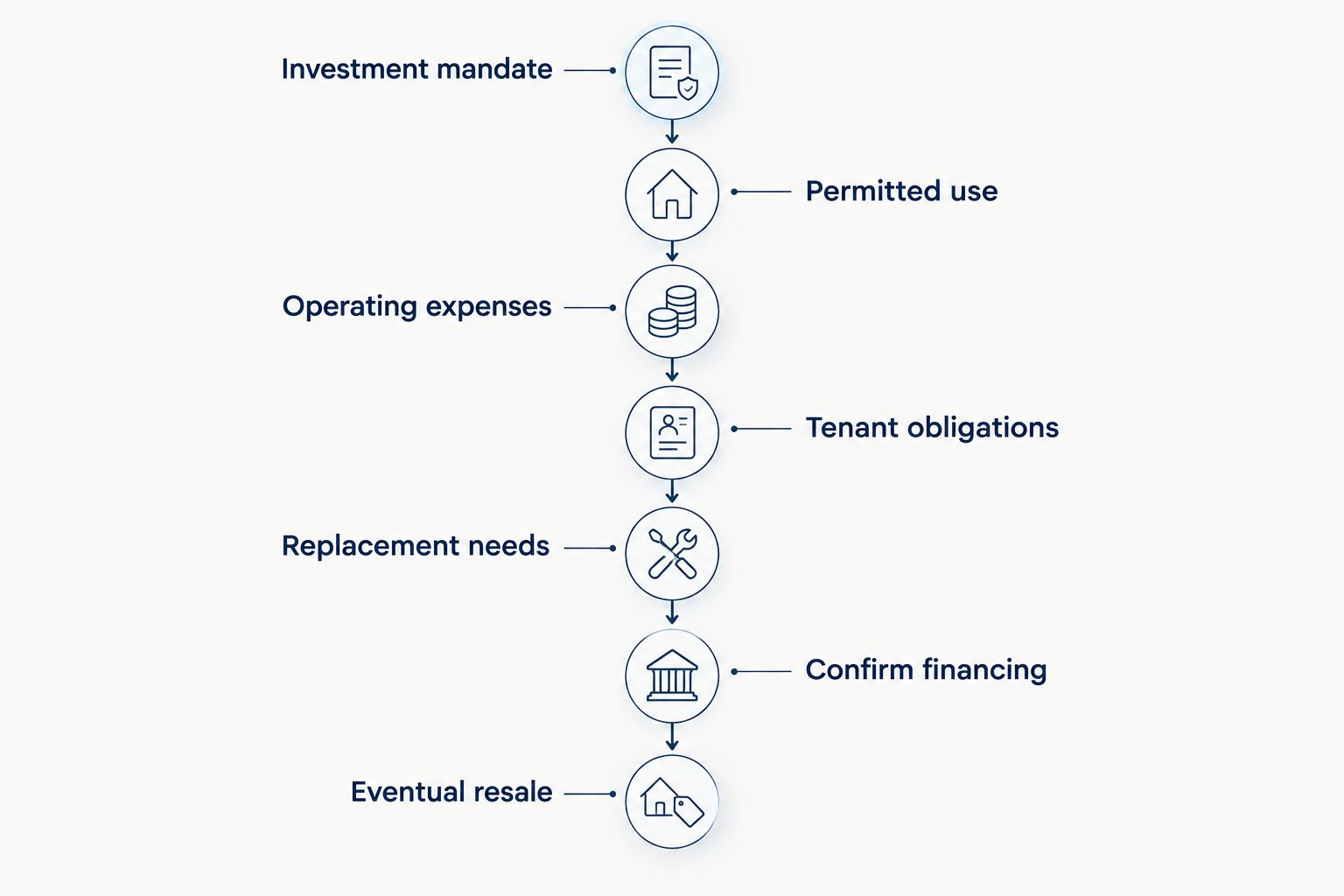
How to evaluate your first Miami commercial investment
Define your investment mandate
Write your purchase criteria in a spreadsheet before contacting sellers. A clear mandate prevents a compelling location or presentation from changing your requirements halfway through a transaction.
Decide whether you want rental income, premises for your own business, or a property requiring improvements. An owner-user purchase and a passive investment need different analyses: your business’s ability to occupy a building does not prove that an outside tenant would rent it on the same terms.
Separate acquisition funds from operating reserves. Include professional fees, lender requirements, repairs, insurance, taxes, and any period without rent. Do not allocate your entire available capital to the acquisition. Set your reserve using property-specific quotes and your obligations, not a generic percentage.
- Define your investment mandate in writing.
- Identify the intended tenant or business use.
- Separate acquisition funds from operating reserves.
- Specify which repairs you can manage.
- Establish conditions that would stop the purchase.
Verify the location and permitted use
Start with the parcel address, jurisdiction, zoning designation, and recorded restrictions. Request written confirmation of your intended use from the relevant authority or a qualified professional; listing language is not permission to operate.
For a 2026 search, compare actual addresses rather than neighborhood names. In Coconut Grove, investigate pedestrian access, deliveries, and nearby competing uses. In Coral Gables, confirm the applicable municipal approval process. In Brickell, distinguish North from South Brickell and inspect the specific block. On Brickell Key, review access and building restrictions rather than importing assumptions from mainland Brickell.
These are diligence questions, not evidence that one neighborhood offers better returns. Obtain parcel-level answers before assigning a location premium. The guide to office spaces for lease in Miami offers a related starting point for examining occupancy needs.
- Verify the property’s jurisdiction and zoning.
- Confirm the intended use and approval requirements.
- Walk the route from parking to the entrance.
- Check delivery access and loading restrictions.
- Review building rules and recorded restrictions.
Reconstruct income and operating expenses
Build your own spreadsheet using source documents before relying on a seller’s investment summary. Request the current rent roll, signed leases, payment records, tax bills, insurance information, maintenance invoices, and association documents where applicable.
Use the latest 12 months of operating records as a starting review period, not as proof of future performance. Separate recurring expenses from unusual items, and investigate discrepancies between lease rent and collected rent. An occupied unit is not the same as a paying tenant.
Net operating income is property operating income minus property operating expenses, before debt service and income taxes. Cash flow after financing is a different calculation. An attractive capitalization rate does not establish affordable debt payments. Carlos Morean’s commercial real estate brokerage guidance belongs alongside this review, while your accountant checks the treatment of expenses and taxes.
- Reconcile the rent roll with signed leases.
- Compare billed rent with collected payments.
- Obtain current insurance and maintenance quotes.
- Identify expenses assigned to the owner.
- Separate net operating income from financed cash flow.
Test the leases and tenant obligations
Read every lease and amendment yourself, then have a commercial real estate attorney review the documents. Marketing terms such as net lease do not substitute for the clauses assigning repairs, taxes, insurance, and other expenses.
Check the remaining term, renewal rights, rent adjustments, assignment provisions, guarantees, and termination rights. Identify who owns tenant improvements and equipment, and what the tenant must remove or restore when leaving. Ask whether there are side agreements or unresolved disputes.
For restaurant and bar premises, distinguish the tenant’s business permissions from the property’s permitted use. Do not assume an operating license, alcohol authorization, or lease transfers with a purchase. In 2026, obtain current requirements from the issuing authority and advice specific to the transaction.
- Read leases, amendments, and side agreements.
- Identify renewal and early-termination rights.
- Verify maintenance and replacement obligations.
- Review guarantees and security arrangements.
- Investigate license and lease-transfer requirements.
Inspect the building and replacement needs
Walk the property before commissioning specialist inspections. Photograph visible issues, identify installed systems, and compare the physical space with plans and representations. Then obtain inspections suited to the building and intended use.
For commercial purchases, discuss environmental diligence with your attorney and lender. ASTM E1527-21 is a published standard for Phase I environmental site assessments; the appropriate scope depends on the transaction. A general building inspection does not replace environmental review.
Restaurant premises require attention to ventilation, grease-management arrangements, utilities, equipment ownership, and fire-related requirements. Industrial premises call for checks of loading access, structural condition, electrical service, and proposed operations. For a commercial condominium, examine association obligations and assessment documents. Existing installations are not proof of current compliance.
- Document visible defects and installed systems.
- Match inspection scope to the intended use.
- Obtain written repair and replacement quotes.
- Review association obligations where applicable.
- Confirm equipment ownership and compliance requirements.
Confirm financing and stress-test cash flow
Request preliminary lender feedback before negotiating a contract that depends on financing. Provide the property type, intended use, lease information, operating records, and your financial position. A residential mortgage assumption is not a commercial financing plan.
Debt-service coverage ratio compares net operating income with debt service. Ask your lender how it calculates both components and what conditions apply; do not import another buyer’s approval criteria into your purchase.
Build 3 scenarios: documented operations, reduced income, and increased expenses. Use actual lease provisions, supplier quotes, and identified repair needs rather than arbitrary projections. Model downtime if a tenant leaves, including the work and approvals required before another tenant occupies the space. A spreadsheet is the manual starting point; broker coordination helps organize the property information lenders request.
- Obtain preliminary lender feedback in writing.
- Confirm equity, reserve, and documentation requirements.
- Model documented income and expenses.
- Test tenant loss and replacement work.
- Examine refinancing exposure before accepting loan terms.
Plan the offer, closing, and eventual resale
Translate unresolved questions into contract protections with your attorney. Specify the documents, inspections, financing conditions, and deadlines you need. A verbal assurance is not an enforceable diligence condition.
Before closing, reconcile the agreement with title findings, survey issues where applicable, lease information, and lender conditions. Review rent prorations, deposits, prepaid expenses, and the transfer of records. Responsibility for each item must be clear.
Plan your exit during the acquisition. Ask which future buyers could use the property and which unresolved issues would narrow that audience. Your 2026 purchase should make sense without a promised resale gain. If the investment works only after a zoning change, major rent increase, or favorable refinance, that dependency belongs in your decision—not outside the spreadsheet.
- Assign responsibility for each unresolved question.
- Put diligence requirements in the contract.
- Reconcile leases and closing adjustments.
- Retain inspection, approval, and operating records.
- Identify future buyer and tenant requirements.
Compare commercial property options
Choose the option that matches the responsibilities you can evaluate. None of these property types is automatically the best first investment, and none eliminates tenant, building, or financing risk.
| Option | Best for | Main advantage | Key limitation |
|---|---|---|---|
| Leased office property | Buyers prepared to evaluate business tenants and lease rollover | Existing leases provide documents for income analysis | Tenant departure can require reconfiguration and new leasing work |
| Retail premises | Buyers who can assess access, visibility, and permitted retail uses | A defined storefront allows location-specific tenant analysis | A visible location does not prove sufficient tenant demand |
| Restaurant or bar premises | Buyers prepared for operational and licensing diligence | Existing installations can be inspected against the intended operation | Equipment condition, permissions, and transfer rights require separate verification |
| Warehouse or industrial property | Buyers who understand the proposed tenant’s operating requirements | Physical suitability can be checked against loading, utilities, and layout needs | A building suited to one operation can be unsuitable for another |
| Commercial condominium | Buyers who prefer a defined unit within a shared property | The ownership interest and shared obligations can be reviewed in governing documents | Association rules and shared assessments affect control and expenses |
Select the property type before selecting the listing. Start with the tenant or operation the premises must support, then examine whether the building can legally and physically accommodate it.
Compare your acquisition support options
Your search method and your investment decision are separate. A listing helps you identify a property; documents and professional review determine whether the proposed transaction meets your criteria.
| Option | Best for | Main advantage | Key limitation |
|---|---|---|---|
| Self-directed listing research | Investors building an initial shortlist | Lets you organize addresses, advertised uses, and questions independently | Advertised details still require verification |
| Carlos Morean commercial real estate brokerage | First-time Miami investors seeking help with the property search and transaction | Provides brokerage services for commercial properties, including restaurants and bars | Does not replace specialist legal, accounting, engineering, or lending advice |
| Specialist legal and technical review | Buyers validating contracts, condition, and transaction-specific risks | Addresses questions requiring professional expertise | Does not replace your investment mandate or ownership decisions |
Use these approaches together rather than treating them as substitutes. Keep a single document checklist so that a broker’s response, an inspector’s finding, and a lender’s condition do not remain in separate email threads.
Common mistakes first-time Miami investors make
Treating a neighborhood name as a valuation
A Brickell or Coconut Grove address does not establish a commercial property’s income value. Compare permitted use, lease terms, physical condition, and access before paying for the location. Apply the same discipline to Coral Gables and Brickell Key.
Buying restaurant premises without identifying the assets
Clarify whether you are acquiring real estate, a business, equipment, or lease rights. A dining room and installed kitchen do not establish ownership of equipment or permission to operate your intended concept.
Accepting projected rent as existing income
Keep contractual rent, collected rent, and proposed future rent in separate spreadsheet lines. Require support for each. Do not use a seller’s proposed repositioning plan to pay today’s debt obligations.
Confusing property ownership with operational control
Commercial condominium ownership does not remove association restrictions. Likewise, a lease can limit how quickly you change the premises or replace a tenant. Review the documents before planning improvements.
Choosing an agent without testing the process
Ask how the broker handles commercial document requests, intended-use questions, inspection coordination, and offer conditions. A polished listing presentation is not a diligence plan. Clarify representation and responsibilities before starting negotiations.
FAQ
What's the best Miami commercial property for a first-time investor?
The best Miami commercial property for a first-time investor is one with a verified permitted use, documented income, understandable ownership obligations, and financing that fits the buyer's resources. Choose the property type you can evaluate rather than assuming office, restaurant, or industrial space is automatically easier.
Should I buy a leased commercial property or a vacant one?
Choose a leased property if your strategy depends on evaluating existing contractual income, and consider vacant premises only with a documented occupancy plan. A lease still requires review of payment history, tenant obligations, and termination rights; vacancy requires analysis of preparation work and operating expenses without rent.
Can I turn a Miami commercial space into a restaurant?
You must verify restaurant use and the required approvals for the specific address before relying on that plan. Check zoning, building restrictions, utilities, ventilation, and other operational requirements with the relevant authorities and qualified professionals.
Is buying a restaurant the same as buying its building?
Buying a restaurant business is not the same as buying its building. The transaction can involve equipment, business assets, lease rights, or real estate, so identify exactly what the agreement transfers.
How do I calculate net operating income?
Calculate net operating income by subtracting property operating expenses from property operating income, before debt service and income taxes. Reconcile income with payment records and identify which expenses the leases assign to the owner.
Do I need a commercial property inspection before buying?
Arrange inspections matched to the property's condition, intended use, and transaction requirements. General condition, environmental concerns, equipment, and association obligations require different types of review.
How can Carlos Morean help a first-time commercial investor?
Carlos Morean provides Miami commercial real estate brokerage services, including properties associated with restaurants and bars. Use brokerage guidance alongside independent legal, accounting, inspection, and lending advice to evaluate the purchase.
One last thing
A good investment needs a replacement-tenant test, not just a current-tenant story. Before signing, ask what must happen if the existing occupant leaves: which uses remain permitted, what needs replacing, and which expenses continue without rent.
Put the answers beside your income model. If you cannot explain the property's usefulness without its current tenant, you have identified a risk that deserves resolution before closing.