
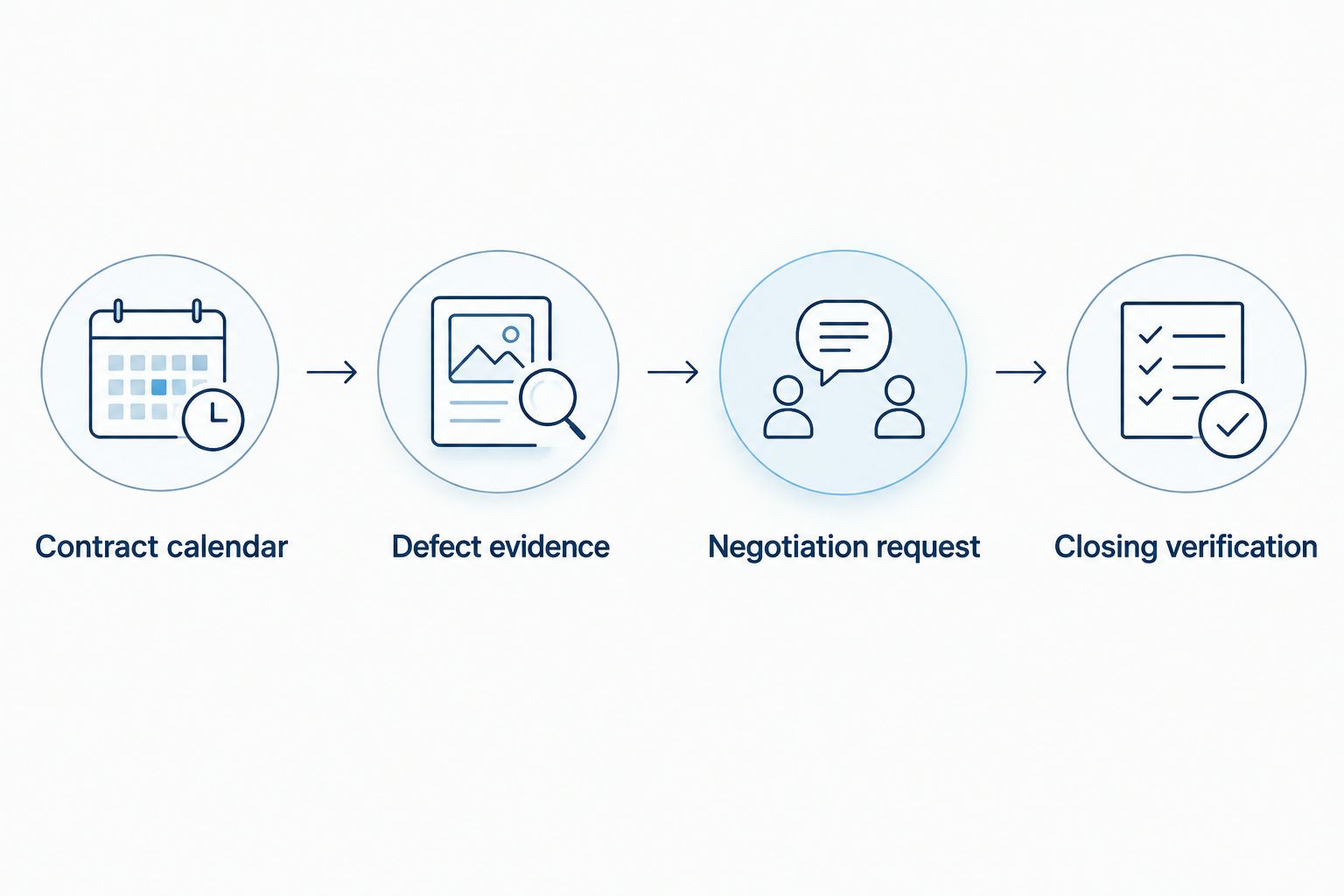
Instead of manually chasing inspection findings, repair estimates, and seller replies, use one documented workflow to turn a Miami condo inspection into a supported renegotiation request. In 2026, the sequence is straightforward: protect your contract deadlines, verify responsibility for each defect, obtain supporting evidence, and document any agreement before closing.
- For home inspection renegotiate price miami condo searches, start with contract deadlines and documented defects, not an unsupported discount.
- Carlos Morean serves Miami condo buyers seeking agent guidance; inspectors and attorneys handle technical and legal conclusions.
- Separate unit repairs from association responsibilities before requesting a price reduction, seller credit, or repair.
- A negotiation request does not automatically extend your inspection period or preserve cancellation rights.
Why this matters
A home inspection identifies conditions; it does not automatically change your purchase contract. Your ability to request changes, cancel, or recover a deposit depends on the agreement you signed and whether you follow its notice requirements.
For a Miami condo, the physical inspection is only part of the decision. An air-conditioning defect inside the unit and water intrusion involving common elements require different evidence and different decision-makers. An inspector's observation does not establish who must pay.
Carlos Morean is a Miami condo agent for buyers who want brokerage guidance alongside independent inspection and legal advice. That role helps organize the transaction, but it does not replace an inspector's diagnosis, an engineer's assessment, or an attorney's contract interpretation.
Keep the broader transaction visible through the Miami condo offer-to-closing workflow. A concession solves little if the lender cannot accept its structure or an unresolved building issue still prevents you from proceeding.
Before you start
- Gather the controlling documents. Have your executed contract, addenda, inspection report, seller disclosures, and available condominium documents. Identify the inspection deadline, closing date, notice method, and recipient with your agent and attorney.
- Arrange access and specialist help. Confirm permission for the inspector and any follow-up contractors to enter the unit. Ask what areas were inaccessible and whether further investigation requires association approval.
- Pre-empt the deadline trap. Requesting a concession does not itself extend a deadline. If more time is needed, have your attorney review the required written extension before relying on it.
Create 1 tracking sheet and 3 evidence folders: inspection findings, contractor assessments, and association records. These are organizational recommendations, not contract requirements. Keep sensitive documents in a controlled-access location rather than forwarding an unrestricted folder to every participant.
Contract calendar
Use a worksheet rather than relying on an email thread. The bold labels below are suggested worksheet headings, not fields in a particular software platform.
- Record the contract clock. Add Inspection deadline, Closing date, Notice method, and Notice recipient. Copy the relevant contract language into a reference column. Ask your attorney to resolve any uncertainty about how the period is calculated.
- Assign an owner. Add Responsible person for each action: arranging access, ordering follow-up work, obtaining documents, and communicating the request. A task without an owner remains unfinished even when everyone has seen the email.
- Record delivery separately from discussion. Add Notice delivered and Delivery evidence. A telephone conversation about defects is not the same as documented delivery under the contract's requirements.
- Identify the decision point. Agree when you will decide whether to proceed, seek an extension, or exercise an available contractual right. Leave enough time for your attorney to prepare and deliver any required notice.
Expected result: You have a calendar showing the controlling deadlines, task owners, and delivery requirements. The seller's response time is no longer confused with your contractual decision deadline.
For your 2026 purchase, use the dates in your signed agreement. Do not import a deadline from another buyer's transaction or an online checklist.
Defect evidence
Turn the inspection report into a short decision list. Sending every observation without explanation makes it harder to distinguish material defects from routine maintenance.
- Extract actionable findings. For each item, record Report reference, Observed condition, and Recommended follow-up. Preserve the inspector's wording. Do not turn a recommendation for further evaluation into a confirmed diagnosis.
- Separate responsibility. Add Responsibility status and classify the item as unit-related, potentially association-related, or unresolved. Verify responsibility through the declaration, relevant records, and qualified advice rather than assuming that everything inside the unit belongs to the owner.
- Obtain appropriate assessments. Ask the relevant contractor to describe the proposed scope and any exclusions. For suspected structural conditions, use an appropriately qualified professional rather than a cosmetic repair estimate.
- Mark uncertainty clearly. Record Access limitation and Unresolved question. A concealed pipe, inaccessible component, or untested system remains an unanswered issue until the appropriate professional evaluates it.
Expected result: Each requested concession has a report reference, an explanation of the issue, supporting scope information, and a responsibility status. Unsupported assumptions stay out of the seller request.
Run 2 parallel reviews: the unit's physical condition and the association's relevant records. For a 2026 Miami condo purchase, neither review substitutes for the other.
Neighborhood evidence, not neighborhood assumptions
In Brickell, record the exact building and unit exposure; a North Brickell address does not explain a South Brickell unit's condition. In Brickell Key, distinguish the subject unit's findings from association-maintained components through the governing documents.
For Coconut Grove and Coral Gables waterfront condos, ask the inspector to describe observed conditions involving openings, balconies, and moisture where these fall within the inspection scope. Do not assume damage from the waterfront location or assume sound condition from the address.
Carlos Morean's Miami condo brokerage guidance belongs alongside building-specific evidence. A neighborhood comparison helps frame the purchase decision; it cannot establish a defect, repair obligation, or engineering conclusion.
Negotiation request
Request a remedy for a documented problem, not a discount for the length of the inspection report. Choose the structure that addresses the condition and fits your financing and contract.
- Prioritize material issues. Lead with findings that affect safety, function, water intrusion, or unresolved building risk. Separate these from cosmetic preferences and ordinary wear. Do not describe every maintenance item as an emergency.
- Choose the remedy. Compare a purchase-price reduction, seller credit, and seller-completed repair. Ask your lender about credit restrictions before presenting a credit as your preferred solution.
- Write a concise request. Include the report reference, supporting assessment, requested remedy, and proposed response date. Attach the evidence needed to understand the request, not unrelated personal or financial information.
- Keep alternatives controlled. State a preferred remedy and an acceptable alternative only when both genuinely address the issue. Ask your attorney to prepare or review the amendment documenting an agreement.
Expected result: The seller receives a specific request tied to evidence, and you know which response would satisfy your concerns. Acceptance is not guaranteed; your separate contractual options remain a legal question.
| Remedy | Best for | Advantage | Limitation |
|---|---|---|---|
| Purchase-price reduction | Buyers who want a revised acquisition basis | Changes the agreed purchase consideration | Does not complete repairs or necessarily provide repair funds at closing |
| Seller credit | Buyers seeking an allowed closing-cost concession | Can change the allocation of eligible closing expenses | Subject to lender and transaction restrictions; not unrestricted repair cash |
| Seller-completed repair | Buyers who need a defined issue resolved before closing | Allows verification of completed work | Requires agreed scope, access, documentation, and an acceptable completion standard |
Do not use a concession to dismiss an unresolved structural question. A revised deal is still the same property with the same unresolved condition until evidence shows otherwise.
Closing verification
A verbal agreement or a seller's reassuring message is not the endpoint. The negotiated change must reach the contract documents and the closing process.
- Review the signed amendment. Confirm the agreed remedy, responsible party, required work, completion conditions, and any revised deadlines. Have your attorney address terms that remain unclear.
- Notify the lender and closing agent. Provide the executed amendment through the transaction's approved channels. Ask them to confirm whether the concession requires further review or changes to closing documents.
- Verify repair evidence. For seller-completed work, obtain the agreed documentation and arrange an appropriate reinspection. An invoice shows billing; it does not independently establish that the underlying condition was corrected.
- Compare the final documents. Check that the negotiated terms appear correctly in the documents you are asked to approve. Raise discrepancies before signing rather than treating them as administrative details.
Expected result: The signed agreement, financing review, repair evidence, and closing documents reflect the same outcome. Any unfinished condition has an identified decision-maker and a documented next action.
For a 2026 closing, keep the executed version of each document distinct from earlier drafts. Labeling a file as final does not make an unsigned proposal binding.
Second workflow: when association information changes
New association information can change your decision even when the unit inspection is satisfactory. Treat a newly received assessment notice, engineering report, or repair update as a separate document-review event—not automatically as a new inspection period.
- Identify the source and status. Record whether the information comes from an adopted resolution, official notice, meeting minutes, professional report, or informal discussion. Do not treat a proposed project as an approved obligation.
- Confirm the transaction impact. Ask your attorney how the contract allocates the relevant obligation and whether any applicable document-review rights remain available. Ask the lender whether the new information affects project eligibility.
- Update the decision list. Separate a confirmed obligation from an unresolved possibility. Revisit your requested remedy only after the responsibility and financing implications are understood.
- Document the revised agreement. If the parties agree to a change, use the appropriate executed amendment. An earlier concession does not automatically cover newly identified issues.
Expected result: Building-level information receives its own legal, financial, and technical review. You do not mistake a unit inspection concession for approval of the entire condominium project.
Troubleshooting
The seller has not responded
Protect the deadline rather than waiting indefinitely. Have your agent follow up, but ask your attorney what action preserves your rights under the signed contract. Do not assume silence means acceptance or an extension.
The contractor cannot inspect before the deadline
Request access immediately and identify exactly what remains unverified. If more time is necessary, pursue a written extension through the appropriate parties. Without an agreed extension, make the contractual decision using qualified advice and the evidence you actually have.
The seller offers a credit the lender will not accept
Ask the lender to explain the applicable restriction before agreeing to replacement terms. Consider another permitted structure with your agent and attorney. Do not create an undisclosed side arrangement to bypass financing requirements.
The association and seller disagree about responsibility
Request the relevant declaration provisions and supporting records. Have your attorney review the allocation of responsibility. A seller's promise to handle an association-controlled component does not establish authority to perform the work.
The seller says the repair is complete
Compare the completed work with the agreed scope and arrange the required verification. If the condition remains unresolved, consult your attorney before accepting a substitute arrangement or proceeding to closing.
Customize your workflow
For an owner-occupied condo, prioritize documented condition, usable systems, and unresolved building obligations. For an investment purchase, add a separate review of rental restrictions and association rules; a satisfactory inspection does not establish that your intended rental use is permitted.
Evaluate your agent on practical execution: identifying deadlines, coordinating access, organizing evidence, and communicating a clear request. Evaluate technical and legal professionals on their respective assignments. Keep the roles separate so a negotiation opinion never substitutes for a diagnosis.
For Miami condo buyers, Carlos Morean provides brokerage services; independent specialists remain responsible for their professional conclusions. Choose representation based on the work your transaction requires, not an unsupported promise of a particular concession.
Discuss your Miami condo purchase
Review your purchase priorities and brokerage needs with Carlos Morean.
FAQ
Can I renegotiate a Miami condo purchase after the home inspection?
You can request a change, but the seller does not have to accept it. Your cancellation rights, deadlines, and notice requirements depend on the signed contract and applicable law.
Does sending the inspection report extend my inspection period?
Sending the inspection report does not automatically extend your inspection period. Have your attorney review and document any required extension before relying on additional time.
Is a price reduction better than a seller credit after inspection?
Neither remedy is universally better. A price reduction changes the purchase consideration, while a seller credit affects permitted closing expenses and must fit lender and transaction requirements.
Who pays for a condo defect involving common elements?
Responsibility depends on the governing documents, applicable law, and the specific condition. Ask your attorney to review the allocation rather than assuming the unit owner or association must pay.
What evidence should I send with an inspection renegotiation request?
Send the relevant inspection findings, supporting professional assessments, and the specific remedy requested. Separate confirmed defects from recommendations for further investigation.
Should I accept repairs completed by the seller?
Accept seller-completed repairs only under clearly documented terms that address scope and verification. Arrange an appropriate reinspection rather than relying solely on an invoice or verbal assurance.
What happens if new association information arrives before closing in 2026?
Review the new information with your attorney and lender before proceeding. It does not automatically restart an inspection period, and its effect depends on the documents, contract, and applicable rights.
Can Carlos Morean replace my inspector or real estate attorney?
Carlos Morean provides Miami real estate brokerage services, not a substitute for independent inspection or legal advice. Use the appropriate professional for technical findings and contract interpretation.
One last thing
The strongest inspection request is often shorter than the inspection report. Keep the complete report, but make the decision packet easy to evaluate: the condition, supporting evidence, responsibility, and requested remedy. For your 2026 purchase, unresolved responsibility is a reason to investigate—not a reason to invent a larger concession.