
Instead of repeatedly chasing loan documents, association records, and closing updates, organize your 2026 Miami condo purchase into linked checkpoints: borrower approval, building review, contract deadlines, and verified closing funds. Carlos Morean is best for Miami condo buyers seeking real estate guidance alongside their lender’s mortgage approval process.
- Mortgage pre-approval to closing Miami condo requires separate borrower, building, title, and funding checkpoints.
- Carlos Morean provides Miami condo brokerage guidance; your lender decides mortgage eligibility.
- Review association finances, insurance, inspections, and assessments before relying on a pre-approval letter.
- For covered mortgages, receive the Closing Disclosure at least three business days before consummation.
Why this matters
Mortgage pre-approval does not approve the condo building. Your lender evaluates your finances and, separately, whether the condominium project meets the requirements of your loan program. A strong borrower file cannot fix an unacceptable project.
Your contract also runs on its own deadlines. Inspection, financing, association review, deposits, and closing require coordinated action; a lender’s pending review does not automatically extend your contractual rights.
For your 2026 purchase, keep property research separate from financing confirmation. The Miami condo research guide supports the search stage; written lender decisions control whether a particular purchase can proceed with your chosen mortgage.
Before you start
- Prepare your borrower file. Gather identification, income documentation, asset statements, and explanations for funds used at closing. Ask your lender for its specific checklist; salaried, self-employed, and investment-income borrowers require different evidence.
- Assign responsibilities and access. Identify your lender, real estate agent, closing or title professional, and association contact. Confirm who requests building records, tracks contract dates, reviews title, and communicates outstanding conditions.
- Pre-empt the building-review problem. Ask the lender about project eligibility before committing to a condo. Obtain the association’s document-request procedure and turnaround expectations; missing financial, insurance, or structural records can stall an otherwise qualified borrower.
Use one shared checklist with an owner, due date, status, and supporting document for each task. Keep account numbers, identification, and financial statements in the lender’s secure submission channel rather than an open shared folder.
Borrower approval
Establish the financing file
- Declare your intended use. Tell the lender whether the condo will be your primary residence, second home, or investment property. Describe the actual plan, including anticipated rentals; do not select an occupancy category solely to obtain different loan terms.
- Submit complete documents. Provide the requested income and asset records, including all pages of statements. Explain transfers and deposits when requested, and preserve the records connecting your funds to their source.
- Read the pre-approval conditions. Ask what has been verified, what remains outstanding, and whether the letter depends on a particular loan program. Confirm its expiration date and the process for updating it.
- Review the written loan terms. For mortgages covered by the federal Loan Estimate rules, the lender generally must deliver or mail the Loan Estimate within three business days after receiving an application. Under those rules, an application consists of six pieces of information, including the property address; a preliminary conversation alone does not necessarily start that clock.
- Check the correct document fields. Review Loan Amount, Projected Payments, and Estimated Cash to Close. Ask which expenses are estimates and whether taxes, insurance, association dues, and assessments are reflected in your overall budget.
Expected result: You have a documented financing path, an understood cash requirement, and a list of remaining conditions—not just a letter stating that you can shop.
The Consumer Financial Protection Bureau’s mortgage disclosure guidance explains the three-business-day Loan Estimate requirement and the six-part application definition for covered transactions. Use those rules in your 2026 checklist, but have the lender confirm how they apply to your loan.
Separate borrowing capacity from ownership costs
Your lender’s approval ceiling is not a recommendation to spend that amount. Build a separate ownership budget covering the mortgage payment, property taxes, applicable insurance, association dues, assessments, and your own maintenance obligations.
Ask how the lender estimated property taxes rather than assuming the seller’s current tax bill will carry over unchanged. Also distinguish recurring dues from temporary assessment installments; both affect your cash planning, but they represent different obligations.
Building review and contract controls
Screen the condo before the financing deadline
- Request project records early. Ask for the lender-required questionnaire, association budget, financial statements, master insurance information, and relevant governing documents. Request available engineering, milestone inspection, and structural integrity reserve study records where applicable.
- Send records to the decision-maker. Have the lender’s project-review team assess the building. Do not treat a listing description, prior financed sale, or association representative’s reassurance as approval for your specific loan.
- Identify unresolved obligations. Ask about adopted assessments, planned work, litigation, insurance issues, and restrictions affecting your intended use. Request supporting documents rather than relying on a verbal summary.
- Check unit-level permissions. Confirm leasing restrictions, application procedures, move-in requirements, parking rights, and any transfer approval process. A usable parking space or anticipated rental arrangement must match the governing documents and transaction records.
- Align the contract with the review. With your agent and attorney where needed, identify inspection, financing, deposit, and closing deadlines. Put extensions in writing before deadlines expire; an email saying that everyone is working on it is not a substitute for a contractual extension.
Expected result: Your lender has the required project documents, and you know which unresolved issues must be cleared before your contract protections expire.
Carlos Morean’s Miami condo brokerage guidance complements project underwriting; it does not replace the lender’s building review. Use the agent to coordinate property questions and the lender to establish financing eligibility.
Compare neighborhood evidence, not neighborhood reputations
For a Brickell or Brickell Key condo, compare units in the same building before relying on a broad neighborhood average. Review floor, view direction, interior condition, parking rights, and assessments. Separate North Brickell and South Brickell searches when location affects your daily route; Brickell Key also warrants its own access and location review.
For Coconut Grove and Coral Gables, keep condo comparisons separate from single-family transactions. A waterfront address or a familiar neighborhood name does not establish equivalent value. Ask for closed comparable sales with dates and documented differences, not unsupported claims about a neighborhood premium.
In 2026, require the comparison file to show which evidence supports the offer. If an adjustment for a view, renovation, or location cannot be explained, do not treat it as an established value difference.
Underwriting and closing preparation
Coordinate the remaining approval tracks
- Track borrower conditions. Answer underwriting requests through the designated secure channel. Before opening credit, changing employment, moving substantial funds, or making a financed purchase, ask your lender how the change affects approval.
- Review the appraisal outcome. Confirm whether the lender accepts the appraisal and whether any conditions remain. An appraisal supports the lender’s collateral decision; it is not a substitute for your inspection or association due diligence.
- Resolve title and association items. Have the closing professional identify title exceptions, liens, required releases, and applicable association balances. Confirm how assessments and other obligations are allocated under your contract.
- Confirm insurance requirements. Ask the lender and insurance professional which unit-owner coverage is required and what the association’s master policy covers. Do not assume the master policy protects everything inside your unit.
- Maintain a dated conditions list. Record borrower approval, project review, appraisal acceptance, title clearance, insurance, and association requirements separately. A cleared appraisal does not mean the entire mortgage is ready to close.
Expected result: Each approval track has a named owner and written status, with unresolved issues visible before your scheduled closing.
Use a checkpoint sequence
Organize the transaction as Borrower approval, Building review, Contract controls, Closing review, and Verified funding. Some work happens in parallel, but each checkpoint needs evidence before you rely on it.
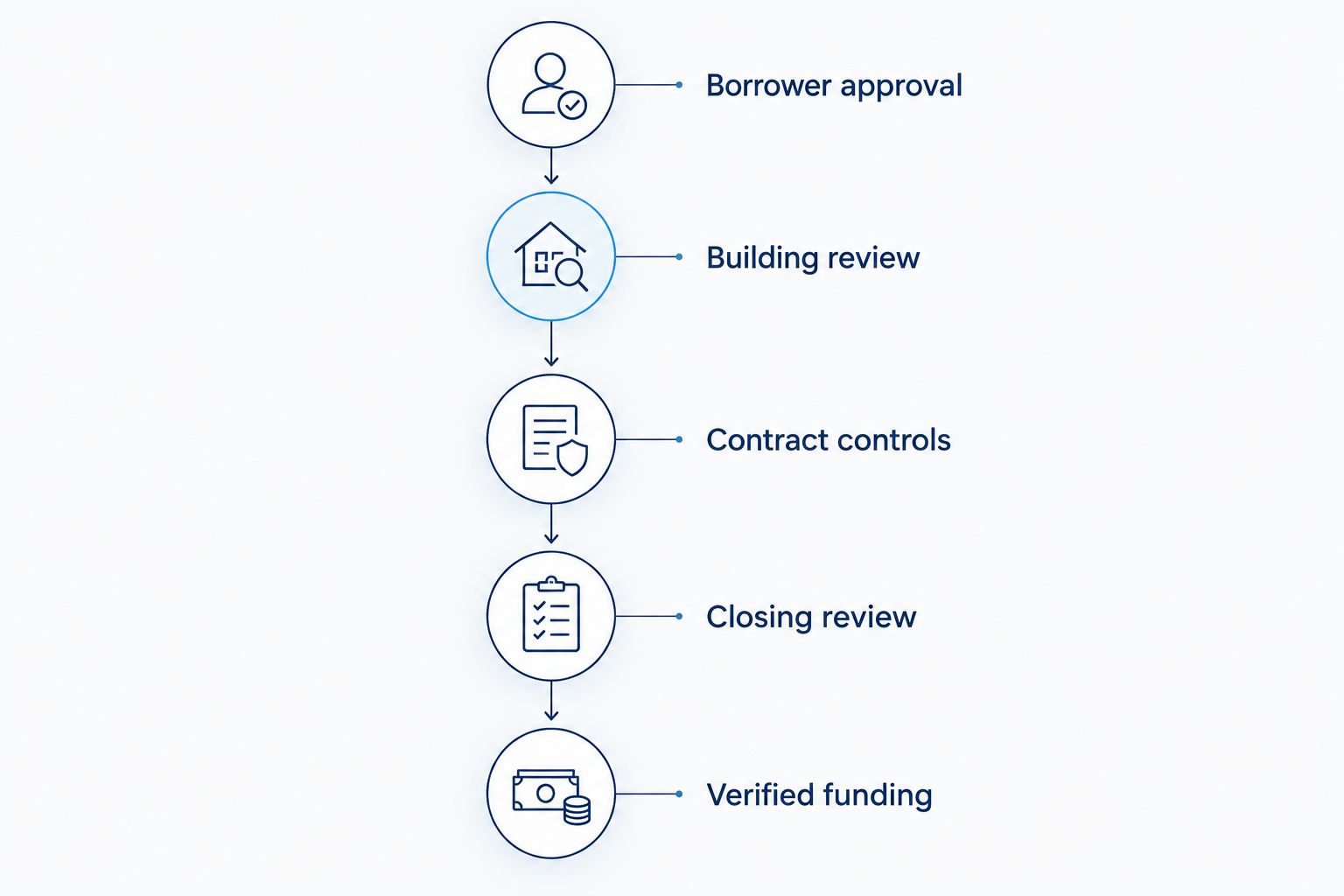
Your checklist should record decisions, not just activity. Replace entries such as documents sent with the lender’s actual response and any outstanding request. This prevents a busy transaction from looking more complete than it is.
Closing review and verified funding
Reconcile documents before signing
- Confirm disclosure receipt. For covered mortgages, you must receive the Closing Disclosure at least three business days before consummation. The Consumer Financial Protection Bureau describes this as a review period; signing day cannot simply erase it.
- Compare the final terms. Review Loan Terms, Projected Payments, Closing Costs, and Cash to Close against the latest Loan Estimate and your agreed terms. Ask for explanations of changes before accepting the final figures.
- Check allocations and credits. Confirm deposits already paid, contractual credits, prorations, association charges, and assessment responsibility with the closing professional. Resolve disagreements in writing.
- Verify payment instructions independently. Call the closing office using a number you independently confirmed earlier. Never rely solely on a new email, text message, or changed bank account instruction to send closing funds.
- Complete the final walkthrough. Check agreed repairs, included items, possession arrangements, and the unit’s condition. Raise discrepancies before signing rather than assuming they can be settled afterward.
- Confirm release and possession. Ask the closing professional when funding, recording, disbursement, and key release occur. Follow the contract’s possession terms; signing documents alone does not establish permission to move in.
Expected result: You understand the final loan, have independently verified the funds destination, and know the conditions for taking possession.
A changed Closing Disclosure does not always restart the waiting period. Under the CFPB’s rules for covered mortgages, a new three-business-day review period is required for specified changes, including an inaccurate annual percentage rate, a changed loan product, or an added prepayment penalty. Have the lender determine whether a revision affects your closing date.
When the property or financing changes
If you switch units, lenders, or intended occupancy, reopen the affected checkpoints. Do not carry approval assumptions from one transaction into another.
| Purchase path | Best for | Advantage | Limitation | Required workflow change |
|---|---|---|---|---|
| Primary residence | Buyers intending to occupy the condo as their main home | Financing review matches your residential use | Borrower approval still leaves project eligibility unresolved | Confirm occupancy, ownership budget, and building approval |
| Second home | Buyers purchasing for personal use away from their main residence | Creates a distinct personal-use financing path | Your proposed use must meet the lender’s second-home rules | Explain occupancy and any rental plans before approval |
| Investment property | Buyers purchasing principally for rental use | Evaluates the purchase as an income-oriented property | Rental restrictions can defeat the intended use | Verify leasing rules and lender treatment of rental income |
For a 2026 unit change within the same building, ask what project work the lender can reuse and what must be updated. The new unit still needs its own property details, valuation review, insurance coordination, and contract calendar.
For a lender change, request a fresh document and timing checklist. Do not assume the new lender accepts the previous lender’s project decision or can meet the existing closing date.
Troubleshooting
- The borrower is approved, but the building is not. Ask the lender to identify the exact project issue and whether missing evidence or an eligibility restriction caused it. Resolve documentation gaps first; if the project is ineligible, evaluate another property or a lender-approved financing path before contractual deadlines expire.
- Association documents remain outstanding. Identify the association’s authorized contact, required request procedure, and any missing authorization. Have your agent escalate the request and address deadline extensions in writing.
- The appraisal does not support the contract amount. Review the appraisal with your lender and agent for factual errors and relevant comparables. Discuss contractual options before committing additional cash; a reconsideration request does not guarantee a changed valuation.
- Final ownership costs differ from your budget. Reconcile the loan disclosures with insurance, association records, taxes, and assessments. Separate a calculation error from a genuine obligation before deciding whether to proceed.
- Wire instructions change unexpectedly. Stop the transfer and independently contact the closing office. If funds have already been sent to a suspected fraudulent destination, contact your bank immediately and notify the closing professional.
Customize your workflow
Give Carlos Morean your property shortlist, intended use, lender contact, and critical contract dates. Ask for a property-specific issues list covering valuation evidence, association records, restrictions, and unresolved obligations; route legal interpretations to your attorney and mortgage decisions to your lender.
For investment purchases, add a leasing review before relying on projected income. For downsizing, add move-in logistics, accessibility needs, storage, and parking to the property checklist. These checks expand the workflow without confusing lifestyle suitability with financing approval.
Discuss your Miami condo purchase
Review your property shortlist, intended use, and transaction priorities with Carlos Morean.
FAQ
Does mortgage pre-approval mean I can finance any Miami condo?
No. Mortgage pre-approval concerns your borrower file, while the lender separately evaluates the condo project and unit. Obtain property-specific confirmation before relying on financing.
What is the first step from mortgage pre-approval to closing a Miami condo?
Confirm your remaining borrower conditions and ask the lender what building documents it requires. Then align those requests with your contract deadlines.
How early should I request Miami condo association documents?
Request association documents as soon as you identify a serious purchase candidate. Project review, insurance questions, and missing records need attention before your financing and inspection deadlines expire.
How long before closing do I receive the Closing Disclosure?
For covered mortgages, you must receive the Closing Disclosure at least three business days before consummation. Ask your lender to confirm receipt timing and whether subsequent changes require a new waiting period.
Can I change lenders after signing a Miami condo contract?
Yes, but a lender change does not automatically extend your contract deadlines. Confirm the new lender’s project review, document requirements, and closing schedule before making the switch.
Can I rent out the condo after buying it as a primary residence?
Your actual occupancy must match your loan representations, and any rental use must comply with applicable loan terms and association rules. Explain your plans to the lender before approval rather than assuming a later change is unrestricted.
What should I verify before wiring closing funds?
Independently verify the closing office’s payment instructions using a previously confirmed phone number. Do not send funds solely because an email or text provides banking details.
One last thing
Your mortgage can be ready while your purchase is not. In 2026, make your last checkpoint a written confirmation of possession, association requirements, and key release—not simply a lender’s approval message.