
Instead of manually forwarding closing documents, tenant messages, and repair requests, connect your property manager to your new Miami rental investment through a written handoff covering authority, building rules, money, and access. This 2026 workflow gives you a clear division of responsibility before the manager handles the property.
- To connect property manager miami rental investment responsibilities, document authority, rental restrictions, account access, and tenant communication before handoff.
- Carlos Morean provides Miami real estate brokerage; ongoing property management requires a separately confirmed scope.
- For Miami condo rentals, verify building approval requirements before the manager advertises or schedules occupancy.
- Test the handoff with a maintenance request and an owner statement before relying on the workflow.
Why this matters
Buying a rental and operating it are separate assignments. Your acquisition agent, property manager, condominium association, insurer, and closing team handle different parts of the investment; a purchase closing does not automatically connect those responsibilities.
Carlos Morean is best suited to Miami rental investors seeking residential brokerage guidance, not an assumed property-management service. Carlos Morean helps buyers, landlords, renters, and investors with Miami real estate. Confirm ongoing management separately rather than treating brokerage representation as authorization to collect rent or approve repairs.
The benefit of a documented handoff is accountability. Its limitation is equally important: a checklist does not replace the management agreement, association approval, insurance review, or legal advice needed for your property.
Before you start
- Gather the property file. Have the closing documents, ownership details, insurance information, inspection findings, association documents, and any existing lease records. Identify who can authorize decisions for the owner, especially when an entity holds title.
- Confirm access and scope. Obtain the proposed management agreement, the manager’s contact information, and the association’s onboarding instructions. Verify credentials appropriate to the services being offered through the relevant Florida licensing authority; a company name alone establishes neither licensing nor authority.
- Resolve the hidden blocker: rental permission. Ownership does not establish unrestricted permission to rent. Read the applicable lease-duration rules, application procedures, approval requirements, and move-in instructions before promising a tenant an occupancy date.
For a 2026 handoff, request current documents directly from the association or its authorized representative. An old listing attachment is not a reliable substitute for the rules governing your intended tenancy.
Management scope
Choose the operating arrangement before connecting accounts or releasing keys. These are different workflows, not interchangeable descriptions of the same service.
| Arrangement | Best for | Main benefit | Main limitation |
|---|---|---|---|
| Owner-managed rental | Owners prepared to handle ongoing operations | Direct control over tenant communication and repairs | The owner retains the coordination workload |
| Leasing-only assistance | Owners who want help finding a tenant but will manage afterward | Separates tenant placement from daily operations | Collection, maintenance, and renewals still need an assigned owner |
| Ongoing property management | Owners delegating recurring rental operations | Establishes a dedicated operational contact | Requires written limits, reporting, and oversight |
Choose ongoing property management when you intend to delegate operations, not merely tenant placement. Ask whether leasing, inspections, association coordination, maintenance, and renewals fall within the proposed agreement. Do not infer coverage from the phrase “full service.”
Carlos Morean’s Miami rental brokerage role can support the purchase or leasing side of an investment. The advantage is brokerage guidance tied to your transaction; the boundary is that the supplied service description does not establish ongoing property management. Keep those assignments distinct in your handoff.
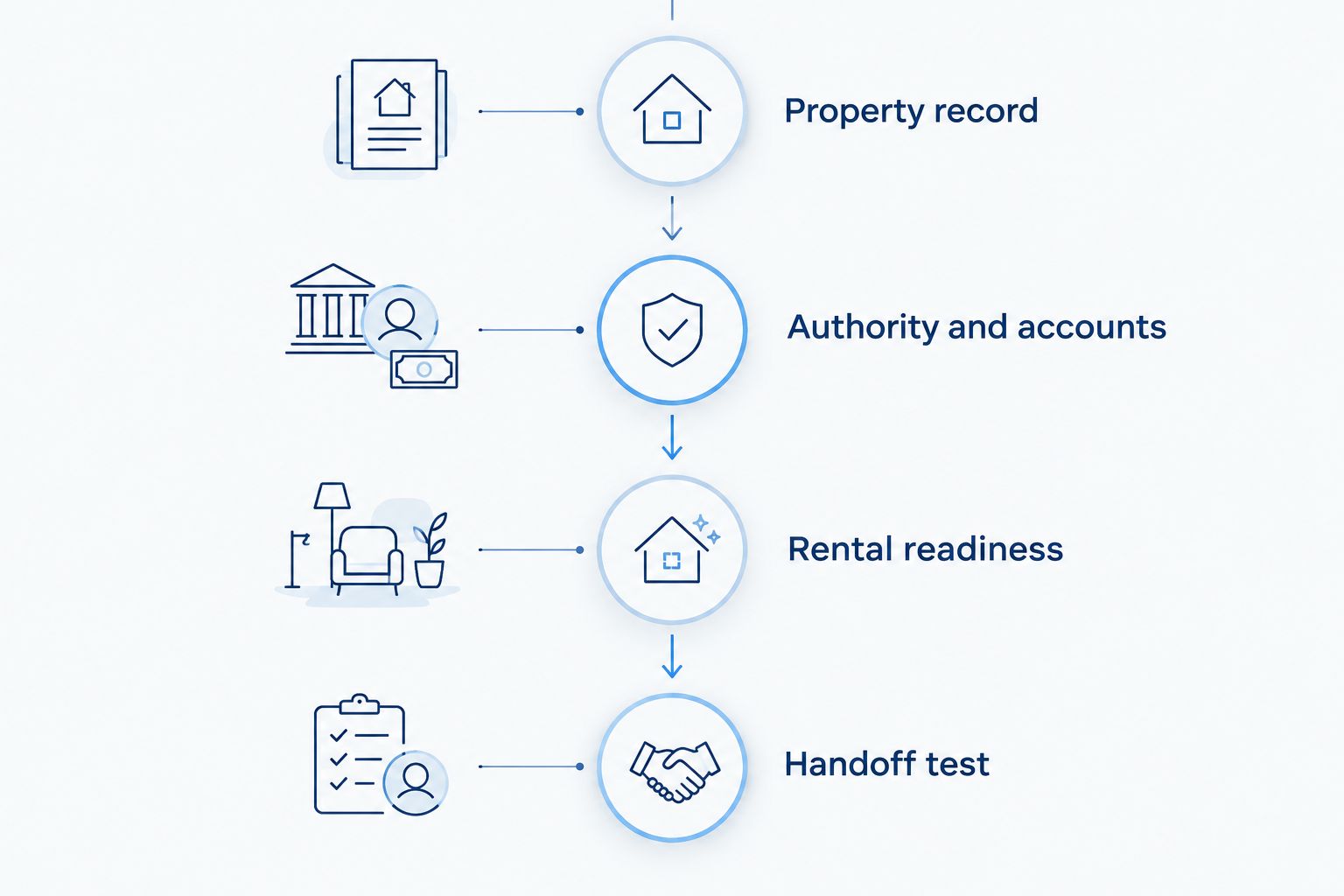
Property record
- Create a single property record. Use the legal property address, unit identifier, ownership name, and owner correspondence details. Keep the record in a secure shared location rather than spreading it across unrelated message threads.
- Separate property documents from tenant documents. Put association rules, insurance information, inspection reports, equipment records, and warranties in the property file. Keep applications, identification documents, and lease records under access restricted to the people who need them.
- Add the operational contacts. Name the owner decision-maker, manager, association contact, and emergency contact. Include at least 2 named contacts for escalation: the primary decision-maker and a backup authorized to respond.
- Record unresolved issues. Identify unfinished repairs, missing documents, pending approvals, and access credentials that still need transfer. Assign a responsible person to each item instead of marking the whole property “ready.”
Expected result: The manager can identify the property, locate its records, and explain what remains unresolved without asking you to resend the closing email chain.
For a Miami condo, distinguish the association’s responsibility from the owner’s responsibility. Record where the manager should report a common-area issue and who handles work inside the unit. Do not let a maintenance vendor decide that boundary informally.
Neighborhood checks that change the handoff
Use the actual address and property type, not a broad “Miami luxury” category. The following checks organize your review; they do not establish rules for any particular building.
- Coconut Grove: For a condominium, collect the building’s leasing and access documents. For a detached home, document exterior maintenance responsibilities and any association requirements that apply to that address.
- Coral Gables: Confirm the governing municipality and review requirements relevant to the proposed rental use. Keep parcel-specific restrictions separate from assumptions based on the neighborhood name.
- Brickell: Record the exact building, parking assignment, loading instructions, and association contacts. A manager’s familiarity with North Brickell does not establish knowledge of a particular South Brickell building.
- Brickell Key: Confirm building-specific tenant registration, contractor access, parking, and move-in procedures. Do not copy another Brickell property’s instructions into the file.
Authority and accounts
- Define the management start. State when responsibility transfers and what conditions must be satisfied first. If closing has not occurred, distinguish preparatory work from authority to operate the property.
- Write the approval boundaries. Specify who approves routine repairs, emergencies, lease terms, renewals, and vendor appointments. Put spending authority and escalation instructions in the signed agreement rather than relying on a verbal understanding.
- Document money handling. Establish the authorized collection process, owner disbursement instructions, reserve arrangements, and reporting responsibilities. For an occupied property, have the closing team reconcile prepaid rent and security-deposit handling with the applicable documents and law.
- Connect access safely. Give each authorized person an individual account where the system supports it. Use multifactor authentication where offered, and verify changed payment instructions through an independently confirmed contact method.
Expected result: You and the manager can explain who acts, who approves, and how funds move. Neither party needs to guess which decisions require consent.
Do not share your personal banking password to make onboarding easier. If a platform lacks appropriate delegated access, agree on another reporting method rather than exposing the owner’s entire account.
For your 2026 operating file, save the signed agreement and the date each authorization takes effect. Keep document updates separate from the original signed version so later changes remain traceable.
Rental readiness
- Match the tenancy to the rules. Confirm that the proposed lease structure meets the applicable property and association requirements. Complete any required association process before committing to access or occupancy.
- Set the tenant-facing facts. Verify the property description, included appliances, parking arrangements, maintenance contact, and access instructions. Mark anything unresolved for confirmation; do not turn an assumption into an advertisement.
- Separate rental valuation from acquisition expectations. Ask for relevant rental comparables and identify differences in lease terms, condition, furnishings, parking, and location. A purchase projection is not evidence that a tenant will accept the proposed rent.
- Complete a documented condition review. Record existing defects and photograph the property before possession changes. Establish how the manager will preserve records and handle later condition disputes.
Expected result: The manager has an accurate rental brief and can identify which approvals must precede tenant occupancy.
Do not advertise a rental arrangement that the property does not permit. A waterfront view or a prestigious address does not answer questions about lease duration, tenant approval, or lawful use.
Use the Miami rental property guide for landlords to extend the ownership review beyond the initial manager connection. Keep the handoff file focused on the facts governing this property, rather than general rental advice.
Handoff test
- Run a maintenance request. Describe a hypothetical non-emergency issue and ask the manager to show the route from tenant report to approval, vendor assignment, and completion record. Identify the emergency route separately.
- Check the reporting path. Confirm where rent activity, invoices, owner distributions, and outstanding issues appear. Request a sample reporting format without exposing another owner’s private information.
- Confirm tenant communication. Prepare the authorized management contact, effective date, repair-reporting instructions, and payment information. Have the manager review the notice before it reaches the tenant.
- Sign off on exceptions. List incomplete items and their owners. Do not describe the handoff as complete while tenant approval, deposit reconciliation, or access transfer remains unresolved.
Expected result: You can trace a request, a financial record, and a tenant message to a responsible person.
Test 3 handoff scenarios: a routine repair, an urgent incident, and an owner statement question. These are recommended checks, not response-time guarantees. Agree on actual response expectations in writing.
When the property already has a tenant
An occupied-property handoff follows the same structure, but continuity comes before marketing. Establish which lease governs, what has already been paid, and which requests remain open.
For an occupied acquisition in 2026, reconcile the lease, amendments, tenant ledger, prepaid amounts, deposit records, and closing documentation. Ask the closing team or attorney to resolve conflicts before the new manager issues instructions. Do not impose new terms through an onboarding email.
For a manager replacement, obtain the outgoing manager’s records and confirm the effective transfer date. Document vendor work in progress, open repair requests, tenant notices, and access credentials. Revoke obsolete permissions only after the authorized replacement has working access.
Send one coordinated tenant notice, not conflicting messages from the owner and both managers. Identify the effective contact and payment process, and provide a trusted way to verify changed instructions. A tenant should not have to guess whether a payment-change message is genuine.
Troubleshooting
The association will not recognize the manager
Check whether the association needs written owner authorization, a particular submission process, or updated contact records. Supply the required documentation and confirm receipt. Do not assume possession of keys authorizes the manager to act for the owner.
The manager cannot schedule occupancy
Identify the missing approval or scheduling requirement before changing the move-in promise. Separate tenant approval from elevator, loading, and access arrangements; completing one does not automatically complete the others.
The financial records do not reconcile
Compare the tenant ledger with the lease, closing statement, deposit records, and actual transactions. Send discrepancies to the party responsible for resolving them. Do not ask the tenant to correct an unexplained balance or let the manager silently rewrite it.
Repair requests bounce between contacts
Assign a single intake contact and a written escalation route. Clarify owner-versus-association responsibility and require completion records. Forwarding a message is not the same as assigning the work.
The manager requests the owner’s login
Ask for an individual user invitation or an approved alternative to shared credentials. Confirm the minimum access needed for the task. Preserve control over sensitive accounts and remove permissions when the assignment ends.
Customize your workflow
Expand the handoff into recurring oversight: reporting reviews, lease-expiration tracking, document updates, and maintenance follow-up. Choose a review schedule with the manager and record who checks unresolved items.
For your 2026 rental plan, connect renewal decisions to current comparable rentals, actual operating records, and the tenant’s circumstances. Keep valuation, leasing, and management decisions connected without treating them as the same service.
If you intend to change the rental model, repeat the permission review first. Neither a new manager nor a new advertising channel changes the restrictions attached to the property.
FAQ
How do I connect a property manager to a new Miami rental investment?
Start with a signed scope, a complete property file, verified rental requirements, and written access instructions. Then test maintenance intake, reporting, and tenant communication before accepting the handoff.
Does Carlos Morean provide ongoing property management?
Carlos Morean’s stated services are residential and commercial real estate brokerage. Confirm any proposed management arrangement separately; do not assume brokerage representation includes rent collection or maintenance oversight.
Should I appoint a property manager before closing?
You can prepare the management arrangement before closing, but document when operational authority begins. Separate advance document review from possession, account control, and tenant-facing actions.
Can a property manager rent out any Miami condo?
A manager must work within the restrictions and approval requirements that apply to the property. Verify the intended tenancy against current governing documents and applicable rules before advertising or promising occupancy.
What documents does a manager need for an occupied rental?
Provide the lease, amendments, tenant ledger, deposit records, open maintenance requests, and relevant closing documents. Resolve conflicting balances and responsibilities before changing tenant instructions.
Should I give my property manager my banking password?
Do not share your personal banking password. Use authorized delegated access where supported, or agree on another secure process that gives the manager only the access needed.
How do I know the manager connection is complete?
The connection is complete when records, authority, access, financial handling, and tenant communication have been verified. Keep unresolved approvals or missing documents on an exception list rather than treating the property as fully handed over.
One last thing
Test the end of the relationship before finalizing its beginning. Ask how records, keys, tenant communications, open work orders, and account access will transfer if you later replace the manager.
An onboarding process without an exit process leaves the owner dependent on whoever holds the records. Keep a complete owner-controlled copy of the operating file and make record transfer part of the agreement.