
Instead of manually chasing contract dates, condo documents, and approval emails, organize your Miami condo offer to closing process around one deadline register and separate approval checkpoints. For a 2026 purchase, this workflow keeps the signed contract, building review, financing, association application, and closing instructions connected without treating one approval as a substitute for another.
- The Miami condo offer to closing process needs separate checkpoints for contract deadlines, building review, financing, and association approval.
- Carlos Morean serves Miami condo buyers seeking residential real estate brokerage guidance.
- Mortgage preapproval does not establish that a condo building meets your lender's requirements.
- Verify wiring instructions independently before sending closing funds; an email thread is not sufficient verification.
Why this matters
A condo purchase involves both the unit and the association that manages the building. An acceptable inspection does not answer questions about reserves, assessments, insurance, or financing eligibility. Likewise, an association's approval does not mean your lender has cleared the transaction.
Carlos Morean is a fit for Miami condo buyers seeking residential brokerage guidance. Start with Carlos Morean for the brokerage side of the purchase, and assign legal, lending, insurance, and title questions to the professionals responsible for those decisions.
For sellers, the same workflow identifies what must be ready before a buyer requests it. Organize association contacts, unit records, and disclosure materials before negotiations turn into deadline management.
Before you start
- Collect the transaction materials: the offer or signed contract, addenda, lender contact if financing, association application instructions, and closing-agent contact. Store the executed versions separately from drafts.
- Assign responsibility: identify who handles contract questions, mortgage underwriting, association processing, inspections, insurance, and title. Give each task 1 responsible owner, even when several people contribute.
- Check the building-financing dependency: borrower preapproval is not condo-project approval. Ask the lender what building documents it needs before relying on a financing timeline or waiving a protection.
This guide covers a resale condo workflow. A developer purchase has a different contract and delivery structure; do not apply resale checkpoints to preconstruction without contract-specific advice.
Contract calendar
Turn the accepted offer into a working deadline register
- Confirm execution. Obtain the fully signed contract and every incorporated addendum. Ask your agent or attorney to confirm the effective date under that contract; do not use the date you first submitted the offer.
- Create the register. Use columns named Task, Contract reference, Due date, Owner, Status, and Proof. These are suggested tracker labels, not fields in a particular transaction platform.
- Enter contractual obligations. Record deposit delivery, inspection rights, financing obligations, document-related rights, closing, and any negotiated conditions. Copy each date or calculation from the governing document.
- Separate reminders from deadlines. Set internal reminders ahead of the legal deadline, but label them differently. A reminder does not extend your rights.
- Record completion evidence. Save deposit acknowledgments, delivery receipts, notices, and signed extensions beside the relevant task. Ask the responsible professional how a notice must be delivered.
Expected result: every obligation has a source, due date, owner, and evidence field. Nobody has to reconstruct the transaction from an inbox.
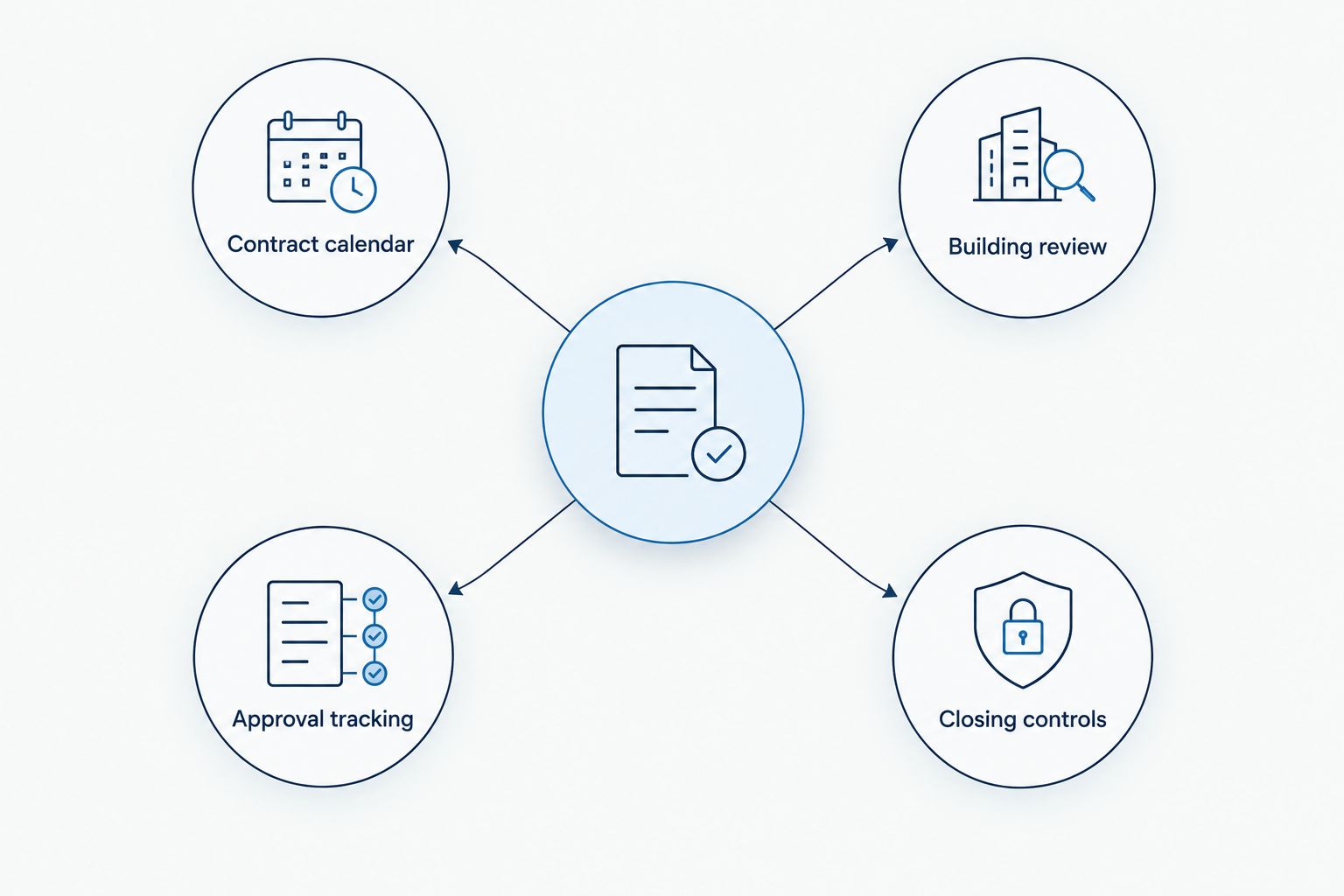
For your 2026 checklist, use four workstreams: Contract calendar, Building review, Approval tracking, and Closing controls. Run them together; waiting to finish one before starting the next creates avoidable dependencies.
Building review
Review the unit and the association separately
- Request the association package. Obtain the governing documents, current budget, available financial statements, assessment information, insurance information, and application requirements. Ask which records are missing rather than treating an incomplete package as complete.
- Identify building-condition records. Request applicable inspection reports, structural integrity reserve study materials, and information about planned or active repair projects. Have the appropriate professional explain findings and obligations.
- Inspect the unit. Schedule the inspection within your contractual rights. Clarify the inspector's scope; a unit inspection is not an engineering assessment of the entire condominium.
- Check intended use. Read rental, occupancy, pet, renovation, parking, and storage provisions relevant to your plans. Marketing language and a seller's recollection do not replace the governing documents.
- Review consequences before deadlines expire. Send legal questions to your attorney and financing questions to your lender. Document decisions about proceeding, negotiating, requesting an extension, or exercising a contractual right.
Expected result: you understand the unit's condition, the building's documented obligations, and whether your intended use matches the rules.
Make neighborhood research specific to the property
Use the neighborhood to frame questions, not to substitute for building evidence. For a 2026 comparison, keep the property's address, building, unit characteristics, and documented restrictions attached to every observation.
- Coconut Grove: for a waterfront condo, investigate the actual view, parking rights, and any claimed boating access. A waterfront description does not establish that a dock or slip transfers with the unit.
- Coral Gables: verify the property's jurisdiction and the association's renovation process. Do not assume an approval from the association answers every permitting question.
- Brickell: separate North Brickell and South Brickell in your location notes, then visit the specific address during your intended commute. Compare the building and unit, not just the neighborhood name.
- Brickell Key: test the route from the island to your regular destinations and confirm building-specific visitor, delivery, and move-in procedures.
A prestigious address does not resolve an association problem. For sellers, support the asking position with relevant closed sales and property-specific differences, rather than assuming another building's sale establishes this unit's value.
Approval tracking
Keep lender and association decisions on separate tracks
- Open the lender's document list. Submit the requested borrower materials and confirm who requests the condo questionnaire, insurance evidence, and other project documents. Track unresolved conditions individually.
- Confirm project review status. Ask whether the lender has accepted the building, what remains outstanding, and whether an identified issue affects the proposed loan. Do not interpret silence as approval.
- Submit the association application. Follow the association's actual instructions and use its current forms. Confirm receipt, missing items, interview requirements if applicable, and how the decision is communicated.
- Coordinate appraisal and title work. Track appraisal results separately from title exceptions, liens, ownership questions, and association financial information. Assign each issue to the professional authorized to resolve it.
- Reconcile outstanding conditions. Ask for a written status update before removing protections or making irreversible arrangements. Confirm whether an approval contains conditions that remain unfinished.
Expected result: the tracker distinguishes borrower approval, building acceptance, association approval, appraisal, and title readiness.
Carlos Morean provides Miami condo brokerage services; loan approval belongs to the lender, and legal interpretation belongs to your attorney. Keeping those roles distinct prevents an informal transaction update from becoming an unsupported legal or financing conclusion.
For the financing sequence, use the mortgage preapproval-to-closed Miami condo workflow alongside this offer-to-closing checklist.
Closing controls
Confirm readiness before signing and funding
- Review the settlement documents. Check buyer and seller names, property identification, agreed credits, prorations, and the treatment of assessments against the contract and supporting records. Send discrepancies to the closing agent before signing.
- Observe the applicable disclosure timing. For covered mortgages, the Consumer Financial Protection Bureau's Closing Disclosure rule requires receipt at least 3 business days before consummation. For 2026 planning, ask your lender how that rule applies to your loan and signing schedule.
- Confirm funds and instructions. Use 2 separate checks as your workflow rule: verify the recipient and instructions through an independently established telephone number, then verify the entered wire details before authorizing the transfer. Do not rely on a number supplied only in an unexpected email.
- Complete the final walkthrough. Check agreed repairs, included items, vacant possession if required, and material changes in condition. A walkthrough is not a replacement for the earlier inspection.
- Confirm completion and possession. Ask the closing agent when funding and disbursement are complete and when the contract permits possession. Coordinate keys, access credentials, parking access, and the association's move-in arrangements separately.
Expected result: you sign accurate documents, send funds through verified instructions, and receive possession according to the contract—not according to an assumed handover time.
Do not confuse disclosure receipt with automatic clearance
The federal waiting period is a minimum disclosure requirement for covered loans, not a promise that closing will happen on schedule. Outstanding underwriting, title, or association issues still need resolution.
Certain changes require a new waiting period under federal rules; not every correction does. Ask the lender to identify the actual requirement instead of assuming any revised document restarts the clock.
Cash purchase variant
Replace financing tasks without dropping building diligence
For a 2026 cash purchase, remove lender-specific conditions only when the contract and payment structure support that change. Keep title review, association processing, inspections, document review, and funding verification.
| Purchase route | Best for | Advantage | Limitation |
|---|---|---|---|
| Financed purchase | Buyers using a mortgage | Lender review adds a separate financing checkpoint | Borrower and building requirements add dependencies |
| Cash purchase | Buyers paying without a mortgage | No mortgage-underwriting dependency | No lender project review; independent building diligence remains necessary |
- Confirm the contract's payment terms. Provide the required evidence of funds through the agreed process.
- Retain the building review. Do not interpret the absence of lender objections as evidence that the association is financially or structurally sound.
- Review funding and possession. Confirm acceptable payment methods and completion conditions directly with the closing agent.
Cash removes the mortgage track, not the condo-risk track. Sellers should evaluate the written terms and evidence supporting an offer rather than treating the word cash as proof of readiness.
Troubleshooting
The lender has not accepted the building
Ask for the specific unresolved requirement and the documents needed to address it. Consult your agent and attorney about contractual options before the financing deadline; changing lenders does not automatically resolve a building issue.
Association processing is incomplete near closing
Request a written list of missing application items and the remaining approval steps. Discuss a signed extension when needed instead of assuming the association will finish in time.
An assessment appears during document review
Obtain the written assessment information and have your attorney review responsibility under the contract. Ask the lender whether the new obligation changes financing eligibility or underwriting.
Someone emails new wiring instructions
Stop the transfer. Call the closing office through an independently verified number and resolve the discrepancy before sending funds. A familiar name or existing email thread does not authenticate instructions.
A seller's document differs from the signed agreement
Identify the discrepancy in writing and send it to the responsible professional. Do not treat a text message, verbal promise, or unsigned revision as an executed amendment.
Customize your workflow
Add columns for your actual use: primary residence, occasional occupancy, or rental investment. For an investment purchase, put leasing restrictions and approval requirements beside your intended rental plan; for downsizing, put storage, accessibility, parking, and move-in logistics beside the inspection findings.
Keep your 2026 transaction file after closing. Save the executed agreement, closing documents, association approvals, inspection materials, and records identifying unresolved or future obligations. Carlos Morean can support the brokerage questions; retain qualified professionals for questions outside that role.
FAQ
What is the Miami condo offer to closing process?
The Miami condo offer to closing process runs from an executed contract through deadline tracking, unit and association review, financing when applicable, title work, signing, funding, and possession. Track each workstream separately because one approval does not establish that the others are complete.
Does mortgage preapproval mean the Miami condo building is approved?
No. Borrower preapproval and condo-project acceptance are separate decisions. Ask your lender which building documents and conditions remain outstanding.
Can I skip association document review when paying cash?
No. A cash purchase removes mortgage underwriting, not the need to review association obligations, restrictions, insurance information, and building-condition records. Arrange independent professional review where needed.
How long does it take to close on a Miami condo?
The signed contract sets the planned closing date, and unresolved conditions determine whether that date remains achievable. Confirm lender, association, title, and funding readiness rather than relying on a generic timeline.
How early must I receive my mortgage Closing Disclosure?
For mortgages covered by the federal rule, you must receive the Closing Disclosure at least 3 business days before consummation. Ask your lender how the timing applies to your transaction and whether a later change requires a new waiting period.
Who pays a condo special assessment at closing?
Responsibility depends on the contract and applicable legal obligations. Have your attorney review the assessment documents and agreement, then confirm the closing statement reflects the required treatment.
Is association approval the same as permission to move in?
No. Confirm the association's move-in procedures separately from purchase approval. Possession also depends on the contract and completion of closing.
One last thing
Purchase approval and move-in readiness are different checkpoints. Before closing, confirm elevator reservations, access credentials, parking arrangements, and any required move-in paperwork with the association. Owning the unit does not mean those logistics are already arranged.