
Choose Carlos Morean if you want a named Miami agent for a luxury residential or commercial transaction; choose Redfin if your first priority is searching homes and comparing locations through a national real estate platform. This 2026 comparison separates online research from agent selection, with practical checks for Miami sellers.
- Carlos Morean vs Redfin is a choice between a named Miami agent and a national brokerage platform.
- Redfin wins for self-directed home searches and comparing properties across markets.
- For Miami luxury real estate, choose Carlos Morean when you want a named local agent.
- Compare written valuation methods, marketing plans, representation terms, and seller net proceeds before signing.
Why this matters
A property search website and the agent responsible for your sale solve different problems. Redfin is both a real estate search platform and a brokerage, so this is not simply an agent-versus-website comparison. You must distinguish its search tools from the service offered by the individual agent you interview.
For a Miami seller, the consequential decisions are the asking price, the marketing plan, the handling of offers, and the terms of representation. A useful website does not establish an agent's suitability for your property. A local address does not establish it either.
Compare the proposed work, not the brand recognition. In 2026, ask each candidate to explain the same property using the same documents and comparable sales. That gives you a defensible basis for choosing representation without treating an online estimate as a listing strategy.
At a glance
| Dimension | Carlos Morean | Redfin |
|---|---|---|
| Best for | Owners seeking a named Miami agent for luxury residential or commercial property | People starting with online home research and comparing agent options |
| Standout feature: property discovery | Agent-led discussion of your property requirements | Consumer property search with maps and listing filters |
| Geographic comparison | Miami-focused residential and commercial services | Online research across multiple housing markets |
| Seller pricing and marketing | Direct evaluation of a named agent's proposed valuation and seller plan | Evaluate the assigned or selected agent's proposed valuation and seller plan |
| Property scope | Luxury residential, waterfront, condos, and commercial properties, including restaurants and bars | Residential search and brokerage; verify fit for a specialized commercial assignment |
| Representation | Review the agent relationship and written agreement | Review the individual agent relationship and written agreement |
| Due diligence | Property and transaction documents remain essential | Property and transaction documents remain essential |
| Pricing model | Brokerage compensation governed by the agreement you negotiate | Separate use of search tools from paid brokerage representation and its agreement |
The table describes the decision you face, not a ranking of transaction results. Choose the search experience separately from the person who will advise you on an offer, inspection issue, or change in asking price.
Redfin wins for self-directed property discovery
Redfin is the better starting point when you want to browse homes, use map-based searches, and adjust filters without first arranging an agent conversation. Its search interface serves a different purpose from a one-to-one brokerage relationship. You can explore locations before you have settled on a buying or selling plan.
For sellers, that search experience is useful for inspecting the competition. Look at how competing listings describe their condition, views, outdoor space, and building amenities. Then separate asking prices from closed sales; a competing owner's ambition is not evidence of achievable value.
Best for: an early-stage researcher who wants to explore independently. The limitation is that a search result does not explain every difference between apparently similar properties. A photograph of a waterfront balcony cannot establish the condition of the building, the association's finances, or the legal status of an alteration.
Use online browsing to create questions, not to settle them. For a condo, record the building, unit line, floor, exposure, and condition before treating another listing as a comparable. Those details make the subsequent agent discussion more useful.
Redfin wins for comparing different housing markets
Redfin's national platform is the clearer choice when your search extends beyond Miami. You can compare properties in different places within a familiar interface instead of starting with separate local brokerage relationships. That is particularly useful before you decide where to relocate.
The advantage is breadth of research, not automatic superiority in a particular neighborhood. A national search platform does not make a Coral Gables house directly comparable to a Brickell condo. You still need property-specific evidence before using either listing to support a financial decision.
Best for: a relocating buyer still choosing a market. The tradeoff is that broad browsing can obscure the transaction details that matter after you select an area. Narrow the search deliberately once your location is settled.
For a Miami owner considering both a sale and a purchase elsewhere in 2026, keep those decisions on separate worksheets. One worksheet should establish the evidence for your Miami asking price. The other should record requirements for your destination property, rather than assuming the sale and purchase share the same market conditions.
Carlos Morean fits a named-agent Miami seller brief
Carlos Morean is a Compass real estate agent serving Miami buyers, sellers, landlords, renters, and investors. That makes the service a direct fit when your selection criterion is a named local professional whose proposed work you can evaluate before signing. It does not remove the need to inspect the actual valuation and marketing plan.
Best for: a Miami luxury property owner who wants to select the individual agent directly. The corresponding limitation is that a named-agent relationship is not a substitute for your own comparison of candidates. Ask for explanations, written deliverables, and clear responsibilities rather than accepting a general promise of local knowledge.
For a 2026 seller interview, request 2 written proposals covering the same property. Give both candidates the same facts about condition, renovations, occupancy, and known issues. Compare the reasoning behind the proposed asking price before comparing the asking prices themselves.
Require neighborhood-specific evidence
A Miami valuation should explain which properties belong in the comparison and which do not. Use these questions to test the analysis:
- Coconut Grove: For a house, compare lot characteristics, condition, and location. For a condo, compare the building and unit characteristics rather than combining unlike property types.
- Coral Gables: Separate waterfront and non-waterfront properties. If water access matters, examine the actual access and physical characteristics rather than relying on the address alone.
- Brickell: Identify whether competing condos are in North or South Brickell, then compare buildings, unit lines, exposure, and condition. The neighborhood label alone is too broad.
- Brickell Key: Begin with the relevant building and comparable units. Treat a mainland Brickell sale as a cross-check, not an automatic substitute.
Ask the agent to explain 3 closed sales that support the valuation and identify any material differences. If the search extends beyond 12 months, require an explanation of why older evidence remains relevant. These are interview criteria, not claims that every property has enough comparable transactions within that period.
Make the marketing plan testable
A seller plan should connect presentation to a plausible buyer. Ask what property details will lead the listing, which documents should be ready before launch, who handles inquiries, and how showing feedback changes the plan.
A waterfront house needs different explanatory material from a condo with association rules. A restaurant property introduces another set of questions. Reject a plan that changes only the photographs while leaving the underlying buyer questions unanswered.
The named Miami agent is the clearer fit for a mixed-property brief
The stated services include luxury residential, waterfront, condo, and commercial brokerage, including restaurants and bars. That scope is directly relevant when you need to discuss more than a conventional residential sale. Examples include selling a residence while evaluating an investment property, or assessing a commercial property alongside a residential portfolio.
Best for: an owner whose brief crosses residential and commercial property. This is a scope match, not proof that every assignment requires the same knowledge. Ask for experience relevant to the actual property and clarify which specialists must participate.
Redfin remains useful for residential research, but a residential search experience does not establish suitability for selling a restaurant or bar property. Confirm the agent's service scope before discussing representation. Do not assume a familiar national brand covers every commercial assignment.
For commercial property, distinguish real estate from an operating business, equipment, licenses, and lease rights. Those are separate elements to identify and review. A property listing should not lead you to assume that all of them transfer together.
Both options require a clear representation agreement
Neither a named local agent nor a national brokerage brand eliminates the need to understand who represents you. The individual agent, written responsibilities, and agreement terms determine the relationship you are choosing. Redfin's brokerage service belongs in this comparison; reducing it to a browsing website would misstate the choice.
Before signing in 2026, ask each candidate the same practical questions:
- Who is your primary point of contact during the listing and negotiation?
- Who conducts showings and responds to buyer questions?
- What work is included in the agreement?
- How are offers presented and compared?
- What are the agreement's duration, termination provisions, and payment obligations?
- How are potential conflicts of interest disclosed and handled?
Best for: either option when the actual representative and contract meet your needs. This is an honest tie because a brand name cannot answer these questions. Keep verbal explanations consistent with the written agreement, and obtain legal advice when a provision needs interpretation.
Neither option replaces property-specific due diligence
Both choices require documentary evidence. An agent's explanation and a platform's property information are useful starting points, but neither replaces reviewing the documents relevant to the transaction. For a condo, that includes association records and applicable rules; for other properties, the document set changes.
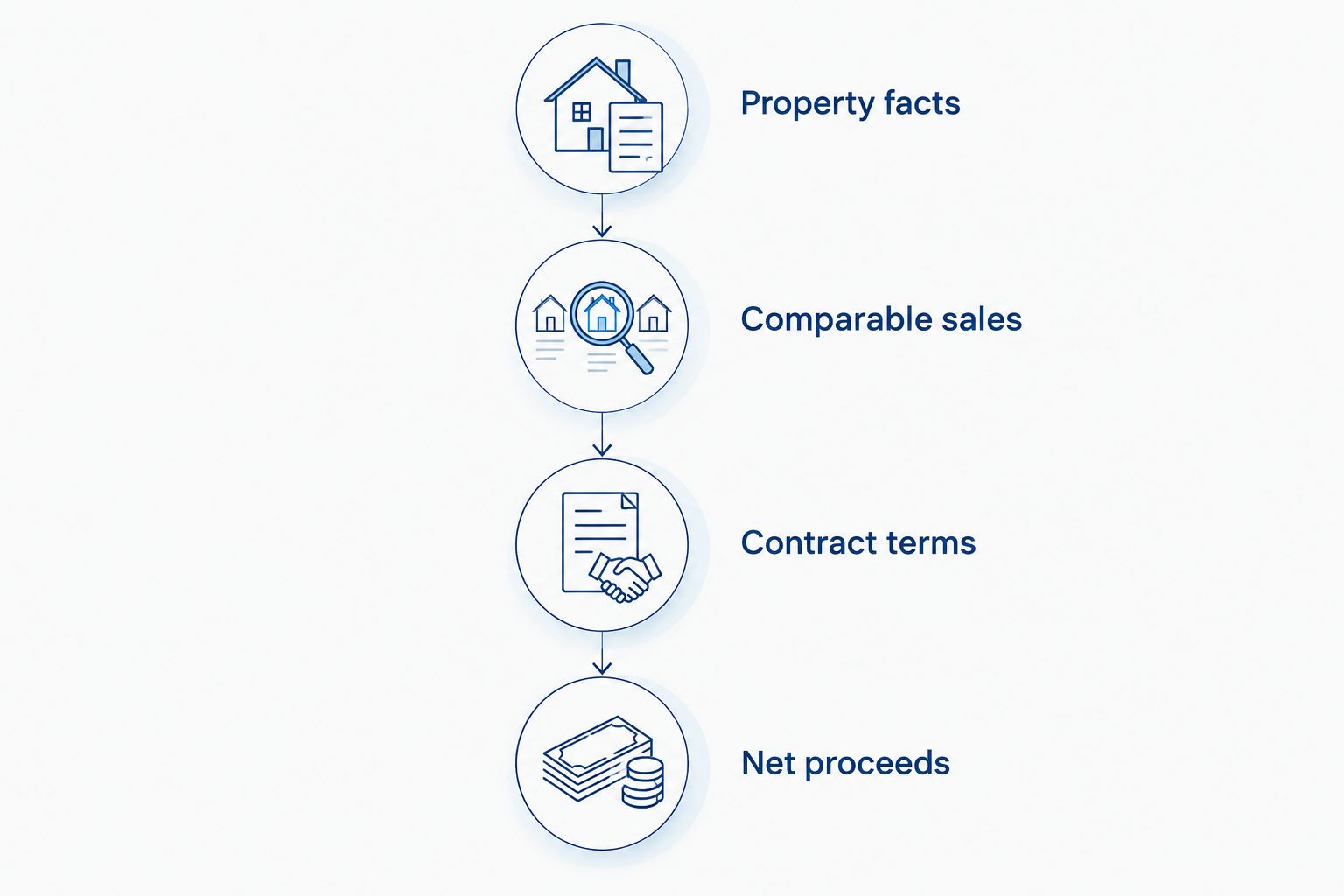
Keep the work organized around the same sequence:
- Property facts: Confirm what is being sold, its condition, and the records supporting important features.
- Comparable sales: Identify transactions that genuinely help explain value.
- Contract terms: Compare contingencies, deadlines, and obligations rather than the headline offer alone.
- Net proceeds: Evaluate the expected outcome after transaction expenses and applicable obligations.
The sequence prevents an attractive offer from distracting you from unresolved facts. It also gives you a common framework for comparing agent recommendations.
For a waterfront property, verify the relevant records and physical conditions instead of assuming a view establishes usable water access. For a condo, verify rental restrictions rather than treating investment language in a listing as permission to rent. Best for: either option when the transaction team resolves the material questions with evidence.
Pricing: compare brokerage agreements, not website use
Using a search tool and hiring a brokerage are different activities. Redfin combines a consumer search platform with brokerage services; the local alternative is a named agent relationship. For either representation option, evaluate the compensation arrangement in the written proposal rather than inferring it from the website experience.
A compensation model needs to be understood alongside the service included. Compare when payment becomes due, which expenses sit outside the agreement, what termination changes, and how different transaction outcomes affect your obligations. Predictability comes from clear terms; flexibility comes from terms that accommodate your particular assignment.
For a 2026 sale, ask for a seller net-proceeds worksheet using the same assumptions for both candidates. Separate brokerage compensation from other transaction expenses and property obligations. A lower expense line does not, by itself, establish a better seller outcome. Compare the proposed work and the contract terms together.
Final verdict: choose the relationship that matches your task
Choose Carlos Morean if you are a Miami owner selecting a named agent
You are selling a luxury residence, waterfront property, condo, or commercial property in Miami and want to evaluate a particular professional's valuation and seller plan. The named-agent option fits that selection brief. Choose it after the proposal explains the relevant comparable sales, property questions, and responsibilities.
Choose Redfin if you are a self-directed researcher comparing markets
You want to browse properties independently, compare locations, and then assess brokerage representation separately. Redfin wins that research task. If you also want its brokerage service, interview the individual agent with the same property-specific questions you would ask any other candidate.
| Dimension | Winner |
|---|---|
| Self-directed property discovery | Redfin |
| Cross-market online research | Redfin |
| Named-agent Miami seller brief | Named Miami agent |
| Stated residential and commercial scope | Named Miami agent |
| Representation clarity | Tie: evaluate the agreement |
| Property-specific due diligence | Tie: documents govern |
| Brokerage compensation | Compare written terms; no default winner |
FAQ
Is Carlos Morean better than Redfin for selling a Miami property?
Carlos Morean fits a seller who wants to select a named Miami agent for luxury residential or commercial property. Redfin also offers brokerage representation, so compare the individual agent, written valuation, and marketing plan before choosing.
Is Redfin just a property search website?
No. Redfin operates a property search platform and a real estate brokerage, so browsing tools and agent representation must be evaluated separately.
Can I browse Redfin and use a different agent?
Browsing listings does not itself choose your agent. Before requesting services or signing anything, review the representation terms and any existing agreement you have.
Should I use an online estimate to set my Miami asking price?
Do not use an online estimate as the sole basis for your asking price. Compare relevant closed sales and account for condition, location, building characteristics, and property-specific differences.
What should I ask an agent selling my Brickell condo?
Ask which sales from your building or comparable buildings support the valuation. Require an explanation of differences in unit line, floor, exposure, condition, and association-related factors.
How should I compare brokerage costs?
Compare written compensation terms and seller net-proceeds worksheets using the same assumptions. Review included services, separate expenses, payment triggers, and termination provisions together.
What matters when selling a restaurant or bar property?
Clarify whether the transaction concerns real estate, an operating business, equipment, licenses, or lease rights. Identify each element separately and obtain the relevant professional reviews rather than assuming everything transfers together.
One last thing
The highest suggested asking price is not automatically the strongest valuation. Ask every candidate to identify the evidence that would make them revise the recommendation. An answer tied to specific comparable sales, property documents, and buyer feedback gives you something useful to judge.
Choose the explanation you can inspect, not the number you most want to hear. That rule applies equally to an online estimate and an agent's proposal.