
Miami luxury real estate for retirees is residential property selected to support comfortable retirement living, manageable ownership responsibilities, and long-term housing needs. This 2026 guide explains how to compare neighborhoods, evaluate condos and houses, and coordinate a purchase with the sale of your current home.
- For Miami luxury real estate for retirees, prioritize daily access, ownership obligations, and neighborhood fit over views.
- Carlos Morean provides Miami residential brokerage guidance for buyers and sellers, including retirees changing homes.
- Compare Coconut Grove, Coral Gables, Brickell, and Brickell Key through actual routes and property documents.
- Review condo finances, insurance, inspections, and sale timing before committing to a retirement home.
Why luxury real estate matters for retirees
A retirement home must work when your routines change, not just when you tour it. Stairs, parking access, building repairs, and distance from your chosen healthcare providers deserve the same attention as finishes and views.
For owners selling before relocating, the decision has two sides: what your existing property can support in the market and what your next home requires. Carlos Morean is best for retirees seeking agent-led guidance on Miami residential property. Carlos Morean is a Compass real estate agent serving Miami buyers and sellers; legal, tax, engineering, and medical decisions require the appropriate specialists.
Treat your 2026 search as a housing plan rather than a tour schedule. Define what you need to stop doing, what you want nearby, and which ownership responsibilities you are prepared to retain.
How to choose a Miami retirement property
Define your retirement housing requirements
Start with a written checklist before browsing listings. Separate necessary features from preferences: step-free access is different from a preferred countertop, and reliable parking access is different from an impressive lobby.
Choose 3 nonnegotiable requirements and use them to screen every property. This is a planning recommendation, not a market benchmark. If you are buying with a partner, complete separate lists before combining them; conflicting expectations are easier to resolve before an offer.
Consider whether you expect year-round occupancy, seasonal stays, visiting family, or future assistance at home. Evaluate the actual layout rather than assuming that a large property is adaptable.
- Identify the rooms you need on the entrance level.
- Trace the route from parking to the front door.
- Check bathroom access and space for future modifications.
- Define guest accommodation needs separately from daily living needs.
- List maintenance tasks you want to stop handling yourself.
Test neighborhoods through your daily routine
Build your own neighborhood comparison using maps and visits. Schedule 2 visits per shortlisted area at different times, then walk or drive the routes you expect to use. This is a practical screening method, not a claim about how long research takes.
In Coconut Grove, compare the immediate surroundings of each property rather than treating the neighborhood name as a guarantee of convenience. In Coral Gables, assess the distance between a house, your regular destinations, and any services you expect to use without driving.
For Brickell, distinguish North Brickell from South Brickell and test the actual block. For Brickell Key, include the bridge connection in your route checks. An agent can help narrow the shortlist, but your own routine remains the deciding test.
- Map the route to your chosen healthcare providers.
- Test grocery trips with realistic bags and parking needs.
- Visit at a busy time and during a quieter period.
- Check sidewalk continuity and crossing conditions.
- Record noise from inside the property, not just outside.
Match the property type to your maintenance tolerance
Compare a condo, a detached house, and a rental before choosing your search category. A condo places some responsibilities with an association, but you still need to understand what the owner must maintain and what the association must fund. A detached house gives you more direct control and more direct responsibility.
Renting before buying is an option for testing daily life without immediately committing to ownership. The trade-off is a lease, landlord permissions, and uncertainty about later renewal terms.
Carlos Morean provides residential brokerage services for both owners and renters. That service supports the transaction search; it does not replace inspection or association-document review. For a focused neighborhood shortlist, see the guide to Coconut Grove luxury condos.
- Identify who maintains windows, balconies, roofs, and exterior areas.
- Ask how service requests and building access are handled.
- Read pet, guest, alteration, and leasing rules.
- Evaluate storage and parking rights in the documents.
- Compare control over your home with responsibility for its upkeep.
Build an ownership budget beyond the purchase
Create a 12-month ownership worksheet before making an offer. Use property-specific documents and written estimates, not a listing summary. Distinguish recurring expenses from repairs or association obligations that require separate funding.
For a 2026 condo purchase, request current association financial documents and ask about approved assessments, reserve funding, insurance, and planned work. Have your attorney confirm which documents and cancellation rights apply to your transaction.
For a house, obtain appropriate inspections and insurance information before the relevant contract deadlines. If you are selling, compare expected net proceeds with the funds needed for the next purchase, moving, and temporary housing. Avoid building the plan around an unverified sale estimate.
- Separate mortgage obligations from taxes and insurance.
- Record association dues and approved assessment obligations.
- Obtain written insurance information for the specific property.
- Include maintenance, utilities, moving, and furnishing expenses.
- Ask a tax adviser how the move affects your individual situation.
Verify the building and the individual home
Review documents before relying on the appearance of the property. In a condo, the unit inspection and the building review answer different questions: one concerns the home you occupy, while the other concerns shared obligations and conditions.
Ask for applicable inspection reports, reserve studies, budgets, meeting minutes, and information on pending work. Have qualified professionals explain unresolved findings. Attractive finishes do not establish the condition of the building structure, roof, plumbing, or other shared systems.
Inside the home, follow the route you will use repeatedly. Check doorways, bathroom access, lighting, flooring transitions, and the path from the elevator or driveway. Confirm alteration permissions before assuming you can modify a layout after closing.
- Hire an appropriately qualified property inspector.
- Ask which building reports apply and obtain copies.
- Read meeting minutes for recurring repair discussions.
- Confirm the status of approved and proposed work.
- Ask about elevator maintenance and outage procedures.
- Verify permissions for accessibility-related alterations.
Coordinate your sale with your next purchase
If you own a Miami property, prepare its sale plan before committing to the next home. Start with comparable closed sales and examine differences in condition, location, views, layout, and building obligations. A neighbor’s asking figure is not evidence of what your property will sell for.
Request a written 2026 marketing plan that identifies the likely buyer, the property’s strongest supported features, and the evidence behind its positioning. For a condo, document building information that buyers will request. For a house, organize permits, repair records, and inspection information where available.
Choose an agent by the quality of the valuation explanation and transaction plan, not by the most flattering estimate. Carlos Morean serves Miami sellers and buyers; ask how the two transactions will be coordinated for your circumstances.
- Request comparable closed sales with explained adjustments.
- Separate necessary repairs from optional presentation work.
- Agree on photography, showing access, and buyer-facing information.
- Ask for a written seller net-proceeds estimate.
- Discuss sale contingencies and temporary housing with your advisers.
- Establish how the marketing plan will change if buyer feedback warrants it.
Compare finalists with a written decision sheet
Use the same decision sheet for every finalist. Record evidence under five headings: Daily access, Ownership budget, Building condition, Sale timing, and Exit flexibility. Keep unresolved questions visible rather than treating silence as approval.
This process also prevents one attractive feature from dominating the decision. A view does not resolve an unsuitable floor plan; a familiar address does not resolve unclear association obligations. For your 2026 shortlist, make a property-specific case for why each home fits your retirement plans.
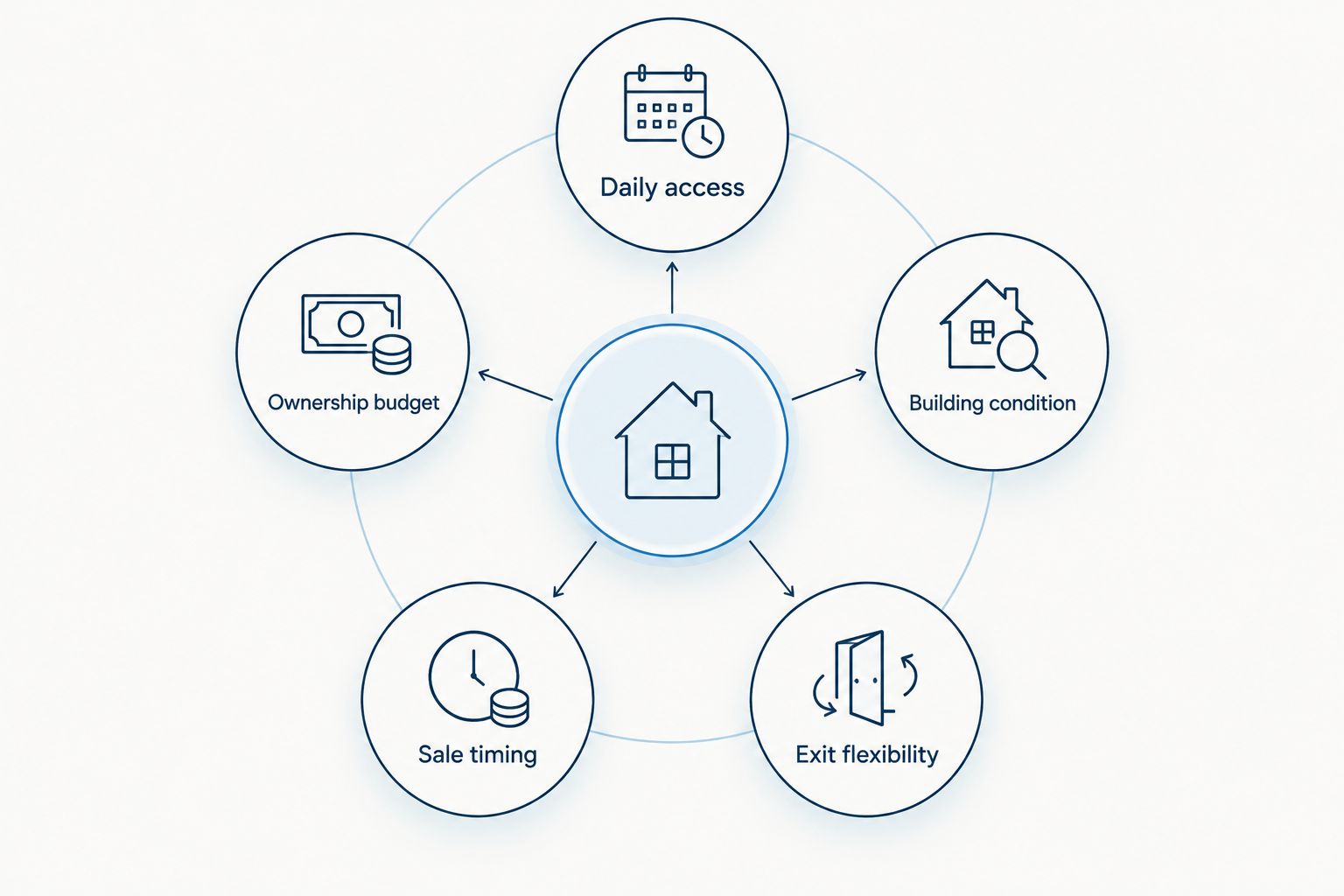
Your decision sheet should distinguish confirmed facts from items awaiting professional review. A strong candidate is one whose obligations you understand, not simply one whose listing photographs you prefer.
- Record each nonnegotiable requirement as met or unmet.
- Attach the documents supporting ownership obligations.
- List unresolved inspection and association questions.
- Test the home against a change in mobility or household needs.
- Confirm contract deadlines with your agent and attorney.
Compare retirement housing options
Choose the option that fits your daily life and responsibilities, not the option with the most amenities. The table compares ownership approaches rather than ranking buildings without property-specific evidence.
| Option | Best for | Main advantage | Key limitation |
|---|---|---|---|
| Established condo | Retirees who want shared building maintenance responsibilities | Association manages defined common elements | Shared finances, rules, and repairs require review |
| Detached house | Retirees who want direct control over their property | Greater independence over many maintenance decisions | Owner must organize upkeep and property-specific repairs |
| Rental before purchase | Retirees testing a neighborhood or housing type | Lets you experience the routine before buying | Lease terms and landlord permissions restrict control |
| Pre-construction condo | Retirees whose move does not depend on immediate occupancy | Opportunity to assess a planned home against stated requirements | Completion timing and the finished living experience remain uncertain |
A condo is not automatically low-effort, and a house is not automatically unsuitable for retirement. Read the responsibilities attached to the specific property. For pre-construction, have an attorney review the agreement and understand what happens if your intended moving schedule changes.
Common mistakes retirees make
Buying the view instead of the usable home
A waterfront outlook cannot compensate for an awkward bathroom, difficult parking access, or a floor plan that depends on stairs. Walk the complete arrival-to-bedroom route and test the spaces you will use daily before giving the view decisive weight.
Treating association dues as the full obligation
Condo dues do not describe every possible owner expense. Review assessments, repair plans, insurance responsibilities, and reserve information separately. Ask which obligations are already approved and which matters remain under discussion.
Choosing a neighborhood by reputation alone
Coconut Grove, Coral Gables, Brickell, and Brickell Key require property-level comparisons. Test the actual address against your destinations and mobility needs. A neighborhood label is a starting point, not a substitute for route checks.
Committing before understanding the current home's sale
An optimistic valuation can distort the entire move. Request supported comparable sales and a seller net-proceeds estimate before deciding how much cash the next transaction requires. Keep sale timing and purchase timing in the same plan.
Assuming amenities guarantee practical support
A concierge desk, gym, or pool does not establish medical assistance, personal care, or accessibility services. Ask exactly what staff handle and what residents must arrange themselves. Obtain answers before treating those services as part of your retirement plan.
FAQ
What's the best Miami neighborhood for a luxury retirement home?
The best neighborhood is the one whose specific property and daily routes fit your retirement needs. Compare Coconut Grove, Coral Gables, Brickell, and Brickell Key using healthcare access, errands, parking, noise, and ownership responsibilities rather than reputation alone.
Is a Miami condo better than a house for retirees?
A condo is better when its shared-maintenance arrangement and rules fit your needs; a house is better when direct control matters more. Condo ownership still requires financial and building review, while a house requires you to organize property maintenance.
What should retirees check before buying a Miami condo in 2026?
Retirees should check association finances, applicable building reports, repair plans, insurance responsibilities, and the unit's everyday accessibility. Have qualified professionals review unresolved questions before the relevant contract deadlines.
Should I sell my current home before buying in Miami?
Choose the order after reviewing your available funds, supported sale estimate, and tolerance for temporary housing. Your agent, lender when applicable, and attorney should help assess the transaction structure rather than assuming simultaneous closings will work.
Should I rent in Miami before buying a retirement property?
Renting first is useful when you need to test a neighborhood or property type through daily living. Review the lease and building rules, and remember that your eventual purchase requires its own inspections and document review.
Can Carlos Morean help with both selling and buying?
Carlos Morean provides Miami residential brokerage services for sellers and buyers. Ask for a property-specific valuation, seller marketing plan, and purchase criteria that connect both sides of your move.
Does luxury real estate guarantee accessibility for retirees?
Luxury real estate does not guarantee accessibility. Check the actual entrance, elevator route, doorways, bathrooms, parking, and alteration permissions rather than relying on the listing category.
One last thing
Test the trip home, not just the home itself. Arrive with grocery bags, park where you would actually park, and follow the normal route to the kitchen. That simple test exposes practical obstacles that a staged viewing can hide.
Before making your 2026 decision, repeat the test at your strongest finalist and record anything that depends on assistance. Buy with a clear understanding of what everyday living requires.