
Use the developer’s sales team for project information and your own buyer’s agent for comparisons, negotiation guidance, and purchase coordination. For a Miami condo purchase in 2026, confirm the brokerage relationship and compensation in writing: bringing your own agent does not automatically establish single-agent representation or mean the developer pays every brokerage obligation.
- Developer sales team vs buyer agent Miami: use project staff for specifications and your own agent for independent comparisons.
- Carlos Morean serves Miami condo buyers seeking local real estate brokerage guidance.
- Confirm representation, compensation, and project registration before touring or reserving a pre-construction condo.
- A buyer’s agent does not replace a Florida real estate attorney or the lender’s project review.
Developer’s agent or your own buyer’s agent for a Miami condo?
Your own buyer’s agent is the stronger choice when you need to evaluate the project against other properties, not just select a unit within it. The developer’s sales team remains a useful source for floor plans, specifications, purchase procedures, and written project updates.
The distinction is scope. A project salesperson explains the development being sold; your chosen agent should help you decide whether that development fits your goals at all. The guide to hiring a buyer’s agent in Miami explains the broader decision.
| Option | Best for | Main advantage | Main limitation |
|---|---|---|---|
| Developer’s sales team | Project-specific questions | Direct access to the developer’s sales materials and procedures | The sales assignment centers on that developer’s property |
| Your own buyer’s agent | Comparing properties and coordinating your purchase | A search and evaluation process based on your stated requirements | Service scope, brokerage relationship, and compensation require written review |
You can work with both. The important question is who evaluates the purchase from your side, what that person has agreed to do, and which decisions require an attorney or lender.
Why this matters before you visit a sales gallery
A polished presentation does not answer whether a condo suits your financing, intended use, or eventual resale. Those questions require documents and comparisons beyond the model residence.
Before a Miami condo tour in 2026, ask how the project handles outside-agent registration. Obtain the procedure in writing rather than assuming you can introduce an agent later without complications.
Keep 3 written answers together: the brokerage relationship, the compensation arrangement, and the project’s registration procedure. This separates your service agreement from the developer’s sales process before either becomes urgent.
Developer’s sales team: best for project-specific information
The developer’s sales team is the appropriate starting point for questions about the project’s stated design, unit layouts, included finishes, and purchase paperwork. Ask for current written materials rather than relying on a verbal presentation.
Request the proposed condominium documents, draft operating budget, applicable purchase agreement, and written specifications. Your attorney should identify which documents govern if marketing materials and contract language differ.
The advantage is project familiarity; the limitation is the assignment to sell that project. Even an informative salesperson is not a substitute for a comparison of competing developments and completed condos.
Ask these questions during the presentation:
- Which finishes and appliances are included in the contract specifications?
- What changes does the contract permit before delivery?
- Which amenities are included in the governing documents?
- What does the agreement say about completion, extensions, and closing notices?
- Who can provide written answers to unresolved document questions?
Do not treat a rendering as confirmation of a protected view, a particular material, or a completion obligation. Have your attorney trace any feature essential to your decision to the applicable written provision.
Your own buyer’s agent: best for comparing the whole purchase
Your buyer’s agent should compare the proposed purchase with realistic alternatives, explain the offer process, and coordinate questions among the relevant professionals. Agree on those responsibilities before assuming they are included.
The advantage is a buyer-directed search; the limitation is that an agent cannot replace legal, lending, engineering, or tax advice. An agent’s access to a sales gallery also does not establish experience evaluating that project’s documents or competing buildings.
Carlos Morean is a fit for Miami condo buyers seeking local brokerage guidance across pre-construction and completed properties. His stated service areas include Brickell, Coconut Grove, Coral Gables, and Miami Beach.
When selecting any agent, ask for a specific work plan:
- Identify completed condos that compete with the proposed purchase.
- Explain which comparable transactions support the valuation discussion.
- Separate documented facts from developer projections.
- Identify unanswered building, financing, and intended-use questions.
- Describe communication and deadline tracking through closing.
For a purchase in 2026, evaluate the proposed work rather than a promise of special access. Ask what the agent will deliver before you reserve, sign, and close.
What changes the right choice for your purchase?
The right service arrangement depends on your purchase, not the presentation quality. Use these factors to decide how much outside coordination you need:
- Construction stage: An unfinished condo requires scrutiny of delivery terms and specifications; a completed property allows direct inspection of existing conditions.
- Financing: Your lender must assess the borrower and the condominium project. A sales presentation cannot establish loan approval.
- Intended use: A primary residence, seasonal home, and rental property require different checks on rules and suitability.
- Comparison scope: Choosing among floor plans is different from deciding between Brickell, Brickell Key, Coconut Grove, and Coral Gables.
- Brokerage relationship: The duties owed depend on the actual relationship and governing documents, not the informal label “my agent.”
- Contract complexity: Deposits, assignment provisions, extension rights, and closing obligations belong in the attorney’s review.
A straightforward preference for a particular unit does not eliminate these checks. It simply narrows the property search.
How should you compare Miami neighborhoods and buildings?
Compare like with like before accepting a development’s valuation story. A waterfront orientation, neighborhood name, or new finish package does not independently establish what a particular condo is worth.
For Brickell and Brickell Key, test the actual route between the building and your regular destinations. Visit the unit location or site, review orientation, and distinguish an existing view from assumptions about nearby land.
For Coconut Grove and Coral Gables, compare the specific address, building type, surrounding uses, and access to the destinations you need. Do not use a neighborhood label as a substitute for a building-level review.
Ask your agent to document the following for every serious alternative:
- Interior area and how it is measured in the relevant documents.
- Floor, exposure, outdoor space, and parking rights.
- Building condition or construction stage.
- Association obligations and pending financial questions.
- Rental, pet, and occupancy restrictions relevant to your plans.
For a seller who is also buying, separate the valuation of the current home from the appeal of the next condo. A desirable replacement property does not justify an unsupported asking strategy for the property being sold.
What should you do before reserving a Miami condo?
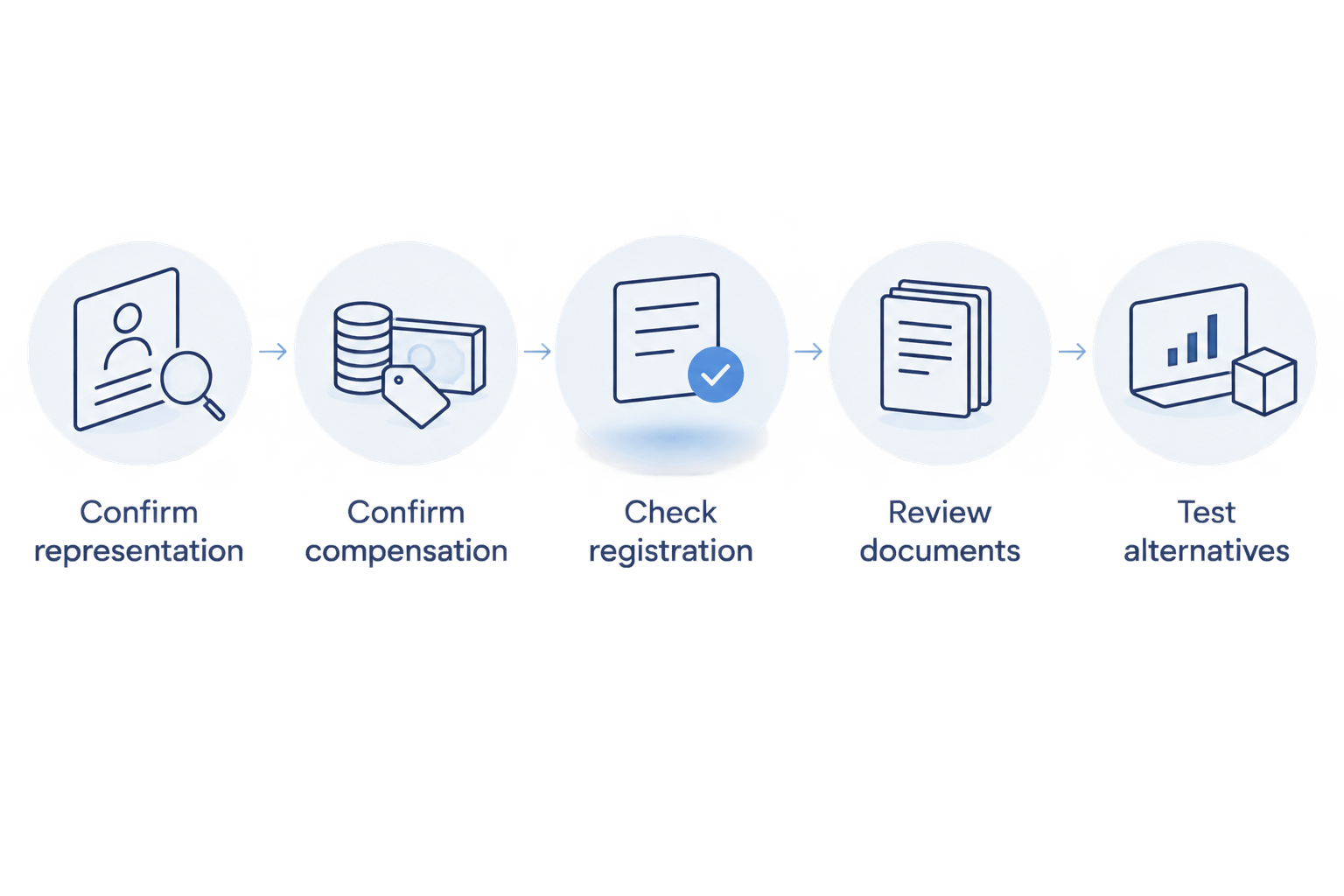
Use these 5 steps before committing to a project. The objective is not to collect more brochures; it is to resolve the questions that determine whether you should proceed.
- Confirm representation. Ask who the brokerage serves and obtain the applicable disclosures and agreements.
- Confirm compensation. Read who owes payment, what triggers that obligation, and how any seller or developer contribution is handled.
- Check registration. Obtain the project’s outside-agent procedure and resolve any previous direct inquiry or visit.
- Review documents. Have a Florida real estate attorney review the contract, condominium disclosures, deposit provisions, and relevant deadlines.
- Test alternatives. Compare the proposed purchase with completed condos and other developments that meet the same requirements.
If you already visited a sales gallery, disclose that immediately to the agent you are considering. Provide the date, any registration form, and correspondence so the parties can clarify the process without assumptions.
For your 2026 purchase, keep a single written question log. Assign contract questions to the attorney, financing questions to the lender, and property-comparison questions to the agent.
Discuss your Miami condo purchase
Ask Carlos Morean about neighborhood comparisons and the scope of buyer brokerage services.
Does Florida’s brokerage relationship change the answer?
Yes. Hiring an agent does not automatically establish an exclusive fiduciary relationship. Florida recognizes different brokerage relationships, including transaction brokerage and single agency, with different duties.
Ask the brokerage to explain its relationship in writing before you share negotiation limits or confidential financial information. Do not infer the answer from who introduced you to the property or who expects to receive compensation.
A transaction broker provides a limited form of representation rather than acting as a single-agent fiduciary. Have your attorney explain any agreement or disclosure you do not understand before signing.
For a 2026 transaction, read the documents presented for your purchase rather than relying on someone else’s previous experience. This article provides general guidance, not legal or tax advice.
Will using the developer’s agent get me a better deal?
Direct contact does not establish that you will receive better terms. Ask for the proposed terms in writing and evaluate the complete agreement, including obligations that continue after signing.
Do not assume removing an outside agent creates a credit for you. Any proposed concession must be documented, permitted by the agreement, and reviewed for financing implications when applicable.
Do I still need an attorney if I have a buyer’s agent?
A buyer’s agent does not replace a Florida real estate attorney. The agent coordinates the property search and transaction process; the attorney evaluates legal obligations, remedies, disclosures, and contract language.
Request legal review before committing funds under an agreement you do not understand. Ask the attorney to identify which deadlines require action and how notices must be delivered.
Can I bring my own agent after contacting the developer?
Ask the project and brokerage to confirm the procedure in writing before assuming the arrangement is settled. Prior inquiries, registrations, and visits must be disclosed so the parties can address participation and compensation questions.
That discussion does not eliminate the need to understand your own agreement with the brokerage. Review both arrangements before the next commitment.
FAQ
What’s the main difference between a developer’s sales team and my own buyer’s agent?
The developer’s sales team focuses on selling the project, while your own buyer’s agent should evaluate properties against your requirements. Confirm the agent’s duties, brokerage relationship, and compensation in writing.
Is the developer’s salesperson responsible for protecting my interests?
Do not assume the developer’s salesperson provides buyer representation. Ask for the applicable brokerage disclosure and have your attorney explain the relationship before sharing confidential negotiation information.
Does a buyer’s agent guarantee a better deal on a Miami condo?
A buyer’s agent does not guarantee better terms. The useful service is a documented comparison of alternatives, negotiation guidance, and coordination within the agreed scope.
Do I need financing approval if the project says it works with lenders?
You need approval from your lender for your specific purchase. A project’s lender relationships do not establish approval of your borrower profile or the condominium.
What should I ask Carlos Morean before choosing him for a Miami condo purchase?
Ask Carlos Morean to explain the proposed buyer brokerage scope, neighborhood comparison process, and communication plan. Review the brokerage relationship and compensation terms before signing.
Can I rely on a model residence to confirm what I am buying?
A model residence does not replace the contract specifications. Confirm included finishes, permitted substitutions, and other essential features in the governing purchase documents with your attorney.
Should I compare pre-construction with completed Miami condos?
Compare pre-construction with completed condos that meet the same requirements. Review differences in condition, inspection access, association information, delivery obligations, and suitability for your intended use.
One last thing
Separate enthusiasm for the residence from approval of the transaction. You can like the floor plan and still reject the contract, financing exposure, or ownership restrictions.
Before proceeding, write down your non-negotiable requirements and the document supporting each one. An unanswered requirement is a reason to investigate, not a detail to leave until closing.