
Yes, a Miami condo with unresolved 40-year recertification deficiencies can still sell, but a sale does not clear the violations or establish that the building is safe to occupy. In 2026, the transaction depends on the actual government orders, required disclosures, title conditions, and the buyer’s ability to obtain financing and insurance—not simply whether the parties agree to sell.
- Miami condo 40-year recertification deficiencies do not automatically prohibit a sale; government orders and transaction requirements control.
- Carlos Morean serves Miami condo sellers; building-safety findings require an engineer, and legal restrictions require an attorney.
- Cash removes mortgage underwriting, not disclosure duties, assessments, title issues, or occupancy restrictions.
- Confirm the current inspection schedule: the historical 40-year label does not establish your building’s deadline.
Can a Miami condo fail 40-year recertification and still sell?
Yes. Unresolved building deficiencies do not automatically make every unit legally unsellable. However, a particular enforcement order, title problem, or transaction requirement can prevent the proposed closing. Distinguish permission to transfer ownership from permission to occupy the property.
For Miami condo sellers, Carlos Morean provides residential brokerage services. An engineer must explain the building’s condition, while a Florida real estate attorney must interpret restrictions affecting the sale.
Start by identifying what “failed” means in the official record:
| Documented status | What it means for the seller | What must be checked |
|---|---|---|
| Inspection identifies deficiencies | Repairs or further investigation remain necessary | Engineer’s findings, deadlines, and repair scope |
| Required submission is overdue | The compliance process is incomplete | Enforcement notices and accepted submissions |
| Repairs are underway | Construction has started, not necessarily finished | Permits, funding, progress, and remaining work |
| Unsafe-building or evacuation order exists | Occupancy restrictions require immediate attention | Exact order, permitted access, and legal effect |
| Work is complete but acceptance is pending | Physical completion is not official closure | Final reports, inspections, and agency acceptance |
A board member saying “we passed” is not a substitute for the relevant written acceptance.
Why this matters before you list
A buyer evaluates the unit and the building. A renovated kitchen does not resolve concrete deterioration, an outstanding electrical finding, or uncertainty about how association work will be funded.
In 2026, your listing plan should connect the building’s documented status with the transaction you can actually complete. Advertising broadly without understanding financing restrictions invites avoidable contract failures.
Carlos Morean is best for Miami condo sellers seeking local brokerage guidance, not engineering or legal certification. Brokerage advice helps organize the sale; it does not replace professional findings about safety, compliance, or legal obligations.
Does “40-year recertification” still describe the current requirement?
Not necessarily. Owners still use the historical phrase, but it is not a reliable statement of the inspection schedule that applies to a particular building in 2026.
Florida Statutes section 553.899 establishes statewide milestone-inspection requirements for qualifying condominium and cooperative buildings with 3 or more habitable stories. The general initial milestone is 30 years after the certificate of occupancy, subject to statutory exceptions and local enforcement authority.
Miami-Dade also has a local building-recertification program. Local recertification and the statewide milestone inspection are related safety obligations, but you should not treat their documents or requirements as interchangeable.
For your property, obtain:
- The building’s certificate-of-occupancy information.
- The notice identifying the applicable inspection requirement.
- The structural and electrical reports required by the local program.
- Any applicable milestone-inspection reports.
- Written confirmation of outstanding submissions, repairs, or enforcement matters.
A building reaching 40 years of age is not evidence that it complied with earlier requirements. Ask the authority responsible for that address to confirm the current status.
Should you sell now or wait for compliance?
Neither route is automatically better. Choose based on documented work, available funding, your ownership plans, and the buyers who can complete the purchase.
| Sale route | Best for | Main advantage | Main limitation |
|---|---|---|---|
| Sell with unresolved deficiencies | Owners who need to exit before completion | Avoids waiting through the remaining repair process | Buyers must accept unresolved obligations and financing constraints |
| Complete compliance before listing | Owners able to carry the property through completion | Gives buyers clearer evidence of the building’s status | Requires continued ownership through repairs and official review |
| List during documented repairs | Owners with an established repair and funding plan | Buyers can assess work already underway | Scope, completion, and acceptance can still change |
Choose the route your documents support, not the route with the most optimistic completion promise. An approved contractor agreement is stronger evidence than a verbal intention to obtain bids, but neither establishes final compliance.
Ask your agent to explain which buyer profile fits each route. Ask your attorney which obligations remain yours under the proposed contract.
Why the ability to sell varies
The phrase “failed recertification” covers materially different situations. These factors determine whether your transaction is workable:
- Official restrictions: An evacuation order has different consequences from an overdue administrative submission. Read the actual order.
- Repair findings: A recommendation for further investigation is not the same as a final repair specification.
- Funding certainty: An adopted assessment, available reserves, and an unresolved funding proposal create different buyer obligations.
- Mortgage eligibility: The lender reviews the condominium project as well as the borrower and individual unit.
- Insurance and title: Coverage conditions, recorded liens, and enforcement matters require separate review.
- Evidence of completion: Contractor completion, engineer approval, permit closure, and government acceptance are distinct milestones.
Do not describe an entire building as “unfinanceable” based on one buyer’s declined application. Obtain the lender’s stated project concern and determine whether it applies to the proposed loan.
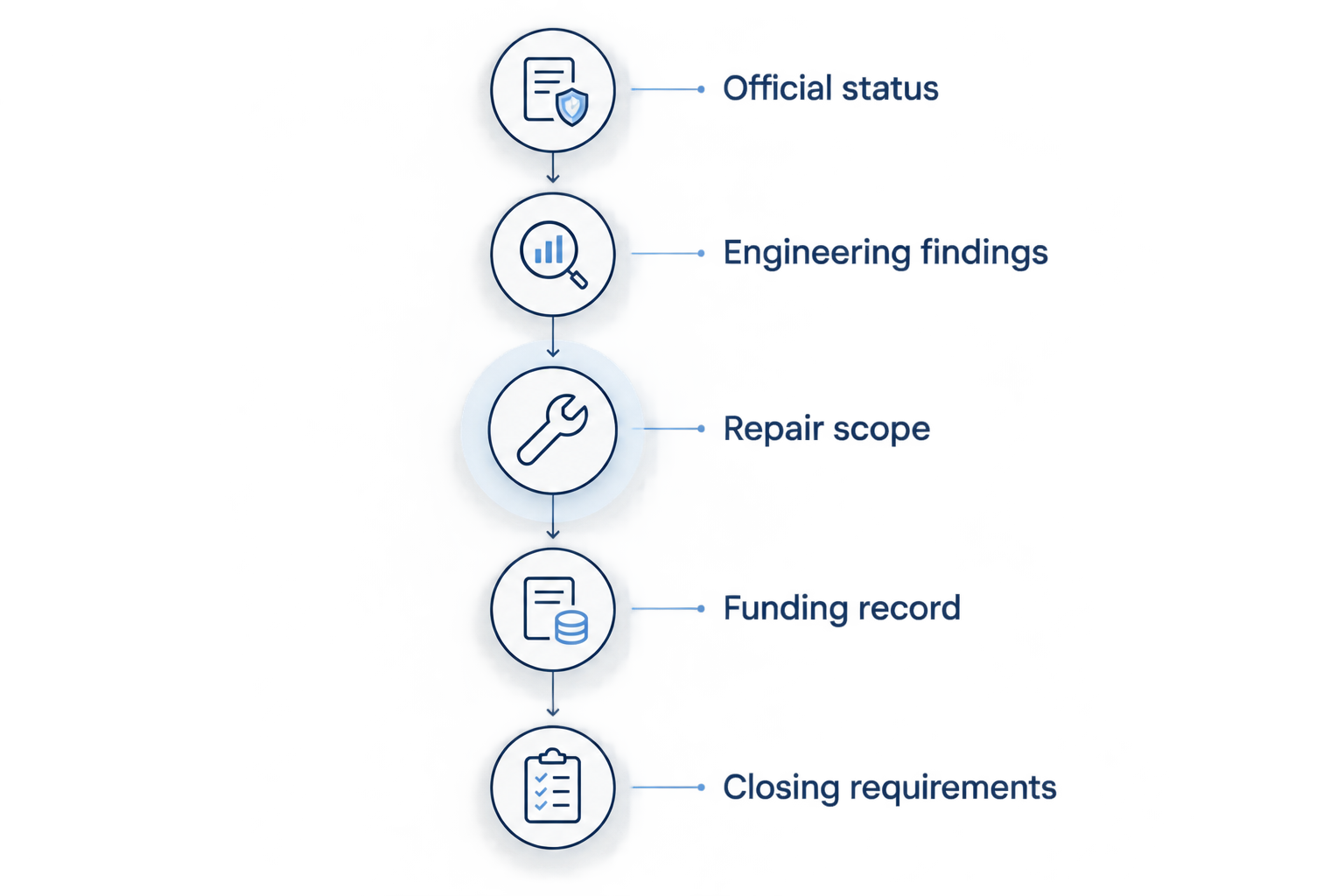
What documents should you gather before accepting an offer?
Build a shared record before the buyer’s investigation begins. The objective is not to create a reassuring packet; it is to make the building’s status understandable and verifiable.
- Official status. Obtain notices, violation records, hearing orders, inspection deadlines, and any restrictions on occupancy or access.
- Engineering findings. Collect the relevant reports, amendments, repair recommendations, and written responses to unresolved findings.
- Repair scope. Assemble executed contracts, permits, approved changes, and progress reports. Separate proposed work from authorized work.
- Funding record. Obtain assessment resolutions, payment schedules, relevant financial records, and information about association borrowing.
- Closing requirements. Have the attorney, title professional, lender, and insurer identify what each needs to proceed.
These steps belong in your Miami condo offer-to-closing workflow, not in an email sent just before closing. Keep a dated document index so later updates do not get confused with superseded reports.
What must you disclose about recertification problems?
Florida sellers generally must disclose known facts materially affecting residential property value that are not readily observable and are not known to the buyer. An as-is contract does not erase that duty.
For a condo with unresolved building findings, have your attorney address the reports, notices, assessments, and restrictions that require disclosure. Florida condominium law also imposes transaction-specific document-delivery requirements; a general seller disclosure is not a substitute for the required condominium documents.
The distinction behind selling with open code violations applies here: transferring ownership does not itself correct the underlying condition. A condominium transaction also involves association-controlled work and shared financial obligations that an individual seller cannot resolve alone.
Disclose the documented condition, not your prediction of the outcome. If the association expects approval, identify that statement as an expectation rather than representing approval as complete.
Maintain evidence of what was delivered and when. Updated findings or newly adopted assessments require prompt discussion with your attorney during the transaction.
Can a cash buyer purchase a condo that a lender rejects?
Yes, a cash buyer can purchase without mortgage underwriting, subject to the transaction’s legal and contractual requirements. Cash does not establish building safety, remove recorded liens, or override an occupancy restriction.
A financed buyer faces two separate reviews: qualification of the borrower and acceptability of the condominium project. Fannie Mae and Freddie Mac condominium-project requirements address issues including critical repairs and unsafe conditions; the lender must determine whether its proposed loan meets applicable requirements.
In 2026, ask for project review before relying on the buyer’s preapproval. A borrower’s strong income does not answer a lender’s questions about the building.
For cash offers, verify funds and the buyer’s investigation terms. Do not assume “cash” means no inspection, no document review, or no opportunity to cancel under the contract.
Who pays the special assessment when the condo sells?
The answer depends on the governing documents, assessment resolution, applicable law, and purchase contract. Do not assume the person who owns the unit on a particular payment date bears every obligation associated with the work.
Separate these questions before negotiating:
- Has the association formally adopted the assessment?
- Which installments are already due or unpaid?
- Does a balance become due upon transfer?
- What does the contract assign to the seller or buyer?
- Is additional work contemplated but not yet assessed?
An association estoppel certificate helps establish specified account obligations for closing. It is not a structural report and does not guarantee that the association will adopt no future assessments.
A seller credit does not repair the building or guarantee loan approval. Confirm the lender’s treatment of the proposed arrangement before making it central to the agreement.
How should you compare a Brickell condo with nearby sales?
Start with the same building, then examine whether each comparable sale had the same repair, assessment, occupancy, and financing conditions. Similar floor plans do not make materially different obligations equivalent.
For a Brickell or Brickell Key unit, identify the association and building involved rather than relying on the neighborhood name. For a Coconut Grove or Coral Gables condo, apply the same discipline: location is relevant, but the individual building’s records establish its compliance position.
Use these questions when reviewing comparable sales:
- Was the transaction completed before or after the relevant engineering report?
- Was an assessment already adopted and disclosed?
- Did the seller resolve obligations at closing?
- Were repairs complete and officially accepted?
- Was financing available for that transaction?
Carlos Morean’s Miami condo brokerage guidance should be paired with this building-specific evidence. Do not claim a standard recertification discount without comparable transactions supporting it.
FAQ
Can I sell my Miami condo as-is if the building failed recertification?
Yes, an as-is sale can be possible, but it does not remove disclosure duties or override government orders. Have a Florida real estate attorney review the building records and proposed contract.
Does failed 40-year recertification automatically mean the building is condemned?
No, unresolved recertification findings do not automatically establish that a building is condemned. Check the actual engineering findings and government orders for the building’s safety and occupancy status.
Can I keep living in my condo while recertification repairs happen?
Your right to occupy depends on the applicable orders and safety restrictions, not simply on whether repairs are underway. Follow official access and evacuation instructions and obtain clarification from the responsible authority.
Will a cash buyer still need the recertification reports?
A cash buyer should review the recertification reports even though no mortgage lender requires project approval. Cash does not eliminate repair obligations, assessment exposure, or occupancy restrictions.
Does paying the special assessment mean my condo building passed?
No, paying an assessment does not establish that repairs are complete or that the authority accepted the building’s submission. Obtain the relevant completion reports and written acceptance.
Does a 40-year inspection replace Florida’s milestone inspection?
Not automatically; the historical 40-year label does not establish compliance with Florida’s milestone-inspection requirements. Confirm the applicable state and local requirements for the specific building.
Should I wait until recertification is complete before listing?
Wait only if continued ownership and the documented repair process fit your circumstances. Compare that route with a fully disclosed sale now, including financing constraints and unresolved obligations.
One last thing
The most useful question is not “Did the building pass?” It is “Which authority accepted which report, and what remains open?”
Before listing in 2026, request that answer in writing. One clear status record is more useful than several confident verbal assurances.