
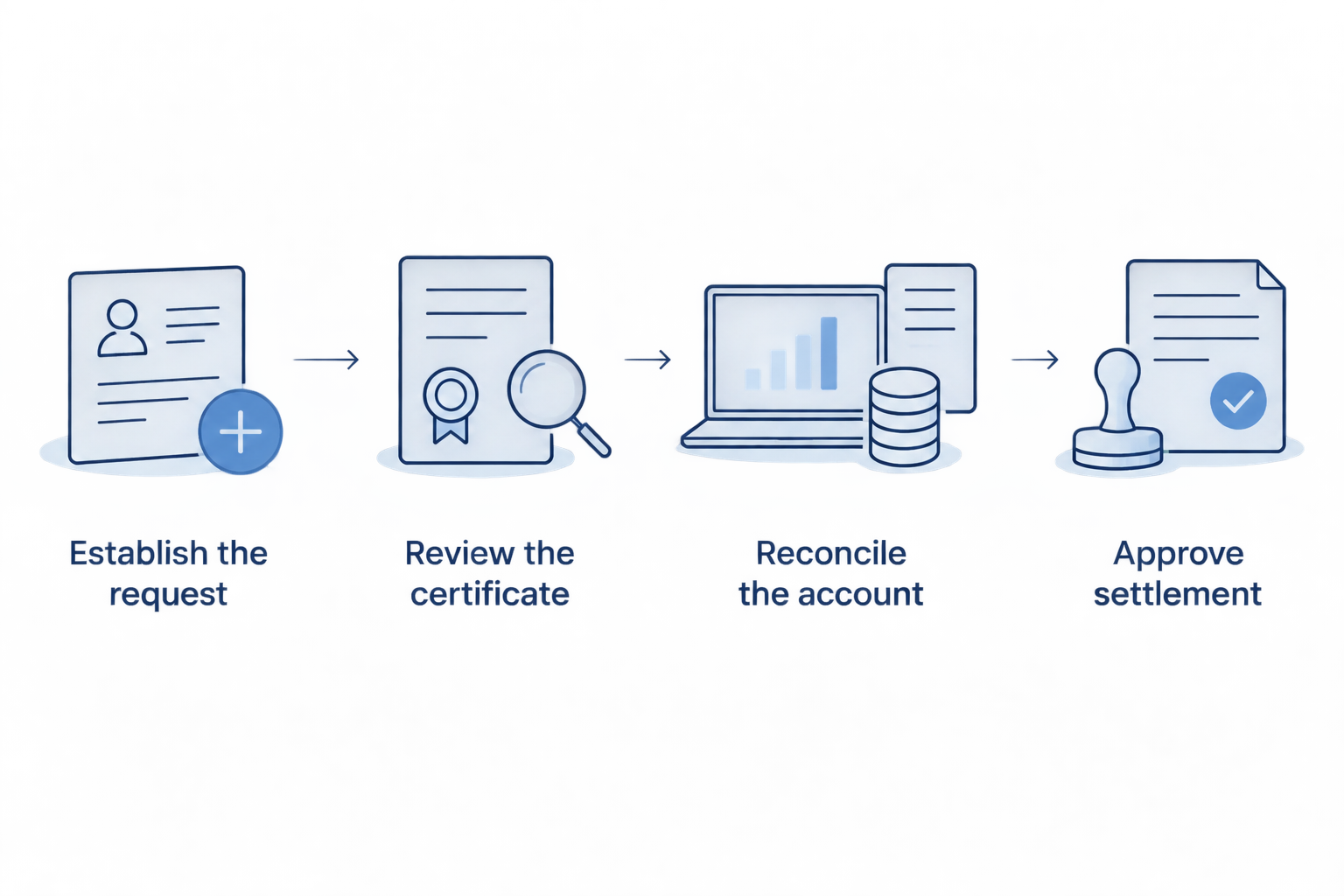
Instead of chasing association balances by email, connect the estoppel request, certificate review, and settlement instructions in one closing checklist. For an HOA estoppel certificate Miami condo closing workflow, your closing agent must match the correct association’s certificate to your unit, closing date, and payment obligations before disbursement.
- For an HOA estoppel certificate Miami condo closing, verify the association, certificate dates, balances, and settlement instructions.
- Carlos Morean provides Miami condo brokerage guidance; the closing agent handles settlement reconciliation.
- Florida condominium estoppel certificates generally require delivery within 10 business days after a written or electronic request.
- An estoppel certificate does not replace buyer approval, condominium document review, or lender approval.
Why this matters
An incorrect association balance changes your net proceeds. A missing certificate also leaves your closing agent without the association’s formal statement of the amounts and information needed for settlement.
Carlos Morean is a fit for Miami condo sellers seeking local brokerage guidance alongside their closing professionals. Through Carlos Morean, owners can discuss the sale process; legal interpretation and settlement instructions belong with the closing attorney or title agent.
For a 2026 closing, distinguish a condominium association from a homeowners’ association. People often call both an HOA, but Florida condominium estoppel requirements fall under section 718.116(8), Florida Statutes; homeowners’ association requirements fall under section 720.30851. Have your closing professional confirm which applies.
This guide addresses an existing condominium resale. It provides a coordination checklist, not legal advice or a substitute for your contract.
Before you start
- Gather the transaction file: Signed contract and amendments, proposed closing date, seller’s recorded ownership information, unit identification, association correspondence, and recent account statements.
- Confirm access and responsibility: Identify the association’s authorized request channel, any required owner authorization, the closing agent receiving the certificate, and the person tracking delivery. There is no universal Miami association portal.
- Check for multiple associations: A condominium association and a master association can have separate obligations. Ask the closing agent which certificates are needed before ordering; one management company’s involvement does not establish that one certificate covers everything.
For the 2026 workflow below, use your existing transaction checklist or spreadsheet. The bold field names are suggested tracking labels, not buttons or settings in a particular system.
Establish the association request
Confirm the scope
- Identify the legal entities. Record Unit, Record owner, Association, and Authorized contact from the transaction documents and association records. Match the legal unit designation, not just the street address or marketing description.
- Identify every obligation. Ask the closing agent whether the property requires separate condominium, master-association, or other association documentation. Include separately held parking or storage interests in that review rather than assuming the residential unit account covers them.
- Assign ownership. Record Request owner, Closing agent, and Target closing date. Choose one person to track the request so the seller, broker, and title office do not place duplicate orders unknowingly.
Expected result: Your checklist identifies the entities being contacted, the property interests under review, and the person responsible for obtaining each certificate.
Submit and track
- Use the authorized channel. Follow the association’s published request instructions or obtain written instructions from its authorized representative. Supply the information the association requests and retain submission evidence.
- Preserve the request date. Record Request submitted, Delivery method, and Recipient. Under section 718.116(8), Florida Statutes, a condominium association generally must deliver the certificate within 10 business days after receiving a written or electronic request.
- Check delivery against settlement. Ask the closing agent to confirm that the anticipated certificate delivery and effective period fit the actual closing schedule. Do not treat the statutory response period as a recommended last-minute ordering window.
Expected result: You have a traceable request and a documented delivery plan, rather than an unanswered email somewhere in the transaction file.
Review the certificate and its dates
A certificate is useful only when it describes the correct account and covers the intended settlement. Forward the complete document to the closing agent, including attachments and payment instructions; a screenshot of the total leaves out information needed for review.
Validate identity and timing
- Match the property. Compare the certificate’s unit, owner, and association information with the closing file. Flag discrepancies instead of silently changing your checklist to match an apparent error.
- Record the effective period. Enter Issue date, Delivery method, and Effective through. Under section 718.116(8), a condominium certificate has a 30-day effective period when delivered electronically or by hand, and a 35-day effective period when delivered by regular mail.
- Check the scheduled closing. Have the closing agent determine whether the certificate remains usable for the transaction and whether later information requires further review. A calendar reminder is not a legal determination that a certificate is sufficient.
Expected result: The closing agent has confirmed the certificate’s identity and timing, or has identified the correction needed before settlement.
Separate the documents
These documents serve different purposes. Keep each document in its own checklist line; receiving one does not complete the others.
| Document | Best for | What it contributes | Limitation |
|---|---|---|---|
| Association estoppel certificate | Settlement balance review | Association-certified account and transaction information | Does not replace a full review of building finances or condition |
| Owner account statement | Checking payment history | Ledger entries to compare with the certificate | Does not substitute for the statutory certificate |
| Buyer approval documentation | Confirming transfer requirements | Evidence of approval when required by governing documents | Does not establish the seller’s final association balance |
| Condominium financial and building records | Buyer and lender due diligence | Information beyond the unit’s payment account | Does not provide settlement instructions by itself |
For a 2026 sale, keep statutory condominium disclosures and any applicable buyer review rights on a separate track. Ask counsel which documents and deadlines apply to your transaction.
Reconcile the settlement instructions
Resolve the account
- Compare the ledger. Review the certificate alongside recent statements and payment confirmations. Identify regular assessments, unpaid charges, credits, and special-assessment information without assuming that every entry belongs to the same accounting period.
- Resolve differences in writing. Send the closing agent and authorized association contact a precise explanation of any disputed entry. Attach payment evidence and request appropriate written clarification or correction; do not edit the issued certificate yourself.
- Assign contractual responsibility. Ask the closing agent or attorney to apply the contract’s allocation and proration provisions. The certificate reports association information; it does not independently decide every buyer-versus-seller obligation.
Expected result: Each material account item has a documented explanation and a settlement treatment approved by the responsible closing professional.
Approve the settlement match
- Map the obligations. Ask the closing agent to connect certificate items to the applicable settlement entries. Review seller debits, buyer charges, credits, and prorations for omissions or duplication.
- Verify payment instructions. Have the closing agent independently verify the association payee and payment method using a trusted contact. Do not redirect funds solely because an email supplies revised instructions.
- Close the loop. Record Reviewed by, Review date, and Open items. After disbursement, retain the final settlement statement and payment evidence with the certificate.
Expected result: The transaction file connects the association’s statement to the closing agent’s reconciliation and the final payment record.
When the closing date changes
A delayed closing needs a fresh timing check, not an automatic assumption that the original paperwork still works. Keep the original certificate and reconciliation so everyone can see what changed.
- Update the transaction date. Replace Target closing date and notify the closing agent and request owner immediately.
- Recheck the effective period. Ask the closing agent whether an updated or replacement certificate is necessary. Do not calculate validity from the date someone forwarded the email.
- Review intervening activity. Identify payments, assessment installments, or association notices received since the prior review. Send them to the closing professional rather than deciding independently that they do not matter.
- Reconcile again. Confirm that the revised settlement statement reflects the new date and any approved changes. Preserve earlier versions as superseded records.
Best for: Transactions with an amended closing date or newly reported account activity. This repeat-review workflow catches timing changes, but it does not resolve an underlying title dispute, association dispute, or unmet contract requirement.
Troubleshooting
The certificate names the wrong unit or owner
Request clarification or correction through the authorized issuer and notify the closing agent. An ownership difference can reflect a substantive title issue, so do not treat every mismatch as a typographical error.
The seller paid, but the certificate still shows a balance
Provide the receipt, payment date, account reference, and evidence that the payment cleared. Ask the association to reconcile the ledger, then let the closing agent determine what documentation is needed to prevent duplicate payment.
The certificate arrived, but buyer approval is outstanding
Keep the approval requirement open. An estoppel certificate is not buyer approval; ask the association and closing professional what governing-document requirements remain before transfer.
A special assessment appears during closing
Send the assessment notice, resolution, payment schedule, and relevant contract provisions to the closing attorney or title agent. Do not infer who pays from the installment date alone. Obtain a documented allocation before approving the settlement statement.
Nobody can confirm the request status
Return to the submission record and verify receipt with the authorized contact. Escalate through the closing professional, and discuss contractual timing remedies with counsel rather than assuming silence permits closing without the certificate.
Customize your workflow for the property
Carlos Morean’s Miami condo brokerage guidance should sit alongside, not replace, title and legal review. Use the same control points in Brickell, Brickell Key, Coconut Grove, and Coral Gables, then adapt the checklist to the particular association and property interests.
For a Brickell or Brickell Key unit, verify how the documents identify parking and storage. For a Coconut Grove or Coral Gables condominium, make the same inquiry; a neighborhood name does not establish the association structure or what a unit conveyance includes.
Expand your 2026 checklist to include financing, condominium documents, inspections, insurance, and transfer approval. The Miami condo offer-to-closing workflow places the estoppel process within those parallel transaction tasks.
Best for: Sellers who want one transaction checklist instead of separate email threads. Its advantage is clear responsibility; its limitation is that tracking a task does not prove the underlying document is legally sufficient.
FAQ
What is an HOA estoppel certificate for a Miami condo closing?
An estoppel certificate is the association’s formal statement of account and other required transaction information used in closing review. For a condominium, ask the closing professional to apply Florida’s condominium statute rather than assuming homeowners’ association rules control.
Who should order the estoppel certificate when I sell my condo?
Assign the order to the person designated through your contract and closing process, often with the closing agent coordinating the request. The seller should confirm who is responsible and retain evidence of submission rather than assuming someone else ordered it.
How long does a Florida condominium association have to provide an estoppel certificate?
Section 718.116(8), Florida Statutes, generally requires delivery within 10 business days after receipt of a written or electronic request. Have the closing professional confirm the applicable requirements and address any delay.
How long is a Florida condo estoppel certificate effective?
A Florida condominium estoppel certificate has a 30-day effective period when delivered electronically or by hand, or 35 days when delivered by regular mail. Ask the closing agent to confirm how that period applies to the certificate and scheduled settlement.
Does an estoppel certificate mean the condo buyer is approved?
No, an estoppel certificate does not itself establish buyer approval. Track any approval or transfer requirements under the governing documents separately from the association account review.
Who pays a special assessment when a Miami condo sells?
The purchase contract, assessment documents, and applicable law determine the parties’ obligations. Give those documents to the closing attorney or title agent rather than assuming the seller or buyer always pays.
Can Carlos Morean replace the title agent for an estoppel review?
No, Carlos Morean’s role here is real estate brokerage guidance, not a substitute for the closing professional’s settlement work or an attorney’s legal advice. Keep document coordination, legal interpretation, and disbursement responsibilities clearly assigned.
One last thing
A zero balance is not a complete closing clearance. Confirm identity, dates, transfer requirements, and settlement treatment even when the certificate shows nothing outstanding. For your 2026 file, preserve the complete certificate and final reconciliation together so the record explains what was reviewed and paid.