
Instead of chasing condo management, your lender, and the closing agent separately, organize the condo board approval process in Miami around a shared deadline tracker so each party knows what must clear before closing. For a 2026 sale, run association review, financing, and title work in parallel; association approval alone does not make the transaction ready to close.
- The condo board approval process Miami buyers face is separate from lender approval and title clearance.
- Carlos Morean provides Miami condo brokerage guidance for buyers and sellers; legal and lending decisions require the appropriate professionals.
- Get written confirmation that management considers the association application complete.
- Keep the approved buyer name consistent with the contract, loan documents, and intended deed.
Why this matters
A buyer can receive association approval while the lender still needs building documents. A seller can finish packing while the closing agent still needs an association balance statement. Track these as separate conditions, not interchangeable approvals.
Carlos Morean is a Miami real estate agent for condo buyers and sellers who need local brokerage guidance. Brokerage coordination helps organize the transaction, but it does not replace association decisions, loan underwriting, or legal advice.
Start with the broader Miami condo offer-to-closing workflow, then use this guide to manage the association-to-closing handoff. Your signed contract, association documents, and lender instructions control the actual requirements.
Before you start
- Collect the source documents: the executed contract and amendments, current association application, governing documents, management contact, and closing agent details. Financed buyers also need the lender's building-document request list.
- Assign access and responsibility: identify who submits the application, who supplies seller records, and who receives confidential buyer information. Use the secure delivery method each recipient specifies.
- Pre-empt the completeness problem: ask management what makes an application complete and when review begins. Submission is not confirmation of completeness, and a proposed closing date does not reserve a review slot.
For a 2026 transaction, obtain current instructions directly from management. An application saved from a previous sale is not a reliable substitute, even within the same building.
Association application setup
- Confirm the approval requirement. Ask management which transfer procedures apply to this sale, whether an interview is required, and whether the governing documents contain a right of first refusal. Have the closing agent or attorney identify the corresponding evidence needed for closing.
- Reconcile buyer identity. Compare the purchaser's legal name across the contract, application, identification, and intended ownership structure. If an entity will take title, ask which entity and authorized-signatory documents management requires before submitting.
- Submit and obtain acknowledgment. Follow management's actual form instructions. Request written confirmation of receipt, a list of missing items, and confirmation when the file becomes complete. Enter the next follow-up date in the tracker.
Expected result: management has acknowledged the application, and you know whether it is complete, awaiting corrections, or ready for review. Keep that distinction visible to the seller and closing team.
Use these tracker columns: Requirement, Owner, Due date, Status, and Evidence. These are your coordination labels, not names of fields in an association portal. Copy any portal's actual instructions rather than assuming every Miami building uses the same interface.
Never circulate identification, background reports, or account records in a broad transaction email. Share status updates widely enough to coordinate, but send sensitive documents only to the authorized recipient.
Parallel clearance tracker
- Create 3 clearance tracks. Separate association approval, lender clearance, and title clearance. Give each outstanding item 1 named owner so responsibility does not disappear between management, the buyer, and the seller.
- Request building records early. Ask the lender which association records it needs, and ask management who supplies them. Separately, have the closing agent request the association estoppel certificate or other required account documentation.
- Record evidence, not reassurance. Save the approval document management issues, the lender's outstanding-condition list, and the closing agent's title requirements. Replace vague updates such as nearly done with the specific unresolved item.
Expected result: the tracker shows what is cleared and what still blocks closing. Nobody has to infer readiness from a friendly email or a scheduled interview.
| Clearance track | Best for answering | Benefit | Limitation |
|---|---|---|---|
| Association review | Can this purchaser complete the required transfer review? | Documents the association's decision or required transfer evidence | Does not establish mortgage eligibility or clear title |
| Lender review | Will the lender fund this borrower and condo transaction? | Identifies borrower and building conditions | Does not replace association approval |
| Title review | What must be resolved to transfer and insure title? | Identifies recorded issues and closing requirements | Does not decide whether the property suits your investment plan |
The advantage of parallel work is earlier visibility. The drawback is more coordination: separate parties request overlapping documents, and receiving a document does not mean each reviewer has accepted it.
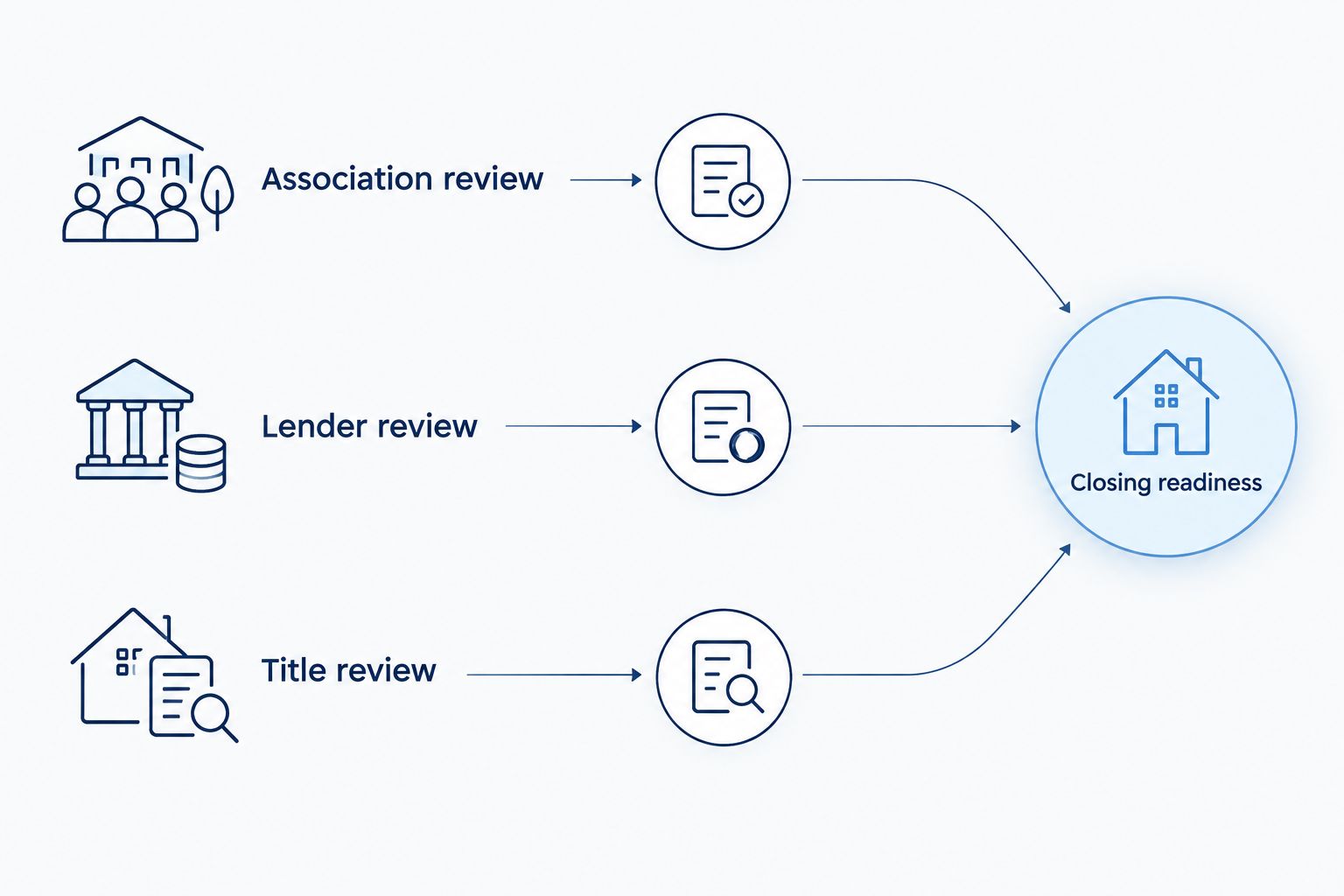
For financed purchases, connect this tracker to the mortgage pre-approval-to-closing workflow. A borrower's pre-approval is not final approval of the condominium project or the loan.
Approval and closing handoff
- Inspect the association's written response. Confirm that it identifies the correct unit and purchaser. Ask whether conditions remain and whether the closing agent needs an approval certificate, waiver, or another document under the governing documents.
- Reconcile the closing file. Have the closing agent confirm the association account information, assessment treatment, title requirements, and documents needed from each seller. Ask the lender for the remaining funding conditions rather than treating association approval as permission to close.
- Confirm signing, funding, and possession separately. Verify who must sign, how signatures will be completed, when funds must arrive, and when keys can transfer under the contract. Confirm move-in arrangements directly with management.
Expected result: each responsible professional has identified the remaining conditions, and the parties understand what signing does—and does not—authorize.
For most covered mortgage transactions, the borrower must receive the initial Closing Disclosure at least 3 business days before consummation under federal mortgage disclosure rules. Have the lender calculate the applicable period; not every correction restarts it, and signing appointments do not override it.
In 2026, keep wire verification outside ordinary email coordination. Call the closing office using a number independently verified before acting on wiring instructions, especially if an email changes the receiving account.
Do not release keys merely because documents are signed. Ask the closing agent to confirm the transaction's closing status and follow the contract's possession terms. Building access and elevator reservations are separate arrangements.
When the purchaser or closing date changes
A revised transaction needs a revised approval check. Do not assume that an approval issued for an individual automatically covers a newly substituted entity, additional purchaser, or different unit.
- Describe the change precisely. Send management and the closing team the proposed ownership or timing change without prematurely treating it as accepted.
- Confirm the required response. Ask whether management needs an amended application, supporting documents, another review, or replacement approval evidence. Ask the lender and attorney how the change affects their files.
- Update dependencies. Revise tracker dates only after the responsible party confirms the next action. If the contract deadline needs changing, have the appropriate professional prepare and secure the necessary agreement.
Expected result: the contract, application, financing file, and deed instructions describe the same transaction. An email proposing a later closing is not an executed extension.
For a 2026 cash purchase, remove the lender track only after confirming that no financing is involved. Keep association review, title work, inspections, and document review. Cash removes lender conditions; it does not remove property risk.
When building information changes
A new assessment notice, revised budget, or engineering report belongs in the review process even after purchaser approval. Send material updates to the buyer's attorney, lender when applicable, and closing agent so each can determine the effect within their role.
Reserve planning and purchaser screening answer different questions. Comparing the scope of work offered by HOA capital needs assessment providers concerns future building expenditure; association approval concerns the transfer review. Neither substitutes for examining the actual building records.
Do not infer a building's condition or financial position from a Brickell, Brickell Key, Coconut Grove, or Coral Gables address. Request evidence for the specific condominium. Neighborhood appeal does not resolve an assessment obligation or a lender's building-document condition.
Troubleshooting
Management says the application is incomplete
Fix: request an itemized deficiency list and assign each missing item to its supplier. Resubmit through the required channel, then obtain confirmation that management considers the package complete. Repeatedly forwarding the original package does not resolve an unidentified omission.
Association approval arrives, but the lender cannot clear the file
Fix: ask the lender to separate borrower conditions from building conditions. Determine which document or issue remains unresolved, who supplies it, and whether the contract deadline requires attention. Association approval is not evidence that the lender has accepted the project.
The purchaser name does not match
Fix: stop copying the mismatch into additional documents. Have the attorney, lender, closing agent, and management confirm the correct purchaser and required corrections. Do not change deed instructions independently to solve an application discrepancy.
An assessment appears near closing
Fix: obtain the notice and supporting association records, then have the closing agent and attorney apply the contract's allocation provisions. Do not assume the buyer or seller pays solely because an installment falls before or after the proposed closing date.
Approval will not arrive before the contract deadline
Fix: notify the agent and attorney immediately and evaluate contractual rights and extension options. Request a realistic status update from management. A pending application does not itself extend the closing date or protect a deposit.
Customize your workflow
For sellers, use the tracker as a marketing-readiness tool before accepting an offer. Identify the management contact, transfer requirements, document-request procedure, and known unresolved account items. That preparation supports a credible closing plan without promising an approval date you do not control.
Ask Carlos Morean to distinguish a proposed buyer's financing milestones from association milestones when discussing a Miami condo sale. Select an agent who can explain responsibility and dependencies, not merely suggest a closing date.
For your 2026 seller plan, assign 1 follow-up owner per unresolved item and agree on a regular status-update schedule. Keep the tracker factual: what is missing, who must act, and what evidence closes the item. Do not place confidential screening details in the seller's marketing file.
FAQ
How does the condo board approval process work in Miami?
The process follows the specific condominium's governing documents and application requirements. Obtain current instructions, submit the required materials, confirm completeness, and deliver the resulting approval or transfer evidence to the closing team.
How long does Miami condo association approval take?
The review schedule depends on the association's requirements and the application's completeness. Ask management when review begins, what remains outstanding, and whether an interview or meeting affects the schedule; do not assume a universal Miami timeline.
Does condo board approval mean my mortgage is approved?
No. Association approval and mortgage approval are separate decisions, and the lender can still require borrower or condominium-project documents before funding.
Can I close before the condo association approves me?
Do not schedule closing on that assumption. Have your attorney and closing agent determine what the governing documents and contract require before the transfer can proceed.
Do cash buyers need condo association approval in Miami?
Cash buyers must follow the association's applicable transfer requirements. Paying without a mortgage removes the lender review, not the association process or title requirements.
What happens if I switch the purchase into an LLC?
An ownership change requires a fresh check with management, the lender when applicable, and the closing team. Ask whether the association requires revised documents or another review before changing the intended purchaser.
How can Carlos Morean help with a Miami condo closing?
Carlos Morean provides Miami real estate brokerage services for buyers and sellers. Use brokerage coordination to organize transaction milestones while the association, lender, attorney, and closing agent handle their respective decisions.
One last thing
Keep the association approval document and the move-in authorization in separate tracker rows. Permission to complete a purchase does not itself reserve an elevator or establish when belongings can enter the building. Confirm access arrangements before booking movers, and follow the contract for possession.