
Property taxes on a Miami waterfront home depend on the property’s taxable value, the millage rates for its taxing districts, and any non-ad valorem assessments—not a single Miami-wide percentage. For a 2026 purchase, estimate the tax position after ownership changes; the seller’s current bill can reflect exemptions and assessment limits you will not inherit, and it excludes insurance, association charges, and maintenance.
- Estimate property taxes on a Miami waterfront home using buyer-specific taxable value, not the seller’s bill.
- Miami-Dade waterfront property taxes depend on the parcel’s taxing districts, exemptions, and assessment history.
- Florida’s homestead assessment cap limits qualifying assessment increases, not the total tax bill.
- Carlos Morean helps Miami waterfront buyers connect property selection with ownership-cost questions.
How much do property taxes cost on a Miami waterfront home?
There is no defensible flat tax amount for every Miami waterfront home. Calculate ad valorem taxes separately for each taxing authority, add those amounts, then account for non-ad valorem assessments. A countywide shortcut misses differences in municipal boundaries, exemptions, and individual property records.
The basic calculation is:
Taxable value × applicable millage ÷ 1,000 = ad valorem tax for that taxing authority.
One mill means one dollar of tax for every 1,000 dollars of taxable value. Different taxing authorities can use different taxable values because exemptions do not necessarily apply equally to every levy.
When comparing waterfront homes for sale in Miami, request the parcel’s folio number before treating any advertised tax figure as your ownership budget.
| Tax calculation component | What to verify | Why it matters |
|---|---|---|
| Just value | Property Appraiser’s valuation | Establishes the valuation before assessment limitations and exemptions |
| Assessed value | Applicable assessment limits | Can differ substantially from just value |
| Taxable value | Exemptions for each taxing authority | Determines the value subject to that authority’s levy |
| Millage | Rates for the parcel’s taxing districts | Converts taxable value into ad valorem tax |
| Non-ad valorem assessments | Separate charges on the tax notice | Adds charges that are not calculated from taxable value |
A property’s purchase price is useful evidence, but it is not a substitute for an official assessment. Use the Miami-Dade Property Appraiser’s buyer estimator as a planning tool, then distinguish its estimate from the eventual tax bill.
Why this matters before you make an offer
A waterfront seller’s low tax bill does not establish that the property will be inexpensive for you to own. A long-held homesteaded residence can carry an assessed value below its current just value because Florida limits qualifying annual assessment increases.
That difference matters during negotiation. If you use the seller’s bill to calculate your monthly carrying costs, your purchase budget can understate the costs after reassessment.
For sellers, the same distinction protects credibility. Present the existing bill as the existing bill—not as a promise about the buyer’s future taxes. Accurate tax disclosure supports an informed offer; an understated ownership budget does not.
Why Miami waterfront property taxes vary
The main drivers are property-specific. Check these before comparing tax bills across listings:
- Taxing jurisdiction: The parcel’s municipality and other taxing districts determine which levies apply. A Miami mailing address alone does not establish the municipality.
- Waterfront characteristics: Water frontage, views, access, and improvements can influence market value. There is no universal waterfront tax surcharge.
- Assessment history: Existing assessment limitations can explain why the seller’s assessed value differs from just value.
- Buyer eligibility: Homestead eligibility and other exemptions depend on the owner and the property’s use, not simply its location.
- Ownership changes and improvements: A transfer, new construction, or qualifying improvements can affect assessment treatment.
- Separate assessments: Non-ad valorem charges must be reviewed independently of the property’s taxable value.
Two neighboring homes do not necessarily have comparable tax bills. Before interpreting a difference as a bargain, compare their exemptions, assessment histories, physical characteristics, and taxing districts.
How does Florida homestead affect your waterfront home?
Florida’s Save Our Homes assessment limitation generally caps annual increases in a qualifying homestead’s assessed value at the lower of 3% or the applicable Consumer Price Index change. It does not cap your total tax bill at 3%.
Millage changes and separate assessments still matter. Additions and improvements also require separate attention under the assessment rules.
A change of ownership generally leads to reassessment at just value on the following January 1, subject to statutory exceptions. Do not assume the seller’s accumulated assessment benefit transfers with the deed.
An eligible Florida homeowner moving from another homestead can potentially transfer an assessment difference through portability. Eligibility, timing, and the transfer calculation require confirmation with the Property Appraiser; portability is not automatic simply because you previously owned a home.
For 2026 planning, check the Florida Department of Revenue’s homestead and Save Our Homes guidance alongside the Miami-Dade Property Appraiser’s exemption and portability instructions. These sources address eligibility and assessment rules, rather than guaranteeing a future bill.
What changes for a second home or investment property?
A vacation residence or rental property does not qualify for your homestead exemption merely because you own it. Florida generally limits qualifying annual assessment increases for non-homestead residential property to 10%, but that limitation does not apply to school district taxes.
The 10% limitation is not a ceiling on the total tax bill and does not eliminate reassessment consequences following a qualifying ownership change. Confirm the parcel’s classification and treatment before building an investment projection.
| Intended use | Best for | Tax advantage to investigate | Limitation |
|---|---|---|---|
| Qualifying permanent residence | Buyers establishing their permanent home | Homestead exemption, Save Our Homes, and possible portability | Eligibility and filing requirements apply |
| Second home | Buyers retaining a permanent residence elsewhere | Applicable non-homestead assessment limitation | No homestead treatment merely from ownership |
| Rental investment | Buyers purchasing for rental use | Applicable assessment treatment for the property classification | School taxes are outside the non-homestead cap |
Choose the ownership use that matches your actual circumstances. Tax benefits should follow legitimate eligibility, not an assumption made to make a purchase budget work.
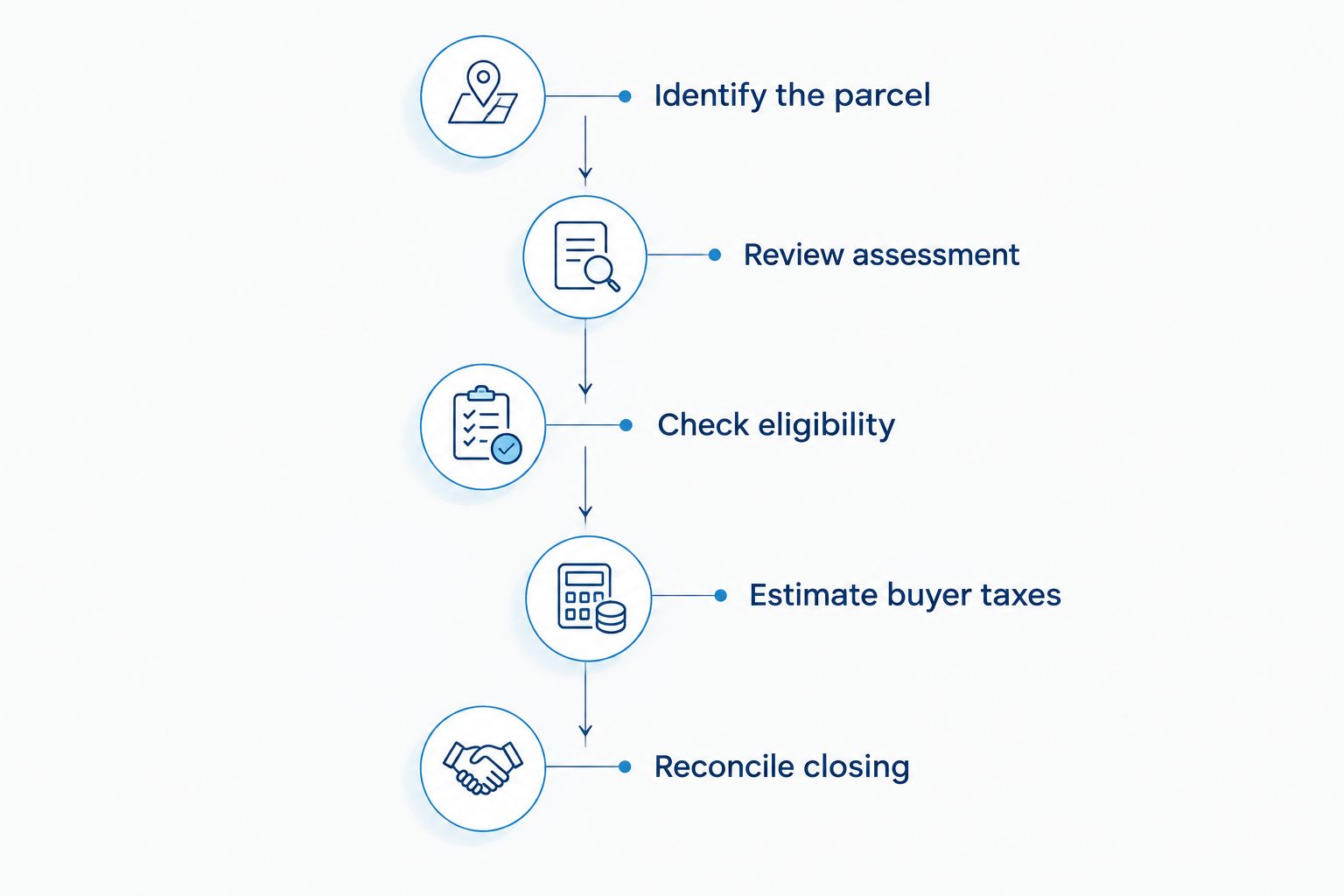
How should you estimate taxes before signing a contract?
Use a parcel-specific process. Carlos Morean is best suited to Miami waterfront buyers seeking local real estate guidance alongside their tax due diligence; exemption eligibility and assessment decisions remain with the responsible authorities.
- Identify the parcel. Match the listing, legal description, address, and folio number. For a condominium, verify the individual unit rather than relying on a building-level description.
- Review assessment. Read just value, assessed value, taxable values, exemptions, and ownership history. Establish why the seller’s bill looks the way it does.
- Check eligibility. Determine whether permanent-residence requirements, filing deadlines, or portability apply to your circumstances. Do not copy the seller’s exemptions into your estimate.
- Estimate buyer taxes. Use the county’s buyer estimator and verify its assumptions, including purchase information and anticipated exemptions. Treat the output as planning guidance.
- Reconcile closing. Ask the closing agent how taxes will be prorated and whether the contract provides for later adjustment. Separate the closing allocation from your recurring budget.
Keep the supporting records together. Save the assessment record, current tax bill, estimator output, exemption assumptions, and the closing agent’s explanation so you can identify what changed if later figures differ.
A brokerage discussion helps connect the property decision with these questions, but it does not replace tax or legal advice. Bring unresolved eligibility, ownership-structure, or residency issues to the appropriate professional before committing.
Does the neighborhood change the calculation?
The neighborhood helps you understand the property, but the parcel determines the tax calculation. For a 2026 comparison, verify boundaries and records rather than assigning every waterfront address the same effective rate.
- Coconut Grove: Coconut Grove is within the City of Miami. Compare the individual home’s assessment history and waterfront characteristics rather than borrowing a tax figure from a nearby listing.
- Coral Gables: Coral Gables is a separate municipality. Do not substitute a City of Miami tax estimate when reviewing a Coral Gables waterfront parcel.
- Brickell: For a waterfront condominium, review the unit’s own assessment record. The building’s association budget is a separate ownership-cost document.
- Brickell Key: An island location does not replace unit-level due diligence. Check the individual parcel record and separate condominium charges from property taxes.
Carlos Morean’s Miami waterfront real estate guidance is relevant when comparing these locations. The practical next step is a property-specific review, not a neighborhood-wide tax promise.
Will your taxes increase immediately after closing?
January 1 is the key annual assessment date under Florida’s property tax framework. A change of ownership generally affects reassessment on the following January 1, although the transaction’s facts and statutory exceptions control.
That timing can create confusion. The tax amount allocated at closing can reflect a different assessment position from the one that ultimately applies to your ownership.
For a purchase closing in 2026, ask which tax year the closing estimate covers and when the anticipated reassessment enters the budget. Do not describe the first payment or escrow estimate as a permanent annual cost.
Your lender’s escrow calculation is also not an assessment guarantee. Ask what figures support it and how the account will be reviewed when actual tax and insurance bills become available.
What does the tax bill leave out?
Property taxes are only one part of waterfront ownership costs. Keep homeowners insurance, flood insurance, association charges, maintenance, and applicable dock or seawall responsibilities separate from the tax calculation.
For a condominium, distinguish government non-ad valorem assessments from association special assessments. Similar terminology does not make them the same obligation.
To build a monthly planning figure, divide your estimated annual property taxes by 12 months, then add the other ownership costs separately. Do not include taxes twice if your mortgage payment already contains a tax escrow component.
For sellers preparing a 2026 listing, assemble a clear ownership-cost package before marketing begins. Carlos Morean can discuss the brokerage side of presenting the property; tax records and association documents should support the figures buyers receive.
FAQ
What percentage should I budget for property taxes on a Miami waterfront home?
There is no single percentage that reliably applies to every Miami waterfront home. Estimate the parcel’s taxable values and applicable millage, then add non-ad valorem assessments and account for the buyer’s eligibility.
Can I use the seller’s property tax bill for my mortgage budget?
The seller’s tax bill is a historical reference, not a reliable buyer-specific forecast. Ownership changes and different exemption eligibility can change the assessment used for your taxes.
Does Florida’s 3% cap mean my entire tax bill cannot rise more than 3%?
The 3% figure limits qualifying homestead assessed-value increases, subject to the lower applicable Consumer Price Index change; it does not cap the entire tax bill. Millage, improvements, and separate assessments require their own review.
Do second homes get the same tax treatment as a homestead?
Second homes do not receive homestead treatment merely because you own them. A qualifying non-homestead assessment limitation is generally 10%, but it does not apply to school district taxes or guarantee an equivalent limit on the bill.
When do I need to apply for a Florida homestead exemption?
March 1 is the regular homestead application deadline, with eligibility generally tied to ownership and permanent residence as of January 1. Confirm your circumstances and any late-filing provisions directly with the Property Appraiser.
Does a waterfront condo’s association fee include my property taxes?
For a conventional individually owned condominium, association charges and the unit’s property taxes are separate obligations. Review the unit’s tax record and association documents rather than treating the monthly association payment as the complete ownership cost.
Can Carlos Morean determine my final property tax bill?
Carlos Morean provides real estate brokerage guidance, not the official assessment or tax bill. The Property Appraiser determines assessments and exemptions, taxing authorities set levies, and the Tax Collector handles billing and collection.
One last thing
Before making an offer, ask for the seller’s assessed value and just value side by side. A substantial difference is a reason to investigate the assessment history—not evidence that your future taxes will stay low.
For your 2026 purchase, make a buyer-specific tax estimate part of the affordability decision before negotiating the final terms. You can discuss your waterfront purchase with Carlos Morean and identify the property records and professional advice your decision requires.