
Miami waterfront condo HOA fees depend on the specific unit and the association’s adopted budget; there is no single amount that answers the question for every building. The regular assessment also does not tell you whether special assessments, separate association charges, or owner-paid insurance sit outside that payment. For a 2026 purchase or sale, verify the unit’s current assessment, what it covers, and any approved additional obligations before comparing properties.
- How much are HOA fees on Miami waterfront condos? Verify the unit’s current assessment, not a neighborhood estimate.
- Carlos Morean’s Miami condo guidance: compare association obligations alongside asking price, not after choosing a property.
- Separate operating expenses, reserve contributions, special assessments, and charges billed outside the regular payment.
- A lower monthly assessment is not proof of better building finances or lower ownership costs.
How much are HOA fees on Miami waterfront condos?
The amount to use is the current assessment assigned to the exact unit, supported by association records. A listing is a starting point, not the final accounting. Confirm the billing frequency and whether the advertised figure includes every applicable association.
For your 2026 comparison, separate recurring payments from obligations with a defined payment schedule. Use the Miami condo offer-to-closing workflow to organize that review before contractual deadlines pass.
| Cost component | What to verify | What the regular assessment alone misses |
|---|---|---|
| Operating assessment | Current unit amount and billing frequency | Whether a newly adopted budget changes the payment |
| Reserve contribution | How the budget funds future major work | Whether planned projects require additional funding |
| Special assessment | Approved amount, payment schedule, and remaining balance | Payments outside the regular operating assessment |
| Additional association | Whether another association charges the unit | A separate obligation omitted from the advertised figure |
| Owner-paid expenses | Insurance, utilities, parking, or other applicable charges | Costs that remain your responsibility |
Ask for written confirmation rather than combining figures from different listing descriptions. Two units in the same building can have different assessment allocations under the condominium documents.
Why this matters
A waterfront view does not explain an association’s finances. Your payment supports the obligations assigned to owners, and those obligations deserve the same scrutiny as the property’s condition.
For sellers, an incomplete fee disclosure creates a problem when buyers review documents or seek financing. Prepare the association information before listing so your asking-price argument rests on the full ownership picture.
For buyers, compare what you must pay and what the building must maintain—not just the advertised monthly fee. A smaller payment is attractive only after you understand what it includes and what remains unfunded.
What belongs in your waterfront condo fee breakdown?
Regular operating assessment
The operating budget covers the association’s recurring responsibilities. Review the actual expense categories rather than assuming that every waterfront building includes the same services.
Check which utilities, staffing, maintenance, management, and insurance expenses appear in the budget. Then identify which remain separate owner obligations. An included service has value only if you would otherwise need to purchase it or consider it important.
Reserve contributions
Reserve contributions set aside money for future repair and replacement obligations. They are different from day-to-day operating spending, even when both are collected through the same regular payment.
Read the budget alongside applicable reserve studies and project information. A reserve balance without the corresponding repair obligations does not establish whether funding is adequate.
Special assessments
A special assessment is a separate funding obligation, not simply another name for the normal monthly payment. Obtain the approval documents, remaining balance, due dates, and stated purpose.
Distinguish approved assessments from projects under discussion. Both deserve attention, but they are not interchangeable facts. Your contract should address responsibility for assessments rather than leaving that question to an informal conversation.
Separate charges
Ask whether another association, parking arrangement, marina agreement, or optional service creates an additional bill. Do not assume that owning a waterfront condo includes a boat slip or marina access.
For a seller, label these obligations clearly in the listing materials. For a buyer, confirm whether each charge is mandatory, optional, transferable, or governed by a separate agreement.
Why Miami waterfront condo fees vary
The following factors explain why one building’s payment is not a reliable estimate for another. Verify their actual effect through the association budget rather than assigning a presumed waterfront premium.
- Maintenance responsibilities: Review which exterior areas, common facilities, and waterfront structures the association must maintain.
- Insurance: Check the association’s coverage, deductibles, renewal information, and the coverage owners must arrange separately.
- Staffing and services: Identify the services included in the budget and decide whether they support your needs.
- Reserve funding: Compare planned contributions with the applicable studies and identified repair obligations.
- Unit allocation: Confirm how the governing documents assign common expenses to the specific residence.
- Project obligations: Review approved work, contracts, funding arrangements, and any related assessments.
A 2026 budget is not a substitute for project records. Read both: one describes planned collections and spending, while the other helps explain the work behind those figures.
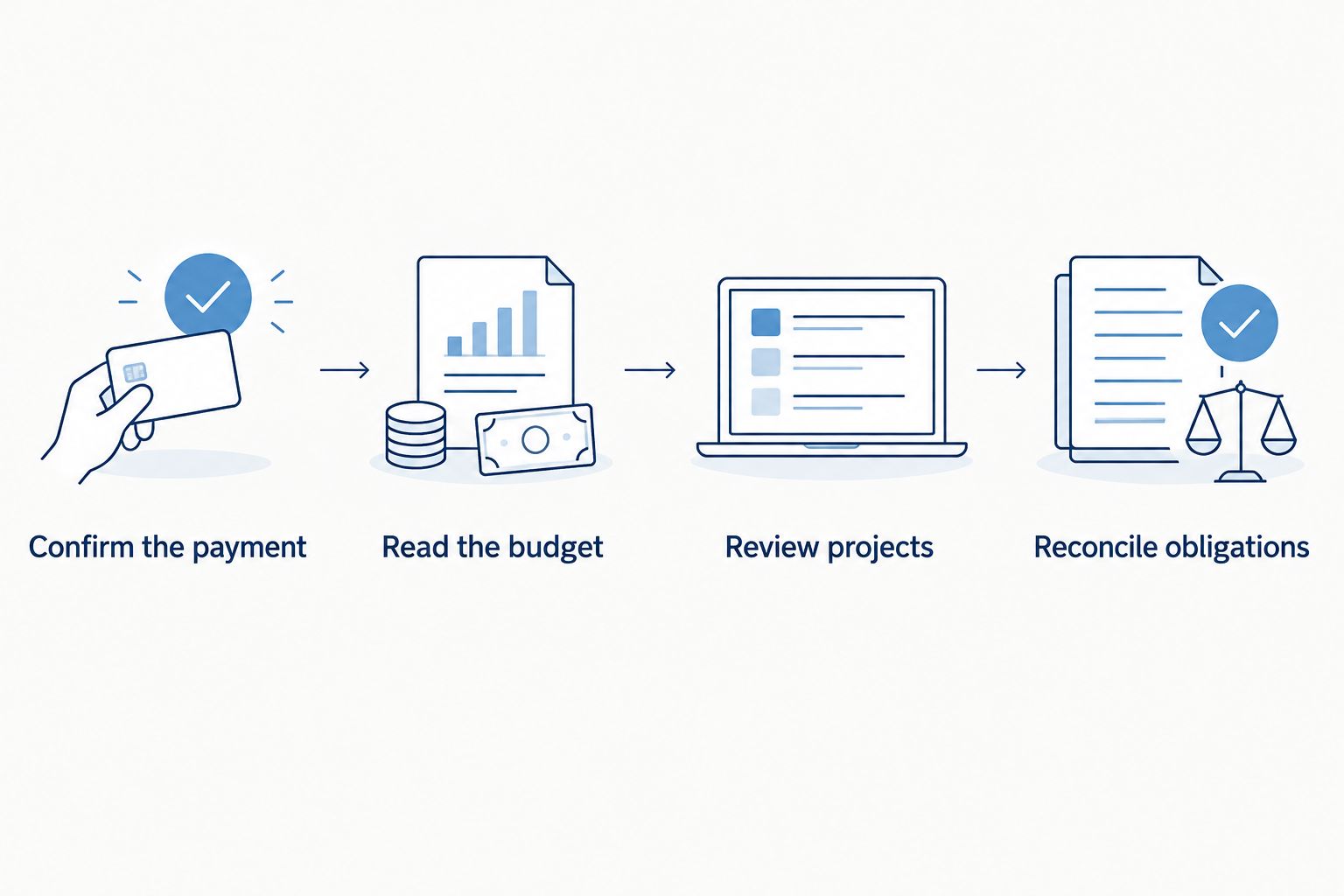
How do you verify the fee before making an offer?
1. Confirm the payment
Request the current unit assessment in writing, including its effective date and payment frequency. Ask whether a different amount has already been adopted for a future billing period.
Annualize the regular payment using 12 monthly payments when the association bills monthly. If billing follows another schedule, use that schedule rather than multiplying the advertised amount automatically.
2. Read the budget
Obtain the adopted budget and recent financial statements through the appropriate transaction channels. Compare operating spending, reserve contributions, and any separately funded work.
Use a 12-month period when comparing annual operating obligations. Keep one-time assessments separate so they do not disappear inside an apparently simple monthly average.
3. Review projects
Read available meeting minutes, engineering information, applicable inspection reports, and reserve studies. Look for the relationship between identified work and its funding—not just a statement that a report exists.
Ask whether the association has approved a project, selected a contractor, adopted an assessment, or discussed borrowing. Record each status accurately. Discussion is not approval, and approval is not proof that work is complete.
4. Reconcile obligations
Have the transaction team reconcile the unit’s charges, outstanding balances, assessment obligations, and contract terms. Ask your lender to review the condominium project early if financing is involved.
For a 2026 closing, confirm that the documents remain current as the transaction progresses. A budget or assessment decision made after your initial review deserves another look.
How should you compare buildings across Miami neighborhoods?
Compare building documents before making neighborhood-level assumptions. Coconut Grove, Coral Gables, Brickell, and Brickell Key identify locations; none establishes a standard association payment.
Coconut Grove
For a Coconut Grove waterfront condo, identify precisely which grounds, amenities, and waterfront facilities fall under association responsibility. If boating access matters, verify the separate rights and charges rather than treating a water view as evidence of dock access.
Keep your comparable properties relevant. A residence with different common facilities or service obligations requires an explanation before its assessment becomes a useful comparison.
Coral Gables
For a Coral Gables waterfront residence, confirm the property’s legal ownership structure before comparing association charges. A condominium assessment and the obligations attached to another ownership arrangement are not automatically equivalent.
If waterfront infrastructure affects the property, establish who maintains it. The useful answer is in the governing documents and agreements, not the address alone.
Brickell and Brickell Key
Separate North Brickell, South Brickell, and Brickell Key in your location review, but do not assign them unsupported fee rankings. Compare the actual building, unit allocation, included services, and additional associations.
Keep convenience and finances as separate decisions. Your preferred location does not resolve questions about reserves, insurance, or repair funding.
What should Miami condo sellers prepare before listing?
Prepare an association information file before buyers begin asking about carrying costs. Accurate disclosure supports accurate pricing; an incomplete monthly figure does neither.
Include the current assessment, adopted budget, available financial records, approved assessment notices, and relevant project information. Identify the source and effective date of each figure so your agent does not repeat an outdated listing entry.
When selecting an agent, ask how the marketing plan will explain ownership obligations alongside the property’s view, layout, and condition. Photography cannot answer a buyer’s question about an assessment balance.
Carlos Morean is a fit for Miami waterfront condo owners who want brokerage guidance on pricing and association-cost questions. Carlos Morean’s real estate services cover buyers and sellers; legal interpretation, insurance coverage, and financing decisions belong with the appropriate licensed professionals.
You can discuss the property and your selling priorities with Carlos Morean. Bring the association records, not just the amount currently shown on your payment statement.
Is a lower HOA fee better for a Miami waterfront condo?
A lower assessment is better only when the underlying obligations support it. Check whether the difference reflects fewer services, a different expense allocation, or funding that deserves further investigation.
The benefit is a smaller recurring payment. The trade-off is that the payment alone tells you nothing conclusive about upcoming work or separate owner expenses. Neither a low fee nor a high fee proves sound management.
Does paying more guarantee better building finances?
A higher assessment does not guarantee stronger finances. It can reflect the association’s service commitments, insurance expenses, repair funding, or other budget items.
The potential benefit is funding for responsibilities you value. The drawback is a larger ongoing obligation, and you still need to assess whether collections match the building’s needs. Compare the budget with supporting records rather than treating the payment as a quality rating.
Can an HOA fee affect your condo’s resale value?
Association obligations affect the ownership cost buyers evaluate alongside asking price. Sellers should explain documented charges accurately and use relevant comparable properties when setting expectations.
Do not reduce or increase a valuation by an invented formula based on fees alone. Your pricing analysis should consider the residence, comparable sales, building condition, and disclosed obligations together.
FAQ
What’s the fastest way to find the HOA fee for a Miami waterfront condo?
Request the current assessment for the exact unit and confirm its billing frequency with the association or its authorized representative. Also ask about separate associations and approved special assessments.
Are condo association fees and HOA fees the same thing?
Buyers often use HOA fees to mean condominium association assessments. Confirm the property’s legal ownership structure and the obligations described in its governing documents.
Does the condo association fee cover my personal insurance?
Do not assume the association payment covers your personal insurance needs. Have an insurance professional review the association policy, deductibles, unit responsibilities, and your separate coverage requirements.
Can my Miami condo assessment change after I buy?
Your assessment can change as the association adopts budgets or approves additional obligations. Review the governing documents, current budget, and notices rather than treating today’s payment as permanent.
Who pays a special assessment when a Miami condo sells?
Responsibility depends on the purchase contract, applicable law, and the assessment’s terms. Have the closing team resolve the obligation before closing rather than relying on a verbal agreement.
Should I review condo fees before applying for financing?
Review association obligations early and give your lender the relevant condominium information. Your personal mortgage qualification does not replace the lender’s review of the project.
Do waterfront condo fees include a boat slip?
Do not assume a waterfront condo assessment includes a boat slip. Confirm ownership or use rights, separate agreements, transfer conditions, and any associated charges.
One last thing
Ask for the date behind every assessment figure. A correctly quoted payment can still be the wrong number for your purchase if a replacement budget or approved charge takes effect before closing.
For your final 2026 review, put the current payment, future adopted payment, special assessments, and separate obligations on one page. A clear ownership-cost summary is more useful than a reassuring monthly number.