A Miami condo closes on the date agreed in the purchase contract, provided financing, association requirements, title clearance, and funds are ready. Cash removes mortgage underwriting, but it does not remove building-level review or transfer requirements; for a financed purchase in 2026, the lender must clear both the borrower and the condo project.
- How long does it take to close on a Miami condo? Your contract sets the target; unresolved requirements determine delays.
- Carlos Morean provides Miami condo buyers and sellers with practical real estate guidance.
- Cash removes mortgage underwriting, not title clearance or applicable association approval.
- Most covered mortgages require receipt of the Closing Disclosure at least 3 business days before consummation.
How long does it take to close on a Miami condo?
The useful distinction is the scheduled closing date versus the date every required party is ready. A signed contract establishes the target, not a guarantee that the lender, association, title company, and buyer will finish together.
Use the Miami condo offer-to-closing workflow to organize those responsibilities before choosing a deadline.
| Purchase route | Best for | What it removes or changes | Main timing constraint |
|---|---|---|---|
| Cash resale | Buyers using verified funds without a mortgage | Removes mortgage underwriting and lender-required appraisal | Title clearance, association requirements, inspections, and funds |
| Financed resale | Buyers purchasing with a mortgage | Adds borrower underwriting and condo-project review | Written lender clearance and required disclosures |
| Pre-construction | Buyers willing to coordinate with a development schedule | Makes completion and contractual delivery provisions central | Building readiness, contract terms, and financing at delivery |
Cash offers fewer lender-related dependencies, but you still need to investigate the property. Financing preserves the option to borrow, but borrower approval alone does not establish that the building meets the lender’s requirements. Pre-construction introduces delivery considerations that do not apply to a completed resale.
Why this matters
For a 2026 seller, the shortest proposed closing period is not automatically the strongest offer. Compare the buyer’s funding evidence, contingencies, association application status, and lender progress before relying on a promised date.
For a buyer, an aggressive deadline creates problems when you book movers, terminate a lease, or arrange travel before the transaction is ready. Separate your purchase deadline from your move-in appointment. Association rules and elevator reservations can affect possession logistics even after closing.
Financed resale: borrower approval is not building approval
Mortgage pre-approval addresses your finances at an early stage. Final approval also depends on the property, appraisal where required, updated borrower documentation, and the lender’s condo-project requirements.
Ask the lender whether project review has started and what remains outstanding. Relevant requests can include the association questionnaire, budget, insurance information, reserve documentation, inspection reports, or information about litigation and repairs. Requirements differ by loan program and project.
A useful status report identifies the missing document, the person responsible for supplying it, and the condition it must satisfy. “Underwriting is working on it” does not tell you whether the closing date remains realistic.
Mortgage waiting periods are not processing estimates
For most closed-end consumer mortgages covered by the federal disclosure rules, the Consumer Financial Protection Bureau explains that:
- The Loan Estimate generally must be delivered or mailed at least 7 business days before consummation. This is a federal disclosure requirement, not a promise that underwriting will finish within that period.
- The buyer must receive the Closing Disclosure at least 3 business days before consummation. Receiving an earlier estimate does not replace this requirement.
These federal requirements apply to covered mortgages in 2026. Business-day definitions and receipt rules matter, so have the lender confirm the actual permissible signing date rather than counting casually from an email notification.
Certain changes require a new waiting period, including an inaccurate annual percentage rate beyond the permitted tolerance, a loan-product change, or addition of a prepayment penalty. Not every correction restarts the clock.
Cash resale: fewer dependencies, not automatic clearance
A cash purchase removes the mortgage approval process. It does not establish that ownership is clear, that association requirements are satisfied, or that the buyer has reviewed the building’s financial and physical condition.
Before accepting a short cash closing, the seller should confirm that proof of funds supports the offer and that the buyer understands the association’s application procedure. The buyer should confirm transfer logistics with the closing agent and independently verify wiring instructions using a trusted telephone number.
Do not waive investigation simply to make a cash timeline look faster. Review applicable inspection rights, association documents, assessments, title exceptions, and occupancy arrangements before those protections expire.
The advantage of cash is narrower coordination. The limitation is that removing a lender also removes that lender’s review; it does not make the underlying risks disappear.
Pre-construction: the delivery provisions control
A pre-construction purchase does not follow the same schedule as a completed resale. The purchase agreement’s delivery provisions, construction status, required occupancy approvals, and closing-notice requirements shape the process.
If you need financing, ask when the lender will refresh income, asset, credit, and project information. An approval obtained earlier in the purchase process is not a substitute for confirming readiness when delivery approaches.
For a seller assigning a contract, first establish whether assignment is permitted and what approvals apply. Have your attorney explain those provisions before you promise an incoming buyer a closing date.
Why Miami condo closing times vary
The closing schedule depends on several parties completing separate tasks. These are the factors to track in a 2026 transaction:
- Association processing. Confirm application requirements, document completeness, any interview requirement, and the procedure for issuing required approval.
- Condo-project review. The lender needs acceptable building information, not merely the buyer’s income and credit documents.
- Title clearance. Liens, judgments, ownership discrepancies, unresolved estate matters, and missing releases require attention before transfer.
- Association balances. Assessments, unpaid amounts, and transfer-related information must be reconciled through the closing process.
- Inspection and contract decisions. Repair negotiations, document review, and contingency deadlines need decisions before their contractual cutoffs.
- Funds and signatures. Bank transfer procedures, international documentation, entity authority, and acceptable signing arrangements must be confirmed early.
Florida Statutes section 718.116 generally requires a condominium association to issue an estoppel certificate within 10 business days after receiving a qualifying written or electronic request. The certificate addresses specified association information and amounts owed; it is not the same thing as approving the buyer.
That statutory period is one component of the transaction, not an overall closing estimate. For a 2026 closing, have the closing agent confirm the request date, certificate validity, and whether updated information is needed.
How do you build a closing schedule you can rely on?
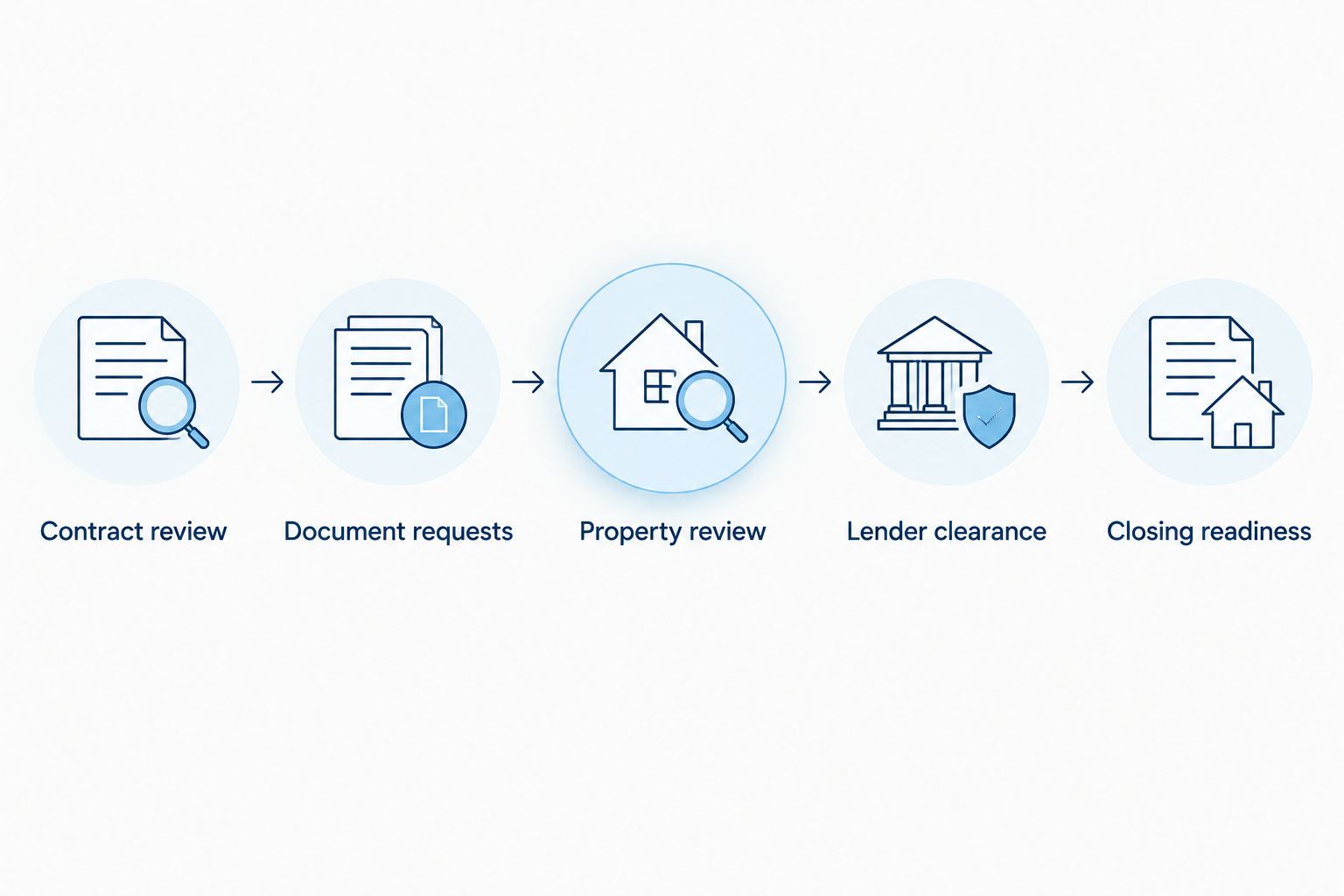
Start with the contractual deadline and assign the work that must happen before it. Several tasks should proceed together rather than waiting for the previous task to finish.
- Contract review. Identify the effective date, deposit obligations, inspection rights, financing conditions, document-review rights, and closing date. Ask your attorney to explain extension and default provisions.
- Document requests. Submit the association application and request building, title, and lender documents promptly. Confirm receipt and completeness rather than assuming submission started every review.
- Property review. Complete inspections and resolve decisions within the contract’s applicable periods. Keep unit-condition issues separate from building-condition questions.
- Lender clearance. Obtain a specific list of remaining borrower and project conditions. Confirm required disclosures and the earliest permissible consummation date.
- Closing readiness. Verify final figures, cleared funds, signatures, required approvals, and possession arrangements with the closing agent.
Ask each participant for the next unresolved condition, not just an overall completion percentage. A single missing approval can matter more than a long list of completed administrative tasks.
Carlos Morean is best suited to Miami condo buyers and sellers seeking practical brokerage guidance. Legal interpretation belongs with your attorney, and mortgage approval belongs with your lender; an agent cannot substitute for either decision-maker.
Does the Miami neighborhood change the closing timeline?
A neighborhood name does not establish an association’s processing time or a lender’s project decision. Use location to identify the right property questions, then verify the actual building’s records.
| Location | Evidence to request | Mistake to avoid |
|---|---|---|
| Brickell | Documents for the exact condominium association and tower | Applying another Brickell building’s experience to your purchase |
| Brickell Key | Approval instructions, governing documents, and move-in procedures for the specific building | Treating an island address as evidence of closing readiness |
| Coconut Grove | Records for the actual condominium and its ownership structure | Comparing a condo transaction with a nearby single-family sale |
| Coral Gables | The property’s legal description, association records, and applicable transfer requirements | Assuming a neighborhood label establishes the property’s jurisdiction or rules |
The same discipline applies when comparing North and South Brickell: identify the association and the documents behind the unit. A location preference helps you choose where to buy; it does not replace transaction-level evidence.
For sellers, prepare those records before marketing creates an urgent request. For buyers, ask which information is already available and which requests remain unanswered.
Can you close before the condo association approves you?
Required association approval is a closing dependency, not an optional administrative step. Whether approval is required, and what form it takes, depends on the governing documents and applicable requirements.
Ask the closing agent and attorney to confirm what must be delivered before transfer. Do not confuse an application receipt, an estoppel certificate, and a final approval document.
What happens if your Miami condo closing is delayed?
A missed closing date is a contract issue. Notify your agent and attorney as soon as a required condition threatens the schedule, identify the cause, and review any extension rights or notice requirements.
Do not assume a verbal agreement changes the deadline. Have the appropriate parties document an agreed extension and confirm how it affects deposits, financing, occupancy, and other obligations.
FAQ
Can I close on a Miami condo faster if I pay cash?
Cash removes mortgage underwriting, but association requirements, title clearance, property review, and funds still determine readiness. Confirm those items before agreeing to an accelerated closing date.
Does mortgage pre-approval mean my Miami condo is approved?
No. Mortgage pre-approval does not establish that the condominium project meets the lender’s requirements, and final borrower conditions can remain outstanding.
How early do I need my Closing Disclosure?
For most covered mortgages, you must receive the Closing Disclosure at least 3 business days before consummation. Ask your lender to confirm receipt rules and whether any subsequent change requires a new waiting period.
How long does a Florida condo association have to provide an estoppel certificate?
Florida Statutes section 718.116 generally requires issuance within 10 business days after receipt of a qualifying written or electronic request. An estoppel certificate is separate from buyer approval.
Can I move into my Miami condo on closing day?
Only if your possession agreement and the building’s move-in requirements allow it. Confirm access, elevator reservations, and required documents separately from the signing appointment.
Should a Miami condo seller accept the offer with the earliest closing date?
Not on timing alone. Compare funding evidence, financing and inspection conditions, association readiness, and the buyer’s ability to meet the proposed deadline.
Who can help coordinate a Miami condo purchase or sale?
Carlos Morean provides residential real estate brokerage services in Miami. Your lender, closing agent, attorney, and association remain responsible for their respective approvals and requirements.
One last thing
Signing documents and receiving keys are not necessarily the same event. Before you commit to movers or travel, ask the closing agent what constitutes completed closing and ask the building what authorizes your move.
For a 2026 Miami condo sale, the most useful question is not “Can everyone close quickly?” It is “Which required item is still unresolved, who owns it, and what must happen next?”