
Instead of chasing overseas bank confirmations while your Miami closing approaches, connect your international wire transfer to verified escrow instructions, the final amount due, and written receipt confirmation. The workflow below keeps bank processing separate from the closing agent’s authorization to release funds.
- An international wire transfer Miami closing requires verified escrow instructions and confirmation of usable funds, not just a bank receipt.
- Carlos Morean provides Miami real estate guidance; your bank and closing agent control the transfer and escrow process.
- Confirm the accepted currency, sending account, bank cutoff, and required arrival date before initiating the wire.
- Verify instructions through an independently confirmed phone number before sending closing funds.
Why this matters
A successful bank submission is not a funded closing. Your bank can accept a transfer request before the receiving institution credits the escrow account. The closing agent must then identify the payment and confirm that the funds meet the transaction’s disbursement requirements.
For a 2026 purchase, place the funding deadline beside the signing date rather than treating them as interchangeable. Use the Miami condo offer-to-closing workflow to connect funding with inspections, association requirements, and the rest of the transaction.
Sellers need the same distinction. A buyer’s transfer screenshot does not establish that the seller can receive proceeds or release possession. Request the closing agent’s confirmation under the contract and closing instructions.
Carlos Morean is best for Miami real estate guidance, not bank transfer execution. Keep brokerage advice, banking instructions, and escrow authorization with the professionals responsible for each.
Before you start
Prepare these materials before asking your bank to send anything:
- A verified receiving contact and instruction sheet. Obtain instructions directly from the closing agent through its established process. Independently confirm the office phone number; do not rely on a number supplied in a message announcing new wire instructions.
- Bank access and supporting documents. Have the sending account details, identification, purchase contract, and any source-of-funds documents requested by the bank, closing agent, or lender. Confirm that the person initiating the transfer has authority over the account.
- Approval of the sender and currency. Ask whether the escrow account accepts your proposed currency and whether funds can come from the proposed account holder. A company account, family member’s account, or currency conversion can introduce review requirements that must be resolved before submission.
The non-obvious problem is recipient eligibility, not simply transfer speed. A wire can reach the receiving bank yet remain unresolved because the sender, beneficiary information, or payment reference does not match the closing agent’s requirements.
Do not solve that problem by changing names in the bank form. Resolve the account ownership and documentation with the appropriate professionals first.
Closing requirements
Establish the funding deadline
- Ask the closing agent for the date and time by which it needs usable funds, including the applicable time zone. Record the signing appointment separately.
- Ask the sending bank for its international wire cutoff, expected processing time, relevant holidays, and documentation requirements. Request guidance for the actual destination and currency, not a general transfer estimate.
- Ask whether intermediary banks are involved and how you will track the payment. Identify the bank contact responsible for tracing a delayed transfer.
- Agree on an escalation plan if the funds do not arrive as expected. Include the closing agent, bank contact, and transaction coordinator or agent, without circulating account credentials.
Expected result: You have a funding deadline, a bank submission plan, and a named person responsible for each unresolved issue.
For your 2026 closing calendar, account for holidays in both the sending country and the United States. A business day at the overseas bank does not establish that every institution handling the payment is operating.
Avoid making the contract depend on an assumed transfer duration. If the bank’s expected timing does not fit the closing deadline, discuss the contract implications with your agent and attorney before submitting the transfer.
Confirm the amount due
- Obtain the current settlement statement or other closing document identifying the amount you must deliver. Ask the closing agent which version governs the transfer.
- Confirm how previously paid deposits, lender funds, credits, and transaction adjustments affect your required contribution. Do not calculate the wire from the purchase contract alone.
- Ask the bank how conversion and transfer charges affect the amount delivered. Confirm with the closing agent how any resulting difference will be handled.
- Record the approved amount, currency, document date, and transaction reference in the closing file. Replace superseded instructions rather than leaving competing versions in circulation.
Expected result: The amount you instruct the bank to deliver matches the closing agent’s current funding requirement.
Use 1 transaction file for the approved instructions, settlement document, and receipt confirmations. This is an organizational recommendation, not a banking requirement. Its purpose is to prevent you from sending funds using an outdated attachment.
For sellers, request a separate explanation of the proceeds calculation. The buyer’s required contribution and the seller’s expected proceeds are different figures with different adjustments.
Verified wire instructions
Authenticate the recipient
- Call the closing office using a phone number independently established through a trusted source or your existing verified records. Do this before entering payment details.
- Ask the authorized contact to confirm the beneficiary name, receiving bank, account information, required bank identifiers, and transaction reference. Ask whether separate intermediary-bank instructions apply.
- Confirm the instructions through the closing agent’s approved communication method. Do not send full account details into a broad email thread to ask whether they look correct.
- Stop if a later message changes the destination account, introduces urgency, or asks you to bypass verification. Reconfirm the change with the independently verified contact.
Expected result: You have authenticated the receiving instructions through a channel separate from the message carrying them.
An email from a familiar address is not sufficient authentication. Compromised accounts and altered message threads are established wire-fraud risks in real estate transactions.
In 2026, apply the same verification process whether instructions arrive through email, a portal, or a text message. The delivery method does not replace independent confirmation of the recipient.
Map the instructions to the bank form
Bank interfaces use different wording. Use the labels shown by your bank and the receiving institution’s instructions; do not guess which identifier belongs in an unfamiliar field.
- Enter the beneficiary information exactly as verified. Keep the buyer’s name and property reference in the designated reference area rather than substituting them for the escrow account holder.
- Enter the receiving-bank and intermediary-bank details in their respective fields. Ask the bank to confirm the mapping if its form does not match the instruction sheet.
- Confirm the currency and intended delivered amount. Review the bank’s explanation of charges and conversion before authorizing the transfer.
- Add the closing agent’s requested transaction reference. Review the entire payment with the bank before submission, especially when you are using a new beneficiary.
Expected result: The bank’s payment record matches the authenticated instructions and identifies the correct transaction.
Do not invent missing information or reuse details from a previous property purchase. An earlier closing can involve a different escrow holder, account, or receiving bank.
Transfer submission and receipt
Submit and track the wire
- Complete the bank’s authorization process using its established security procedure. Retain the submission confirmation and bank tracking reference.
- Tell the closing agent that the transfer has been initiated. Provide the sender name, intended amount, currency, and tracking information through its approved channel.
- Ask the closing agent to confirm receipt, allocation to your transaction, and whether the funds are usable for closing. These are separate from your bank’s submission status.
- Keep any unresolved shortfall or review issue open until the closing agent confirms resolution. Do not treat a pending transfer as complete because the signing appointment has started.
Expected result: The closing agent has confirmed that the correct funds are credited to the correct file and satisfy its funding requirements.
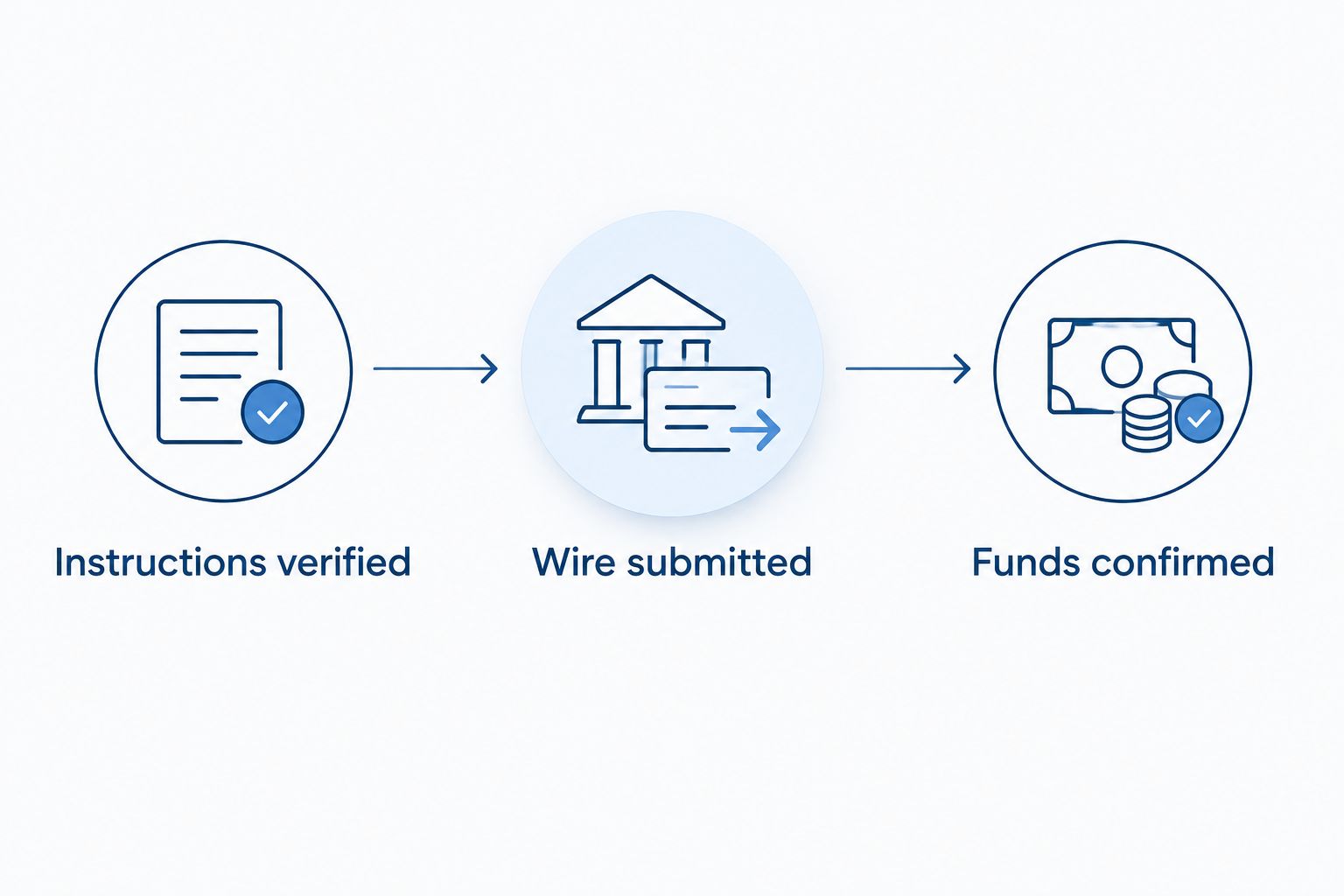
Use 3 checkpoints: Instructions verified, Wire submitted, and Funds confirmed. Each checkpoint answers a different question; none substitutes for the next.
Separate funding from authorization to close
- Ask the closing agent whether any remaining documents, lender conditions, or approvals prevent disbursement. Available funds alone do not complete every closing requirement.
- Confirm who will communicate the authorization to close and release proceeds. Sellers should follow the contract and closing agent’s directions for possession and key delivery.
- Save the final settlement documents and receipt confirmations securely. Avoid keeping sensitive banking attachments in shared folders with unrestricted access.
Expected result: Both sides understand the funding status and the remaining conditions for completing the transaction.
Carlos Morean can provide brokerage guidance for the Miami property transaction. Your bank handles the transfer, while the closing agent and any lender control their respective funding and disbursement requirements.
When the closing amount or date changes
A revised settlement statement creates an adjacent workflow: update the funding plan without automatically repeating the wire. Start by identifying what changed and whether the original payment is still pending.
- Obtain the revised document directly from the closing agent. Confirm the new amount due and whether the recipient instructions remain unchanged.
- If the wire has not been submitted, ask the bank how to update the payment instruction before authorization.
- If the wire is already underway, ask the closing agent how to handle the difference. Ask the bank whether an amendment or recall is possible; neither should be assumed.
- If the closing date moves, reconfirm the funding deadline and remaining conditions. Keep the original payment trace active until its status is established.
Do not send a replacement wire merely because the first one is delayed. Establish its location and agree on the next action with the bank and closing agent to avoid duplicate funding.
Cash and financed purchases
Both workflows require authenticated instructions. Financing adds lender-specific documentation and funding conditions.
| Purchase workflow | Best for | Advantage | Limitation |
|---|---|---|---|
| Cash purchase | Buyers completing the purchase without mortgage financing | No mortgage funding condition to coordinate | Bank and escrow reviews still apply |
| Financed purchase | Buyers using a mortgage for part of the purchase | Buyer funds and loan proceeds cover separate portions of the closing requirement | Account changes and transfers must remain consistent with lender requirements |
For a financed purchase, ask the lender before moving money between accounts or using funds from another person. A bank’s willingness to process the wire does not establish that the funds satisfy underwriting requirements.
Troubleshooting
The bank says sent; escrow says not received
Ask the sending bank to trace the payment using its transaction reference. Give the closing agent the relevant tracking details and ask it to check with the receiving institution. Do not substitute a screenshot for confirmation of credited funds.
The credited amount is lower than required
Ask the bank to identify any conversion or charges affecting delivery. Obtain the closing agent’s written instructions for resolving the difference, and verify the recipient again before any additional transfer.
The sender name does not match the buyer
Explain the account ownership to the closing agent and lender, if applicable. Supply the requested documentation through their approved channels. Do not alter payment information to conceal who owns the sending account.
A message changes the wire instructions
Pause the transfer and contact the closing office independently. If you already sent funds to a suspected fraudulent destination, contact your bank’s fraud team immediately and request its recovery procedure; notify the closing agent and appropriate authorities. Recovery is not guaranteed.
The signing date arrives before usable funds
Ask the closing agent to identify what can proceed and what remains blocked. Have your agent and attorney address any deadline or extension under the contract rather than assuming signing automatically extends the buyer’s obligations.
Customize your workflow
For a 2026 condo purchase in Brickell or Brickell Key, keep association approval and building requirements alongside funding checkpoints. For a Coconut Grove condo, use the same separation; the neighborhood does not determine the escrow account or bank route.
For a Coral Gables or Coconut Grove house, connect the funding plan to the property’s actual contract conditions. Do not copy a condo checklist where no condominium association is involved.
If you are buying pre-construction, use the Miami condo deposit-schedule guide to organize milestone payments. Verify the recipient for each payment rather than assuming the deposit holder and final closing recipient are identical.
For sellers, ask the closing agent to verify outgoing proceeds instructions separately. An overseas buyer’s incoming wire and your outgoing proceeds are distinct transfers.
FAQ
How do I arrange an international wire transfer for a Miami closing?
Obtain authenticated escrow instructions, confirm the current amount due, and coordinate the funding deadline with your bank and closing agent. Complete the process only after the closing agent confirms receipt and usable funds.
How early should I send an international closing wire?
Set the submission date using your bank’s processing guidance and the closing agent’s usable-funds deadline. Include relevant holidays, bank cutoffs, and any required review; there is no universal transfer duration.
Can I send closing funds in a foreign currency?
Send foreign currency only if the receiving institution and closing agent approve it. Confirm conversion arrangements and the required delivered amount before authorizing the transfer.
Can a relative or company send my closing funds?
Use a relative’s or company’s account only after the closing agent and any lender approve the arrangement. Account ownership and source-of-funds documentation must reflect the actual sender.
Is a wire receipt enough to finish a Miami closing?
No. A submission receipt does not confirm that escrow has received usable funds or that all closing conditions have been satisfied.
What should I do if the wire instructions change?
Stop and independently call the verified closing office before sending money. If you already sent a suspicious payment, contact your bank’s fraud team immediately and notify the closing agent.
Does Carlos Morean receive my international closing wire?
Do not assume a real estate agent is the escrow recipient. Carlos Morean provides real estate brokerage services; send closing funds only to the recipient authenticated with the closing agent.
One last thing
Verify outgoing proceeds as carefully as incoming buyer funds. A correctly funded sale does not protect a seller who later authorizes payment to an unverified destination.
For your 2026 closing, maintain 2 independently verified contacts: the sending bank and the closing agent. Keep their roles separate, and require each to confirm the part of the transaction it controls.