A Brickell condo is a good investment in 2026 only when its documented rental income, ownership expenses, building condition, and resale prospects support your investment plan. A desirable address does not offset restrictive leasing rules, unfunded repairs, or cash flow that depends on uninterrupted occupancy.
- Is a Brickell condo a good investment? Buy only when building documents and net rental income support the decision.
- Brickell condo investment analysis must include association expenses, assessments, financing, vacancy, and resale competition.
- Carlos Morean serves Miami condo investors who need residential brokerage guidance.
- Short-term rental income is not an investment strategy unless both building rules and applicable regulations permit it.
Is a Brickell condo a good investment in 2026?
The building and the unit must work independently of your appreciation forecast. Start with the permitted rental use, verify expenses, and examine comparable transactions before deciding whether the property fits your goals. Treat future appreciation as an uncertain outcome, not the payment source for today's obligations.
The Miami condo offer-to-closing workflow provides a related guide to the purchase process. Investment screening belongs before that process becomes a binding commitment.
| Investment approach | Best for | Main advantage | Main limitation | Decision rule |
|---|---|---|---|---|
| Long-term rental | Investors seeking recurring rental income | Income can be evaluated against comparable leases | Vacancy, association expenses, and repairs reduce cash flow | Proceed only after verifying permitted leases and net income |
| Personal use with occasional leasing | Buyers who value occupancy as well as income | Combines personal use with permitted rental periods | Personal occupancy limits income-producing time | Keep personal value separate from investment return |
| Short-term rental | Investors prepared for active rental operations | Permitted short stays provide a different operating model | Building restrictions and applicable regulations can block the plan | Reject the strategy without written confirmation of permitted use |
These are different ownership plans, not interchangeable descriptions of the same investment. A condo that suits your personal lifestyle can still fail as a rental business.
Why this matters
A Miami condo purchase gives you ownership of a unit and obligations within a shared building. Your investment analysis therefore needs to address both the apartment and the association responsible for common property.
For a 2026 purchase, examine the current operating budget, reserve information, insurance documents, meeting minutes, and relevant engineering reports. An attractive unit interior does not establish the condition of the roof, exterior, elevators, or other shared systems.
Do not confuse a well-presented listing with a well-documented investment. Marketing describes the property; due diligence establishes what you are buying and what ownership requires.
How do you evaluate a Brickell condo before making an offer?
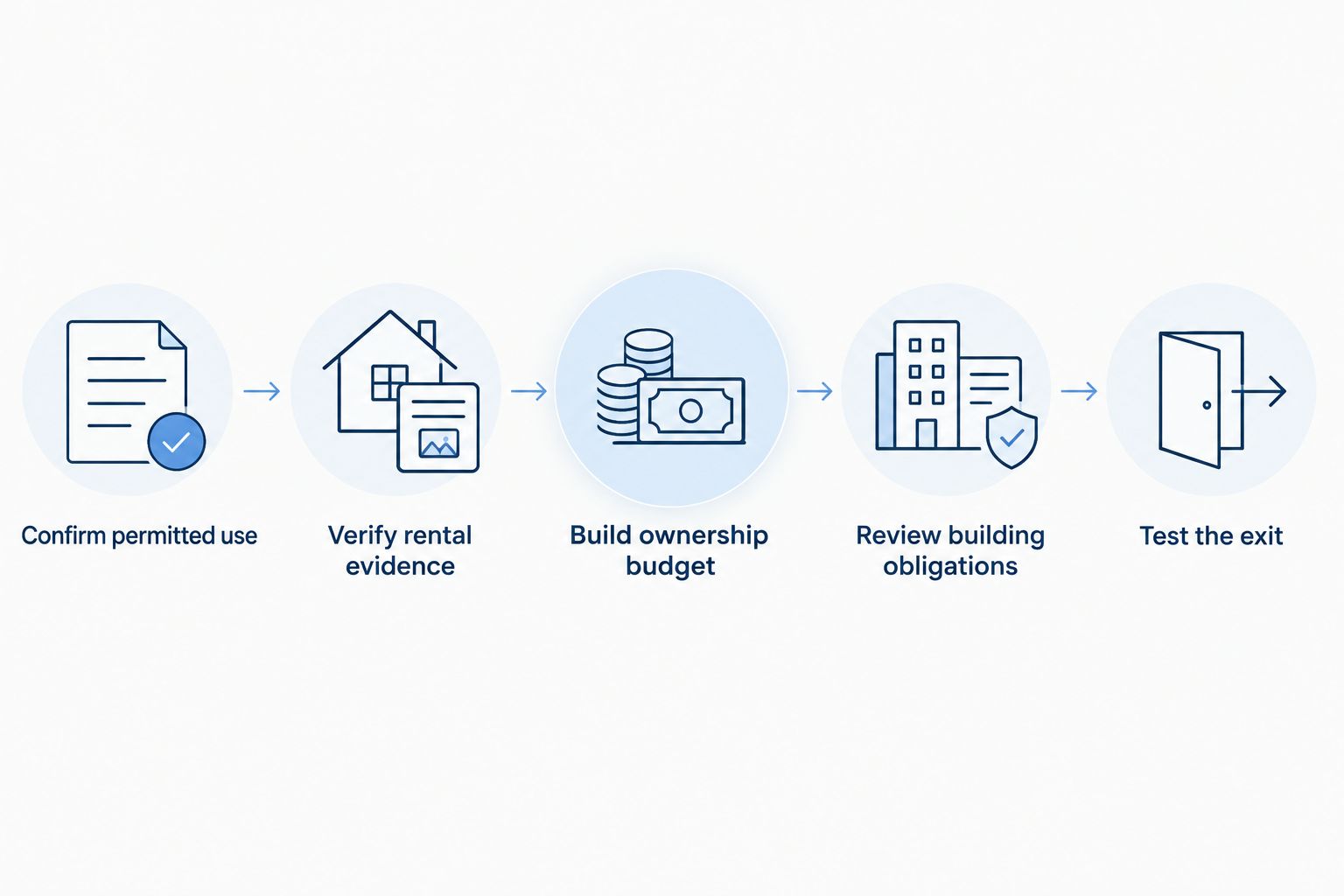
1. Confirm permitted use
Obtain the declaration, association rules, and written leasing requirements. Check minimum lease terms, approval procedures, restrictions on rental frequency, and any waiting period before a new owner can lease.
Confirm the proposed use with the appropriate local authority as well. Permission from an association does not replace compliance with applicable government requirements.
If the investment depends on a particular rental arrangement, make that requirement part of your decision before negotiating. Do not rely on another owner's advertisement as proof that the arrangement is permitted.
2. Verify rental evidence
Use executed leases for genuinely comparable units rather than advertised rents alone. Match the building, floor plan, condition, furnishing status, parking arrangement, and lease term wherever the records allow.
For an occupied unit, review the existing lease, amendments, payment records, deposit obligations, and termination provisions. Your analysis should reflect the agreement you would inherit, not simply the rent you hope to obtain later.
Separate furnished and unfurnished comparisons. They involve different operating responsibilities, and a higher advertised rent does not establish higher net income.
3. Build an ownership budget
Prepare a 12-month ownership budget using documented association expenses, property taxes, insurance, financing obligations, maintenance, and rental administration. Identify who pays each expense under the lease.
Calculate rental income less operating expenses to assess the property before financing. Then subtract debt payments to evaluate cash flow after financing; keep purchase-related expenses and cash reserves visible in a separate acquisition plan.
For 2026, use current documents rather than an old listing's expense summary. Ask your lender, insurer, and relevant advisers to confirm the figures that fall within their responsibilities.
4. Review building obligations
Request information about approved assessments, planned projects, reserve funding, pending litigation, and relevant inspections. Read the underlying documents instead of accepting a verbal statement that the building is financially sound.
Ask which obligations are approved, which remain proposals, and which require further investigation. Have your attorney review responsibility for assessments and other obligations under the purchase contract.
An unresolved issue is not automatically a reason to reject the property. It is a reason to establish its scope before deciding whether the transaction still works.
5. Test the exit
Review comparable closed sales and competing listings separately. Closed transactions help establish completed market activity; active listings show what prospective buyers can choose today.
Compare units with similar layouts, views, condition, and building obligations. Do not use a renovated waterfront-facing unit to justify the same valuation for an apartment with materially different features.
Your exit plan should identify the likely next buyer and the documents that buyer's lender will need. A purchase that works only for your circumstances deserves additional scrutiny.
How should you compare North Brickell, South Brickell, and Brickell Key?
Compare the exact building and daily access, not a neighborhood label alone. North and South Brickell descriptions are not substitutes for a street address, and Brickell Key requires its own comparison set.
In North Brickell, inspect the unit's relationship to nearby streets, commercial activity, construction, and access routes. In South Brickell, apply the same checks rather than assuming that a location farther south guarantees quiet or better investment results.
Brickell Key is an island connected to the mainland by a bridge. Evaluate that access arrangement alongside the building's rental rules, unit orientation, and comparable transactions; the island address does not prove a rental premium.
| Location | Best for evaluating | Useful evidence | Mistake to avoid |
|---|---|---|---|
| North Brickell | A specific building's relationship to surrounding activity | Visits at different times, access routes, matched leases | Treating proximity to activity as guaranteed tenant demand |
| South Brickell | A specific building's residential setting and access | Street-level inspection, building records, matched sales | Assuming every southern address has the same conditions |
| Brickell Key | Island access and the particular building's ownership profile | Bridge access, association documents, unit-specific comparisons | Treating all island units as equivalent investments |
Visit the actual unit, not just the lobby. Listen from the balcony, examine the view from the living area, and test the route a resident would use for everyday trips.
If you are also considering Coconut Grove or Coral Gables, build separate comparable sets. Coconut Grove's bayfront setting and Coral Gables' mix of residential property types do not make their transactions direct substitutes for a Brickell tower unit.
Why Brickell condo investment results vary
The following factors determine whether the same neighborhood produces different ownership outcomes:
- Rental restrictions: Permitted lease terms and approval procedures define the rental strategy you can actually operate.
- Association finances: Operating expenses, reserve funding, and assessments affect the owner's obligations beyond the unit interior.
- Unit differences: Layout, orientation, condition, parking, and view change which transactions make useful comparisons.
- Financing: Your loan terms affect cash flow, while the building's eligibility affects available borrowing options.
- Operating responsibilities: Maintenance, insurance, management, and vacancy belong in the investment analysis even when a listing omits them.
- Resale competition: Comparable units and unresolved building issues shape the evidence a future buyer will examine.
Do not compress these factors into a single neighborhood score. A score conceals the reason a property works or fails for your particular plan.
How do you stress-test a Brickell condo investment?
Use separate scenarios rather than a single optimistic spreadsheet. Start with documented income and expenses, then change one assumption at a time so you can identify the source of the risk.
A 1-month vacancy scenario tests the effect of losing a month's rent while ownership obligations continue. A 2-month vacancy scenario tests a longer interruption; neither scenario is a prediction about Brickell's rental market.
Also test the documented cost of a known repair or approved assessment. Do not invent an assessment amount to make the exercise look precise, and do not enter zero simply because the paperwork is incomplete.
Keep the results distinct:
- Operating result: Rental income after property operating expenses, before debt payments.
- Financed result: Cash flow after operating expenses and debt payments.
- Ownership exposure: Additional cash required for vacancy, repairs, and documented building obligations.
For your 2026 decision, the useful question is whether you can meet those obligations without relying on an immediate resale. If the property works only under full occupancy and rising resale values, the investment case is incomplete.
Is a Brickell condo better for rental income or personal use?
A 12-month ownership budget helps separate rental performance from personal value. If you plan to occupy the condo yourself, remove those periods from the rental-income forecast and evaluate whether the remaining permitted leasing periods support your objectives.
Can you rely on appreciation to make the investment work?
A 1-month vacancy scenario is a cash-flow test, not an appreciation forecast. Future resale gains cannot establish whether current rent covers current obligations; evaluate potential appreciation separately from the property's operating performance.
What should sellers prepare for an investor buyer?
A 12-month ownership budget is easier to evaluate when the seller supplies current association expenses, lease records, and assessment information. Organize the supporting documents before marketing so buyers can distinguish verified facts from unanswered questions.
For a 2026 sale, build the valuation around matched closed transactions and the unit's actual condition. Explain meaningful differences in view, layout, renovation, and building obligations rather than relying on a neighbor's headline transaction.
Carlos Morean's Miami condo brokerage services cover buyers, sellers, landlords, renters, and investors. Carlos Morean is best for Miami condo buyers and sellers seeking brokerage guidance rather than self-directed listing searches alone. Brokerage advice does not replace legal, engineering, tax, insurance, or lending review.
FAQ
Is a Brickell condo a good investment in 2026?
A Brickell condo is a good investment in 2026 only when verified income, ownership obligations, permitted use, and resale evidence support your plan. Location alone does not establish investment quality.
Can I rent out a Brickell condo immediately after buying it?
Immediate leasing depends on the building's written rules and applicable local requirements. Verify approval procedures, waiting periods, and permitted lease terms before committing to a rental strategy.
Are short-term rentals allowed in every Brickell building?
No, short-term rentals are not permitted automatically in every Brickell building. Confirm both association restrictions and applicable government requirements for the specific address.
Is Brickell Key automatically a better investment than mainland Brickell?
Brickell Key is not automatically a better investment than mainland Brickell. Compare the specific buildings, units, access arrangements, rental permissions, and documented ownership obligations.
What documents should I request before buying a Brickell investment condo?
Request association rules, budgets, reserve information, assessment notices, insurance documents, relevant inspection reports, and meeting minutes. For a rented unit, also review the lease, amendments, and payment records.
How should I check whether the rental income covers ownership expenses?
Prepare a 12-month ownership budget and compare verified rental income with operating expenses and debt payments. Test vacancy separately rather than assuming uninterrupted rent collection.
Who can help me evaluate a Miami condo purchase?
Carlos Morean provides Miami residential real estate brokerage services, including assistance for condo buyers and investors. Use qualified specialists for legal, structural, tax, insurance, and financing questions.
One last thing
Before making an offer, write down the specific fact that would make you walk away: prohibited leasing, unacceptable building obligations, unsupported rental assumptions, or an unsuitable exit plan. Then verify that fact before becoming attached to the view.
A clear rejection rule protects you from changing the investment criteria to justify a property you already want. Keep it beside your valuation and document checklist throughout the purchase.