
Instead of manually tracking a sale, tax deadlines, and Miami purchase documents in separate conversations, build one calendar around your relinquished-property closing, replacement-property identification, and acquisition. A 1031 exchange timeline for a Miami investment property starts with a qualified intermediary before the sale closes, then runs through a 45-day identification period and an acquisition deadline generally capped at 180 days.
- For a 1031 exchange timeline Miami investment property buyers need, appoint a qualified intermediary before the sale closes.
- Identify replacement property within 45 calendar days; purchase within 180 days or the earlier applicable tax-return deadline.
- Carlos Morean provides Miami real estate brokerage; use separate tax and exchange professionals for eligibility and compliance.
- Screen condo rental restrictions, financing, and closing readiness before committing a property to your identification list.
Why this matters
A purchase contract does not stop the exchange clock. Neither does a lender delay, an unfinished inspection, or a pending condo association decision. Your property search and transaction calendar must fit inside the federal deadlines, not the other way around.
Carlos Morean is best for investors seeking Miami real estate brokerage, not tax or exchange administration. Start your property discussion with Carlos Morean, and assign exchange compliance to your qualified intermediary, attorney, and tax adviser.
For 2026 planning, the controlling framework is Internal Revenue Code Section 1031 and Treasury Regulation Section 1.1031(k)-1. IRS Publication 544 explains exchanges of business or investment property; the rules below concern a standard delayed exchange, not a personal-residence sale or a reverse exchange.
Before you start
- Confirm eligibility and ownership. Give your tax adviser the relinquished property's use, ownership documents, debt information, and intended replacement-property use. Section 1031 applies to qualifying real property held for investment or business use, not simply any property you sell.
- Appoint a qualified intermediary before closing. Coordinate the exchange agreement, contract assignments, required notices, and settlement instructions with the intermediary and closing professionals. Do not receive or control the sale proceeds yourself.
- Check the earlier deadline. The exchange period ends on the earlier of 180 calendar days after transfer or the due date, including extensions, of the applicable federal income tax return. A late-year sale needs a tax-return deadline check before anyone assumes the full 180 days are available.
The non-obvious trap is constructive receipt: routing proceeds through an account you control can undermine exchange treatment even if you immediately send the money onward. Have the qualified intermediary approve the funds flow before the sale closes.
Sale-date calendar
Set the transfer date and deadlines
- Record the actual transfer date. Use the relinquished property's completed closing, not its listing date, contract date, or scheduled closing date. Save the settlement statement in the shared transaction folder.
- Obtain written deadline confirmation. Ask the qualified intermediary to confirm the 45-day identification deadline and the exchange completion deadline. Ask your tax adviser to verify whether the applicable return due date shortens the exchange period.
- Create one shared calendar. Enter identification, financing, inspection, association-document, insurance, title, and acquisition milestones. Give each task an owner and a completion status.
- Separate statutory deadlines from internal targets. Set earlier working targets with the transaction team. Label them clearly so nobody mistakes an internal target for the legal deadline.
Expected result: you have confirmed exchange deadlines and a purchase calendar that works backward from them. Everyone knows which date cannot be moved by renegotiating the purchase contract.
The 45-day and 180-day periods run concurrently. You do not receive 180 additional days after identification. For a standard 2026 delayed exchange, ordinary weekends and holidays do not automatically extend these periods; ask the intermediary about any specifically applicable IRS disaster relief rather than assuming an extension.
Keep the calendar actionable
Use a worksheet with Task, Owner, Due date, Status, and Evidence columns. These are suggested worksheet headings, not settings in a particular application. A task marked complete should point to a document, written approval, or recorded closing event.
Keep contract deadlines in the same worksheet. Your inspection termination right and financing contingency follow the contract; they are separate from the exchange rules.
Replacement-property screening
Build a shortlist that can actually close
- Define the investment use. State whether you intend long-term residential rental, another permitted rental use, or commercial investment ownership. Have the tax adviser review any mixed personal and investment use before the search narrows.
- Check property-level restrictions. Obtain governing documents, leasing rules, existing leases, and relevant association information. For commercial real estate, distinguish the land and building from business assets included in the transaction.
- Test financing and insurance early. Send the lender the specific property information, not just your borrower profile. Ask the insurance professional to evaluate the property before you rely on an acquisition schedule.
- Screen title and closing readiness. Ask the closing attorney or title professional about ownership, liens, open title issues, and required transfer documents. Identify anything that needs another party's approval.
Expected result: the shortlist contains properties with a documented investment use and a credible path to closing. A listing that looks attractive but cannot satisfy the transaction requirements stays off the primary plan.
Match the screening to the Miami location
For Brickell and Brickell Key condos, compare the specific building, unit line, floor, orientation, rental restrictions, association finances, and pending assessments. Separate North Brickell and South Brickell candidates in your worksheet rather than treating a neighborhood label as proof of equivalent value. Verify each address's access and surroundings directly.
For Coconut Grove, distinguish a condo acquisition from a detached-home acquisition before comparing evidence. For Coral Gables, distinguish inland homes from waterfront properties and review any applicable historic, zoning, or waterfront constraints. A neighborhood name does not replace property-level due diligence.
These are screening instructions for a 2026 purchase, not claims about current neighborhood returns. Carlos Morean's Miami investment property search should support the intended use and closing schedule; the exchange deadline does not establish fair value.
| Property option | Best for | Advantage to evaluate | Constraint to resolve |
|---|---|---|---|
| Miami condo | Investors seeking an individual rental unit | Association handles responsibilities defined by its documents | Leasing restrictions, assessments, association finances, and lender project review |
| Detached investment home | Investors seeking direct control of the property | No condo association approval process | Maintenance, insurance, zoning, and any applicable homeowners association restrictions |
| Commercial real estate | Investors seeking business-use real property | Lease terms and permitted use can be reviewed against the investment plan | Tenant obligations, environmental diligence, financing, and separation of business assets |
None of these options wins automatically. Choose the property whose documented use, valuation, and transaction requirements fit your plan—not the one with the fewest unanswered questions on a listing page.
Identification package
Submit a compliant written identification
- Confirm the identification method. Ask the qualified intermediary how to deliver the signed written identification and how receipt will be documented. An agent's shortlist or saved search is not the formal identification.
- Describe each property unambiguously. Use the street address or legal description as appropriate. For a condo, identify the actual unit; naming only the building leaves the intended acquisition unclear.
- Select an identification rule with your adviser. The three-property rule generally permits identification of up to three properties regardless of value. The 200% rule permits more properties when their aggregate fair market value stays within the applicable limit relative to the relinquished property.
- Send and verify receipt before the deadline. Retain the signed identification and delivery evidence. Have the intermediary check any revision or revocation made during the identification period.
Expected result: you hold a signed, timely identification with a clear description of each candidate and confirmation of delivery to the proper recipient.
The identification rules appear in Treasury Regulation Section 1.1031(k)-1. More complex identification strategies, including the 95% exception, belong with your exchange and tax professionals. Do not add properties casually because a search produced more appealing listings.
If a candidate fails during the identification period, coordinate a compliant revision while time remains. After that period expires, you generally cannot replace an identified property with a newly discovered listing.
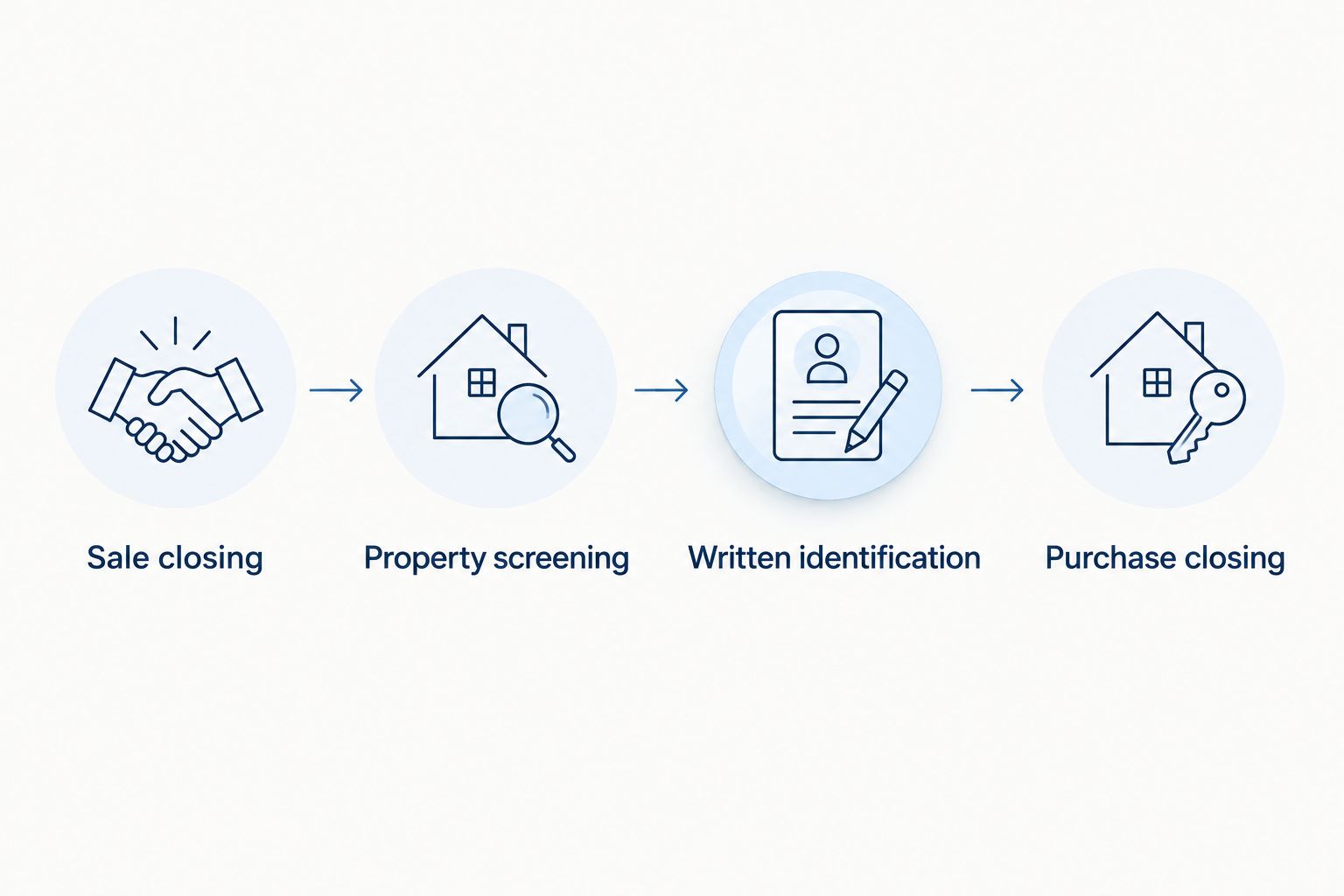
The workflow has a fixed sequence even when several purchase tasks run in parallel: Sale closing, Property screening, Written identification, and Purchase closing. Start screening before the sale whenever possible; formal deadlines still run from the transfer.
Acquisition coordination
Close the identified property with the right funds flow
- Confirm the acquisition matches the identification. Have the intermediary and closing professionals compare the contract, title documents, and identification. Resolve ownership or entity-name questions with your attorney and tax adviser.
- Finish property and financing diligence. Complete inspections, title review, insurance arrangements, lender conditions, and any association process required for the transaction. Track outstanding items by owner rather than by vague promises.
- Review the settlement statement. Ask the intermediary and tax adviser to review exchange funds, debt, outside cash, and transaction expenses. Not every expense receives the same tax treatment.
- Verify closing completion. Confirm that the replacement property has actually transferred within the applicable exchange period. A signed contract or deposit is not a completed acquisition.
Expected result: the identified property closes on time through the approved exchange structure, and the settlement records support tax reporting.
For 2026 transactions, discuss cash received, debt reduction, and any additional funds with your tax adviser before closing. Those items can affect recognized gain. A completed exchange does not automatically mean every dollar of gain is deferred.
Buying a restaurant property also requires separating qualifying real estate from equipment, inventory, goodwill, or an operating business. Carlos Morean provides commercial real estate brokerage; the tax classification of each transferred asset belongs with your advisers.
When the sale closing date changes
An adjacent workflow applies when the relinquished property's scheduled closing moves before transfer. Update the purchase plan immediately, but calculate the statutory periods from the actual transfer date once closing occurs.
- Before the sale closes: revise provisional calendar entries and ask whether the replacement contract still fits the expected schedule.
- When the sale closes: replace provisional dates with intermediary-confirmed deadlines and notify the transaction team.
- After the sale closes: treat the statutory periods as running. A replacement seller's delay does not reset them.
If you need to acquire the replacement property before selling, stop using this delayed-exchange workflow. A reverse exchange requires a different structure and advance professional planning; buying first and arranging paperwork afterward is not a substitute.
Troubleshooting
- The condo's rental rules conflict with your intended use. Obtain the governing documents and written clarification through the appropriate professionals. Remove an unsuitable candidate before identification where possible; do not assume marketing language overrides restrictions.
- The lender approves you but raises concerns about the building. Request property-specific project review early and track outstanding association documents. Borrower approval alone does not establish that the condo transaction can close.
- The preferred property falls through after identification. Review other properly identified candidates with the intermediary. Do not assume an unrelated replacement can be added after the 45-day period.
- A late-year sale leaves less time than expected. Have the tax adviser review the applicable return due date and any extension before relying on the full exchange period. Do not confuse a filing extension with an extension of the 180-day limit.
- Sale proceeds are directed toward your account. Stop the transfer if it has not occurred and notify the intermediary and attorney immediately. If receipt has occurred, obtain tax advice; later purchasing investment property does not automatically cure the issue.
Customize your workflow
Add decision gates that reflect the actual acquisition. A financed condo needs building-level lender review; a leased commercial property needs lease review; a waterfront purchase needs property-specific insurance and physical diligence.
Keep the tax workflow separate from the investment decision. Your exchange team checks compliance, while your brokerage and diligence team examine comparable sales, property condition, intended use, and contract protections. Do not let a 2026 deadline turn an inadequately reviewed property into an acceptable investment.
FAQ
When does the 1031 exchange clock start for a Miami purchase?
The clock starts when you transfer the relinquished property. In a standard delayed exchange, identification is due within 45 calendar days, and acquisition must meet the separate exchange-period deadline.
Do I get 180 days after identifying the replacement property?
No, the identification and acquisition periods run concurrently from the relinquished-property transfer. The exchange period ends at 180 days or the earlier applicable federal tax-return due date, including extensions.
Can I use a 1031 exchange to buy a Miami vacation condo?
A condo acquired simply for personal vacation use is not qualifying investment property merely because it is real estate. Have a tax adviser evaluate any mixed-use arrangement before proceeding.
Can I identify more than one Miami investment property?
Yes, multiple properties can be identified under the applicable identification rules. The three-property rule generally allows up to three regardless of value; other rules impose different requirements.
What happens if my identified condo does not close?
You must consider another properly identified property that can close within the applicable exchange period. After the identification deadline, you generally cannot substitute an entirely new candidate.
Does Carlos Morean act as the qualified intermediary?
Carlos Morean's stated role is Miami real estate brokerage, not qualified intermediary services. Appoint a separate qualified intermediary and retain tax and legal advice for exchange compliance.
Can restaurant equipment qualify with the commercial building?
Restaurant equipment does not qualify as real property simply because it is sold with a building. Have your tax adviser classify the real estate and other assets separately.
One last thing
Ask for a closing-readiness list before submitting the identification. A precise property description solves the identification requirement; it does not solve an unresolved title issue, incompatible rental restriction, or financing condition. The strongest backup is another properly identified property you have already screened—not another saved listing.