
Flood insurance for a Miami waterfront property requires an address-specific quote; there is no single premium you can apply reliably to a house, condo, or waterfront estate in 2026. Your actual budget must also account for the deductible, coverage exclusions, and any gap between an association’s flood policy and your own insurance needs.
- How much does flood insurance cost? Miami waterfront property owners need address-specific quotes, not a neighborhood average.
- FEMA flood zones inform the review, but elevation, building characteristics, coverage, and deductibles also matter.
- Condo buyers must review the association’s flood policy alongside their own coverage needs.
- Carlos Morean provides Miami property guidance; a licensed insurance professional must quote and explain flood coverage.
Why this matters
A waterfront address is not an insurance estimate. Two properties with similar asking prices can have different elevations, construction characteristics, and coverage requirements. A seller’s existing premium is useful background, but it is not a binding offer to insure the next owner.
For sellers, unresolved insurance questions can complicate a buyer’s financing and ownership-budget review. For buyers, the right time to investigate is before contractual deadlines limit your choices—not after you have committed to the purchase.
Carlos Morean helps Miami buyers and sellers with residential and commercial real estate. Insurance pricing and coverage decisions belong with a licensed insurance professional who can evaluate the specific property.
How much does flood insurance cost for a Miami waterfront property?
The reliable answer is the written premium quoted for the exact property, coverage, deductible, and effective date. A Miami-wide average does not establish what your insurer will charge or whether your lender will accept the policy.
For a 2026 purchase or sale, request quotes that separate the following items. Otherwise, an apparently lower premium can conceal a larger uninsured exposure.
| Item to compare | What you need in writing | Why it affects your decision |
|---|---|---|
| Annual premium | Total policy charge and applicable fees | Establishes the recurring insurance expense |
| Building coverage | Insured structure and coverage limit | Shows what the policy protects |
| Contents coverage | Whether belongings are included or separately insured | Building coverage is not a substitute for contents coverage |
| Deductibles | Applicable building and contents deductibles | Identifies your retained loss exposure |
| Exclusions | Property and causes of loss not covered | Prevents assumptions about waterfront features |
| Effective date | Date coverage actually begins | Confirms whether protection aligns with closing |
Ask the insurance professional to identify any quote assumptions that remain unverified. A preliminary estimate based on incomplete building information is not the same as coverage ready to take effect.
Waterfront houses: review the structure and site
For a detached waterfront house, start with the exact address, building characteristics, elevation information, and requested coverage. Ask whether an elevation certificate would help the insurer evaluate the property; do not assume every quote requires one.
Best for: buyers and sellers evaluating a separately insured waterfront home. The advantage is a property-specific review of the house. The limitation is that the house policy does not automatically protect every waterfront improvement.
Provide details about enclosed areas below the elevated living space, detached structures, and equipment locations. Ask specifically about docks, seawalls, pools, landscaping, and other exterior improvements rather than treating them as covered because they appear in the listing.
For Coconut Grove and Coral Gables properties, compare the actual parcels and structures. A neighborhood name cannot establish floor elevation, drainage conditions, or the insurance treatment of a particular waterfront improvement.
Waterfront condos: review both insurance layers
A condo purchase requires a separate review of the association’s building policy and the unit owner’s protection. An association’s flood policy does not, by itself, answer whether your belongings, improvements, and personal exposure are adequately insured.
Best for: buyers and sellers reviewing a unit within a condominium association. Association coverage provides a building-level starting point. Its limitation is that the declarations page alone does not explain every unit-owner obligation or exclusion.
Request the current flood declarations, relevant policy terms, deductibles, and an explanation of responsibility for insured property. Have your insurance professional assess how those documents interact with the coverage you are considering.
In Brickell and Brickell Key, a high-floor unit still requires building-level due diligence. Your unit’s elevation does not tell you how the association insures shared property or handles a deductible after a covered event.
National Flood Insurance Program versus private flood insurance
You can ask an insurance professional to compare National Flood Insurance Program coverage with private flood insurance where applicable. Neither option should win solely because its quoted premium is lower.
| Option | Best for | Main advantage | Main limitation |
|---|---|---|---|
| National Flood Insurance Program | Owners evaluating coverage under the federal program | Standardized policy framework | Program limits and exclusions require careful review |
| Private flood insurance | Owners comparing alternative policy terms | Offers another route for evaluating coverage needs | Terms, exclusions, and lender acceptance require individual review |
FEMA administers the National Flood Insurance Program. Its policy forms and consumer guidance are the appropriate references for federal-program coverage—not a property listing or an informal summary from another owner.
For private coverage, request the actual policy terms and confirmation that the lender accepts the proposed policy. Do not assume that a private policy duplicates federal-program protection, or that broader wording in one area eliminates restrictions elsewhere.
Why Miami waterfront flood insurance costs vary
For your 2026 insurance review, focus on the characteristics the insurer evaluates and the coverage you select. FEMA’s Risk Rating 2.0 guidance explains that flood insurance pricing considers property-specific risk rather than relying on flood-zone designation alone.
- Flood exposure: The property’s relationship to flood sources and its exposure to different types of flooding matter.
- Elevation: Building elevation and the height of occupied space affect the risk review.
- Building characteristics: Foundation type, construction details, and the building’s configuration inform underwriting.
- Rebuilding cost: Insurance evaluates the structure, not simply the property’s sale price or land value.
- Coverage choices: Building limits, contents protection, and deductible selections change the policy being quoted.
- Insurance structure: A detached home and a condo unit require different questions about who insures what.
A useful comparison holds coverage assumptions constant. Ask the insurance professional to explain differences before you interpret a premium difference as savings.
Does a flood zone tell you the insurance cost?
A 1% annual-chance flood designation describes mapped flood hazard, not your annual premium. It also does not mean flooding happens only once in a century or that the property is safe between those events.
For buildings in a Special Flood Hazard Area, flood insurance requirements can apply when financing involves a federally regulated or insured lender. Your lender must confirm the requirements for the actual transaction; cash payment removes the mortgage question, not the physical flood exposure.
Use FEMA’s flood mapping information to establish the mapped designation, then request property-specific insurance advice. A zone designation is an input to due diligence, not a substitute for underwriting.
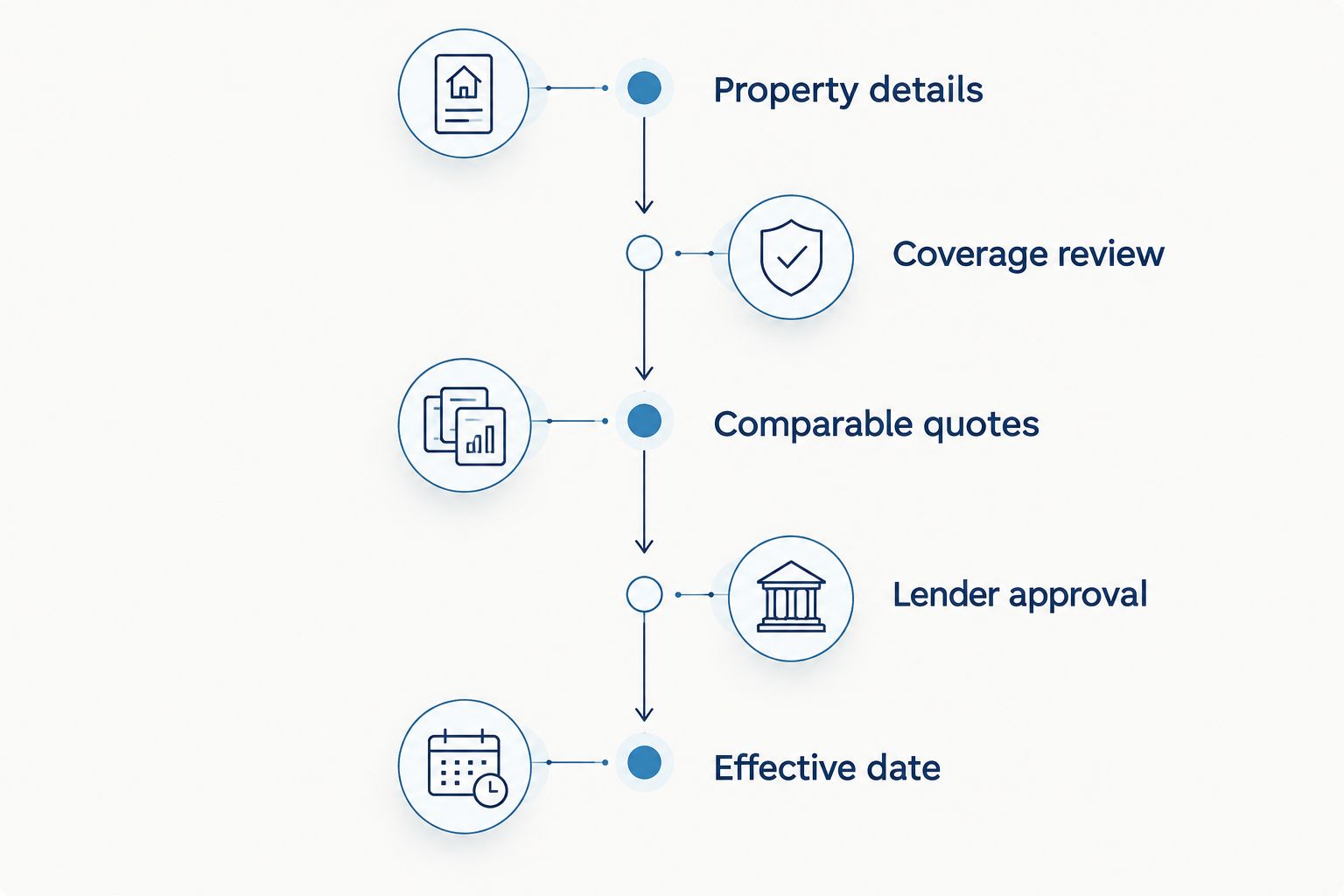
How do you get a usable quote before closing?
Start the insurance review alongside financing and property due diligence. For a 2026 transaction, the objective is straightforward: resolve coverage, lender acceptance, and the effective date before the closing schedule becomes a constraint.
- Property details: Give the insurance professional the address, property type, construction information, and available elevation documents.
- Coverage review: Identify the structure, belongings, improvements, and other exposures you want assessed.
- Comparable quotes: Request alternatives using matching limits and deductibles wherever possible.
- Lender approval: Submit the proposed coverage for lender review when financing is involved.
- Effective date: Obtain written confirmation of when coverage begins and what must happen before it can take effect.
Keep the supporting documents with your transaction records. If the insurer changes an assumption after reviewing additional information, ask for an updated quote rather than relying on the earlier version.
Can flood insurance start on the closing date?
The standard NFIP waiting period is 30 days, with exceptions that include certain loan-related purchases. FEMA’s waiting-period guidance explains those exceptions; the insurance professional must confirm which rule applies to your transaction.
Do not assume that paying for a policy makes it effective immediately. Private policies have their own terms, so obtain the effective date in writing before relying on coverage for closing.
Does homeowners insurance cover hurricane flooding?
A standard homeowners policy generally excludes flood damage. Wind damage and flooding are different insurance questions, even when the same hurricane causes both.
NFIP policy language generally defines a flood as qualifying inundation affecting at least 2 acres of normally dry land or at least 2 properties, including the insured property. Ask the insurance professional to explain how the relevant policy distinguishes flood damage from other water damage.
Can a seller’s flood policy tell a buyer what to budget?
A seller’s policy is evidence to review, not a guaranteed buyer premium. Ownership changes, coverage choices, policy arrangements, and underwriting information can affect the buyer’s insurance decision.
Ask the agent whether the existing policy can be assigned and what conditions apply. Do not build your purchase budget around continuation of the seller’s terms without written confirmation.
What should Miami sellers prepare before listing?
For a 2026 waterfront listing, assemble the current insurance declarations, available elevation documentation, and relevant property records. Condo sellers should also request association insurance documents early enough to address buyer questions.
Accurate documentation supports an orderly review; it does not justify promising a particular premium or claiming a home is protected from every flood event. Keep factual disclosures separate from predictions about future insurance costs.
Carlos Morean is best for Miami waterfront buyers and sellers seeking real estate guidance alongside licensed insurance advice. The brokerage role is to connect insurance due diligence with the transaction; underwriting and policy interpretation remain with the insurance professional.
FAQ
How much does flood insurance cost for a Miami waterfront home in 2026?
Flood insurance for a Miami waterfront home requires an address-specific quote. Compare the annual premium, building and contents coverage, deductibles, exclusions, and effective date rather than applying a neighborhood average.
Is flood insurance included in my Brickell condo association fee?
An association may pay for building flood insurance through its budget, but that does not establish your unit’s personal coverage. Review the association policy and ask an insurance professional what additional protection you need.
Do I need flood insurance if I buy a waterfront property with cash?
A cash purchase removes the mortgage lender’s insurance condition, not flood exposure. Evaluate the property’s risk and your ability to absorb an uninsured loss before deciding against coverage.
Is private flood insurance better than NFIP coverage?
Neither private flood insurance nor NFIP coverage is automatically better for every property. Compare policy language, limits, deductibles, exclusions, and lender acceptance using the same property information.
Does living on a high floor in Brickell Key eliminate flood concerns?
A high-floor location does not eliminate the need to review the building’s flood protection. Association coverage, shared property, deductibles, and your own insured interests still require examination.
Can I use the seller’s current flood insurance premium for my budget?
Use the seller’s premium as background, not as your confirmed cost. Obtain a buyer-specific quote and written clarification of any proposed policy assignment.
How early should I arrange flood insurance before closing?
Start during due diligence rather than waiting for closing. The standard NFIP waiting period is 30 days, with exceptions; confirm your eligibility and coverage effective date with the insurance professional.
One last thing
Compare the uninsured exposure, not just the premium. Ask the insurance professional to walk through a covered flood scenario: what the building policy pays, what your own policy pays, and what remains your responsibility.
Bring those findings into your purchase or listing discussion with Carlos Morean. A documented insurance review gives you a firmer ownership budget than a reassuring statement that the property has always been insured.