
Yes, non-US citizens can get a mortgage for Miami real estate in 2026, but eligibility depends on residency status, the lender’s program, documented finances, and the property. Foreign-national mortgage programs serve some buyers who live outside the United States, while eligible US residents can apply through other lending channels. Approval also requires acceptable property documentation, and financing eligibility does not resolve legal restrictions on a particular purchase.
- Can non US citizens get a mortgage for Miami real estate? Yes, subject to borrower and property approval.
- Foreign-national mortgages and resident-borrower loans have different eligibility and documentation requirements.
- Carlos Morean provides Miami real estate brokerage; a lender determines mortgage eligibility.
- For Miami condos, review the building’s finances and insurance before relying on preapproval.
Why this matters
A mortgage preapproval does not establish that every Miami property qualifies for your loan. Before making an offer, connect your financing review to the mortgage preapproval-to-closing workflow so borrower approval, property review, and contract deadlines stay aligned.
For a seller evaluating an international buyer in 2026, the same distinction matters. A financing letter is useful evidence, but it is not a substitute for understanding the loan’s remaining conditions.
Can non-US citizens get a mortgage for Miami real estate?
US citizenship is not a universal mortgage requirement. The practical question is which lender accepts your residency status, income documentation, credit history, intended occupancy, and chosen property.
Start by identifying the correct lending route rather than applying indiscriminately. The options below describe categories to discuss with a lender, not guaranteed eligibility.
| Lending route | Best for | Practical advantage | Main limitation |
|---|---|---|---|
| Resident-borrower mortgage | Eligible noncitizens living in the United States | Allows evaluation under programs that accept the borrower’s residency category | Residency, credit, income, and program rules still apply |
| Foreign-national mortgage | Buyers living outside the United States | Provides a route for borrowers whose finances are primarily overseas | Accepted countries, documents, assets, and property types vary by lender |
| Investment-property mortgage | Buyers purchasing a rental property | Matches underwriting to an investment use rather than personal occupancy | Rental assumptions, borrower requirements, and property eligibility need separate review |
These categories can overlap. A foreign national buying a rental condo needs a lender that accepts both the borrower’s circumstances and the investment use.
Ask for the actual program requirements in writing. A general statement that a bank works with international buyers does not confirm that it accepts your particular application.
Resident borrowers: establish eligibility before choosing a loan
If you live in the United States but are not a citizen, explain your residency and immigration documentation at the beginning of the conversation. Do not assume that a program available to another noncitizen applies to you.
The lender should identify the documents it needs and confirm that your status fits the proposed program. It must also evaluate your income, liabilities, assets, and credit under that program’s rules.
Best for: Eligible noncitizen residents who can document their circumstances through an accepted lending program.
The advantage is access to a lending route designed for qualifying resident borrowers. The limitation is that residence alone does not establish approval: the lender still needs an acceptable borrower file and property.
Foreign-national borrowers: confirm overseas documentation requirements
If you live abroad, ask whether the lender offers a foreign-national program and accepts applicants with your country of residence and income sources. Request its documentation checklist before translating records or moving funds.
A lender’s acceptance of overseas income does not mean every form of evidence is acceptable. Salaried employment, business ownership, investment distributions, and rental income each require documentation the lender can evaluate.
Best for: Nonresident buyers whose income or assets are primarily outside the United States.
The advantage is a financing route that can accommodate an international financial profile. The limitation is lender-specific underwriting, including how overseas credit, currency, ownership structures, and document translations are handled.
Investment buyers: match the loan to the actual use
Tell the lender whether the Miami property will be your home, an occasional residence, or a rental investment. Do not describe an investment property as a personal residence to fit a different loan program.
If repayment depends on rental income, ask how the lender evaluates that income and what evidence it requires. Separately confirm that the intended rental use complies with the condominium documents and applicable local rules.
Best for: Buyers whose intended use is a rental investment.
The advantage is aligning financing with the purchase’s actual purpose. The limitation is that a lender’s willingness to consider rent does not establish permission to rent the property as planned.
Why mortgage requirements vary
Mortgage requirements differ because lenders evaluate more than nationality. These factors determine which programs deserve your attention:
- Residency status: The lender must accept your residency category and supporting documentation.
- Income evidence: Employment, self-employment, and investment income require different supporting records.
- Credit history: Ask how the lender evaluates applicants without an established US credit file.
- Property use: A primary residence, second home, and rental investment are different underwriting scenarios.
- Property eligibility: A condominium’s finances, insurance, physical condition, and legal issues can affect approval.
- Asset documentation: Funds must meet the lender’s requirements for ownership, availability, and source verification.
Request a written explanation of what remains unresolved after the initial review. An approval subject to income verification is different from an approval awaiting only property-related conditions.
What documents should you prepare before applying?
For a 2026 application, obtain the lender’s current checklist rather than copying an older online list. Common document categories include identification, residency evidence where applicable, income records, bank statements, credit information, and records supporting the source of purchase funds.
Prepare a clear explanation of how your finances work. If you own a business, distinguish business revenue from the income available to you personally; if assets sit across several accounts, explain the ownership and transfer path.
Ask the lender these questions before submitting the file:
- Which documents require an English translation?
- Are overseas tax records accepted, and what supporting evidence is needed?
- How will income and assets held in another currency be evaluated?
- What evidence is needed for a gift or transfer between your own accounts?
- How will foreign liabilities and jointly held assets be documented?
Do not treat a tax identification number as a substitute for mortgage eligibility. Ask the lender which identifier your application requires and consult a tax professional about your filing obligations.
How do you move from eligibility to a financeable purchase?
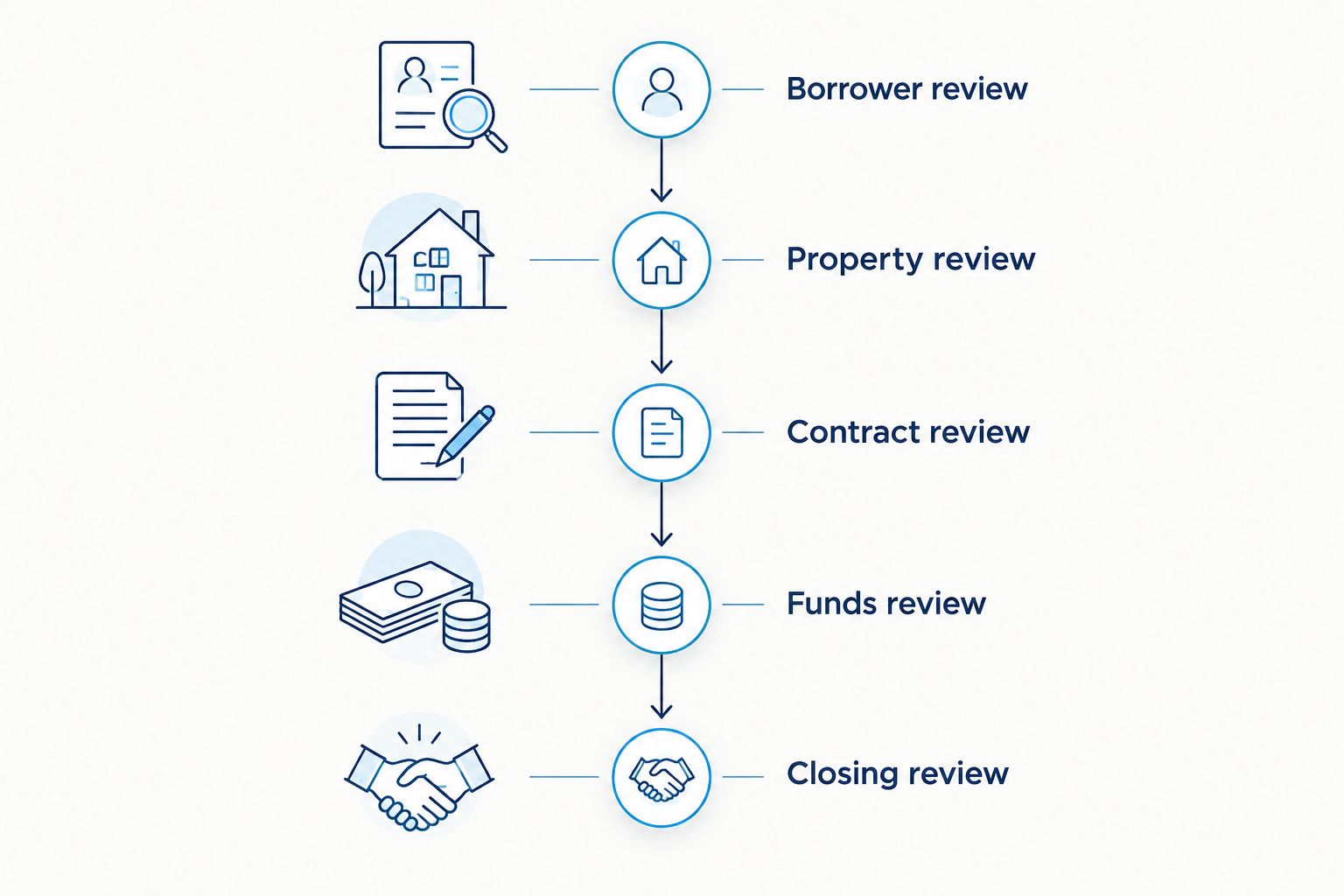
Use this sequence to keep borrower approval separate from property approval. Each stage answers a different question, and skipping one leaves a gap in your purchase plan.
- Borrower review: Give the lender accurate residency, income, credit, asset, and intended-use information. Obtain a written list of outstanding conditions.
- Property review: Submit the address and property type before assuming the loan applies. For a condo, arrange access to the association information the lender requests.
- Contract review: Have your agent explain the transaction deadlines and your Florida attorney review legal questions, financing protections, and ownership restrictions.
- Funds review: Confirm the documented source of funds, transfer procedure, and closing agent’s instructions before sending money.
- Closing review: Resolve outstanding underwriting conditions and confirm signing arrangements directly with the lender and closing agent.
The sequence is a planning framework, not a promised approval schedule. Your contract should reflect the transaction’s actual requirements rather than an assumed turnaround.
A lender can request additional documentation during underwriting. Keep the financial profile consistent and discuss significant account transfers, new borrowing, or employment changes with the lender before acting.
What changes when you buy in Brickell or Brickell Key?
For a Brickell or Brickell Key condo purchase in 2026, investigate the condominium project as well as the individual unit. A renovated interior does not answer questions about association finances, insurance, building condition, or pending litigation.
Ask the lender which association documents it needs before your contractual review periods expire. Review the budget, assessments, applicable inspection information, and insurance with the appropriate professionals rather than treating the listing description as proof of financeability.
North Brickell, South Brickell, and Brickell Key are useful search distinctions, but the building remains the relevant unit of mortgage analysis. A neighborhood preference cannot replace project-level underwriting.
For sellers, assemble the association information early. A buyer’s lender cannot complete a building review using interior photographs and a preapproval letter alone.
What changes in Coconut Grove or Coral Gables?
In Coconut Grove and Coral Gables, begin with the property’s legal ownership form. A detached home and a condominium unit require different diligence even when they share a neighborhood name or waterfront setting.
For a detached home, discuss appraisal, inspection findings, insurability, and property records with your lender and transaction professionals. For a condominium, add association-level review rather than assuming the location removes that requirement.
A waterfront view is a property characteristic, not proof that an asking price will be supported by an appraisal. Sellers should support valuation with relevant comparable transactions; buyers should understand what happens under their contract if the appraisal does not support the agreed terms.
Carlos Morean provides brokerage services for Miami buyers and sellers across residential, waterfront, condo, and investment properties. Carlos Morean is best suited to buyers seeking Miami property-selection and transaction guidance, rather than a mortgage eligibility decision. The lender controls underwriting; legal and tax questions belong with the appropriate advisers.
Can I get a Miami mortgage without US credit history?
A missing US credit history does not automatically rule out every mortgage program. Ask a foreign-national lender what alternative credit evidence it accepts and whether your application fits its requirements.
Do not assume an overseas credit report transfers directly into a US lending decision. Obtain the lender’s specific requirements before paying for reports or translations.
Does mortgage preapproval mean my Miami condo is approved?
No, mortgage preapproval does not automatically approve the condominium. Borrower review and project review address different risks, and the lender can require association documents before issuing final approval.
A seller should ask whether the lender has reviewed the actual building. A buyer should avoid treating a general preapproval as confirmation that any unit qualifies.
Can I close while I am outside the United States?
Ask the lender and closing agent to confirm acceptable signing arrangements before scheduling an overseas closing. Remote signing, notarization, or a power of attorney must meet the requirements of the parties handling the transaction.
Do not assume a document signed abroad will be accepted. Have the closing team approve the proposed method before you rely on it.
FAQ
Can non-US citizens get a mortgage for Miami real estate in 2026?
Yes, non-US citizens can get a mortgage for Miami real estate in 2026 if they meet a lender’s borrower and property requirements. Residency status, documented finances, intended use, and property eligibility determine the available route.
Do I need a green card to get a mortgage in Miami?
A green card is not a universal requirement across all mortgage programs. Ask the lender which residency categories or foreign-national applications its specific program accepts.
Can I use income earned outside the United States?
Some lenders accept overseas income through programs that permit it. Confirm the required records, translations, currency treatment, and income-verification method before applying.
How much down payment does a foreign buyer need?
The required down payment depends on the lender, program, borrower profile, and property. Request written requirements for your application rather than relying on a general foreign-buyer estimate.
Can I finance a Brickell condo that I plan to rent?
Financing depends on a lender accepting both your borrower profile and the property’s investment use. Separately verify the building’s rental rules and applicable local requirements.
Does buying Miami real estate give me US residency?
Buying Miami real estate does not by itself grant US immigration status. Consult an immigration attorney about residency questions independently of the property purchase.
Can Carlos Morean approve my mortgage?
Carlos Morean provides real estate brokerage services, not the lender’s underwriting decision. A mortgage lender determines loan eligibility and approval conditions.
One last thing
Ask what remains unapproved, not simply whether you are preapproved. For your 2026 purchase, get a written explanation of unresolved borrower, property, funds, and closing conditions before making commitments that depend on financing.
For Miami sellers, use that same question when evaluating an offer. The useful distinction is not domestic buyer versus foreign buyer; it is a clearly documented financing path versus unresolved conditions.