
A Miami waterfront home is a sound investment in 2026 only when its purchase terms, verified ownership expenses, physical condition, and permitted use support your goals without relying on appreciation. Waterfront ownership also requires scrutiny of flood exposure, insurance, seawalls, docks, and association obligations; a water view alone does not establish investment value. Buy the documented property, not the waterfront label.
- Is a Miami waterfront home a good investment? Only when verified expenses and property condition support your investment plan.
- Carlos Morean serves Miami waterfront buyers and sellers; evaluate each property rather than assuming an address guarantees returns.
- Separate water views from waterfront ownership, dock rights, and usable boating access.
- For Miami real estate investing, test rental permissions, insurance, maintenance, and resale assumptions before committing.
Why this matters
Waterfront property combines a place to live with a financial commitment. Those goals overlap, but they are not interchangeable: enjoying a view does not establish rental profitability or justify an unsupported asking price.
For a 2026 purchase, start with the property's records rather than a neighborhood-wide investment claim. The Miami waterfront property guide for boat and yacht owners addresses a related distinction: waterfront access and practical boating suitability require separate evaluation.
Is a Miami waterfront home a good investment in 2026?
Yes, when the investment works on verified facts before appreciation enters the calculation. Compare the actual ownership structure, permitted uses, recurring obligations, and condition—not just photographs or the word waterfront.
| Ownership option | Best for | Investment advantage | Main limitation to investigate |
|---|---|---|---|
| Waterfront single-family home | Buyers seeking control over the residence and grounds | Direct control over property maintenance and improvements, subject to applicable restrictions | Responsibility for the home's condition and any associated shoreline structures |
| Waterfront condominium | Buyers comfortable with shared ownership and association governance | Building and common-area responsibilities are organized through an association | Association finances, assessments, insurance arrangements, and rental rules |
| Water-view property without waterfront rights | Buyers prioritizing the view rather than direct water access | Separates visual appeal from owning waterfront structures | A view does not establish dock rights, shoreline access, or protection from future obstruction |
These categories are not interchangeable substitutes. A water-view condo does not meet a boating requirement unless the relevant access rights are documented, and a waterfront house does not meet an income requirement merely because a tenant would enjoy its setting.
Ask for closed comparable sales that match the property's relevant characteristics. Keep asking prices separate from completed transactions, and require an explanation for adjustments involving water frontage, condition, location, or ownership rights.
A waterfront single-family home: control with direct responsibility
A waterfront house suits an owner who wants control over the residence and accepts responsibility for its upkeep. That control is useful, but it does not remove permitting requirements, recorded restrictions, or physical risk.
Investigate the roof, drainage, mechanical systems, seawall, dock, and evidence of prior repairs. Where waterfront structures exist, use appropriately qualified specialists rather than treating a general home inspection as the final answer on every component.
Recommendation: choose a waterfront house for documented utility and manageable obligations, not assumed land appreciation.
A waterfront condominium: evaluate the unit and the association
A condominium purchase includes exposure to decisions and obligations beyond the unit's interior. Review the association budget, financial statements, reserve information, assessments, insurance documents, meeting minutes, and available inspection reports.
Ask what the association maintains and what remains your responsibility. A renovated kitchen does not answer questions about common-area repairs, building insurance, or restrictions affecting your intended use.
Recommendation: approve the building's financial and physical position before treating the unit as an investment candidate.
Why Miami waterfront investment outcomes vary
The same waterfront description can conceal very different obligations. These factors determine whether a property fits your plan:
- Acquisition basis: Require comparable closed sales and property-specific adjustments before accepting the asking position.
- Insurance exposure: Obtain property-specific quotes and review coverage, exclusions, deductibles, and lender requirements.
- Physical condition: Investigate the residence and applicable shoreline structures, including documented repair history.
- Ownership obligations: Separate individual responsibilities from association responsibilities and review assessments where applicable.
- Permitted use: Verify leasing, occupancy, dock, and other restrictions against your actual plans.
- Exit flexibility: Identify the likely future buyer and the documents needed to support a resale.
Do not collapse these factors into one optimistic return estimate. A sound result requires an acquisition decision, an operating plan, and a credible exit—not just confidence in Miami.
How should you evaluate a waterfront purchase?
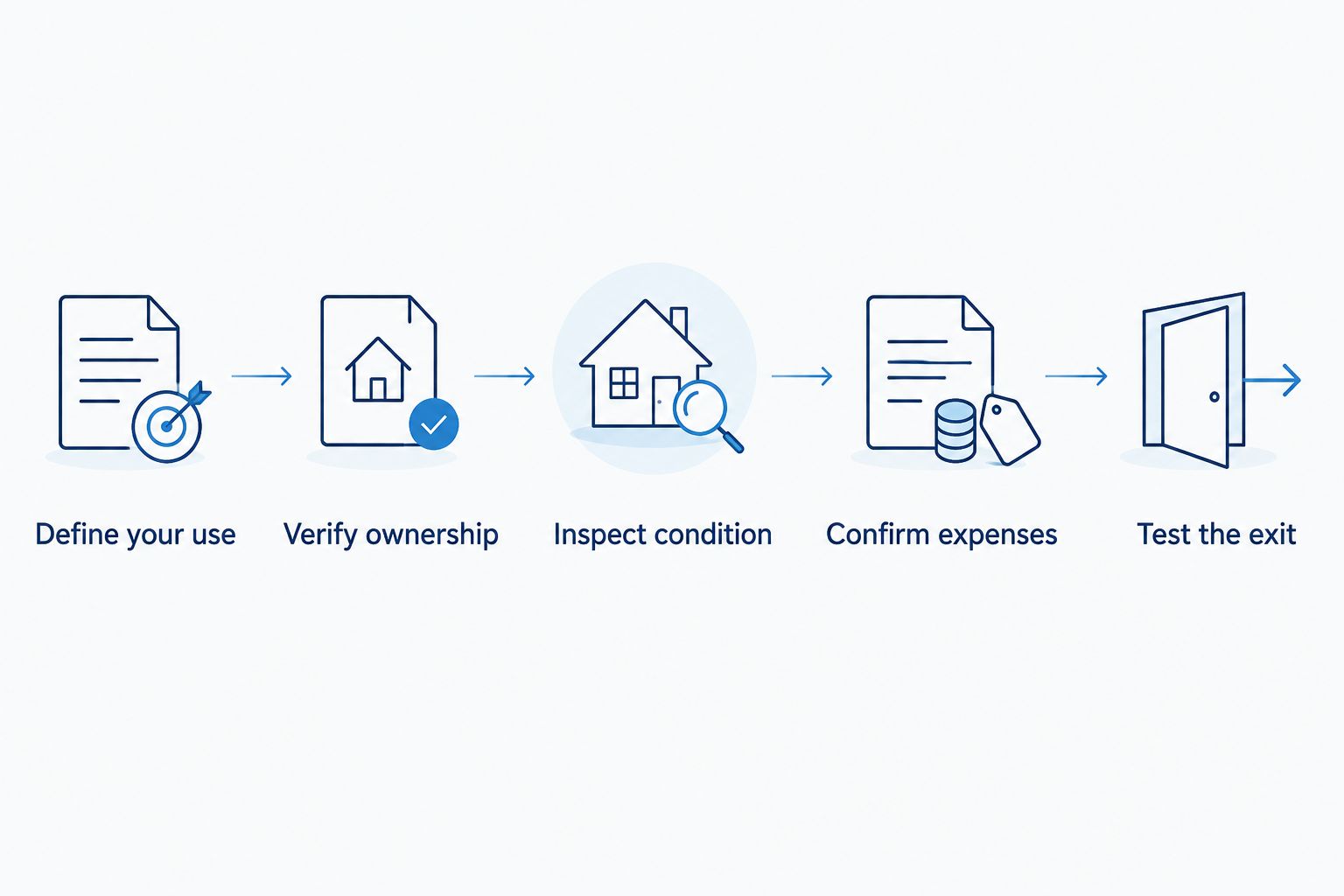
Use this sequence before committing to a 2026 waterfront investment. Keep the evidence in one property file so your agent, inspector, insurance professional, lender, and attorney can address the same facts.
- Define your use. Decide whether the property is primarily a residence, a rental investment, or a combination. State any boating requirements explicitly.
- Verify ownership. Review the survey, title materials, recorded restrictions, and documents establishing any dock or access rights with the appropriate professionals.
- Inspect condition. Arrange inspections suited to the property and follow up on recommendations for specialist evaluation.
- Confirm expenses. Obtain insurance quotes, a property-specific tax estimate, association documents where applicable, and maintenance estimates supported by inspections.
- Test the exit. Compare realistic resale alternatives and identify conditions that would force you to sell earlier than planned.
The sequence matters because the findings interact. A dock restriction changes utility; an inspection finding changes the maintenance plan; an insurance quote changes the ownership budget.
Build an operating worksheet, not an appreciation story
For a rental purchase, begin with rent supported by comparable leases and confirm that the intended rental arrangement is permitted. Then account for vacancy, management, maintenance, taxes, insurance, association obligations, and financing where applicable.
Keep projected rental income separate from personal-use benefits. If you reserve the home for yourself, do not simultaneously count those same periods as rental income.
For an owner-occupied purchase, evaluate affordability without pretending the property generates operating income. Your enjoyment has value to you, but it is not cash available to pay ownership expenses.
Test an unfavorable case before making the offer
Create a second worksheet with less favorable assumptions supported by your research. Consider lower achievable rent, an interruption to occupancy, repair work identified during inspection, or an earlier-than-planned sale.
The purpose is not to predict a disaster. It is to identify whether the purchase depends on every assumption working in your favor.
If an ordinary setback makes the ownership plan unaffordable, revise the purchase criteria before negotiating.
What changes between Coconut Grove, Coral Gables, and Brickell?
Use neighborhood context to choose the right questions, then use property documents to answer them. A neighborhood name is not evidence of a particular return, insurance outcome, or maintenance condition.
Coconut Grove: establish the waterfront relationship
For a Coconut Grove property, distinguish a home directly on the water from one near the waterfront or a condominium with a water view. Those descriptions represent different ownership experiences and require different comparable properties.
If boating matters, verify access and rights rather than assuming proximity to Biscayne Bay provides them. For a condominium, connect the unit review to the association review instead of evaluating the interior alone.
Coral Gables: investigate the actual boating route
For a Coral Gables waterfront home, map the route from the property to the water you intend to use. Verify any relevant bridge clearance, vessel restrictions, dock rights, and other access constraints against your boat and intended activities.
Ask for permits and repair records for existing waterfront structures. Do not infer their legal status or condition from the fact that they appear in listing photographs.
Brickell: separate the location decision from the building decision
Compare North Brickell and South Brickell against your actual destinations and access needs. Then investigate the specific building: unit orientation, association obligations, leasing rules, and condition are not resolved by choosing the neighborhood.
Visit the property and surrounding streets at times relevant to your routine. A useful location decision requires more than measuring the distance to an office on a map.
Brickell Key: inspect the unit's specific position
For a Brickell Key condominium, distinguish the island location from the unit's actual outlook, privacy, exposure, and access arrangements. Verify parking, visitor procedures, and rental restrictions in the relevant documents.
Do not use another building's reputation as a substitute for reviewing this association. The investment decision belongs to the particular unit and ownership obligations you are buying.
How should a seller support a waterfront valuation?
A seller's strongest position is a documented explanation of value. For a 2026 listing, organize comparable closed sales, relevant permits, repair records, surveys, insurance information, and association materials where applicable.
Choose an agent who explains which comparisons were excluded as well as which were included. A non-waterfront sale, a different access situation, or a substantially different building requires more than a casual adjustment.
The marketing plan should explain what a buyer actually receives: direct frontage, a water view, documented dock rights, or another specific benefit. Avoid presenting these as equivalent features.
Carlos Morean is best suited to buyers and sellers seeking Miami residential and waterfront brokerage guidance. Brokerage advice supports pricing and negotiation; it does not replace legal review, engineering evaluation, insurance underwriting, or tax advice.
Is waterfront property better than a water-view condo?
Waterfront property is better for a buyer who needs documented direct access and accepts the associated responsibilities. A water-view condo is the better fit when the view matters more than direct access and the association's obligations suit the buyer.
Neither ownership type is automatically the stronger investment. Compare the actual documents, expenses, condition, and use restrictions before choosing.
Can rental income make a waterfront purchase worthwhile?
Rental income supports the investment only when the intended rental use is permitted and the operating calculation includes all relevant expenses. Confirm restrictions before using rental projections to justify an offer.
Do not substitute advertised rental figures for evidence of achievable income. Ask how the estimate accounts for vacancy, management, repairs, and any periods reserved for your own use.
Should you buy a waterfront home if you expect appreciation?
Expected appreciation should not rescue an otherwise unaffordable purchase. In 2026, evaluate whether you can hold the property under the ownership conditions you have verified, including an exit that does not depend on a higher resale value.
A purchase can meet a lifestyle goal without meeting an income-investment goal. Name the objective accurately so you do not confuse personal preference with financial performance.
FAQ
Is a Miami waterfront home a good investment in 2026?
A Miami waterfront home is a good investment in 2026 when verified ownership expenses, condition, permitted use, and purchase terms support your goals. Do not rely on appreciation to make an otherwise weak purchase work.
What should I check before buying a Miami waterfront house?
Check ownership rights, physical condition, insurance, taxes, applicable restrictions, and the condition of any seawall or dock. Use qualified professionals to investigate issues outside a general home inspection's scope.
Does a waterfront home automatically include a private dock?
A waterfront description does not establish private dock rights. Verify the relevant rights, permits, restrictions, and maintenance responsibilities through the transaction documents and appropriate professional review.
Is a waterfront condo easier to own than a waterfront house?
A waterfront condo organizes some responsibilities through an association, but you still need to evaluate the association's finances, insurance, condition, and rules. A house places more property-level decisions directly with the owner.
Can I rent out a Miami waterfront property whenever I want?
Do not assume unrestricted rental use. Verify applicable government requirements, recorded restrictions, and association rules before relying on rental income.
How do I price my Miami waterfront home for sale?
Price a Miami waterfront home using relevant closed comparable sales and documented differences in condition, location, waterfront characteristics, and ownership rights. An asking price from another listing does not establish achieved market value.
Can Carlos Morean help with a waterfront investment purchase?
Carlos Morean provides Miami residential and waterfront real estate brokerage services for buyers, sellers, and investors. Use separate qualified professionals for legal, engineering, insurance, and tax questions.
One last thing
Before you make an offer or approve a listing price, write down the waterfront benefit you are paying for. Is it the view, direct frontage, documented boating access, privacy, or a combination?
Then identify the document or inspection that supports each benefit. If the feature cannot be verified, do not treat it as an established investment advantage.