
A Miami condo special assessment has no fixed citywide cost: your obligation depends on the association’s approved funding need, your unit’s allocation under the condominium documents, and the payment terms. In 2026, evaluate the remaining balance alongside regular association dues, financing charges, and any additional work that remains unfunded.
- How much does a condo special assessment cost in Miami? Start with the approved assessment and your unit’s allocation.
- Carlos Morean helps Miami condo sellers; assessment liability also requires association records and contract review.
- Separate approved assessments, proposed projects, reserve contributions, and association loan payments before evaluating your exposure.
- For a sale, document the unpaid balance, payment schedule, project scope, and responsibility at closing.
Why this matters
An assessment is both a payment obligation and a sale-negotiation issue. Buyers need to understand the building’s condition, the work being funded, and the obligations they would assume. Sellers need those answers before presenting an asking-price recommendation as defensible.
Start by separating assessments from the recurring charges covered in the guide to HOA fees on Miami waterfront condos. A regular monthly statement does not, by itself, explain the building’s entire capital funding position.
For a 2026 listing, assemble the assessment records before choosing your marketing language. Avoid describing a building as financially settled merely because the current owner has paid an assessment.
How much does a condo special assessment cost in Miami?
Your unit’s assessment comes from the association’s adopted funding decision and the allocation required by its governing documents. Do not divide the project budget equally among apartments unless the condominium documents require equal allocation.
The practical calculation is the amount assigned to your unit, less credited payments, plus any applicable financing charges or other authorized charges. Confirm each component with management rather than reconstructing the balance from old payment notices.
| Component | What establishes it | What you need to verify |
|---|---|---|
| Approved assessment | Adopted resolution and assessment notice | Purpose, total obligation, and payment terms |
| Unit allocation | Declaration and applicable allocation provisions | The share assigned to your unit |
| Payments credited | Unit ledger | Payments received and remaining principal |
| Financing charges | Association financing and payment documents | Whether interest or other charges apply |
| Closing obligation | Contract, estoppel certificate, and legal review | Who pays and when payment is required |
| Unfunded work | Engineering reports, studies, and meeting records | Whether additional funding remains under consideration |
Ask management to reconcile discrepancies between the assessment notice and the unit ledger. An installment amount is not the same thing as the unpaid balance, and a contractor’s estimate is not an adopted assessment.
Which documents establish the amount I actually owe?
Read the assessment notice, the governing allocation provisions, and the current unit ledger together. Each answers a different question: what was adopted, how it is distributed, and what remains unpaid.
Then request the payment schedule and relevant board records. If an association loan funds the work, establish whether your stated balance includes financing charges and whether paying early changes your obligation.
Approved assessments: confirm the existing obligation
An approved assessment requires a different response from a project still under discussion. Obtain the adoption records and confirm the effective payment terms with the association.
For sellers, the immediate task is to document the balance and identify the contract treatment. For buyers, it is to understand both the obligation being transferred and the project it funds.
An approved assessment does not establish that every building repair is funded. Compare its stated scope with the engineering recommendations and any excluded work. Ask whether the construction contract covers the same scope described to owners.
Proposed assessments: distinguish estimates from adopted charges
A proposed assessment is not interchangeable with an approved payment obligation. Board discussions, contractor bids, and draft funding plans belong in the due-diligence file, but they do not establish your final unit balance.
Ask what remains undecided: scope, bids, funding source, allocation, or adoption. Describe the status accurately when discussing the property with prospective buyers.
For a 2026 sale, avoid either extreme: presenting an estimate as final or implying that an unresolved project has no financial significance. Have your attorney identify the required disclosures and appropriate contract language.
Reserve funding: review it separately
Reserve contributions and special assessments address related funding needs, but they are not interchangeable. A reserve study identifies funding considerations; it does not replace the association’s adopted budget or assessment documents.
Florida Statutes §718.112 addresses structural integrity reserve studies for covered condominium buildings of 3 stories or higher and generally requires the study at least every 10 years. Applicability, permitted funding arrangements, and current compliance requirements require building-specific review under the law in effect in 2026.
Do not interpret the study interval as a guarantee against assessments between studies. The useful seller question is narrower: what work has been identified, what money is committed, and what remains unresolved?
Why Miami condo special assessments vary
Assessments vary because buildings have different obligations and funding positions. Compare the documents behind the charge, not just the amount appearing on an owner’s statement.
- Project scope: Concrete restoration, waterproofing, roof work, and equipment replacement involve different work. Confirm what the adopted project includes.
- Available funding: Existing reserves, insurance proceeds, and borrowing affect how the association funds a project. Verify committed funds rather than assumed reimbursements.
- Unit allocation: Your declaration determines how applicable expenses are allocated. Another owner’s obligation is not automatically yours.
- Payment structure: A lump-sum obligation and installments have different cash-flow consequences. Read the actual terms.
- Financing terms: Association borrowing can add financing obligations. Establish how those charges reach individual owners.
- Unresolved conditions: Engineering findings, incomplete bids, and scope changes affect funding certainty. Identify what remains open before negotiating a sale.
None of these factors establishes a neighborhood average. A building’s own records provide the evidence needed to evaluate its assessment.
How should you compare Coconut Grove, Coral Gables, and Brickell?
Use neighborhood context to select comparable properties, then use building records to evaluate assessment exposure. Coconut Grove, Coral Gables, Brickell, and Brickell Key are not substitutes for association-level financial analysis.
For each competing listing, record the exact building, unit characteristics, assessment status, and seller concessions. Keep North Brickell and South Brickell location differences visible in your comparison, but do not treat either location as evidence of better reserves or fewer repairs.
Apply the same discipline when comparing a Coconut Grove condo with a Coral Gables alternative. Check the individual property’s waterfront position, building condition, and documented funding obligations rather than assigning a premium to the neighborhood name alone.
On Brickell Key, a shared island address does not make separate associations financially interchangeable. Request the records for the specific association governing the unit.
When reviewing closed sales, determine whether an assessment payoff or other concession changed the transaction economics. A recorded closing figure alone does not explain what the seller retained or what obligations the buyer assumed.
What should a seller do before listing?
Build a document-backed explanation before photography, showings, and negotiations begin. Carlos Morean’s Miami condo brokerage services are relevant to preparing the listing and negotiating the sale; legal responsibility for assessments requires contract and association-document review.
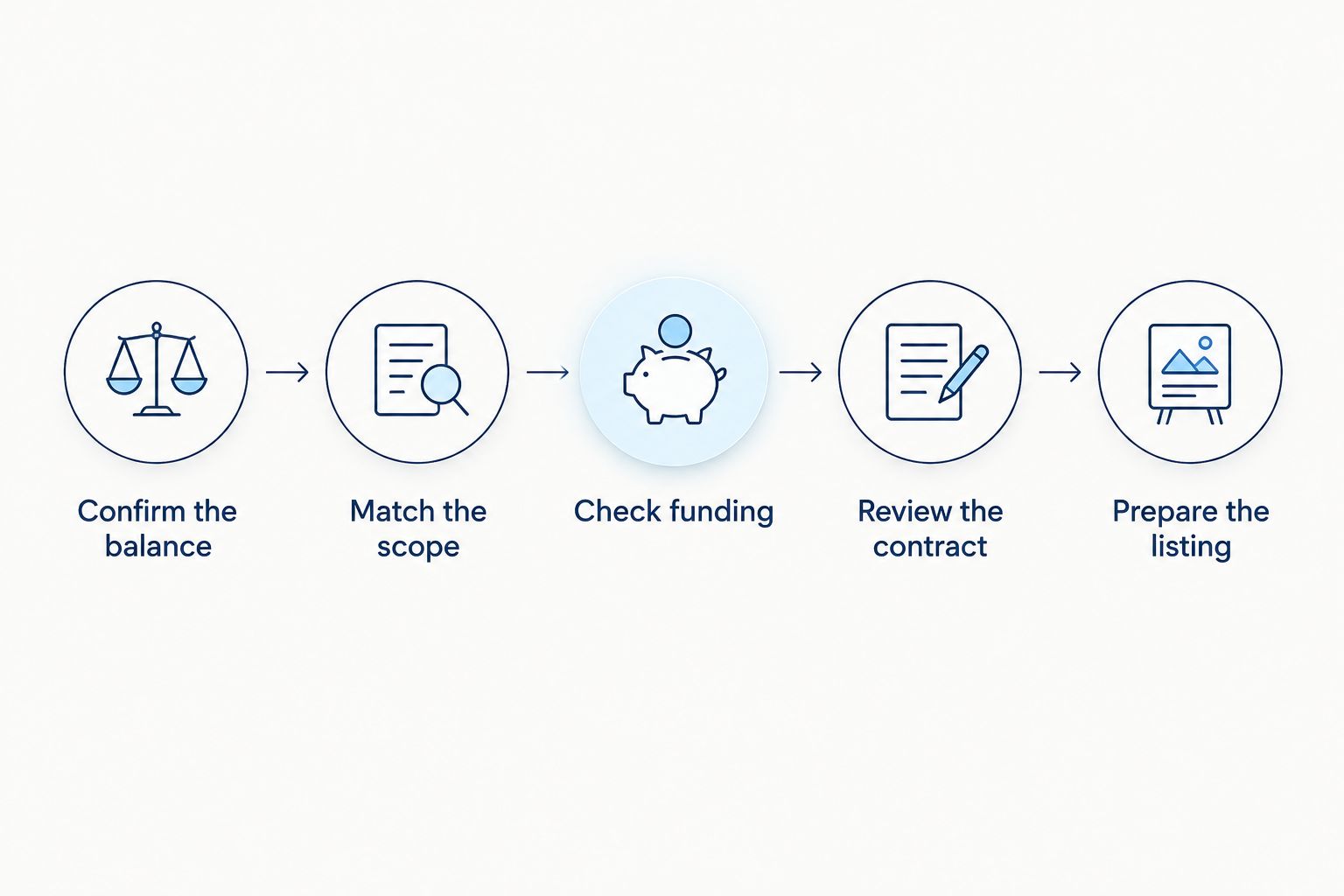
- Confirm the balance. Request a current ledger showing the unit’s unpaid obligation and credited payments.
- Match the scope. Compare the assessment notice with the engineering recommendations and construction scope.
- Check funding. Identify committed funding and projects still awaiting a funding decision.
- Review the contract. Have your attorney explain assessment allocation, disclosure obligations, and closing treatment.
- Prepare the listing. Give your agent a consistent, documented explanation for buyer questions.
For the marketing file, request the latest meeting records and consider reviewing the preceding 12 months as a starting point. Extend that review when references point to older engineering reports, earlier funding decisions, or ongoing disputes.
A written question log helps prevent inconsistent answers. Record the question, the supporting document, and any outstanding response; do not turn an unanswered question into an assurance.
Who should verify the project and funding plan?
A seller’s agent handles market positioning and negotiations, not engineering conclusions. Management supplies association records, qualified technical professionals evaluate building needs, and counsel addresses legal obligations.
The distinction matters when selecting or evaluating HOA capital needs assessment providers: a technical assessment informs the work and funding discussion, while the association’s adopted documents establish the owner’s payment obligation. Neither document should be presented as a substitute for the other.
Ask whether the technical scope matches the funded scope. If a report identifies work outside the current project, request a written explanation of its status rather than assuming it has been abandoned or paid for.
In 2026, keep every report’s date visible in the listing file. A report completed before later inspections, bids, or scope changes does not resolve those later developments.
Should you pay the assessment before selling or negotiate it?
Choose the approach after reviewing your contract, cash position, and buyer financing requirements. Paying an assessment does not prove that your sale proceeds will increase by the same amount.
| Approach | Best for | Advantage | Limitation |
|---|---|---|---|
| Seller payoff | Sellers seeking a clearly settled existing balance | Removes that unpaid obligation if properly confirmed | Uses seller funds and does not settle future projects |
| Negotiated allocation | Transactions needing tailored responsibility | Makes the agreed division explicit | Requires precise drafting and closing coordination |
| Buyer assumption, if permitted | Buyers prepared to accept documented obligations | Preserves the agreed payment structure | Depends on contract terms, association rules, and financing review |
Have the closing team verify whether an association loan, installment arrangement, or transfer provision changes the payoff requirement. Do not assume that an arrangement available to the current owner automatically continues unchanged for the buyer.
Carlos Morean serves Miami condo sellers who need brokerage guidance on pricing, marketing, and negotiation. The benefit is a transaction-focused discussion; the boundary is clear: brokerage advice does not replace engineering, legal, or lending review.
FAQ
How much does a condo special assessment cost in Miami in 2026?
A Miami condo special assessment has no fixed citywide cost. Verify your unit’s allocation, credited payments, unpaid balance, and applicable financing charges using the association’s adopted documents and current ledger.
Is a special assessment included in my regular condo fees?
Do not assume a special assessment is included in regular condo fees. Review the adopted budget, assessment notice, and unit statement to distinguish recurring dues from separately imposed obligations.
Does every owner pay the same assessment?
Owners do not necessarily pay the same assessment. The condominium declaration and applicable allocation provisions determine how the expense is distributed among units.
Does the seller have to pay the entire assessment before closing?
Do not assume the seller must pay the entire assessment before closing. Contract terms, association documents, applicable law, and financing requirements determine how the obligation must be handled.
Does a completed reserve study mean there will be no special assessments?
A completed reserve study does not guarantee that there will be no special assessments. Compare the identified work with available funding, adopted budgets, and subsequent project decisions.
Can a condo special assessment affect my buyer’s financing?
An assessment can affect financing review because lenders evaluate both the borrower and the condominium project. Give the lender the assessment documents and related project information early.
Which records should I request before listing my Miami condo?
Request the assessment notice, current unit ledger, payment schedule, relevant meeting records, engineering reports, reserve study, and adopted budget. Have management identify later amendments or funding decisions.
One last thing
A paid assessment and a fully funded building are different claims. Before advertising that an assessment is paid, verify the unit ledger; before suggesting the building’s work is funded, verify the project scope and funding documents.
For a 2026 sale, accurate wording protects the negotiation. State what the records establish, identify unresolved items, and let buyers evaluate the property without promises the documents cannot support.