
Instead of chasing insurance documents during the final closing review, connect flood insurance to your Miami waterfront purchase as soon as the contract is signed: confirm the lender’s requirements, obtain acceptable coverage, and match its effective date to the closing. For a 2026 transaction, a quote is only the starting point—not proof that coverage is in force.
- For flood insurance Miami waterfront closing requirements, obtain written lender acceptance before treating the insurance condition as cleared.
- Carlos Morean helps Miami waterfront buyers coordinate property questions; licensed insurance professionals determine coverage and policy terms.
- An NFIP policy generally has a 30-day waiting period, but qualifying loan-related purchases have an exception.
- For Brickell and Brickell Key condos, review association flood coverage alongside the buyer’s individual insurance requirements.
Why this matters
A waterfront address does not establish the insurance requirement. The lender’s flood determination, property characteristics, ownership structure, and proposed coverage all affect what must reach the closing file.
Standard homeowners insurance generally excludes flood damage. Wind coverage does not substitute for flood insurance, and title insurance addresses a different category of risk entirely. Keep these reviews separate even when the same closing coordinator collects the documents.
Carlos Morean is best for Miami waterfront buyers who need local real estate guidance alongside separate insurance and lending advice. For a financed condominium purchase, connect this checklist to the broader mortgage pre-approval-to-closing workflow, rather than treating insurance as a final administrative task.
Before you start
- Assemble the property file. Have the executed contract, exact property address, unit number where applicable, intended ownership name, planned use, and closing date. Request existing insurance information and any available elevation certificate from the seller; let the insurance professional determine what additional records are necessary.
- Identify the decision-makers. You need the lender’s insurance reviewer, a licensed insurance professional, the closing agent, and—for a condominium—the association’s manager or insurance contact. Assign someone to track requests and unresolved conditions.
- Resolve the waiting-period issue first. FEMA’s National Flood Insurance Program guidance generally specifies a 30-day waiting period, with exceptions that include qualifying coverage purchased in connection with making, increasing, extending, or renewing a loan. Do not assume every purchase qualifies: have the agent confirm the applicable rule and effective date before scheduling around it.
For your 2026 closing file, create a shared checklist with an owner, due date, supporting document, and written acceptance for each insurance condition. Use your existing transaction system or a simple document; no special integration software is necessary.
Property and lender requirements
Establish the coverage brief
- Request the lender’s written flood determination. Ask whether flood insurance is required for the loan and which building or collateral the determination covers. Do not substitute a listing description or a seller’s recollection for the lender’s determination.
- Obtain the lender’s insurance instructions. Request the required coverage amount, deductible restrictions, acceptable evidence, mortgagee wording, loan number instructions, and any condominium-specific conditions. Ask who has authority to mark the condition satisfied.
- Confirm the insured identity. Give the insurance professional the buyer’s exact legal name and intended ownership structure. If an entity or trust will take title, coordinate the naming requirements with the lender and closing agent before issuing documents.
- Record the property’s actual use. Disclose whether the home will be a primary residence, seasonal residence, or rental. Ask the insurance professional how that use affects the proposed policy and its terms.
Expected result: You have one written brief identifying the property, borrower, required coverage, document standard, and person responsible for approval.
For a 2026 purchase, use the current determination rather than assuming an older policy proves today’s lending requirement. FEMA describes a Special Flood Hazard Area as land subject to a flood with a 1% annual chance; being outside that area does not mean a property has no flood risk.
Separate the local property questions
Neighborhood names are not insurance classifications. Use the following questions to obtain property-level evidence rather than making coverage assumptions from an address:
- Coconut Grove: For a waterfront house, identify the insured residence and ask separately about docks, seawalls, detached structures, and equipment. Do not assume the residence’s flood policy protects every waterfront improvement.
- Coral Gables: For a canal-front property, reconcile the legal address and insured building description. Ask the insurance professional to explain how lower-level spaces and equipment are treated under the proposed coverage.
- Brickell: For a condominium, obtain the association’s flood documents and send them to the lender. A unit’s high floor does not answer questions about the building’s insurance.
- Brickell Key: Review the particular association and building, not just the island location. Confirm the policy term, insured building, coverage, and deductible in the actual documents.
These are document requests, not claims that every property in a neighborhood shares the same exposure.
Policy selection and condominium review
Compare the coverage routes
- Request the appropriate proposals. Ask a licensed insurance professional to explain NFIP coverage and any private flood proposal being considered. Give each proposal the same property, ownership, use, and closing information.
- Compare terms before choosing. Review covered property, exclusions, deductibles, effective-date rules, cancellation provisions, and lender acceptance. A proposal that looks simpler can still leave an unresolved closing condition.
- Submit the proposed coverage to the lender. Obtain written acceptance before relying on it for closing, especially when private flood insurance or association coverage is involved.
- Identify any remaining gap. Ask whether additional building coverage, contents protection, or other insurance is appropriate. The lender’s minimum requirement is not a complete assessment of your financial exposure.
| Coverage route | Best for | Advantage | Limitation to resolve |
|---|---|---|---|
| NFIP flood policy | Buyers whose coverage needs fit federal program terms | Uses federally defined policy forms | Limits, exclusions, and waiting-period rules require review |
| Private flood policy | Buyers evaluating alternatives to NFIP terms | Allows comparison of different coverage structures | Terms vary, and lender acceptance must be confirmed |
| Association master flood policy | Condo buyers documenting building-level protection | Addresses the association’s insured building exposure | Does not automatically resolve every unit-owner or lender requirement |
Expected result: The lender has accepted the proposed coverage route, and you understand which exposures remain outside it.
For NFIP coverage, the standard policy term is generally 12 months. Ask how renewal will be handled after closing; clearing the purchase condition does not remove the need to maintain required coverage.
For a 2026 Brickell or Brickell Key closing, send the association documents for review early enough to address missing information. An insurance certificate summarizes coverage; the lender or insurance professional can require declarations, endorsements, or other policy documents.
Effective date and closing evidence
Align the insurance calendar
- Confirm the effective date in writing. Ask the insurance professional to identify both the date and time coverage begins. Verify that any waiting-period exception applies to this transaction rather than assuming that a scheduled closing eliminates the wait.
- Arrange payment through verified instructions. Confirm who pays the initial premium and whether payment occurs before closing or through settlement. Coordinate with the closing agent so payment responsibility is neither missed nor duplicated.
- Obtain the evidence the lender requires. Request the declarations, evidence of coverage, payment confirmation, and endorsements specified by the reviewer. A quote or application alone does not establish that coverage has taken effect.
- Reconcile the documents. Check the property address, unit number, named insured, mortgagee clause, effective date, coverage, and deductible against the lender’s instructions. Send discrepancies back to the issuer rather than editing insurance documents yourself.
Expected result: The closing file contains accepted evidence showing the correct property and parties, with coverage effective when required.
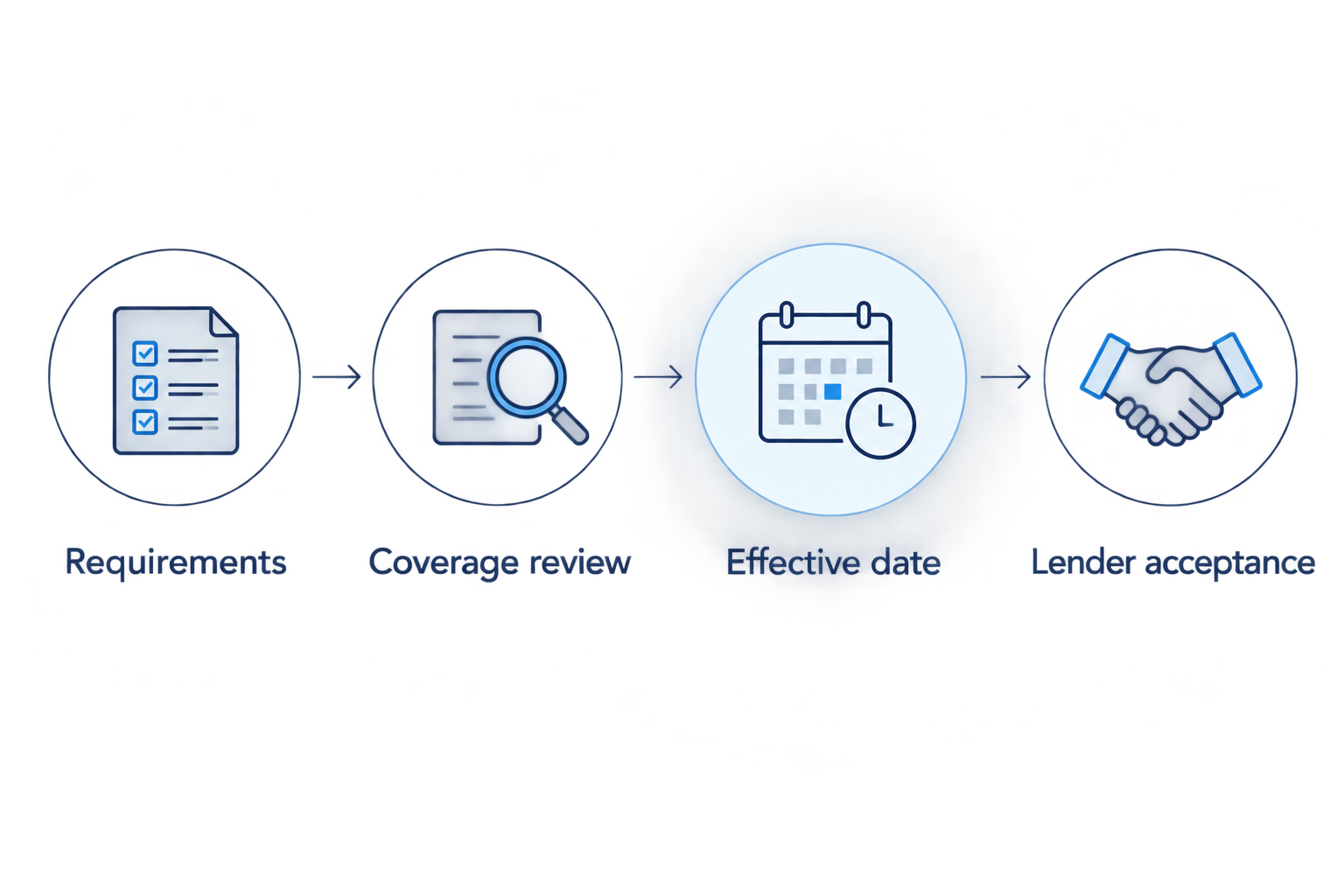
The handoff follows a simple sequence: Requirements, Coverage review, Effective date, and Lender acceptance. Each stage produces a document or confirmation needed by the next person; forwarding an email without checking acceptance leaves the task unfinished.
Close the lender’s insurance condition
- Send one complete submission. Include the requested documents and identify the borrower, property, loan reference, and scheduled closing. Ask the reviewer to specify any remaining deficiency in writing.
- Obtain explicit clearance. An acknowledgment of receipt is not the same as approval. Request confirmation that the flood insurance condition is satisfied, subject to any stated final requirements.
- Check the settlement paperwork. Reconcile insurance-related entries and payment responsibility with the closing agent. Ask about any discrepancy before signing rather than assuming another participant will correct it.
- Save the final policy file. Keep the issued policy, endorsements, payment record, and lender acceptance with your ownership documents. Confirm the contact responsible for servicing and renewal questions.
Expected result: You can identify the policy, effective date, payment status, and written lender clearance without searching through conflicting email versions.
Carlos Morean’s role in the Miami waterfront closing is real estate coordination. Your licensed insurance professional explains policy terms, the lender decides whether its insurance requirements are satisfied, and the closing agent handles the settlement responsibilities assigned to that office.
When the closing date changes
A postponed closing requires a new date check, not an automatic cancellation and replacement of coverage. Ask the insurance professional what the change means before requesting an amendment.
- Notify the insurance professional, lender, and closing agent of the revised date.
- Ask whether the existing effective date should remain or whether a permitted change is appropriate.
- Confirm that any waiting-period exception still applies and obtain revised evidence if necessary.
- Resubmit changed documents and obtain renewed lender acceptance where required.
Expected result: The revised closing date and insurance evidence remain consistent, without an unintended lapse or unsupported assumption about coverage.
For a cash purchase, remove the lender-approval step—not the coverage review. Without a lender collecting documents, you must still arrange the intended protection and verify when it begins.
Troubleshooting
The lender rejects the insurance submission
Ask for the exact deficiency in writing: insufficient coverage, unacceptable deductible, missing mortgagee wording, incomplete evidence, or another stated issue. Send that requirement to the insurance professional and resubmit corrected documents. Do not replace the entire policy before understanding the objection.
The seller says the existing policy transfers automatically
Treat transfer as unconfirmed until the insurer or servicing agent approves the applicable process. An NFIP policy assignment can require specific documentation and consent; a seller’s declarations page alone does not establish coverage for the buyer. Keep the seller’s cancellation timing separate from the buyer’s protection.
The condo association sends only a certificate
Forward it for review, but request the additional documents the lender or insurance professional identifies. Confirm the insured building, policy term, deductible, and relevant endorsements. Do not infer complete unit-owner protection from the existence of a master policy.
Coverage starts after the planned closing
Ask whether a valid waiting-period exception applies or another acceptable policy can take effect when required. If neither resolves the gap, discuss timing with the lender, closing agent, and your attorney. Do not treat a paid application as active coverage.
The ownership name changes late
Notify every affected participant before signing. Ask the insurance professional to correct the insured information and the lender to review the revised evidence; an entity-name change is not merely a cosmetic edit.
Customize your workflow
Sellers can prepare the insurance handoff before listing by organizing existing declarations, available elevation records, association contacts, and relevant property documentation. Preparation does not guarantee the buyer’s coverage or lender approval, but it gives those reviewers a clearer starting file.
Buyers should connect insurance review to inspection findings and intended renovations. Changes to occupancy, building configuration, or ownership belong in the insurance discussion, not just the purchase contract.
For a 2026 sale or purchase, ask Carlos Morean to help identify which real estate deadlines depend on outside insurance decisions. Keep binding coverage and interpreting exclusions with the licensed professionals responsible for those tasks.
Coordinate your waterfront purchase
Discuss property questions and the real estate deadlines that depend on insurance review.
FAQ
Do I need flood insurance to close on a Miami waterfront home?
You need flood insurance when your lender requires it, and waterfront location alone does not establish the requirement. Obtain the lender’s flood determination and written insurance instructions, then separately assess protection for your own exposure.
Can flood insurance start on the day I close?
Flood insurance can start on closing day when the policy’s rules and transaction circumstances permit it. NFIP coverage generally has a 30-day waiting period, but qualifying loan-related purchases have an exception; obtain written confirmation for your transaction.
Does a Brickell condo association’s flood policy cover my unit?
An association’s flood policy does not automatically satisfy every unit-owner coverage need or lender requirement. Have the association documents reviewed alongside your proposed individual protection.
Is private flood insurance better than NFIP coverage for a Miami closing?
Neither private flood insurance nor NFIP coverage is automatically better for every Miami closing. Compare policy terms, exclusions, deductibles, effective dates, and lender acceptance for the specific property.
Can I use the seller’s flood insurance policy?
You can use an existing policy only through a transfer or assignment process that the insurer permits and that satisfies any lender requirements. Do not assume the seller’s policy becomes yours when title transfers.
What happens to flood insurance if my closing is delayed?
A delayed closing requires review of the policy’s effective date and any transaction-related conditions. Ask the insurance professional whether changes are needed, then send revised evidence to the lender and closing agent.
Who should coordinate flood insurance during a Miami waterfront closing?
The buyer should assign a clear coordinator while keeping professional responsibilities separate. Carlos Morean handles real estate guidance, the insurance professional addresses coverage, the lender approves its insurance conditions, and the closing agent coordinates settlement requirements.
One last thing
The most useful final question is not whether insurance was ordered; it is whether the lender accepted evidence of coverage effective when required. Ask for that answer in writing. It distinguishes a task someone started from a closing condition someone actually cleared.