
Instead of manually chasing documents, showing feedback, and closing updates, organize selling your Brickell condo around a single file, an evidence-based valuation, and a deadline calendar. This 2026 workflow connects pricing, marketing, negotiation, and closing so you can identify problems before they threaten the sale.
- Selling your Brickell condo starts with building documents and comparable closed sales, not competing asking prices.
- Carlos Morean helps Miami condo sellers connect valuation, property marketing, and transaction decisions.
- Confirm association requirements before launch; buyer financing and building review are separate checkpoints.
- Choose a vacant or tenant-occupied workflow before promising access or possession.
Why this matters
A condo sale involves more than finding someone who likes your view. Your unit, the building, the buyer’s financing, and the contract all need to support the same transaction.
Carlos Morean is best for Miami condo sellers seeking local brokerage guidance on valuation, marketing, and closing. Start with a Carlos Morean consultation focused on your building, your ownership documents, and your intended move—not an unsupported target figure.
For a 2026 listing, separate what you know from what still requires confirmation. A renovated kitchen is visible; an unresolved assessment, incomplete association package, or undocumented parking assignment requires investigation.
Before you start
- Gather ownership and property records. Locate your deed, mortgage statement, renovation records, lease if occupied, and documents supporting parking or storage rights. Identify everyone whose authorization is required to sell.
- Establish access and responsibilities. Confirm who handles association requests, photography access, showing appointments, title work, and legal questions. Ask prospective agents for a written valuation rationale and marketing plan.
- Pre-empt the financing gotcha. A buyer’s mortgage pre-approval does not establish that the lender will accept your condo building. Request current association documents early and have the buyer’s lender address project eligibility before treating financing as settled.
Keep sensitive financial records separate from the public marketing folder. Buyers need accurate property information, not unrestricted access to your personal documents.
Property file and comparable sales
1. Build the property file
Create a shared transaction folder with separate sections for ownership, association records, property condition, marketing, and contracts. Record the document date and who supplied it; replace outdated versions rather than circulating conflicting copies.
Request the association’s current budget, applicable financial and reserve information, assessment notices, insurance information, governing documents, and buyer application instructions. Ask about inspections, repairs, litigation, and planned work, then have the appropriate professional explain anything that affects the transaction.
Document the unit itself: layout, exposure, balcony, condition, renovations, parking, storage, and occupancy. Distinguish deeded rights from assigned or separately arranged use.
2. Establish the comparable-sales hierarchy
Ask your agent to begin with closed sales in the same building, emphasizing comparable layouts, views, condition, and floor positions. Request at least 3 relevant closed sales when available; when evidence is limited, require an explanation of the broader comparison set.
Brickell and Brickell Key should not become interchangeable labels on a spreadsheet. Compare each property’s actual access, surroundings, building services, and waterfront relationship rather than applying a neighborhood-wide assumption.
Likewise, a Coconut Grove or Coral Gables property does not establish your Brickell condo’s value simply because both attract luxury buyers. Explain why each comparable belongs in the analysis.
3. Set decision rules before launch
Separate the asking strategy from your acceptable contract terms. Prepare 2 scenarios: a financed buyer with lender review and a cash buyer with verified funds, noting contingencies and possession requirements for each.
For your 2026 valuation file, record which evidence supports the asking strategy and what would justify revisiting it. An agent’s recommendation should explain the evidence, not merely repeat the amount you hope to receive.
Expected result: You can explain your unit’s competitive position, identify missing documents, and distinguish valuation evidence from seller preference.
Launch plan and showing access
1. Choose the occupancy workflow
Decide whether you will market the condo vacant, owner-occupied, or tenant-occupied. Each approach changes access and preparation; none automatically produces a better result.
| Workflow | Best for | Advantage | Limitation |
|---|---|---|---|
| Vacant | Owners who have already relocated | Easier coordination of preparation and appointments | Empty rooms need careful presentation; ownership expenses continue |
| Owner-occupied | Sellers remaining through the marketing period | You retain use of the home | Showings require repeated preparation and scheduling |
| Tenant-occupied | Owners selling subject to an existing tenancy | Buyers can evaluate the property with its lease context | Access and possession depend on the lease and applicable requirements |
Confirm building rules for photography, visitor entry, signs, and appointments before booking vendors. Do not promise unrestricted access because the unit is vacant.
2. Prepare a factual marketing brief
Have your agent connect every selling point to evidence. Describe the actual view, floor plan, outdoor space, documented improvements, and confirmed parking arrangement; avoid treating an address as a substitute for property detail.
For Brickell, show the relationship between the building entrance and nearby destinations accurately. For Brickell Key, explain the property’s island setting without implying that every unit has the same exposure or outlook.
Review photographs and descriptions before publication. Remove personal documents, clarify what furnishings are excluded, and avoid presenting digitally altered conditions as existing features.
3. Establish the feedback routine
Schedule a review every 7 days while actively marketing. Track completed showings, substantive buyer objections, document requests, and changes among genuinely competing listings—not just page views.
Your 2026 marketing review should answer one question: is the obstacle presentation, access, property condition, building information, or the asking strategy? Change the relevant part rather than automatically changing everything.
Expected result: Buyers receive consistent information, appointments follow an agreed process, and each review ends with a specific action.
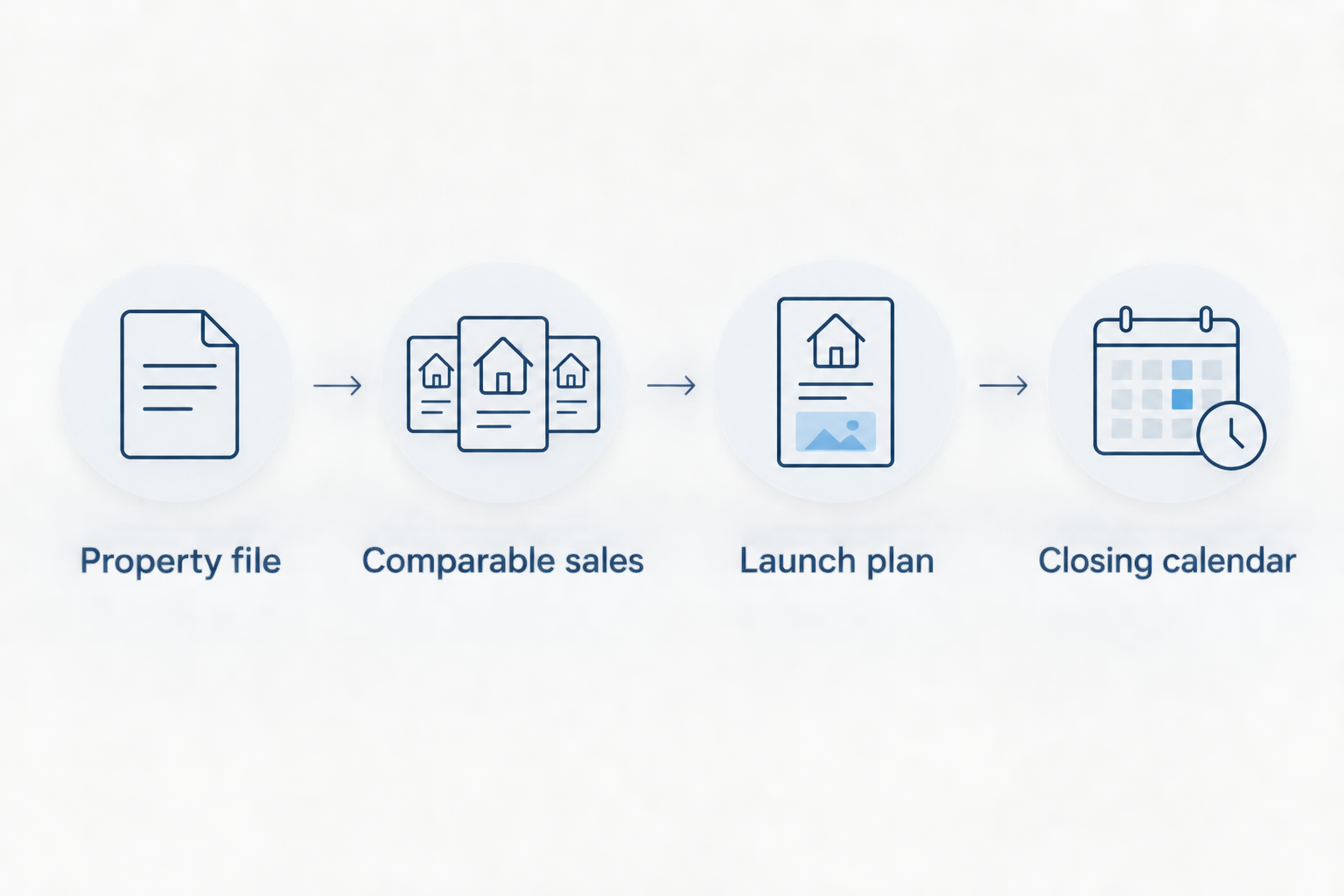
The sale works as a sequence: complete the evidence, establish the comparison, launch accurately, and manage the contract calendar. Skipping the property file leaves later decisions dependent on assumptions.
Offer review and contract calendar
1. Compare complete offers
Have your agent summarize financing, deposit obligations, inspection provisions, requested concessions, association review, closing date, and possession terms. Ask the closing professional to prepare an estimated seller settlement statement using the proposed terms.
A stronger headline offer is not automatically a stronger contract. Evaluate the buyer’s documented ability to perform and the conditions under which the buyer can terminate or renegotiate.
Carlos Morean’s role as a Miami condo agent is brokerage guidance; obtain legal and tax advice from the appropriate professionals. Keep each adviser’s responsibilities explicit.
2. Assign every deadline
Once an agreement is signed, copy deadlines from the executed contract—not from memory or a generic checklist. Assign an owner to deposit confirmation, inspections, document delivery, financing updates, association submissions, title issues, and possession arrangements.
Ask the closing professional or attorney to explain how deadlines are calculated and how notices must be delivered. Record amendments alongside the original agreement so everyone works from the same calendar.
3. Coordinate building and lender review
Ask the buyer’s side to confirm what the lender needs from the association and who is obtaining it. Track outstanding requests without distributing confidential buyer financial information unnecessarily.
For the next stage, the Miami condo offer-to-closing workflow connects contract obligations with transaction checkpoints. Use your executed agreement as the controlling source for your own deadlines.
Expected result: Every material obligation has a responsible person, a documented deadline, and a clear status.
Closing calendar and handover
1. Resolve exceptions before scheduling the move
Ask the closing professional to identify outstanding title matters, association balances, mortgage payoff requirements, and missing signatures. Have the attorney address disputes about responsibility for assessments or other contractual obligations.
Confirm whether the buyer must complete an application or receive association approval. Obtain the applicable requirements directly rather than assuming another building’s process applies.
2. Verify the settlement and funds process
Review the seller settlement statement against the contract and written amendments. Question unexplained deductions, credits, or allocations before signing.
Treat emailed wiring changes as a fraud warning. Verify instructions through a trusted, independently established telephone number, not contact details supplied in the unexpected message.
3. Separate signing from possession
Confirm with the closing professional when the transaction is considered closed and when funds are disbursed. Follow the agreement on keys, access devices, furnishings, and occupancy; do not equate a signed document with permission to hand over possession.
Coordinate elevator reservations and move-out procedures with management. Keep proof of the handover and retain your closing documents securely.
Expected result: You know what remains outstanding, how funds will be handled, and exactly when possession transfers.
Second workflow: selling with a tenant in place
A tenant-occupied Brickell condo needs a parallel lease file. Before marketing, collect the executed lease, amendments, payment records, security-deposit records, and any documented renewal or termination arrangements.
Ask an attorney to review access, notice, and possession questions. A sale does not, by itself, establish that you can deliver the unit vacant; the lease, contract, and applicable law require review.
Then adjust the workflow:
- Define occupancy. State whether you are seeking a sale subject to the tenancy or proposing vacant possession supported by a lawful, documented arrangement.
- Coordinate access. Establish showing procedures consistent with the lease and applicable requirements. Keep the tenant informed without promising exceptions you cannot authorize.
- Prepare the transfer. Have the closing professional address lease documents, deposits, prorations, and notices applicable to the transaction.
For a 2026 sale, verify the current lease status again before accepting an offer. An old marketing description should not become an accidental promise about occupancy.
Expected result: The buyer’s expectations, the tenant’s rights, and the seller’s delivery obligations are aligned.
Troubleshooting a stalled Brickell condo sale
Showings occur, but offers do not
Separate repeated objections from isolated preferences. If buyers consistently identify the same condition issue, obtain a professional assessment; if access prevents return visits, fix scheduling before blaming exposure.
Review the valuation against relevant closed sales and current competing inventory. The distinction between asking price versus sale price matters because an advertised amount shows a seller’s position, while a completed transaction records an agreed outcome. Neither substitutes for checking whether the properties are genuinely comparable.
The lender requests documents nobody has collected
Create an outstanding-document list naming the requester, association contact, and responsible coordinator. Ask the lender to identify the actual missing requirement instead of accepting a vague statement that the building is under review.
Escalate deadline concerns through the agent and attorney before a contractual date passes. Do not represent silence as approval.
An assessment creates a negotiation dispute
Obtain the written notice and supporting association information. Have the attorney interpret the executed contract’s allocation of responsibility and document any negotiated change.
Avoid verbal promises about who will pay or when work will finish. Keep association statements distinct from your own expectations.
Closing is scheduled, but possession remains unclear
Check the contract, amendments, lease if applicable, and building move-out requirements together. Resolve any mismatch in writing before arranging key delivery.
If your next purchase depends on sale proceeds, notify both closing teams. Do not commit those proceeds until the closing professional confirms their status.
Customize your workflow
Ask your agent to add the issue that makes your sale different: a renovation record gap, an overseas signer, a tenant, an inherited interest, or a purchase dependent on closing. Assign the relevant professional before launch rather than during a deadline dispute.
For agent selection, request a sample valuation explanation, a building-document checklist, and a reporting routine. Local knowledge should produce specific decisions; broad claims about luxury marketing are not a substitute.
FAQ
What is the first step in selling your Brickell condo?
Start by assembling ownership records, association documents, and relevant comparable closed sales. Establish the property's documented condition and occupancy before setting the marketing strategy.
How should I choose an asking strategy for my Brickell condo?
Base the strategy on comparable closed sales, your unit's characteristics, and current competition. Ask the agent to explain differences in layout, view, condition, parking, and building circumstances rather than relying on a neighborhood average.
Does a pre-approved buyer guarantee that my condo will qualify for financing?
No. Buyer qualification and the lender's review of the condo project are separate matters, so request building information early and track outstanding lender requirements.
Can I sell my Brickell condo while a tenant lives there?
Yes, but the lease and applicable legal requirements govern important access and occupancy questions. Have an attorney review any promise to deliver vacant possession before you accept that obligation.
Should I renovate my condo before listing it?
Do not approve major work without a property-specific comparison of the alternatives. Ask your agent which defects affect presentation, obtain appropriate contractor advice, and distinguish necessary repairs from elective changes.
How long will selling a Brickell condo take in 2026?
There is no reliable single timeline for every Brickell condo. Marketing response, contract contingencies, financing, association requirements, and title issues determine the schedule for the individual transaction.
How does Carlos Morean help Miami condo sellers?
Carlos Morean provides residential real estate brokerage services in Miami, including condo sales. Ask for a property-specific discussion of valuation, marketing, and transaction responsibilities.
One last thing
Document the parking arrangement before photographing the space. A numbered stall does not establish whether the right is deeded, assigned, transferable, or subject to association rules. Resolving that distinction early prevents the marketing description from promising more than your ownership documents support.