
Instead of forwarding disconnected emails during your sale, connect a CPA for Miami investment property sale planning through a shared document checklist, defined responsibilities, and contract-change updates. Start before signing a sale contract so your accountant can review tax consequences while your broker handles valuation and negotiations.
- Engage a CPA for Miami investment property sale planning before signing, not just when preparing your return.
- Carlos Morean handles Miami real estate brokerage; your CPA handles tax analysis and reporting.
- Keep closing proceeds separate from taxable gain: mortgage payoff does not establish your tax basis.
- For a deferred exchange, involve a qualified intermediary before closing and track statutory deadlines.
Why this matters
Carlos Morean is best for Miami investment property owners seeking real estate brokerage, not tax-return preparation. Your CPA serves a different role: interpreting your ownership, depreciation history, and tax position. Keep those responsibilities separate, but connect the people doing the work.
A conversation with Carlos Morean can establish the brokerage side of your sale. Bring your CPA into the process before you approve terms that affect your tax planning.
For a 2026 sale, organize the process around three different figures: expected closing proceeds, estimated taxable gain, and funds reserved for taxes. They answer different questions. Treating the wire received at closing as your investment profit is a costly starting point.
This guide covers coordination, not individualized tax or legal advice. Your CPA and attorney must apply the rules to your ownership structure, residency, property use, and transaction.
Before you start
- Confirm professional access. Identify your CPA, listing broker, and closing attorney or title contact. Confirm who can authorize information sharing, especially when an entity owns the property.
- Gather the underlying records. Locate the acquisition closing statement, depreciation schedules, improvement invoices, leases, entity documents, loan information, and association notices. Use your CPA’s secure upload method for sensitive files.
- Flag the decision that cannot wait. If you are considering a deferred Section 1031 exchange, consult a qualified intermediary before closing. Receiving the proceeds yourself can defeat the intended exchange structure; an accountant cannot simply reclassify the transaction afterward.
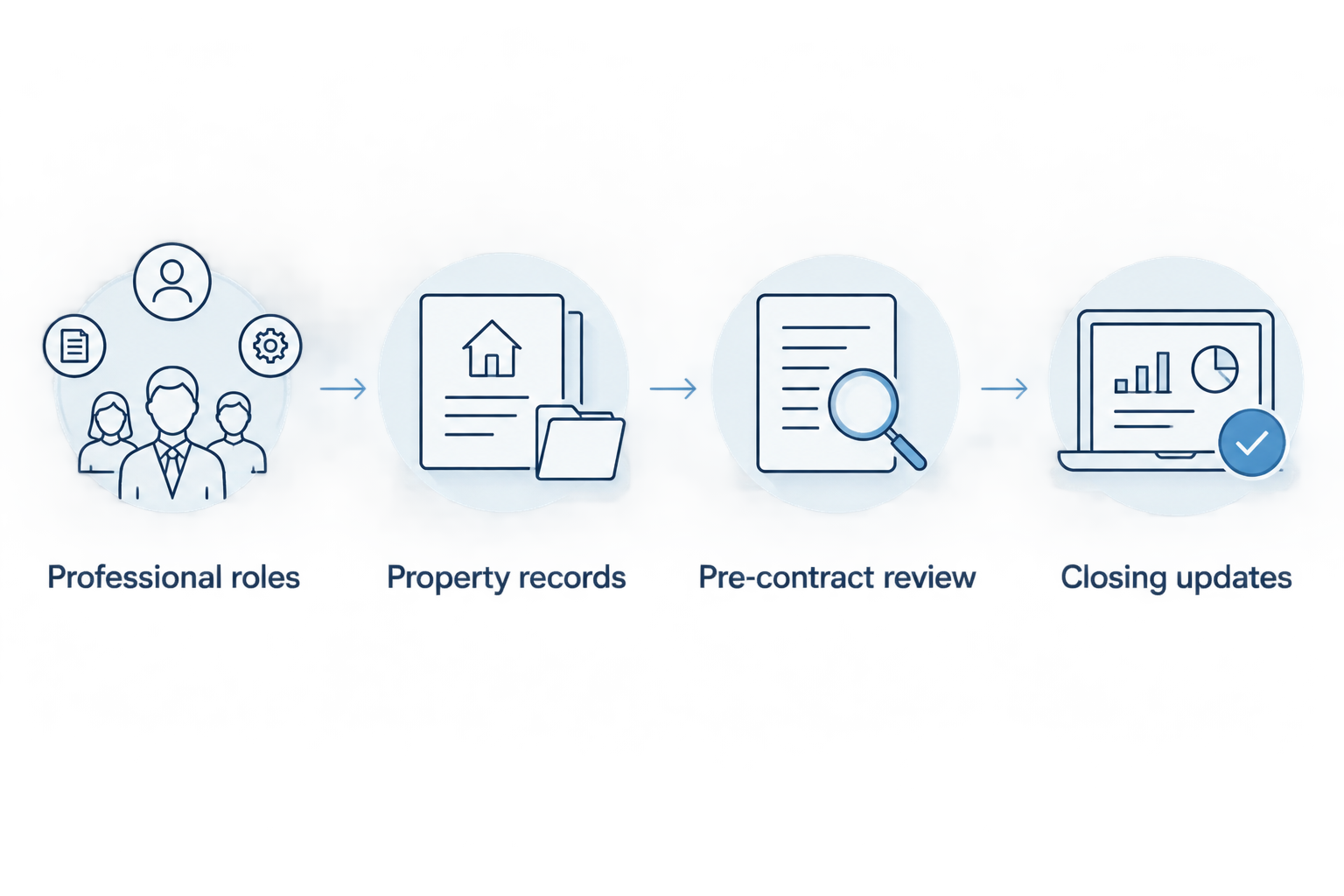
Configuration unit: Professional roles
Select the CPA and define the engagement
- Ask whether the CPA handles sales of rental or investment real estate and the type of owner shown on your deed. An individual owner, partnership, corporation, and trust do not create identical reporting questions.
- Explain any foreign ownership, personal occupancy, inherited ownership, prior exchanges, or business assets included in the sale. Ask whether the engagement covers those issues or requires another specialist.
- Obtain a written scope covering the pre-sale estimate, contract-change reviews, closing reconciliation, and tax reporting. Confirm who will prepare any required filings.
- Authorize a direct introduction among the professionals. Share transaction information with permission; do not circulate complete tax returns to everyone involved.
Use the following responsibility table during the introduction. These are professional roles, not interchangeable service options.
| Professional | Best for | Contribution | Limitation |
|---|---|---|---|
| CPA | Tax analysis and reporting | Reviews basis, depreciation, estimated gain, and filing obligations | Does not replace brokerage or legal advice |
| Real estate broker | Valuation and sale execution | Develops pricing, marketing, and negotiation strategy | Does not determine your tax liability |
| Closing attorney or title professional | Transfer and closing coordination | Handles assigned title, document, disbursement, and settlement tasks | Scope varies; title services do not automatically include legal representation |
| Qualified intermediary | Deferred exchange administration | Structures and administers the intermediary role in an intended exchange | Does not replace independent tax or legal advice |
Expected result: Every participant knows the assignment, the decision-maker, and the limits of their role. No one assumes the broker is calculating taxes or that the CPA is reviewing title.
Configuration unit: Property records
Build the CPA’s review package
- Create three document sets named Acquisition, Ownership, and Sale. These are suggested folder labels, not settings in a particular application.
- Put your acquisition closing statement, deed, and prior exchange documents in Acquisition. Include records supporting inherited or gifted ownership when applicable.
- Put depreciation schedules, improvement invoices, rental records, and changes in property use in Ownership. Separate documented capital improvements from routine repairs for the CPA to classify.
- Put the listing agreement, contract, amendments, estimated settlement statement, and final settlement statement in Sale as they become available.
- Ask the CPA to identify missing records and unresolved assumptions in writing. Do not substitute your mortgage balance or a current market estimate for historical basis records.
For your 2026 file, preserve the original documents and clearly distinguish drafts from signed versions. A revised settlement statement should not silently overwrite the version used for an earlier estimate.
Expected result: Your CPA can trace the property from acquisition through ownership to disposition and identify which calculations remain provisional.
Add Miami property details without confusing value and basis
A Brickell or Brickell Key condo file should include association statements, special-assessment notices, and records of unit improvements. Ask the closing professional to verify balances and obligations; ask the CPA to determine their tax treatment. An assessment is not automatically deductible or automatically added to basis.
For a Coconut Grove or Coral Gables rental home, collect renovation contracts, permits, and invoices for documented work. Those records support review; they do not prove that every improvement produces an equivalent increase in market value.
Keep valuation evidence separate from tax evidence. Comparable sales help your broker support an asking strategy. Acquisition records and qualifying adjustments help your CPA establish basis. Neither file replaces the other.
Configuration unit: Pre-contract tax review
Turn the records into decision-ready instructions
- Ask your CPA to prepare a preliminary disposition analysis using your actual records and clearly stated assumptions. Request separate treatment of estimated taxable gain and expected closing proceeds.
- Identify depreciation issues, suspended passive losses, ownership allocations, and any personal-use history. Let the CPA determine which rules apply rather than assuming every rental sale receives identical treatment.
- Ask whether seller residency or entity ownership creates withholding or additional reporting requirements. Foreign-person withholding under FIRPTA requires early attention; nationality alone does not determine tax residency.
- Discuss any intended exchange, seller financing, or allocation between real estate and other assets before accepting those terms. These decisions affect more than the closing statement.
- Give your broker transaction instructions, not an entire tax return. Relevant instructions include required timing, unresolved professional approvals, or a proposed structure that needs attorney review.
For a 2026 transaction involving a former home, tell the CPA exactly when you lived there and when rental use began. Do not assume a prior residence automatically receives the same treatment as a property used only for investment.
Expected result: You know which proposed terms require another tax review before acceptance. The CPA’s estimate remains an estimate until the facts and settlement figures are final.
Configuration unit: Contract and closing updates
Make changes trigger a fresh review
- Designate one person to circulate signed contracts and amendments. Include the property address, document status, and requested decision in each message.
- Create a short change log with the fields Change, Responsible person, Tax review, and Resolved. These are your own tracking labels, not prescribed software controls.
- Send the CPA changes involving seller credits, closing dates, included assets, financing terms, or ownership information. Ask which changes require a revised analysis.
- Have the closing professional provide a draft settlement statement for review before closing. Allow time for questions rather than treating signature day as the first review opportunity.
- After closing, deliver the final executed statement and supporting adjustments to the CPA. Obtain updated instructions for tax reserves, payments, and reporting.
Expected result: Your broker, CPA, and closing professional work from the same executed documents. A contract amendment does not remain trapped in someone’s inbox.
Second workflow: Coordinate an intended exchange
A deferred Section 1031 exchange adds a qualified intermediary and replacement-property deadlines to the sale workflow. Discuss exchange eligibility before closing; buying another property afterward is not enough by itself.
For a 2026 exchange, IRS Publication 544 and IRS guidance on like-kind exchanges describe two central federal deadlines: identify replacement property within 45 calendar days after transferring the relinquished property, and receive it within 180 calendar days or the applicable tax-return due date, including extensions, whichever is earlier. Confirm the calculation and any applicable relief with your advisers.
- Ask the CPA whether the property, taxpayer, and intended replacement use qualify for the proposed structure.
- Engage the qualified intermediary before transferring the relinquished property. Have the attorney and closing professional review the required transaction documents.
- Record the identification and completion deadlines supplied by your advisers. Calendar both rather than treating the longer period as the only deadline.
- Have the broker evaluate replacement candidates against your investment requirements while the CPA reviews ownership, debt, and cash implications.
- Route identification notices and exchange instructions through the required professional process. An informal shortlist sent only to your broker is not a substitute.
The Miami exchange timeline guide connects the disposition with replacement-property planning. The benefit is potential tax deferral when requirements are met; the limitation is less flexibility over timing, funds, and transaction structure.
Troubleshooting
Your CPA cannot establish adjusted basis
Fix: Retrieve the acquisition closing statement, depreciation history, and supporting improvement records. Ask the CPA how to reconstruct gaps and document uncertainty. A payoff letter explains debt, not adjusted basis.
The accountant and closing statement show different results
Fix: Check whether you are comparing taxable gain with net proceeds. Then reconcile debt payoff, prorations, transaction expenses, credits, and tax adjustments individually. Do not force two different calculations to produce the same result.
A contract amendment never reached the CPA
Fix: Pause the internal approval process for the affected decision and circulate the executed amendment. Request a written response identifying whether the prior estimate or instructions changed. Keep the superseded version for the record.
An assessment appears late in a condo sale
Fix: Obtain the association documentation and have the closing professional confirm responsibility under the contract and applicable requirements. Ask the CPA to classify the item separately. Do not assume the buyer’s credit and the seller’s tax treatment are identical.
Foreign ownership is identified just before closing
Fix: Notify the CPA, attorney, and closing professional immediately. Have them determine FIRPTA applicability, documentation, withholding, and filing responsibilities. Do not use an unsupported exemption assumption to finalize disbursements.
Customize your workflow
For a 2026 sale involving multiple owners, identify who approves contract changes and who receives tax information. Ask the CPA whether owners require separate analyses. Shared ownership does not guarantee identical personal tax consequences.
For a restaurant or bar property transaction, distinguish the real estate from any business interest or other assets included in the deal. Carlos Morean provides residential and commercial real estate brokerage services; your CPA and attorney must review the proposed structure and allocations.
Use a written handoff, not an assumed referral. A practical introduction states the property, ownership, intended transaction, document location, and unresolved decisions. It should also identify who will request the next review.
FAQ
When should I hire a CPA for my Miami investment property sale?
Hire the CPA before signing a sale contract. Early review gives you time to address basis records, depreciation, ownership, residency, and any intended exchange before transaction terms become binding.
Can Carlos Morean replace my CPA during a property sale?
No. Carlos Morean provides real estate brokerage services, while your CPA handles tax analysis and reporting within the agreed engagement. Connect both professionals so pricing and contract decisions reach the accountant when needed.
Is my mortgage payoff deducted when calculating taxable gain?
Mortgage payoff generally affects your closing proceeds rather than establishing your taxable gain. Your CPA calculates gain using the applicable amount realized, adjusted basis, and tax rules, not simply the cash remaining after debt repayment.
What records should I send my CPA before selling a rental condo?
Send acquisition documents, depreciation schedules, improvement records, rental-use history, and available sale documents. Include association assessments and ownership documents so the CPA can identify additional questions before closing.
Can I start a deferred exchange after receiving the closing proceeds?
Do not assume you can create a deferred exchange after receiving the proceeds. Consult a qualified intermediary before closing because actual or constructive receipt of funds can defeat the intended structure.
Does owning a Miami property through an LLC remove the need for tax planning?
No. An LLC does not by itself determine the federal tax treatment of a property sale. Your CPA must review the entity’s tax classification, ownership, and transaction facts.
Does a Miami investment property sale involve FIRPTA?
FIRPTA requires review when the seller is a foreign person for federal tax purposes. Your CPA, attorney, and closing professional should determine applicability and responsibilities before closing rather than relying on citizenship alone.
One last thing
The wire received at closing is not your tax return. Before distributing or reinvesting proceeds, obtain the final settlement statement and ask your CPA to update the reserve instructions. Closing completes the transfer; it does not complete the tax analysis.