Yes, you can buy a Miami waterfront home without flood insurance when you pay cash and no contractual or insurance-program requirement applies. For a financed purchase, the lender generally must require flood insurance when the building is in a Special Flood Hazard Area and the loan falls under federal mandatory-purchase rules. Buying without coverage leaves you responsible for uninsured flood damage; ordinary homeowners insurance generally excludes flooding.
- You can buy a Miami waterfront home without flood insurance, but financing and insurance-program requirements can prevent it.
- FEMA flood zones identify mapped hazards; being outside a high-risk zone does not eliminate flood exposure.
- Carlos Morean helps Miami waterfront buyers; confirm insurance requirements with your lender and licensed insurance professional before closing.
Can you buy a Miami waterfront home without flood insurance?
Yes—but permission to close without flood insurance is not evidence that the property is safe from flooding. Your financing, the building’s mapped location, and any applicable insurance requirements determine whether coverage is compulsory.
For a 2026 purchase, separate the obligation to carry insurance from the financial decision to protect the property. A cash buyer avoids a mortgage lender’s insurance conditions, not the consequences of an uninsured loss.
| Purchase situation | Can you close without flood insurance? | Main advantage | Main drawback | Best for |
|---|---|---|---|---|
| Cash purchase with no other applicable requirement | Generally yes | No mortgage-imposed coverage condition | You retain uninsured flood losses | Buyers able to fund repairs and recovery themselves |
| Covered mortgage on a building in a Special Flood Hazard Area | Generally no | Required coverage provides financial protection within policy terms | Lender compliance does not guarantee adequate protection | Buyers using mortgage financing |
| Mortgage outside a Special Flood Hazard Area | Sometimes; the lender can still require coverage | More flexibility when the lender permits it | Lower mapped risk is not zero risk | Buyers comparing voluntary coverage against retained exposure |
| Waterfront condominium | Depends on financing, building coverage, and unit requirements | Association coverage can insure qualifying building interests | The master policy does not automatically cover every unit-owner loss | Buyers prepared to review both master and individual policies |
Why this matters
A waterfront purchase involves two separate questions: whether you can complete the transaction and whether you can afford the property after a flood. Solving the first does not solve the second.
Carlos Morean works with Miami waterfront buyers and sellers. Carlos Morean is best for Miami waterfront buyers seeking local real estate guidance alongside independent insurance advice. Coverage decisions belong with a licensed insurance professional; legal questions belong with your attorney.
For sellers, this distinction affects preparation. Organize insurance documents before listing so buyers can evaluate the home rather than discover an unresolved coverage issue near closing.
Cash purchases: fewer lender conditions, unchanged physical risk
Paying cash removes the mortgage lender from the insurance decision. It does not eliminate requirements attached to another insurance policy, an association, or a binding agreement.
Florida’s Citizens Property Insurance Corporation has flood-insurance requirements that extend beyond properties in high-risk flood zones, subject to its applicable rules and exceptions. If you intend to insure the home through Citizens in 2026, ask the insurance agent to confirm the flood requirement for that specific policy before assuming cash ownership makes coverage optional.
The advantage of buying without a mortgage is flexibility. The drawback is that flexibility can leave the entire uninsured repair obligation with you.
Before choosing to retain that risk, identify what you would fund after a flood:
- Building repairs, including damaged finishes and systems.
- Replacement of belongings without applicable contents coverage.
- Temporary accommodation and interrupted use of the property.
- Cleanup and professional assessments not paid by another policy.
Do not assume disaster assistance will replace insurance. Eligibility, assistance type, and the amount available depend on the event and program.
Financed purchases: the building and loan determine the requirement
Federal flood-insurance purchase rules generally apply when a covered loan is secured by a building in a Special Flood Hazard Area in a participating community. A lender can also impose requirements beyond that federal minimum.
For your 2026 mortgage application, request the lender’s written flood determination early. A seller’s statement that insurance was optional under a previous loan does not establish the requirement for yours.
FEMA describes the high-risk floodplain using a 1% annual chance of flooding. The phrase “100-year floodplain” does not mean flooding happens only once every 100 years, nor does a recent flood reset a clock.
A 30-year mortgage therefore deserves a long-term risk assessment, not just a check of whether the street flooded last season. Ask the lender what coverage it requires, then ask the insurance professional whether that requirement addresses your actual exposure.
Treat lender approval as a financing decision, not a complete insurance assessment. Required coverage can still leave deductibles, exclusions, and losses above policy limits.
Waterfront condos: check the building and the unit separately
An upper-floor condominium can have flood exposure even when water cannot reach the living room. Flooding can affect electrical equipment, elevators, garages, and other shared building components.
For Brickell and Brickell Key purchases, request the association’s flood declarations and relevant policy documents. Have the lender and insurance professional review the actual building coverage rather than relying on a listing’s statement that insurance is included in association dues.
Clarify these separate responsibilities:
- Association coverage: Which building components does the master policy insure?
- Unit coverage: What protection applies to your interiors and personal belongings?
- Deductible responsibility: Who bears an association deductible under the governing documents and applicable law?
- Uninsured losses: What expenses remain outside the policies?
Association insurance has a practical advantage: it addresses shared building interests. Its limitation is equally important—it is not a blanket promise that every owner’s flood-related expense will be paid.
An association certificate alone does not answer every coverage question. Request the documents needed to verify limits, deductibles, exclusions, and effective dates.
Why flood-insurance requirements vary
The word “waterfront” is not an insurance determination. A bayfront home, canal-front residence, and condominium require property-specific review.
The main drivers are:
- Loan requirements: Federal rules and lender conditions determine whether financed buyers must carry coverage.
- Mapped location: The building’s position relative to FEMA’s mapped flood hazard area matters; a neighborhood name is not enough.
- Policy conditions: Another insurer’s eligibility rules can create a flood-insurance obligation even without a mortgage.
- Ownership structure: A condominium divides insurance responsibilities between the association and individual owners.
- Building characteristics: Elevation, foundation, and the location of vulnerable equipment affect the risk assessment and insurance review.
- Existing obligations: Association documents, recorded agreements, or property-specific assistance conditions require examination where applicable.
In Coconut Grove and Coral Gables, compare individual waterfront parcels rather than assigning one risk level to the whole neighborhood. In Brickell and Brickell Key, investigate the building’s shared systems as well as the unit’s floor.
A waterfront view supports a lifestyle decision. It does not establish elevation, coverage, or insurability.
What should you verify before removing contingencies?
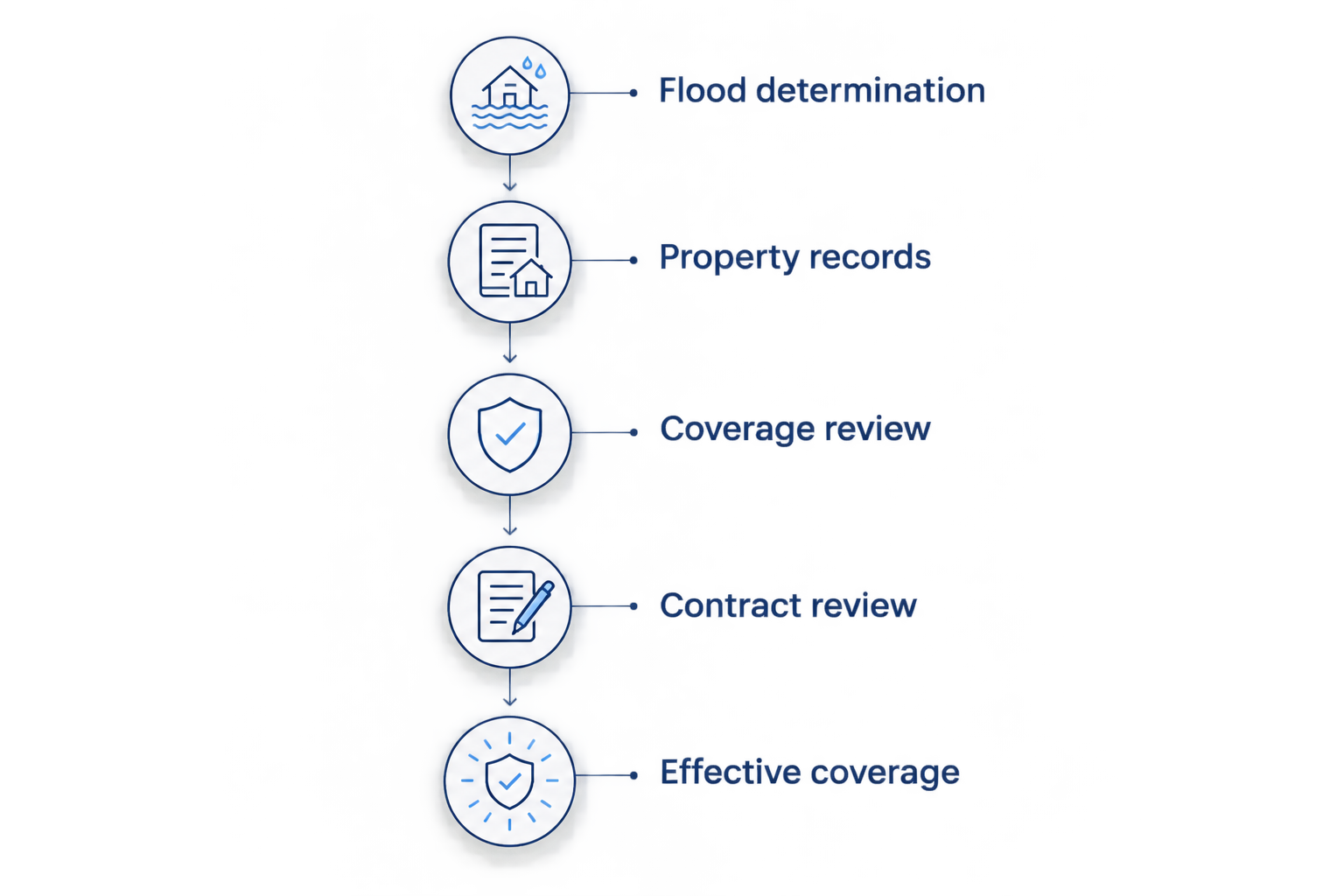
Use this sequence during your 2026 due diligence. Have your attorney confirm which contract deadlines protect your ability to investigate insurance and respond to an unacceptable result.
- Flood determination: Obtain the lender’s determination and review the current effective FEMA map for the building location.
- Property records: Request available elevation documentation, seller disclosures, and records relevant to previous flood damage and repairs.
- Coverage review: Send the property details to a licensed insurance professional and obtain written coverage terms.
- Contract review: Have your attorney explain the applicable contingencies, deadlines, and consequences of proceeding.
- Effective coverage: Confirm that required insurance will take effect when needed and that the lender accepts the evidence provided.
The National Flood Insurance Program generally has a 30-day waiting period, with exceptions that include qualifying loan-related purchases. Do not assume an exception applies to your transaction; have the insurance professional confirm the effective date in writing.
A quote is not proof that coverage is active. Coordinate the insurance documents with your Miami waterfront closing workflow, including the lender’s review and the policy’s effective date.
What happens if you decide to retain the flood risk?
Buying without flood coverage means accepting a recovery obligation, not simply removing a closing requirement. Write down how you would fund repairs, protect damaged property, and manage a period when the home cannot be occupied.
Planning the first steps after a flood belongs in that decision because safe access, damage documentation, and appropriate cleanup remain necessary even when no insurer will reimburse the loss. Follow official safety instructions and avoid entering floodwater or an unsafe building.
Ask your insurance professional to distinguish flood from wind-driven rain, sewer backup, and other water-related causes of damage. Those distinctions depend on policy language and the circumstances of the loss; the presence of water alone does not identify the applicable coverage.
For a waterfront purchase, accept uninsured exposure only after understanding what you are retaining. An intention to renovate later does not protect the existing building in the meantime.
How should flood insurance affect a seller’s pricing strategy?
For a 2026 listing, make the property’s insurance position clear without promising a buyer’s future premium or eligibility. The seller’s policy is evidence of an existing arrangement, not a binding offer to the next owner.
Provide available elevation records, relevant repair documentation, and current policy information through the appropriate transaction channels. Let buyers obtain their own insurance assessment before they commit beyond their contractual protections.
Carlos Morean helps Miami waterfront sellers evaluate the real estate side of that preparation. The insurance professional determines coverage terms; the attorney advises on disclosures and contract language.
Avoid treating a neighboring sale as proof that your home has the same insurance profile. Differences in building elevation, construction, coverage history, and financing can matter even on the same street.
Does being outside a high-risk flood zone mean you can skip coverage?
Being outside a Special Flood Hazard Area does not eliminate flood exposure or prevent a lender from requiring insurance. It changes the mapped-risk classification, not the physical possibility of flooding.
Ask the insurance professional to explain voluntary protection alongside the losses you would retain without it. Your decision should reflect the property and your ability to absorb damage, not just the absence of a mandatory-purchase notice.
Can the seller’s flood policy transfer to you?
An existing flood policy is not automatically yours when the deed transfers. Some NFIP policies can be assigned subject to program requirements and transaction details.
Have the insurance agent verify eligibility, required signatures, lender acceptance, and effective coverage. Do not cancel or replace arrangements based on an informal promise of transfer.
FAQ
Can I buy a Miami waterfront home without flood insurance if I pay cash?
Yes, a cash buyer can generally purchase without flood insurance when no other applicable requirement exists. Check insurance-program conditions, association obligations, and property-specific agreements before deciding coverage is optional.
Does a mortgage always require flood insurance on a waterfront home?
No, waterfront location alone does not establish the federal insurance requirement. The building’s mapped flood hazard location, the loan, and the lender’s own conditions determine the requirement.
Does homeowners insurance cover flood damage in Miami?
Ordinary homeowners insurance generally excludes flood damage. Ask a licensed insurance professional to explain separate flood protection and how the policies distinguish different causes of water damage.
Do I need flood insurance for a high-floor Brickell condo?
A high floor does not settle the flood-insurance question. Your lender must evaluate applicable building coverage, and you should separately review protection for unit interiors, belongings, and shared-building exposure.
How long does flood insurance take to become effective?
NFIP coverage generally has a 30-day waiting period, with specified exceptions. Qualifying loan-related purchases can receive different treatment; confirm the effective date for your transaction rather than assuming immediate coverage.
Can Citizens require flood insurance even without a mortgage?
Yes, Citizens flood-insurance requirements can apply independently of mortgage requirements. Ask your insurance agent to confirm the rules and exceptions applicable to the specific property and policy in 2026.
Can I cancel flood insurance after closing?
Do not cancel required flood insurance after closing. A lender can require continued coverage and obtain lender-placed coverage when required insurance lapses; other applicable policy or contractual obligations also need review.
One last thing
Ask about coverage for the equipment, not just the living space. An elevated home can still have vulnerable systems below it, and a high-floor condo still depends on shared building infrastructure.
Before you authorize closing, obtain written confirmation of what is required, what is insured, and when protection begins. Those answers matter more than a general assurance that the property has never flooded.