
A pre-listing survey before selling in Miami is worth it when uncertain boundaries, additions, fences, or waterfront improvements need clarification before you market the property. It is not an automatic requirement for every sale, and a survey identifies physical conditions rather than resolving ownership disputes, title defects, or permit problems.
- A pre-listing survey before selling in Miami is useful when boundaries or improvements raise specific questions.
- Review your existing survey with the title professional before commissioning replacement work.
- A boundary survey does not replace a home inspection, title review, or elevation certificate.
- Carlos Morean provides Miami real estate brokerage guidance; licensed surveyors determine survey scope and boundary findings.
Is a pre-listing survey worth it before selling in Miami?
Order a survey to answer a property-specific question, not simply because you are preparing to sell in 2026. For a detached home, that question often concerns the relationship between the legal boundary and visible improvements. For a condominium, the starting documents are different.
Carlos Morean is a fit for Miami property sellers seeking real estate brokerage guidance alongside separate surveying and title advice.
Use this comparison to identify your next move:
| Approach | Best for | Main benefit | Limitation |
|---|---|---|---|
| Review an existing survey | Sellers with prior survey documents | Establishes what was previously measured and shown | Does not establish whether conditions remain unchanged or the document will be accepted |
| Commission current boundary survey work | Sellers with unclear boundaries or changed improvements | Documents conditions within the agreed scope | Does not resolve title rights, permitting, or disputes by itself |
| Start with condo documents | Sellers of individual condominium units | Directs attention to the unit, parking, storage, and recorded rights | Does not substitute for surveying when a specific land-related issue requires it |
A useful survey decision starts with the property's legal description, existing documents, and actual condition. An address alone is not enough to define the work.
Why this matters
A fence, hedge, driveway, or seawall can look like a boundary without establishing where the legal boundary lies. If your marketing treats appearance as proof, a buyer's later review can expose a discrepancy after negotiations have started.
The objective is not to create another listing document. It is to establish which claims you can support and which questions need specialist review before you accept an offer.
For your 2026 sale, separate market value from legal and physical certainty. A desirable address does not resolve an encroachment, and an attractive renovation does not establish that every improvement sits within the property's boundaries.
Existing survey: Review it before replacing it
Best for: Owners who retained documents from their purchase or subsequent work. Find the complete survey, including its notes, certification, legal description, and any attached pages. A cropped image of the drawing leaves out information the reviewing professional needs.
Compare the document with what exists today. Look for additions, new fences, expanded paving, pools, accessory structures, and waterfront work completed after the survey.
The advantage is a clearer starting point: an existing document can help identify whether new work is necessary and what that work should address. The limitation is acceptance. Your title professional and any buyer's lender must determine their requirements; possession of an old survey does not guarantee reuse.
Ask the original surveying firm whether it can review the prior work and what it requires for any update. Do not assume a homeowner's statement that nothing changed makes the document acceptable to every party.
Current boundary survey: Resolve a defined uncertainty
Best for: Detached-home sellers with boundary questions or changed improvements. Tell the licensed surveyor what prompted the request, rather than asking only for a generic pre-listing survey.
Examples include a fence close to the apparent lot edge, a driveway used by adjoining owners, or an addition whose relationship to the boundary is unclear. Provide the legal description and available title information so the surveyor can define the appropriate scope.
The benefit is documentation of the conditions covered by that scope. The limitation is equally important: a survey drawing does not decide who has enforceable rights to use a disputed area.
If the work identifies an apparent encroachment or conflicts with recorded information, involve the title professional and a Florida real estate attorney. Finding an issue is not the same as curing it. Do not promise a buyer that a revised drawing alone settles the matter.
Condo sale: Start with the unit's recorded rights
Best for: Owners selling individual units in Brickell, Brickell Key, or other condominium buildings. Begin with the declaration, recorded condominium documents, and records addressing parking, storage, and other rights represented in the listing.
Selling an individual condo unit differs from selling a detached parcel. A new boundary survey is not a substitute for understanding what the unit owner actually owns or has the right to use.
For a Brickell listing, confirm the basis for any parking or storage claim. For a Brickell Key listing, distinguish a waterfront outlook from any separate docking or access right. Neither a photograph nor the seller's customary use establishes those rights.
The benefit of this document-first approach is relevance: it targets the claims buyers need to verify. Its limitation is that unusual boundary, development, or common-property questions still require the appropriate professional. For broader sale preparation, review how to choose a real estate agent for a Brickell condo.
Why the value of a pre-listing survey varies
The value comes from the uncertainty the work addresses, not from a blanket rule about Miami property. These factors should drive the decision:
- Property type: A detached parcel presents different questions from an individual condominium unit.
- Existing documentation: A complete prior survey gives the reviewing professionals a different starting point from an incomplete sketch.
- Physical changes: Additions, paving, fences, pools, and waterfront improvements warrant comparison with prior records.
- Boundary concerns: Shared access, apparent encroachments, or inconsistent boundary information call for specific investigation.
- Transaction requirements: The contract, title insurer, and lender can affect which documents are required and accepted.
- Proposed marketing claims: Statements about lot configuration, access, or improvements need support appropriate to the claim.
There is no defensible universal payback figure for ordering a survey. Buy clarity about a defined issue, not a promise of a higher selling price. A clean result also does not guarantee that every buyer or lender will waive further review.
What should you check before ordering a survey?
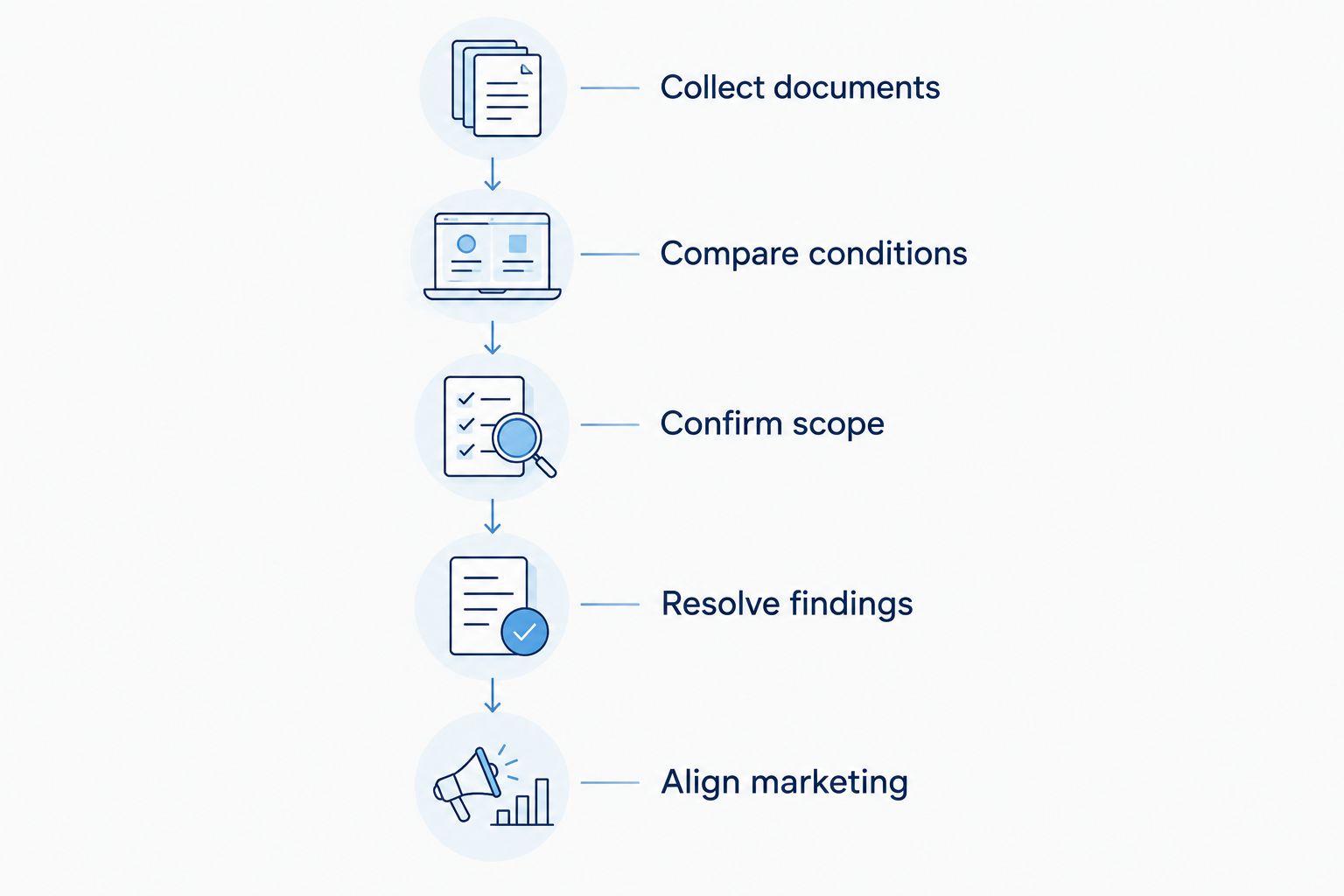
Use this sequence before authorizing work for a 2026 listing. Keep the survey decision connected to your marketing plan rather than treating it as an isolated administrative task.
- Collect documents. Gather the deed, legal description, existing survey, available title records, and records of later improvements. Preserve complete copies rather than screenshots.
- Compare conditions. Identify what changed and where visible use does not clearly match the documentation. Note the concern without attempting your own legal boundary determination.
- Confirm scope. Ask the title professional and licensed surveyor what work addresses the issue and which transaction requirements remain separate.
- Resolve findings. Direct boundary interpretation to the surveyor and legal rights or title questions to the appropriate attorney or title professional.
- Align marketing. Adjust listing descriptions, supporting documents, and negotiations to the verified information. Avoid presenting unresolved assumptions as established features.
Set expectations about deliverables before authorizing the assignment. Ask what the drawing will show, what documents the surveyor needs, and which questions fall outside the engagement. This avoids confusing a boundary assignment with elevation work, an inspection, or a legal opinion.
How should Miami neighborhoods affect your decision?
Use neighborhood context to choose questions, not to assume answers. Without parcel-level evidence, no neighborhood name establishes that your property needs a new survey or that an existing survey is sufficient.
For a Coconut Grove house, compare any garden walls, fences, accessory structures, and driveway configuration with the available records. Mature landscaping can obscure physical features; it does not establish a legal boundary.
For a Coral Gables house, examine the relationship between the documented parcel and any additions, pool, paving, or perimeter improvements. Keep municipal approval questions separate from boundary questions: evidence addressing one does not automatically answer the other.
For Brickell and Brickell Key condos, begin with recorded unit rights and the association documents relevant to your listing claims. Do not apply a detached-home checklist mechanically to a condominium sale.
Carlos Morean's Miami real estate brokerage services cover residential, waterfront, and condominium properties. Use brokerage guidance to connect these property-specific questions to pricing and presentation, while keeping technical conclusions with the qualified professionals.
Does a survey replace a home inspection or title search?
A survey replaces neither a home inspection nor a title search. A boundary survey addresses the land and physical features within its scope; an inspection evaluates building conditions within the inspector's engagement.
A title review examines recorded ownership and interests affecting the transaction. The documents work together: a title exception can require interpretation alongside the survey, while a visible feature can raise a question for further title review.
Similarly, a boundary survey is not automatically an elevation certificate. If flood-elevation documentation is needed for your 2026 sale, ask specifically which document is required and who is qualified to prepare it.
Can you sell a Miami property without a new survey?
A new survey is not automatically required for every Miami sale. Whether one is needed depends on the property, the contract, existing documentation, and the requirements of the parties involved.
Do not convert that answer into a promise that the buyer will accept your existing paperwork. Confirm requirements early enough to address discrepancies before they become an urgent closing issue.
Should you correct a boundary issue before listing?
Investigate a suspected boundary issue before deciding how to market the property. First establish what the survey shows, then obtain advice about legal consequences and possible responses.
Do not move a fence, remove an improvement, or assure a neighbor that ownership is settled based solely on your reading of a drawing. A physical change without the right advice can create a separate problem rather than resolve the original one.
FAQ
Is a pre-listing survey before selling in Miami always worth it?
A pre-listing survey before selling in Miami is worth considering when it addresses uncertain boundaries, changed improvements, or a transaction requirement. Review existing records first rather than assuming every property needs new work.
Can I use the survey from when I bought my Miami house?
Your existing survey needs review before you rely on it for the sale. Physical changes, the document's contents, and title or lender requirements determine whether additional work is needed.
Do I need a boundary survey to sell my Brickell condo?
A new boundary survey is not an automatic starting requirement for every individual Brickell condo sale. Begin with the recorded unit documents and verify parking, storage, and other rights represented in the listing.
Will a survey tell me whether my addition was permitted?
A survey does not establish that an addition was properly permitted. Review permit and approval records separately, even if the addition appears on the survey drawing.
Does a survey prove that I own the land inside my fence?
A fence does not establish legal ownership, and a survey is not a legal ownership judgment. Ask a licensed surveyor about the boundary findings and an attorney about disputed rights.
Is a boundary survey the same as an elevation certificate?
A boundary survey is not the same as an elevation certificate. Ask which document is needed for the specific boundary, flood-elevation, insurance, or transaction question.
Does a clean survey guarantee a smooth closing?
A clean survey does not guarantee a smooth closing. Title matters, financing, inspections, association requirements, and contractual obligations remain separate considerations.
One last thing
A survey can show a physical improvement without establishing that the improvement is authorized. Keep boundary location, ownership rights, permits, and condition as separate questions when preparing your 2026 listing.
Before you commission work, write down the exact question you need answered. Bring that question and your existing records to Carlos Morean for a discussion of your sale preparation, then obtain the necessary surveying or legal advice.