
When you sell a home in Miami in 2026, your title insurance expense depends on the insured amount, the applicable Florida premium rules, and whether your contract assigns the premium to you or the buyer. The premium does not include every title-related closing charge, so request an itemized seller estimate rather than treating a single title-company total as insurance.
- Title insurance cost selling a home in Miami depends on coverage, Florida premium rules, and the contract’s payment allocation.
- Miami-Dade buyers commonly pay the owner’s premium, but the signed contract controls your responsibility.
- Florida title insurance premiums are separate from settlement services, searches, recording charges, and mortgage payoffs.
- Compare itemized estimates using the same coverage and contract terms, not just the bottom-line total.
Why this matters
Your first question should be who pays, not just how much the policy costs. A seller estimate that assigns you an expense belonging to the buyer understates your expected proceeds. An estimate that leaves out an expense you accepted does the opposite.
For your 2026 sale, review the title provisions before accepting an offer. Carlos Morean provides Miami real estate brokerage services for sellers; the closing agent calculates the title charges, and an attorney addresses legal questions about the contract or ownership.
The practical goal is a seller net sheet that separates insurance, closing services, debt repayment, and other deductions. That separation makes competing offers easier to evaluate without confusing a larger purchase offer with a better net outcome.
How much does title insurance cost when selling a home in Miami?
There is no single premium that applies to every Miami sale. Florida Administrative Code Rule 69O-186.003 establishes title insurance premium rules, including provisions relevant to original coverage, reissue coverage, and simultaneous issuance. Your closing agent should identify the applicable treatment on the written estimate.
For a 2026 transaction, use this breakdown to understand what you are reviewing:
| Charge or coverage | What it addresses | What the seller should confirm |
|---|---|---|
| Owner’s title policy | Covered defects affecting the buyer’s ownership, subject to policy terms | Insured amount, applicable premium treatment, and assigned payer |
| Lender’s title policy | Covered risks affecting the mortgage lender’s interest | Whether financing requires it and how the contract allocates charges |
| Title search and examination | Review of ownership records and recorded matters | Whether these services appear separately from the premium |
| Settlement services | Administration of the closing | Which services are included and which party pays |
| Recording and government charges | Recording documents and applicable transaction charges | That these are not presented as insurance premiums |
| Title-clearing work | Resolving issues needed to convey insurable title | What work is necessary and how it will be billed |
Ask for the premium as its own line item. A bundled title-company estimate does not tell you which part is insurance or whether the seller owes every listed charge.
The owner’s policy protects the buyer
An owner’s policy addresses covered title risks under its terms, conditions, exclusions, and exceptions. It is not a home inspection, a flood policy, or a guarantee of the property’s physical condition.
The benefit is ownership protection against covered claims. The limitation is equally important: not every problem affecting the property falls within the policy. Review the proposed exceptions rather than assuming the word insured means every ownership concern has disappeared.
The lender’s policy protects the lender
A lender’s policy protects the lender’s insured interest, not the buyer’s equity. A financed purchase can involve both an owner’s policy and a lender’s policy, with simultaneous-issue treatment relevant to the premium calculation.
The benefit is protection for the mortgage lender against covered title risks. The limitation is that the buyer does not receive owner’s coverage merely because the lender requires a policy. As the seller, confirm which charges the contract actually assigns to you.
Who pays title insurance when you sell in Miami?
In Miami-Dade County, buyers commonly pay the owner’s title insurance premium, but local custom does not override your signed contract. The agreement can assign the premium differently, and related search, examination, and closing charges do not necessarily follow the same allocation.
Read the selected title provisions, any addenda, and negotiated changes together. Do not rely on a verbal statement that the buyer pays title without clarifying exactly which charges that statement covers.
Before accepting an offer, ask:
- Who selects the closing agent under this agreement?
- Who pays the owner’s premium?
- Who pays title searches, examination, and closing services?
- Does a seller credit cover any buyer expenses?
- Does an addendum change the standard allocation?
For your 2026 seller net sheet, distinguish a direct seller charge from a negotiated buyer credit. Both affect proceeds, but they are different contract obligations and should remain separate on the estimate.
How do you get a useful title insurance estimate?
A useful estimate connects the proposed transaction to the actual contract. Follow this sequence before treating a net-proceeds figure as dependable.
- Contract review. Send the closing agent the executed agreement and relevant addenda. Ask which title provisions determine your obligations.
- Policy review. Supply an existing owner’s title policy if you have it. Ask whether it supports reissue treatment under Florida’s rules.
- Itemized estimate. Request separate entries for premiums, services, government charges, and any work required to clear title.
- Net proceeds. Reconcile the estimate with mortgage payoffs, seller credits, association obligations, and other deductions from the sale.
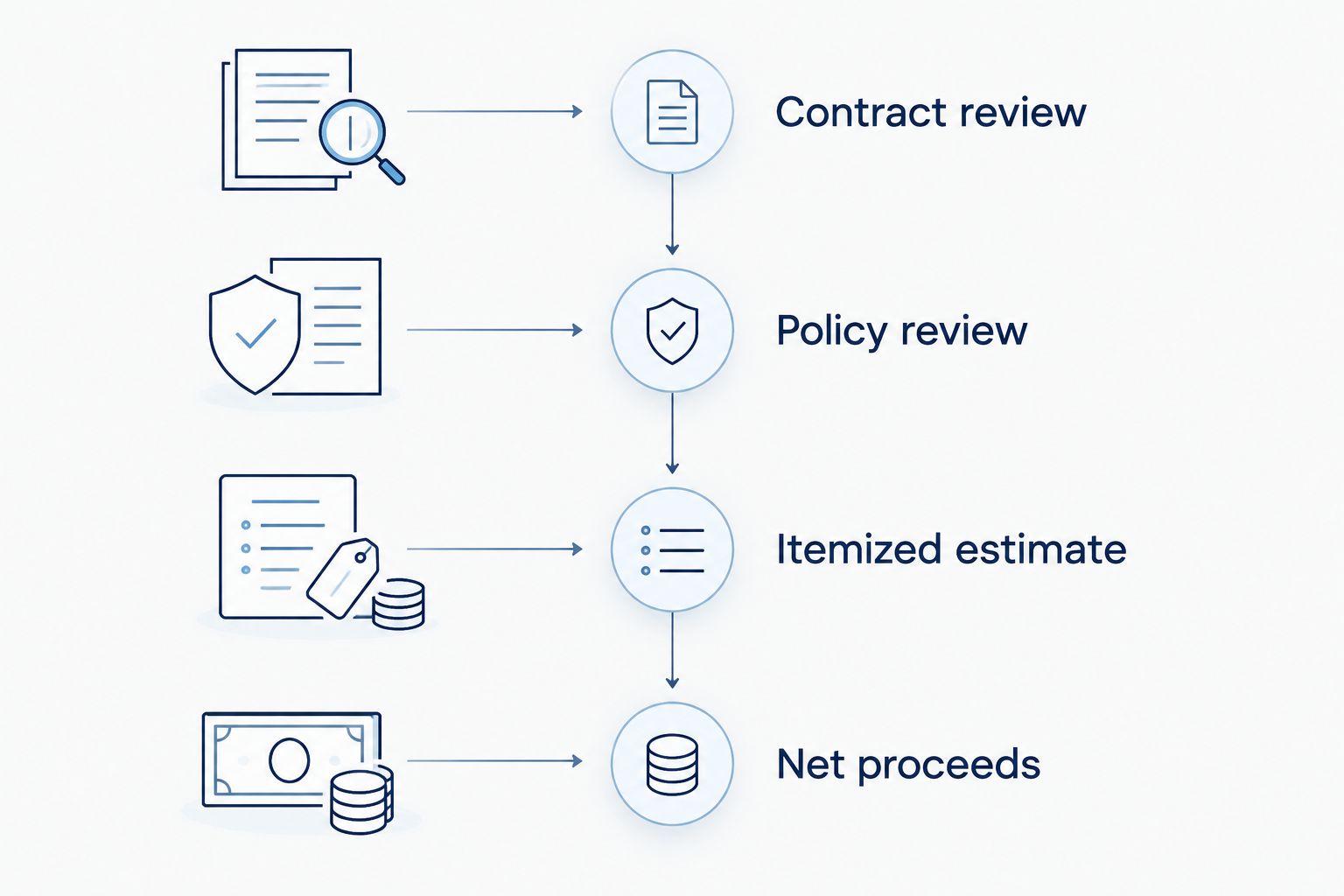
Keep the estimate dated and tied to its assumptions. A preliminary worksheet prepared before the contract is signed is not the same as a closing statement prepared after title issues and payoff requirements have been identified.
For a 2026 closing, request an updated estimate when the agreement changes or a newly identified obligation affects your proceeds. Accuracy matters more than preserving an early estimate that no longer reflects the transaction.
Why your seller title expense varies
Your seller expense changes for reasons beyond the basic premium calculation. These are the factors to discuss with the closing agent:
- Insured amount. The amount of coverage is an input to the premium calculation. Confirm it matches the intended transaction and policy.
- Contract allocation. Your agreement determines whether you pay the owner’s premium and which related services belong on your side of the statement.
- Existing policy documentation. An earlier owner’s policy can be relevant to reissue eligibility. The closing agent must confirm that the requirements are satisfied.
- Financing and policy structure. A financed purchase introduces lender coverage and raises the question of simultaneous issuance.
- Endorsements and coverage requirements. Additional coverage requirements affect the policy package. Ask what is included and why it is needed.
- Title issues and closing services. Unreleased liens, ownership questions, and other matters requiring resolution can create work separate from the insurance premium.
Do not confuse a lower insurance line with lower total seller expenses. Compare the complete allocation of obligations while keeping premiums distinct from services and title-clearing work.
Does your Miami neighborhood change the premium?
A neighborhood name is not a substitute for the insured amount and applicable Florida premium rules. A Brickell Key address does not, by itself, explain a different premium from a Coconut Grove address.
The property’s ownership structure and transaction documents still matter. Use these neighborhood-specific review points without assuming they apply to every property:
- Brickell and Brickell Key condos: Keep association estoppel information, assessments, and association-related charges separate from title insurance. Review parking and storage rights in the relevant documents.
- Coconut Grove properties: For waterfront or other properties with access questions, review recorded easements and the legal description. Do not assume title insurance establishes physical boundaries or dock rights.
- Coral Gables properties: Review recorded restrictions and easements affecting the parcel. Distinguish title matters from permit, code, and physical-condition questions that require separate investigation.
For a 2026 sale, use the actual parcel, building, and contract documents. A nearby closing can suggest useful questions, but it does not establish your coverage or payment obligations.
How should you compare closing-agent estimates?
Compare the same transaction assumptions before comparing totals. Different coverage, omitted services, or a different allocation between buyer and seller can make estimates appear inconsistent.
| Review approach | Best for | Benefit | Limitation |
|---|---|---|---|
| Itemized written estimate | Checking your seller obligations | Separates premiums, services, and other deductions | Remains dependent on stated assumptions |
| Contract-matched seller net sheet | Evaluating an offer | Connects closing obligations to expected proceeds | Needs updating when transaction details change |
| Final closing statement review | Confirming actual disbursements | Shows the amounts assigned at closing | Is too late to replace careful offer-stage planning |
Ask each closing agent to identify the policy coverage, premium treatment, service charges, exclusions from the estimate, and contract provisions used. A useful response explains the differences rather than simply presenting another total.
Carlos Morean is a fit for Miami sellers seeking real estate brokerage guidance on offer terms and expected proceeds. Title insurance underwriting and legal interpretation belong with the appropriate title and legal professionals; brokerage guidance does not replace either role.
Can an existing owner’s policy reduce the premium?
An existing owner’s policy can support reissue treatment when the applicable Florida requirements are met. Give the closing agent the policy itself and ask for a written eligibility determination rather than assuming an old closing statement is enough.
The useful distinction is between having previously purchased insurance and documenting eligibility for the current transaction. Do not build a reduction into your expected proceeds until the closing agent confirms it.
Does title insurance cover unpaid condo assessments?
Title insurance does not replace association due diligence. Whether a particular claim falls within coverage depends on the policy and the facts, while estoppel information and the contract help determine obligations at closing.
For a Brickell or Brickell Key condo, reconcile association balances and assessment obligations separately. An assessment should not disappear into a general title-expense category on your seller worksheet.
Can you negotiate who pays the owner’s premium?
You can negotiate responsibility for the owner’s premium in the purchase agreement. Negotiating the payer is different from changing Florida’s applicable premium rules.
Evaluate the proposed allocation alongside the buyer’s other requested concessions. A buyer-paid premium does not automatically make an offer stronger if other seller obligations reduce your proceeds.
FAQ
How do I calculate title insurance cost when selling a home in Miami?
Request an itemized calculation from the closing agent using the insured amount, applicable Florida premium rules, and your contract’s payment allocation. Keep insurance premiums separate from settlement services, government charges, and title-clearing work.
Does the seller always pay title insurance in Miami?
No, the seller does not always pay title insurance in Miami. Buyers commonly pay the owner’s premium in Miami-Dade County, but the signed agreement determines responsibility.
Is title insurance included in the closing agent’s fee?
Do not assume the insurance premium is included in the closing agent’s service fee. Ask for an itemized estimate showing premiums and services separately, even if an initial quotation combines them.
Does a cash buyer still need an owner’s title policy?
A cash buyer has no mortgage lender requiring lender coverage, but ownership risks still exist. An owner’s policy addresses covered title risks under its terms; the buyer should discuss the coverage decision with the closing agent or attorney.
Can I use my old title policy when I sell?
Provide your existing owner’s policy so the closing agent can review reissue eligibility. The prior policy does not automatically transfer to the buyer or guarantee reduced treatment for the new transaction.
Does title insurance cover flood damage to a Miami home?
Title insurance does not insure physical flood damage. It addresses covered title risks, while flood coverage and property-condition investigations serve different purposes.
Can Carlos Morean help me understand my seller net sheet?
Carlos Morean provides Miami real estate brokerage guidance for sellers, including practical discussion of offer terms and seller expenses. The closing agent supplies the title calculation, and legal questions require an attorney.
One last thing
Find your existing owner’s title policy before you list the property. Store it with your deed and closing records, then provide it when the closing agent requests documentation. It gives the agent something concrete to review for reissue eligibility instead of leaving that question unresolved until closing preparation.