
Selling a house in Miami in 2026 costs you the agreed brokerage compensation, seller-assigned closing charges, applicable transfer taxes, and any preparation or repair expenses you authorize—not a fixed percentage that fits every property. Your mortgage payoff, unpaid property obligations, and buyer credits also reduce what you receive, so compare offers by net proceeds, not the headline sale amount.
- How much does it cost to sell a house in Miami? Your contract, property obligations, and negotiated compensation determine the total.
- Carlos Morean provides Miami real estate brokerage services for owners selling residential, waterfront, and condo properties.
- Separate seller closing costs from mortgage payoff when estimating net proceeds.
- For Brickell and Brickell Key condos, check association balances and assessment obligations before accepting an offer.
How much does it cost to sell a house in Miami in 2026?
Your selling budget should separate transaction expenses, property preparation, and existing debts. Combining everything into a single closing-cost estimate hides which expenses you can negotiate and which obligations already belong to the property.
Use this breakdown when requesting a written seller net sheet:
| Expense or deduction | What determines it | What you should verify |
|---|---|---|
| Brokerage compensation | Your signed agreement and any additional compensation you authorize | Services included, payment terms, and separate charges |
| Deed transfer taxes | Taxable consideration and applicable exemptions | Documentary stamp tax and any applicable surtax |
| Title and settlement charges | Contract allocation and closing services | Which party pays each item |
| Mortgage payoff | Your lender's payoff statement | Interest through payoff and any release charges |
| Property-tax adjustment | Contract terms, closing date, and tax information | Whether the entry is a debit or credit |
| Association obligations | Association records and governing documents | Unpaid balances, assessments, and transfer-related charges |
| Repairs and buyer concessions | Your negotiated contract and amendments | Whether an obligation is a repair, credit, or other payment |
| Preparation and moving | Work you approve and your relocation arrangements | Expenses paid before closing versus deducted at closing |
For the condo transaction sequence, review the Miami condo offer-to-closing workflow. Request a seller-specific estimate rather than treating a buyer's closing checklist as your own.
Why this matters
A stronger offer on paper does not automatically leave you with more money. Buyer concessions, repair commitments, association obligations, and the closing date all affect the result.
In 2026, build your decision around a written estimate that changes with the contract. An estimate prepared before listing is a planning document; an updated estimate after negotiations is the decision document. Neither replaces the final settlement statement.
Keep mortgage debt separate from selling expenses. Paying off an existing loan reduces your equity distribution, but it does not measure what the brokerage and closing process cost you.
Brokerage compensation: review the agreement, not a default rate
Real estate commissions are negotiable. Your listing agreement should explain the compensation you owe, the services covered, when payment becomes due, and any separate charges.
If an offer asks you to contribute toward the buyer's brokerage compensation, identify that request separately. Do not assume the listing agreement already includes every payment requested in a purchase offer.
Ask an agent candidate to connect the proposed compensation to a specific seller marketing plan. For a Coconut Grove house, that discussion should address the property's condition, usable outdoor space, and competing listings; for a Brickell condo, it should address the building, unit position, view, and association documentation.
Carlos Morean is a fit for Miami residential sellers seeking agent representation rather than a self-managed sale. Brokerage representation adds professional assistance, but it also creates a compensation obligation under the agreement; compare that obligation with the actual services described.
Transfer taxes: distinguish the base tax from the surtax
For 2026 planning, Florida Department of Revenue guidance on documentary stamp tax provides the relevant Miami-Dade distinction: the county's base deed tax is 0.60% of taxable consideration. Actual calculation follows the state's taxable-increment rules, so have the closing agent calculate the final charge.
Miami-Dade also imposes a 0.45% surtax on applicable transfers. Transfers involving a single-family dwelling are exempt from that surtax under the applicable rules; have the closing agent confirm the property's treatment rather than deciding from a listing label.
Where both taxes apply, their combined nominal rate is 1.05% of taxable consideration, before accounting for the statutory calculation increments. These rates describe deed taxes, not the total cost of selling.
Source scope: Florida Department of Revenue, Documentary Stamp Tax guidance, and Florida Statutes sections 201.02 and 201.031. Confirm applicability and current requirements with the closing agent for your transaction.
Do not assume that paying a deed tax means every other transfer-related charge is covered. Title services, recording, mortgage releases, and association documents belong on separate lines.
Title, settlement, and mortgage payoff: keep the categories separate
Your purchase contract determines the allocation of many closing expenses. Local practice is not a substitute for reading the executed agreement, especially when an offer uses terms different from your expectations.
Ask the closing agent to identify title insurance, settlement services, document preparation, recording, and other charges separately. Request an explanation of unfamiliar entries before you sign closing documents.
For a financed property, obtain an official payoff statement from the lender. An online principal balance is not a closing payoff because accrued interest and other applicable items affect the amount required to release the mortgage.
A delayed closing also changes the calculation. Confirm the payoff statement's valid-through date and request an updated figure when the schedule moves beyond it.
Association obligations: check the building before negotiating
For a Brickell or Brickell Key condo, the association's financial records affect the seller's estimate. Verify the unit's account balance, pending or approved assessments, document charges, and any transfer or approval requirements that apply.
An assessment's payment schedule does not, by itself, settle who pays it in a sale. Review the contract language and association documents together, and have the closing agent or attorney resolve the allocation.
The same discipline applies to a Coconut Grove condo or a property within an association in Coral Gables. Do not treat a neighborhood name as proof that the ownership structure is simple.
Keep association obligations distinct from your ordinary carrying expenses. Regular payments made while you own the property and amounts collected through closing serve different purposes, even when both reduce your available cash.
Why selling costs vary across Miami properties
These factors change either the expenses themselves or the amount deducted from your proceeds:
- Property type. A house, condominium, and commercial property do not share identical documentation, tax treatment, or association requirements.
- Ownership structure. Association membership introduces account verification and governing-document questions that do not apply to every property.
- Contract terms. Negotiated compensation, buyer credits, repair agreements, and closing-charge allocations change your obligations.
- Property condition. A sale involving repairs or unresolved property issues requires different decisions from a sale without those issues.
- Closing date. The date affects mortgage interest, prorations, and how long you continue paying carrying expenses.
- Existing obligations. Mortgage debt, liens, unpaid balances, and assessments affect the amount available for distribution.
Neighborhood detail matters most when it improves the comparison. In Coconut Grove and Coral Gables, distinguish the property's ownership structure and physical condition; in Brickell and Brickell Key, distinguish the building and the unit rather than relying on neighborhood-wide averages.
None of those locations justifies a universal seller-cost percentage. Use property records, actual agreements, and written closing estimates.
How do you estimate your net proceeds before listing?
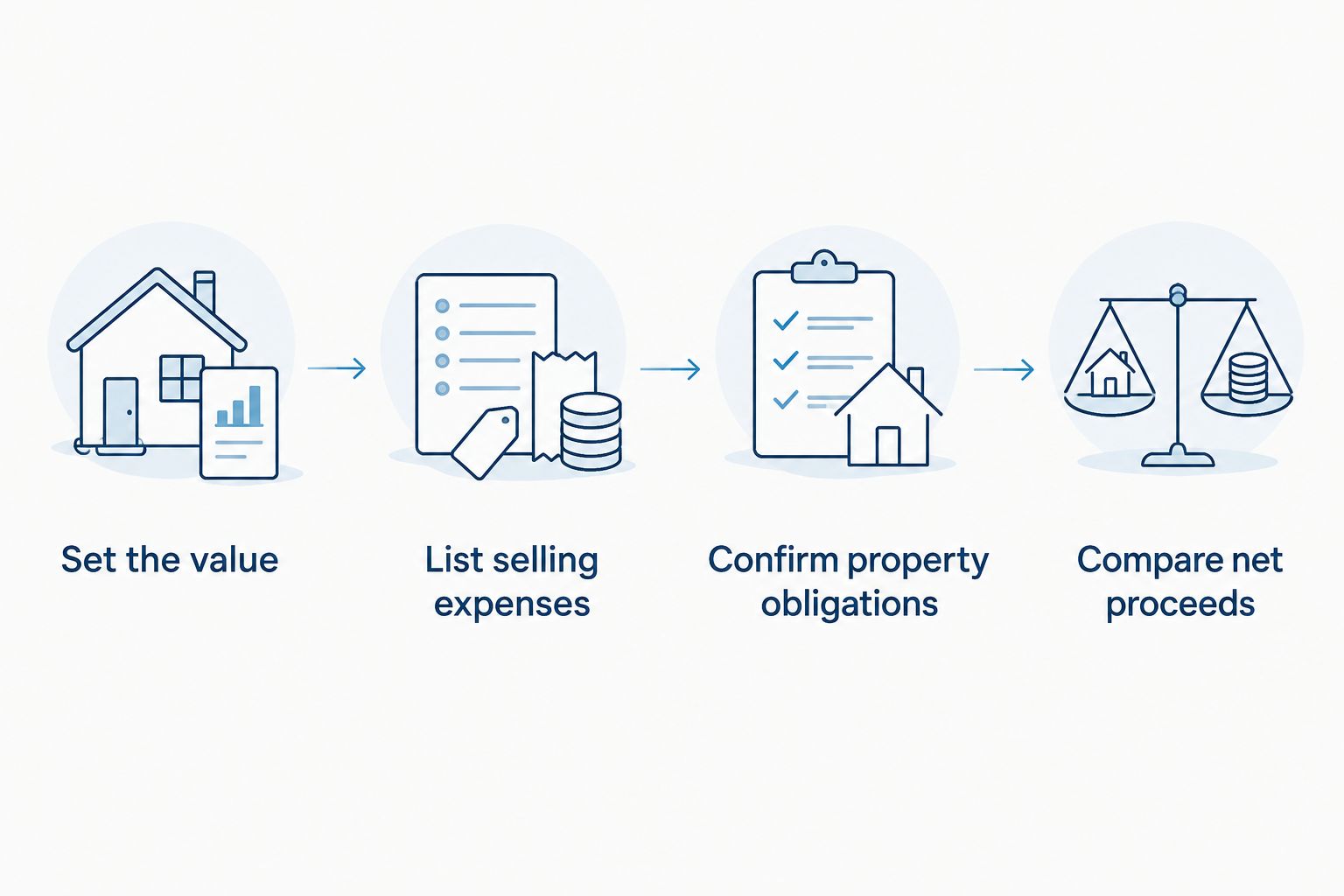
Build your 2026 estimate in a consistent order. That makes it easier to spot a missing obligation and compare revised offers without rebuilding the calculation each time.
- Set the value. Establish a defensible expected sale amount using relevant closed transactions and current competition. Separate asking amounts from evidence of completed sales.
- List selling expenses. Add agreed compensation, seller-assigned closing charges, applicable taxes, and preparation expenses. Mark expenses already paid so they are not deducted twice.
- Confirm property obligations. Obtain mortgage payoff information and identify liens, association balances, and assessments. Assign responsibility using the contract and applicable documents.
- Compare net proceeds. Subtract the relevant expenses, credits, and obligations from each offer. Keep the assumptions and closing date visible.
A useful estimate identifies who supplied each figure: the listing agreement, lender, association, contractor, or closing agent. That record makes updates easier when a negotiation changes only part of the transaction.
Ask Carlos Morean about residential brokerage representation for your Miami sale, and have the closing agent verify settlement charges. An agent's pricing advice and a closing agent's financial calculation answer different questions.
Should you repair the property or offer a buyer credit?
Choose repairs or credits based on the property's condition, contract requirements, and effect on your net proceeds—not on an assumed return. A repair offers a completed result; a credit leaves the work for the buyer but reduces your proceeds and requires an acceptable agreement.
| Approach | Best for | Benefit | Limitation |
|---|---|---|---|
| Complete repairs | Sellers with defined work and time to manage it | Resolves the identified issue before closing | Requires upfront spending and contractor coordination |
| Negotiate a credit | Sellers and buyers who agree on a documented adjustment | Avoids seller-managed construction | Reduces proceeds and remains subject to contract and financing constraints |
| Sell without agreed repairs | Sellers accepting condition-related negotiation | Limits voluntary preparation work | Does not remove disclosure duties or buyer inspection concerns |
Obtain a written scope before approving work. Cosmetic improvements do not resolve an underlying defect, and a buyer credit does not automatically satisfy a lender's property-condition requirements.
For a waterfront property, keep dock, seawall, and other waterfront-condition questions separate from ordinary interior presentation. Have qualified professionals evaluate the relevant components rather than treating staging as a substitute for due diligence.
Does the closing date change what you receive?
The closing date changes mortgage interest, prorations, and carrying expenses. An offer that closes sooner and an offer that closes later should therefore use different net-proceeds assumptions.
Include the ownership expenses you continue paying before closing, but distinguish them from charges appearing on the settlement statement. That prevents a misleading comparison in which one offer includes carrying expenses and another ignores them.
When evaluating a delayed closing, review the buyer's financing and contractual deadlines as well. A proposed date is not the same as a completed transaction.
FAQ
How much does it cost to sell a house in Miami in 2026?
Your total depends on negotiated brokerage compensation, contract-assigned closing charges, applicable taxes, and property-specific expenses. Mortgage payoff and other existing obligations also reduce net proceeds but should be tracked separately from transaction costs.
Is there a standard real estate commission for Miami sellers?
No standard commission applies to every Miami sale; brokerage compensation is negotiable. Review your listing agreement and any separately requested buyer-side compensation before accepting an offer.
What deed tax applies when I sell in Miami-Dade?
Miami-Dade's base documentary stamp tax on deeds is 0.60% of taxable consideration, calculated under statutory increment rules. An additional 0.45% surtax applies to qualifying transfers, subject to exemptions that your closing agent should confirm.
Does my mortgage balance count as a selling expense?
Your mortgage payoff reduces your net proceeds but is separate from the transaction expenses of selling. Obtain a lender payoff statement rather than using the principal balance shown online.
Who pays a condo special assessment when a Miami unit sells?
Responsibility depends on the contract, the assessment, and the applicable association documents. Confirm the allocation in writing rather than assuming the current payment schedule determines who pays.
Should I accept the offer with the highest sale amount?
Compare estimated net proceeds and contract terms rather than the sale amount alone. Credits, repairs, compensation requests, financing conditions, and closing timing affect the result.
Can Carlos Morean help me sell a Miami condo?
Carlos Morean provides residential real estate brokerage services in Miami, including condos and waterfront properties. Review the proposed representation agreement, marketing plan, and compensation before appointing an agent.
One last thing
A property-tax credit on the settlement statement is not necessarily a second tax payment. Proration allocates the relevant tax obligation between buyer and seller according to the contract and closing calculation.
Before signing, reconcile the final statement against your latest estimate line by line. Ask for explanations of changed entries, confirm the mortgage payoff, and distinguish actual charges from credits, prorations, and returned funds.