
Yes, short-term rental is allowed in some Miami condo buildings, but you must confirm the property's local land-use rules, the condominium's governing documents, and applicable licensing requirements before accepting bookings. A listing advertised as rental-friendly is not proof that your intended stay length, booking frequency, or operating arrangement is permitted in 2026.
- Is short term rental allowed in Miami condo buildings? Sometimes; verify local rules, condominium restrictions, and licensing separately.
- Carlos Morean helps Miami condo buyers and sellers; rental permission still requires property-specific documentation.
- Condo rental restrictions affect your investment assumptions and the claims you make when selling.
- Confirm minimum stays, rental frequency, approval procedures, and operating requirements before committing.
Why this matters
Rental permission is a property-specific finding, not a neighborhood feature. A condo that suits your personal use can still fail your rental plan if its documents prohibit the stays you intend to offer.
For sellers, the same distinction affects accurate positioning. Describe documented rental rights rather than promising investment potential that depends on an unverified operating model. Start with the Miami rental property guide for landlords, then verify the individual property.
Your 2026 decision should separate permission from profitability. Legal rental use does not establish expected occupancy, operating expenses, insurability, financing eligibility, or resale value.
Is short-term rental allowed in Miami condo buildings?
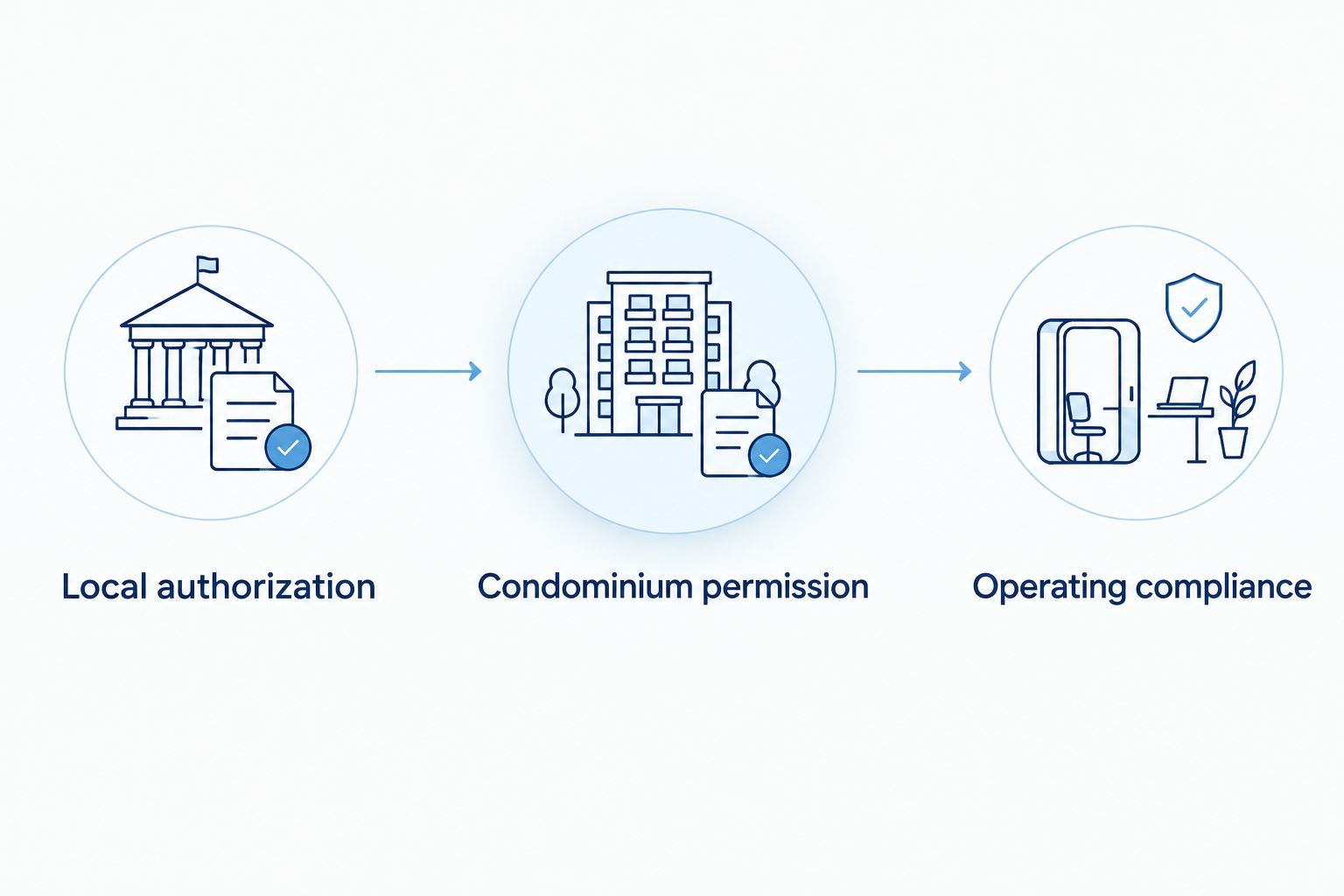
Short-term rental is allowed only where the intended use satisfies all applicable requirements. Use 3 permission checks: local authorization, condominium permission, and operating compliance. Passing one check does not replace the others.
| Permission check | What you need to establish | What does not establish it |
|---|---|---|
| Local authorization | The relevant jurisdiction permits the proposed rental use at the property | A Miami mailing address or nearby vacation rentals |
| Condominium permission | The governing documents permit your stay length, frequency, and approval process | A listing description or another owner's bookings |
| Operating compliance | Required registrations, licenses, tax accounts, and operating conditions are addressed | Approval to purchase the unit or use a booking platform |
1. Identify the jurisdiction
Confirm the property's municipality and parcel before researching rental rules. Miami, Miami Beach, Coral Gables, and unincorporated Miami-Dade County are not interchangeable jurisdictions.
Ask the responsible planning or zoning office how it classifies your proposed activity. Describe the actual arrangement: entire-unit rentals, owner occupancy, guest turnover, and intended stay length. A general question about whether rentals are allowed can produce an answer that does not cover your plan.
2. Read the condominium documents
Request the declaration, amendments, current rules, and rental application procedures. Locate the provisions that govern minimum lease terms, rental frequency, waiting periods after purchase, tenant approval, and guest occupancy.
Have a Florida real estate attorney resolve conflicting provisions or uncertain amendment histories. A manager's explanation helps you locate the rule; it does not replace the governing document.
3. Confirm operating requirements
Determine which state and local requirements apply to the proposed activity. Address licensing, business registrations, tax collection, safety requirements, and any applicable operating restrictions before advertising or accepting reservations.
For a 2026 review, ask counsel to distinguish Florida Statutes Chapter 718, which addresses condominiums, from Chapter 509, which addresses public lodging establishments and related regulation. Neither chapter is a substitute for checking the property's local rules and recorded restrictions.
What does a rental-friendly condo actually allow?
Rental-friendly is an informal description, not a complete statement of rights. Ask the person using it to identify the exact provision supporting the claim.
A building can permit leasing while prohibiting the short stays you intend to offer. It can also permit a particular lease duration while limiting how often an owner rents during the year. Read those provisions together.
| Rental arrangement | Best for | Practical advantage | Limitation to verify |
|---|---|---|---|
| Short stays | Owners seeking frequent guest turnover | Supports a short-stay operating plan where expressly permitted | Local authorization, booking frequency, guest procedures, and operating requirements |
| Extended furnished stays | Owners targeting temporary housing needs | Fits renters who need more than a brief visit | Minimum lease term, tenant approval, and furnished-use restrictions |
| Longer-term leasing | Owners seeking a conventional tenant arrangement | Reduces turnover compared with repeated short bookings | Lease restrictions, screening, renewal provisions, and landlord obligations |
These are operating choices, not recommendations for a particular building. Choose the rental arrangement after verifying permission, not before. A longer booking does not automatically solve every restriction, and changing the booking platform does not change the underlying use.
Which documents should you request before buying or selling?
Organize your review into 4 document groups. Keep the source, date, and property identification with each record so that your conclusion can be checked later.
- Recorded restrictions: The declaration and relevant amendments establish the starting point for condominium rental rights. Obtain the provisions themselves, not a summary copied from an older listing.
- Association procedures: Current rules, application forms, tenant-screening instructions, and guest-registration procedures explain how a permitted rental is administered.
- Local authorization: Written guidance, applicable approvals, and property-specific records help establish whether the proposed use is allowed by the responsible jurisdiction.
- Operating records: Applicable licenses, registrations, insurance terms, and any management agreement show what is required to operate the rental arrangement.
Ask for 2 written confirmations as part of this review: the association's explanation of the applicable rental provisions and the relevant local authority's response about the proposed use. Neither is a substitute for legal interpretation, but both create a clearer record than a verbal assurance.
If you already own the condo, repeat the document review before making rental claims in a 2026 listing. An old rental advertisement does not establish today's permissions or the rights a buyer will receive.
Why short-term rental permission varies
The answer changes because several independent rules apply to the same property. Focus on these factors rather than relying on a building's reputation:
- Jurisdiction and land use: The responsible municipality or county controls the applicable local framework. Verify the parcel rather than searching only by neighborhood name.
- Recorded condominium restrictions: A declaration or amendment can limit rentals even where local rules permit the use.
- Stay length and frequency: Minimum lease terms and limits on repeated rentals address different parts of the operating plan. Both need review.
- Ownership and approval conditions: Waiting periods, application procedures, and tenant approvals can affect when and how an owner rents.
- Operating classification: The actual rental activity determines which licensing, registration, tax, and safety requirements need examination.
An existing owner's rental history does not settle these questions for a buyer. Ask counsel whether any exception, amendment, agreement, or ownership-specific circumstance affects the rights being represented.
Does the answer change between Brickell and Coconut Grove?
The neighborhood helps identify the search area, but it does not establish rental permission. In Brickell, Brickell Key, and Coconut Grove, review the specific building and unit rather than extending one association's policy to another.
North Brickell and South Brickell are useful location distinctions for a property search. They are not substitutes for a condominium's rental provisions. Likewise, a waterfront position in Brickell Key does not establish permission for transient occupancy.
Coral Gables requires a separate jurisdictional review because it is a different municipality from the City of Miami. Do not apply a City of Miami answer to a Coral Gables property simply because both appear in a broader Miami search.
For each candidate, record the municipality, condominium association, minimum lease term, rental-frequency rule, and approval process. That creates a usable comparison without inventing neighborhood-wide permissions.
How should rental permission affect your selling strategy?
Market the rights you can document, not the income a buyer hopes to earn. If short stays are permitted, identify the supporting documents and disclose the conditions that shape the operating arrangement.
A seller's marketing file should explain the permitted lease structure, approval procedures, and any relevant management obligations. Keep rental history separate from forward-looking income assumptions. Past bookings do not guarantee future bookings or establish that every past rental complied with the rules.
For a 2026 valuation, compare properties with similar documented rental rights as well as similar physical characteristics. A view, renovation, or prestigious address does not establish an income premium on its own.
When selecting an agent, ask how the agent will verify rental claims, explain restrictions to buyers, and distinguish comparable properties. Request a marketing plan that states what will be advertised and which records support it.
Carlos Morean is best for Miami condo buyers and sellers seeking residential real estate brokerage guidance. Brokerage guidance supports the transaction; legal interpretation, licensing determinations, and tax advice require the relevant professionals.
What should buyers verify before making an offer?
Complete the permission review before treating projected rental income as the reason to purchase. If your offer depends on a particular rental arrangement, discuss appropriate review rights and contract language with your attorney before signing.
Use this sequence:
- Define the intended use. State the stay length, booking frequency, occupancy arrangement, and whether a manager will operate the property.
- Collect the documents. Obtain current restrictions, amendments, procedures, and property-specific local information.
- Resolve contradictions. Ask counsel to address differences between the listing, association response, recorded documents, and local guidance.
- Check the operating plan. Review insurance, financing, management obligations, taxes, and required registrations for the actual use.
- Decide without assumed income. Evaluate whether the purchase still works if the proposed rental arrangement is unavailable.
Do not treat a management company's willingness to accept the unit as proof of authorization. The owner still needs a clear understanding of the property's restrictions and the proposed operation.
Can a condo association prohibit short-term rentals?
A condo association's governing documents can restrict rentals, including lease duration and rental frequency. Whether a particular restriction applies to a particular owner requires review of the documents, amendments, ownership circumstances, and applicable Florida law.
Do not assume a board can create any restriction informally, or that a prior owner's treatment automatically transfers to you. Have counsel identify the provision that controls your situation.
Does an active vacation-rental listing prove the unit is legal?
An active vacation-rental listing does not prove that the unit complies with local rules or condominium restrictions. It shows that someone advertised the property, not that the proposed use was authorized.
Request the underlying approvals and documents. Guest reviews, booking calendars, and photographs do not replace them.
Should you buy if the rental documents are unclear?
Unclear rental documents are a reason to resolve the issue before relying on short-term income. Request the missing records and obtain legal advice while your contractual review options remain available.
If short stays are essential to your purchase, an unresolved permission question is an unresolved investment condition. Do not turn uncertainty into a positive assumption.
FAQ
Can I rent my Miami condo on Airbnb?
You can rent through Airbnb only if the actual rental use complies with applicable local rules, condominium restrictions, and operating requirements. The platform you choose does not establish permission.
Do all Brickell condos allow short-term rentals?
No. Brickell condo rental permission must be checked building by building, using the governing documents and applicable local requirements.
Is there one minimum rental term for every Miami condo?
There is no single building-level lease term you should assume for every Miami condo. Check the property's local requirements and the association's minimum term and rental-frequency provisions together.
Can a seller promise that a condo is rental-friendly?
A seller should support any rental-friendly claim with current documents and describe the applicable restrictions. An informal label does not establish short-term rental permission.
Does a rental license override condo restrictions?
A rental license does not by itself establish compliance with condominium restrictions. Public authorization and private restrictions require separate review.
Can Carlos Morean help me evaluate a Miami rental condo?
Carlos Morean provides Miami residential real estate brokerage services for buyers, sellers, landlords, renters, and investors. Use an attorney for legal interpretation and the responsible authority for property-specific regulatory determinations.
Should I recheck rental permission before selling in 2026?
Yes, recheck rental permission before making rental claims in a 2026 sale. Assemble the current governing documents, amendments, procedures, and relevant operating records rather than relying on an older listing.
One last thing
Ask a narrower question than whether rentals are allowed: Which document permits the exact rental arrangement I intend to operate, and which conditions apply? That wording separates ordinary leasing permission from permission for repeated short stays.
For sellers, give your agent the evidence before approving the listing copy. For buyers, keep the permission review separate from the income forecast. A property's right to operate and its financial performance are different questions.