
The cost to lease restaurant space in Miami is the base rent plus the expenses assigned to you in the lease—not the advertised rent alone. For a 2026 budget, calculate recurring occupancy expenses separately from construction, equipment, deposits, and opening reserves. Compare properties only after confirming the quoted area, billing period, permitted use, and condition of the space.
- How much does restaurant space cost to lease in Miami? Compare total occupancy obligations, not base rent alone.
- Separate recurring lease expenses from kitchen construction, equipment, deposits, and opening reserves.
- Existing restaurant infrastructure needs inspection; a previous restaurant use does not establish approval for your concept.
- Carlos Morean provides Miami commercial real estate brokerage services for restaurant and bar property searches.
How much does restaurant space cost to lease in Miami?
Your restaurant lease budget needs two separate calculations: what you owe while occupying the property and what you must fund before opening. Mixing these produces a misleading comparison between a finished restaurant and an unfinished storefront.
Use this breakdown when requesting written terms. Carlos Morean is a Miami commercial real estate brokerage resource for restaurant operators seeking property representation.
| Budget component | What to request | How to evaluate it |
|---|---|---|
| Base rent | Written quote, area measurement, billing period, increases | Convert every proposal to the same monthly basis |
| Additional rent | Expense categories, allocation method, reconciliation terms | Identify obligations outside base rent |
| Direct operating expenses | Utility responsibilities, insurance requirements, maintenance duties | Separate landlord charges from your own accounts |
| Upfront commitments | Deposit, prepaid obligations, guarantees | Track cash committed before opening |
| Premises work | Delivery condition, landlord work, tenant work | Obtain a scope before comparing construction exposure |
| Opening reserves | Your operating budget and approval schedule | Budget for obligations before revenue begins |
Why this matters
A restaurant lease is also an allocation of building risk. A favorable base-rent quote does not resolve an inadequate electrical service, an unusable exhaust route, or a lease that starts charging rent before your work is complete.
Compare the property, the contract, and the opening plan together. For a 2026 decision, a written expense schedule is more useful than a neighborhood-wide asking-rent headline.
How to calculate your monthly restaurant occupancy budget
Start with the quote's unit. Commercial proposals can express rent per square foot per year, per square foot per month, or as a monthly total; those are not interchangeable.
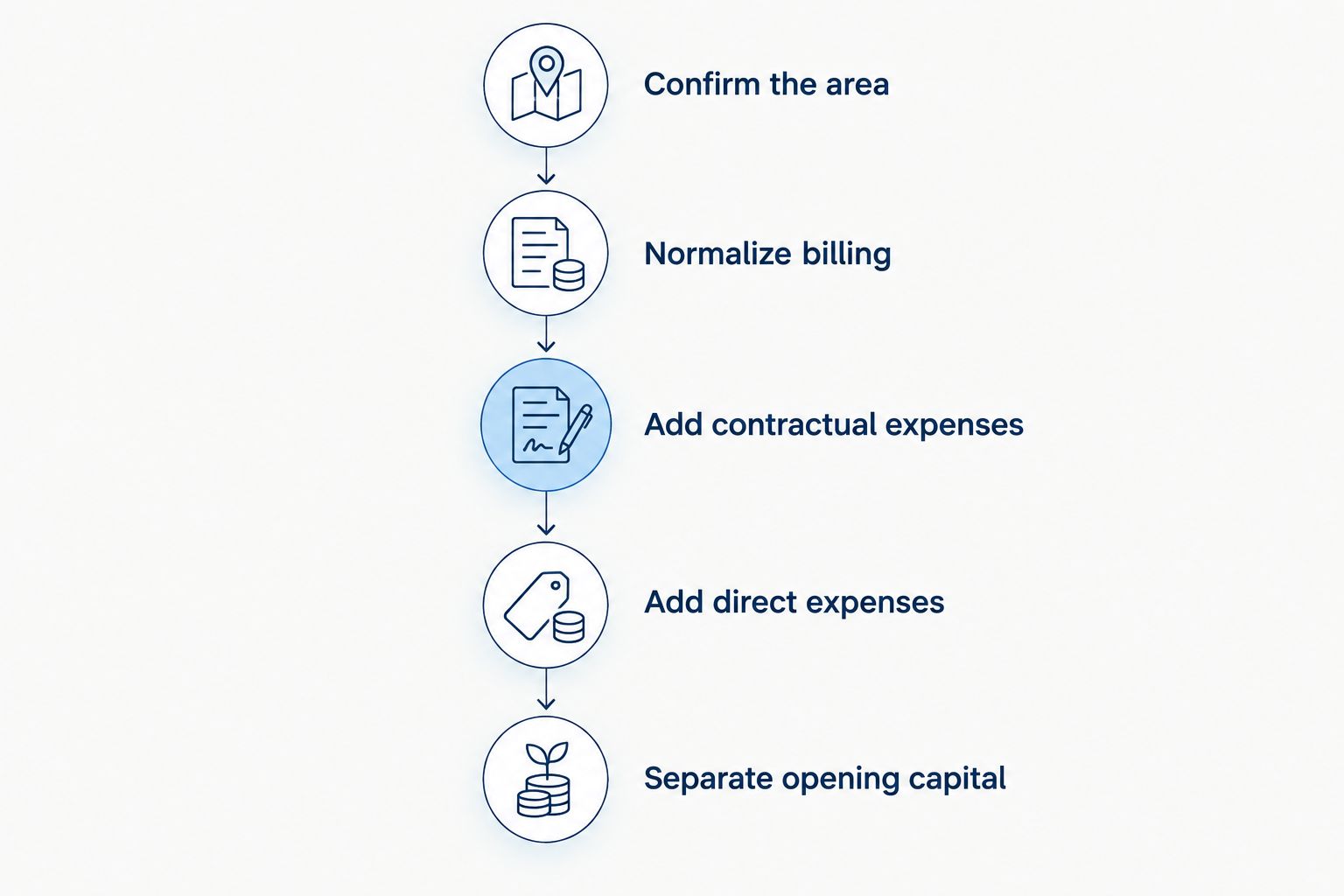
- Confirm the area. Ask which measurement controls the lease and whether the quoted area includes space outside your exclusive premises. Keep the same measurement basis throughout your comparison.
- Normalize the billing period. When rent is quoted annually per square foot, multiply the annual rate by the quoted area, then divide by 12 months. An annual billing basis covers 1 year, not a single monthly payment.
- Add contractual expenses. Include the charges the proposed lease assigns to you. Request the supporting budget and the method used to allocate shared expenses.
- Add direct expenses. Build separate allowances from actual quotes for utilities, insurance, maintenance, and other obligations paid outside the landlord's invoice.
- Keep opening capital separate. Construction and equipment belong in the project budget, even when you spread them across an internal financial model.
Your recurring comparison should show the obligation for 1 month alongside the annual total. A rate quoted for 1 square foot is a unit of measurement, not the amount payable for the entire premises.
Do not treat a preliminary expense estimate as a fixed contractual limit. Ask your attorney to identify which expenses can change, which require reconciliation, and whether the lease limits any increases.
Second-generation restaurant space: inspect what you inherit
Best for operators whose concept fits the existing kitchen, layout, and building systems. Previously used restaurant premises give you something concrete to inspect, but existing equipment is not proof that the property is ready for your operation.
Request equipment ownership records, maintenance information, available plans, and documentation for existing installations. Establish whether equipment belongs to the landlord, the departing tenant, or another party before including it in your opening plan.
The advantage is the opportunity to reuse suitable infrastructure. The drawback is inheriting limitations: kitchen placement, exhaust routing, electrical capacity, or a dining layout that does not suit your service model.
Recommendation: evaluate reusable infrastructure by condition and suitability, not by its mere presence. Have qualified professionals examine the systems before treating them as a construction saving.
Shell space: define the landlord's delivery obligations
Best for operators who need a custom layout and can manage a construction project. A shell gives you fewer existing restaurant features to work around, but the lease must establish exactly what the landlord delivers.
Clarify utility connections, structural conditions, restroom requirements, roof access, and responsibility for restaurant-specific installations. Attach an agreed scope rather than relying on a broad description such as restaurant-ready.
The advantage is design flexibility. The drawback is responsibility for coordinating work, approvals, and the cash required before opening.
Recommendation: obtain a feasibility review and construction scope before negotiating around the base rent. A layout that works on paper still needs a workable path for exhaust, deliveries, waste handling, and customer access.
Turnkey premises: verify the meaning before relying on it
Best for operators seeking an existing setup that closely matches their concept. Treat turnkey as a description to investigate, not a substitute for equipment schedules, inspections, and lease terms.
A furnished dining room does not establish ownership of the furniture, suitability of the kitchen, or approval for a different operating model. Separate the premises lease from any proposed acquisition of business assets.
| Space type | Best for | Potential advantage | Main limitation to investigate |
|---|---|---|---|
| Second-generation restaurant | A concept compatible with existing infrastructure | Opportunity to reuse suitable systems | Condition, ownership, and suitability of inherited installations |
| Shell space | A custom restaurant layout | Greater control over the fit-out | Construction scope and responsibility before opening |
| Turnkey premises | A concept matching the existing setup | Opportunity to retain an established physical layout | What is included and whether it supports your operation |
Recommendation: require an itemized description of everything included. Neither a listing label nor a previous tenant's business establishes what your lease delivers.
Why Miami restaurant lease budgets vary
These factors belong in every 2026 comparison. Evaluate them at the property level rather than assigning a cost premium to a neighborhood name.
- Exact location and access. Inspect the block, frontage, customer approach, loading arrangements, and surrounding uses. An address alone does not establish suitability for your customers.
- Usable layout. Compare dining, kitchen, storage, circulation, and service areas. Equal quoted areas do not necessarily support the same restaurant operation.
- Infrastructure condition. Verify exhaust, grease management, electrical service, plumbing, and cooling with qualified professionals. Record the work your concept requires.
- Lease expense allocation. Identify responsibility for taxes, insurance, shared-area expenses, maintenance, and repairs. The allocation belongs in the written comparison.
- Delivery and commencement terms. Distinguish possession, construction access, rent commencement, and opening obligations. These dates determine when contractual obligations begin.
- Operating restrictions. Confirm the proposed use, hours, signage, outdoor seating, deliveries, and alcohol-related plans where relevant. Obtain written answers before relying on a feature.
Do not assume a concession solves a technical defect. A financial allowance and a feasible restaurant installation answer different questions.
Compare Miami neighborhoods without inventing a rent ranking
Compare addresses within each neighborhood before comparing neighborhood labels. For your 2026 shortlist, use the same property checklist in Coconut Grove, Coral Gables, Brickell, and Brickell Key.
In Coconut Grove, inspect the actual pedestrian approach, storefront visibility, outdoor seating boundaries, and service access. Keep observations from the specific premises separate from assumptions about the wider neighborhood.
In Coral Gables, confirm the governing jurisdiction and the proposed use requirements for the address. Ask how signage, exterior work, customer access, and deliveries fit the property before committing to a layout.
In Brickell, distinguish North Brickell from South Brickell in your site visits. Document the immediate surroundings, building entrances, loading route, and customer approach rather than treating all Brickell addresses as equivalent.
For Brickell Key, test the route customers, suppliers, and staff would actually use. If premises sit within a managed building, obtain the applicable building rules as well as the landlord's proposed terms.
These are diligence questions, not evidence that one neighborhood commands a particular rent. Your concept needs an address-level assessment, including visits during the service periods you intend to operate.
What should you negotiate before signing?
Negotiate the obligations that determine whether the restaurant can open and operate as planned. A concession is useful only when the rest of the lease supports the business.
Ask your attorney to address:
- Permitted use: describe the intended restaurant operation clearly, including relevant ancillary activities.
- Delivery condition: identify landlord work, tenant work, completion standards, and remedies for incomplete delivery.
- Approval process: establish responsibility for applications, landlord cooperation, and the consequences of an unsuccessful approval process.
- Maintenance: allocate responsibility for equipment, building systems, structural elements, and replacements.
- Guarantees and transfers: review personal exposure, assignment rights, subletting, and a future business sale.
- End-of-lease obligations: identify removal, restoration, and equipment ownership requirements.
Keep the letter of intent consistent with these priorities, but have counsel review the binding lease itself. Do not rely on a verbal assurance to resolve a written obligation.
Can an existing restaurant save you money on the opening?
An existing restaurant offers an opportunity to reuse suitable installations, not a guaranteed saving. Compare the documented condition of the premises with the work your concept requires.
A kitchen that needs substantial alteration changes the project. Obtain a scope that distinguishes retained equipment, repairs, replacement, and new work before making the comparison.
Does restaurant rent include taxes, insurance, and maintenance?
Restaurant rent includes those expenses only to the extent the lease says it does. Read the definitions of base rent, additional rent, operating expenses, and tenant maintenance obligations together.
Request a written expense schedule and ask how adjustments are calculated. A single quoted monthly amount does not answer every allocation question.
Who should help you evaluate a restaurant lease?
Carlos Morean is a relevant Miami commercial real estate contact for restaurant operators seeking brokerage representation. Brokerage, legal review, and technical inspections serve different purposes; none replaces the others.
Use your broker to organize the property search and commercial terms, your attorney to review contractual obligations, and qualified technical professionals to evaluate the premises. Select an agent by asking how the comparison will document delivery condition, expense allocation, and your operating requirements.
FAQ
How much does restaurant space cost to lease in Miami in 2026?
Calculate Miami restaurant lease costs from the property's written base rent, additional charges, and your direct occupancy expenses. Keep construction, equipment, deposits, and opening reserves in a separate upfront budget.
How do I convert annual restaurant rent into a monthly amount?
Multiply the annual rate per square foot by the quoted area, then divide by 12 months. Add the lease's other applicable charges separately.
Is a former restaurant better than an empty storefront?
A former restaurant is a better fit when its verified infrastructure and layout suit your concept. An empty storefront offers design flexibility but requires a defined construction and approval plan.
Can I assume an existing kitchen is approved for my restaurant?
No, an existing kitchen does not establish approval for your proposed operation. Confirm the use requirements and have qualified professionals assess the systems your concept needs.
What should I ask about a triple-net restaurant lease?
Ask which expenses the lease passes through to you, how your share is calculated, and how adjustments work. Review maintenance and replacement obligations separately rather than relying on the lease label.
Should I compare North Brickell and South Brickell separately?
Yes, compare the actual premises and immediate surroundings in North Brickell and South Brickell separately. Document customer access, deliveries, visibility, and building restrictions instead of assuming the neighborhood name establishes suitability.
Can Carlos Morean help with restaurant property searches?
Carlos Morean provides Miami commercial real estate brokerage services, including restaurant and bar properties. Use separate legal and technical advice to evaluate lease obligations and the physical premises.
One last thing
Walk the delivery route before you fall in love with the dining room. Trace how supplies reach storage, how waste leaves, and where staff enter; then check that the lease and building rules permit the operation you observed.
For a 2026 restaurant search, this is a practical final filter. A dining room photographs well; a workable service route needs to function every operating day.