
Best overall screening profile: stabilized multifamily with documented income. Best for hands-on investors: value-add apartments. Best for direct operational control: small owner-managed buildings. To compare Miami multifamily properties by cap rate in 2026, rank verified net operating income against acquisition price—not projected rents against yesterday’s expenses.
- Compare Miami multifamily properties by cap rate using consistent expenses and documented rental collections.
- Stabilized multifamily is the default screening choice for investors prioritizing current income over renovation execution.
- Carlos Morean serves Miami investors seeking residential and commercial real estate brokerage guidance.
- Separate current cap rate, projected cap rate, financing costs, and capital repairs before making an offer.
Why this matters
A high advertised cap rate is not automatically a better investment. It can reflect deferred maintenance, uncertain collections, understated expenses, or assumptions about rents that the property does not currently earn.
Carlos Morean is a fit for Miami investors who need residential and commercial brokerage guidance. Start your conversation with Carlos Morean around the operating records, your management capacity, and your investment objective—not a headline yield.
The ranking below prioritizes property profiles for further investigation. It is not a descending leaderboard of individual buildings or verified market cap rates. An address earns its position on your shortlist only after its financial records and physical condition support the calculation.
What makes the best Miami multifamily investment
Use these criteria before comparing any 2026 offering:
- Documented income: Reconcile the rent roll, leases, concessions, arrears, and actual collections.
- Consistent expenses: Include management, maintenance, insurance, taxes, utilities, and other property operating costs on the same basis.
- Physical condition: Separate recurring repairs from capital replacements, then assess both.
- Legal operation: Verify authorized units, permitted improvements, occupancy records, and applicable rental restrictions.
- Executable business plan: Distinguish existing income from renovations, lease changes, or approvals that have not happened.
- Financing fit: Test debt service and cash requirements separately from cap rate.
A seller benefits from the same discipline. A clean operating file gives buyers something concrete to evaluate; unsupported adjustments create objections rather than value.
Miami multifamily investment profiles at a glance
| Rank and profile | Best for | Standout characteristic | Key limitation |
|---|---|---|---|
| 1. Stabilized multifamily | Current-income investors | Existing operations provide a basis for income verification | Occupancy alone does not establish reliable collections |
| 2. Value-add apartments | Renovation-capable investors | Identifiable operational or physical improvements | Projected income depends on execution |
| 3. Small owner-managed buildings | Hands-on owners | Direct oversight of leasing and maintenance | Unpaid owner labor can overstate operating income |
| 4. Redevelopment-oriented multifamily | Entitlement and development specialists | Existing rental operations alongside a separate development thesis | Cap rate does not measure development feasibility |
These are distinct investment strategies, not interchangeable yield claims. A building with dependable existing income and a building awaiting substantial improvements should not share an unlabeled cap-rate column.
1. Stabilized multifamily: best for current-income investors
Stabilized multifamily has established rental operations rather than a business plan built primarily around future improvements. For a current-income buyer, the first task is verifying that occupied apartments produce the income shown in the offering materials.
Read the leases alongside collection records. A full rent roll does not resolve unpaid balances, concessions, approaching expirations, or expenses the seller has excluded.
Stabilized multifamily pros:
- Existing leases provide specific income obligations to review.
- Operating statements provide a starting point for expense analysis.
- The investment thesis relies less on completing renovations before earning income.
Stabilized multifamily cons:
- Deferred replacements can sit behind apparently steady operations.
- Favorable seller-specific expenses do not necessarily transfer to the buyer.
Best for: Investors who prioritize documented existing operations and do not want renovation execution to drive the investment case.
For a 2026 purchase, obtain current insurance information and a buyer-specific tax analysis rather than treating the seller’s historical bills as permanent. Verify whether any service agreements or utility arrangements change at transfer.
Verdict: Hold until collections, expenses, and physical condition support the stated cap rate.
2. Value-add apartments: best for renovation-capable investors
Value-add multifamily depends on improving the property, its operations, or both. The opportunity must be specific: an identifiable repair scope, a documented operating issue, or a supported rental adjustment—not simply a promise of upside.
Keep existing net operating income separate from the projected result. If improvements require vacant possession, approvals, or construction, show those dependencies explicitly.
Value-add apartments pros:
- A defined improvement plan creates measurable execution tasks.
- Lease-level analysis helps distinguish operational issues from physical ones.
- Separate current and projected underwriting makes assumptions easier to challenge.
Value-add apartments cons:
- Renovation disruption and leasing delays affect cash requirements.
- Projected rents do not establish current income.
Best for: Investors with the capital, management capacity, and professional support to complete the stated work.
For properties in Coconut Grove or Coral Gables, examine the actual parcel and governing jurisdiction before assuming alterations or additional units are permitted. A neighborhood name is not evidence of development rights or permission to change the building.
Verdict: Hold until the scope, permissions, funding, and rent assumptions are independently supported.
3. Small owner-managed buildings: best for hands-on owners
An owner-managed building puts leasing, maintenance coordination, and tenant communication close to the investor. That suits a buyer who wants direct operational involvement rather than an investment dependent on outside management.
The accounting needs special attention. If the seller performs work personally, reported expenses do not necessarily represent what you will spend to operate the property.
Small owner-managed building pros:
- Direct oversight connects leasing decisions with maintenance priorities.
- Lease-by-lease review exposes differences between advertised and collected rents.
- The buyer can evaluate each operating responsibility before taking it on.
Small owner-managed building cons:
- Unpaid owner labor can make reported income look stronger.
- Each vacant apartment represents a larger share of income in a smaller building.
Best for: Buyers prepared to manage actively and account for the economic cost of their time.
Underwrite a management allowance even if you intend to self-manage. This separates the property’s operating performance from the benefit of providing your own labor and helps you evaluate an eventual management handoff.
Verdict: Hold until the operating statement includes the responsibilities and expenses you will actually assume.
4. Redevelopment-oriented multifamily: best for specialists
Redevelopment-oriented multifamily combines existing rental operations with a separate land-use or construction thesis. Current income matters, but it cannot establish whether a proposed redevelopment is feasible.
Analyze the rental building as it operates today. Then evaluate the proposed project separately, including entitlement, tenant obligations, construction, financing, and holding requirements.
Redevelopment-oriented multifamily pros:
- Existing leases provide an operating business to analyze independently.
- A separate development study identifies the approvals the plan requires.
- Distinct operating and development models expose conflicting assumptions.
Redevelopment-oriented multifamily cons:
- Rental income does not establish entitlement or construction feasibility.
- Lease obligations and project timing require coordinated legal review.
Best for: Investors with development experience and qualified legal, planning, construction, and financing advisers.
Do not describe a redevelopment prospect as the best income property merely because a listing shows an attractive projected yield. The investment decision depends on a different set of risks.
Verdict: Skip if your objective is straightforward rental income rather than development execution.
How to calculate a comparable cap rate
Capitalization rate equals annual net operating income divided by acquisition price, expressed as a percentage. Net operating income generally excludes mortgage payments, income taxes, depreciation, and capital expenditures.
A trailing operating statement covering 12 months is commonly called a T12. Reconcile that statement with current leases and collections; a historical period and today’s rent roll answer different questions.
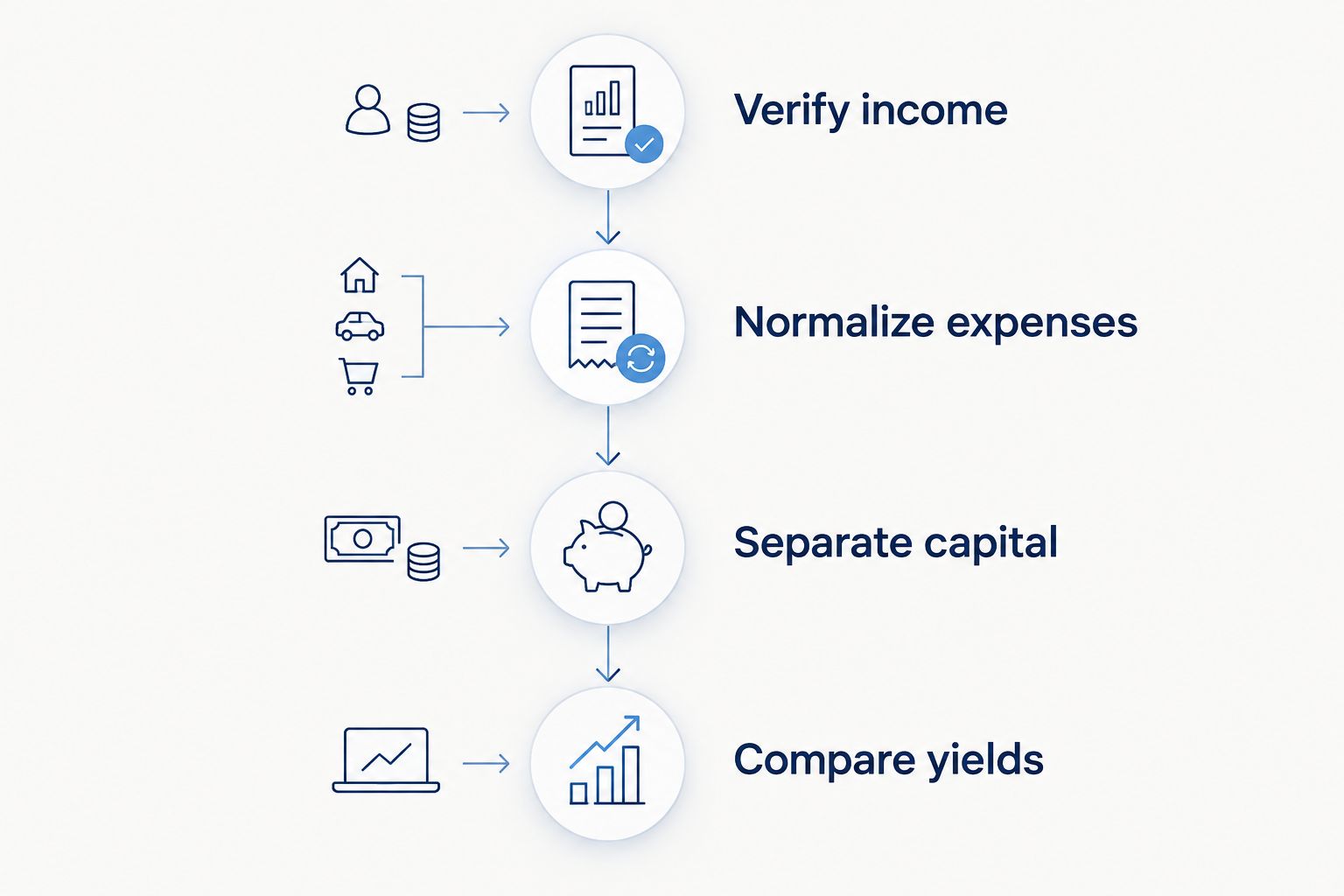
Follow this sequence for each candidate:
- Verify income: Match leases, concessions, arrears, and collections.
- Normalize expenses: Apply a consistent treatment of management, maintenance, utilities, taxes, and insurance.
- Separate capital: Identify replacements and other capital work outside recurring operating expenses.
- Compare yields: Label actual, adjusted, and projected calculations distinctly.
A difference of 100 basis points equals 1 percentage point. Before treating that spread as meaningful, check whether both calculations use the same income period and expense assumptions.
Capital expenditures still require funding even though they sit outside NOI. Keep a separate capital schedule so an attractive operating yield does not obscure near-term cash needs.
Keep cap rate separate from financed cash flow
Cap rate measures property income relative to acquisition price before financing. Cash-on-cash return evaluates cash flow relative to invested cash; it is not interchangeable with cap rate.
Review the proposed loan alongside operating cash flow, required reserves, and capital work. The guide to financing Miami commercial property addresses the financing side of the purchase.
For your 2026 comparison, keep these outputs separate:
- Unlevered operating yield.
- Cash flow after debt service.
- Cash required at closing and for planned work.
- Downside performance if collections weaken or expenses rise.
Do not let a financing structure substitute for a sound property-level analysis. Borrowing terms change the investor’s cash flow, not the building’s underlying NOI.
Use neighborhood detail without inventing a yield hierarchy
Coconut Grove, Coral Gables, Brickell, and Brickell Key are not substitutes for property-level evidence. An address does not prove rental income, expense efficiency, or future appreciation.
When evaluating Coconut Grove or Coral Gables, confirm the municipality and parcel-specific rules rather than applying assumptions across neighborhood boundaries. For a condominium investment in Brickell or Brickell Key, review association expenses and rental rules; ownership of individual condo units is not equivalent to ownership of an apartment building.
Build the comparison around:
- Property type and ownership structure.
- Unit mix and lease terms.
- Condition and documented capital needs.
- Actual rental collections and recurring expenses.
Keep the evidence as local as the claim. A comparable property must support the feature being evaluated, not merely share a recognizable neighborhood name.
How these profiles are ranked
The order favors income that can be examined through existing operations before plans that depend on substantial execution or development. It is a screening priority, not a claim that stabilized buildings offer the highest cap rates.
For 2026, rank individual candidates only after applying the same underwriting method. If one calculation uses actual collections and another uses hypothetical renovated rents, place them in separate columns rather than presenting them as direct competitors.
Which Miami multifamily property should you choose?
Choose documented stabilized operations as the default starting point if your priority is current income. Move to value-add, direct management, or redevelopment only when that work matches your capabilities and investment plan.
For sellers, prepare leases, collections, operating expenses, service contracts, and capital records before presenting a yield. Carlos Morean’s residential and commercial brokerage services give buyers and sellers a point of contact for discussing the transaction and its property-specific questions.
Discuss your Miami investment criteria
Define your income objective, property type, and due-diligence priorities before comparing candidates.
FAQ
What's the best way to rank Miami multifamily properties by cap rate?
Rank Miami multifamily properties by cap rate only after calculating NOI on a consistent basis. Separate actual collections from projected rents, normalize operating expenses, and review capital needs outside the cap-rate calculation.
Is the highest cap rate always the best investment?
No. A higher cap rate does not establish better collections, building condition, legal compliance, or cash flow after financing. Investigate what produces the difference before choosing a property.
Should I use actual or projected income?
Use documented existing income to evaluate current operating performance and a separate projection to evaluate the proposed business plan. Label both clearly so future improvements are not presented as income already earned.
Does a multifamily cap rate include mortgage payments?
No. Cap rate uses net operating income before debt service. Analyze mortgage payments separately when evaluating financed cash flow.
Is a Brickell condo comparable to an entire apartment building?
Not automatically. A condo investment has its own ownership structure, association expenses, and governing documents. Compare those obligations with the operating responsibilities of owning an entire rental building.
What records should a Miami multifamily seller prepare?
Prepare leases, the rent roll, collection records, operating statements, insurance information, tax records, service contracts, and documentation of capital work. Reconcile differences before presenting the investment to buyers.
Can Carlos Morean help with Miami investment property transactions?
Carlos Morean provides residential and commercial real estate brokerage services in Miami and serves investors. Discuss your target property type, income objectives, and transaction requirements directly.
One last thing
A cap rate can improve on paper without a single additional rent payment being collected. Removing an expense or replacing actual rent with projected rent changes the calculation, not the property’s performance.
Before advancing any 2026 candidate, ask for a reconciliation from reported NOI to adjusted NOI. Every adjustment should have a document, an explanation, and a clear distinction between an existing fact and a future assumption.