
Yes. In 2026, a Miami landlord can generally raise residential rent at each annual renewal because Florida does not impose a statewide rent-increase cap, but a fixed-term lease controls rent during its term. The increase must still comply with the lease, applicable notice requirements, and laws against discrimination and retaliation; subsidized housing can have separate restrictions.
- Can a landlord raise rent every year in Miami? Yes, generally at renewal, subject to the lease and applicable law.
- A fixed-term lease generally protects the agreed rent during its term unless it permits an adjustment.
- Florida requires at least 30 days’ notice to terminate an ordinary month-to-month residential tenancy.
- Carlos Morean serves Miami landlords and renters seeking residential real estate brokerage guidance.
Why this matters
Permission to increase rent is not permission to disregard the lease. A landlord needs to separate the proposed renewal terms from the existing agreement. A tenant needs to distinguish a negotiation from a legally effective notice.
For Miami owners deciding whether to renew, relet, or sell, Carlos Morean provides residential real estate brokerage services. The legal question comes first; the market question is whether the proposed rent makes sense for the property.
Can a landlord raise rent every year in Miami?
Yes, generally. For an ordinary private residential rental in Miami in 2026, Florida law does not set a maximum annual percentage increase. An annual renewal is a common opportunity to propose new rent, but the calendar alone does not authorize a change.
Start by identifying the tenancy. Florida Statutes Chapter 83, Part II governs residential landlord-tenant relationships, while the agreement establishes the rent and many renewal conditions.
| Rental arrangement | When rent can generally change | What to check first |
|---|---|---|
| Fixed-term residential lease | At renewal, or under an express adjustment provision | Rent clause, expiration date, renewal rights, and notice provisions |
| Month-to-month residential tenancy | Prospectively, subject to the agreement and applicable law | Written terms, communication of the change, and termination requirements |
| Subsidized or income-restricted housing | Under the applicable program and lease rules | Program limits, approval requirements, and notices |
| Commercial lease | According to the commercial agreement | Escalation clauses, options, and negotiated notice terms |
No statewide cap does not mean every increase is lawful. A discriminatory increase, a retaliatory increase, or an increase that breaches the agreement presents a different legal issue from whether the amount exceeds a statutory ceiling.
Does Florida limit the annual percentage increase?
Florida does not impose a general annual percentage cap on ordinary private residential rent in 2026. Do not mistake that rule for a guaranteed right to change rent whenever an owner chooses.
Florida Statutes section 83.425 preempts local regulation of residential tenancy matters, including rent-related regulation and notice requirements. Older summaries of Miami-Dade notice ordinances are not a dependable substitute for checking the current state framework.
Fixed-term leases: the agreed rent controls
A landlord generally cannot replace the agreed rent midway through a fixed-term lease simply because insurance, association expenses, or nearby asking rents have increased. Read the actual agreement for any provision permitting an adjustment.
A renewal is different. Unless an enforceable renewal option establishes the terms, the landlord can propose a different rent for the next term. The tenant can accept, negotiate, or decline, subject to the agreement and lawful termination procedures.
Check whether an automatic-renewal clause requires action before a deadline. Silence is not a safe strategy when the lease specifies how to exercise an option or prevent renewal.
Landlord action: review the agreement before sending a renewal proposal. Tenant action: keep the signed lease and compare the proposal against its renewal language, rather than relying on a listing or an informal conversation.
Month-to-month tenancies: distinguish changes from termination
A month-to-month arrangement does not lock the rent indefinitely. However, changing terms and terminating a tenancy are separate legal actions, and the wording of the communication matters.
For an ordinary residential month-to-month tenancy, Florida Statutes section 83.57 requires at least 30 days’ written notice before the end of the monthly period to terminate. That is a termination rule—not a universal statement that every rent increase becomes effective exactly 30 days after an email.
The monthly period also matters. Count from the tenancy’s actual rental period, not automatically from the date the owner happens to send a message.
If the tenant rejects new terms, the landlord must use the appropriate legal process rather than assume the proposal itself ends possession. If the tenant stays and pays after receiving changed terms, the legal effect depends on the agreement and circumstances. Get advice before treating acceptance as settled.
What notice periods should Miami landlords check?
The following periods concern termination of residential tenancies without a specific duration under Florida Statutes section 83.57. They are not a table of universal rent-increase deadlines.
| Tenancy without a specific duration | Statutory termination notice |
|---|---|
| Year-to-year | At least 60 days before the end of the annual period |
| Quarter-to-quarter | At least 30 days before the end of the quarterly period |
| Month-to-month | At least 30 days before the end of the monthly period |
| Week-to-week | At least 7 days before the end of the weekly period |
A lease lasting a year is not automatically a year-to-year periodic tenancy. A written agreement with a defined expiration date requires a separate review.
For specified-duration residential agreements, section 83.575 addresses contractual notice of nonrenewal. Where the agreement requires that notice, the statutory framework generally places the contractual period between 30 days and 60 days and requires reciprocal notice obligations. Additional conditions apply to contractual damages for a tenant’s failure to give notice.
For a 2026 renewal, check both the statute and the signed agreement. Do not copy a notice deadline from a different tenancy type.
Why rent-increase rules vary
The relevant differences come from the rental arrangement, not from whether the address sounds expensive:
- Lease duration: a fixed expiration date and a periodic tenancy require different analysis.
- Adjustment language: an express rent-adjustment provision changes what the landlord can propose during the term.
- Renewal rights: an enforceable option can establish terms before the current lease expires.
- Housing program: subsidized or restricted housing requires program-specific review.
- Reason for the increase: retaliation and discrimination remain legal concerns even without a general percentage cap.
- Property use: residential tenancy rules do not automatically govern a restaurant, bar, or office lease.
A Brickell condo and a Coral Gables house do not acquire different state rent caps because they occupy different neighborhoods. Their agreements and applicable housing restrictions are the starting points.
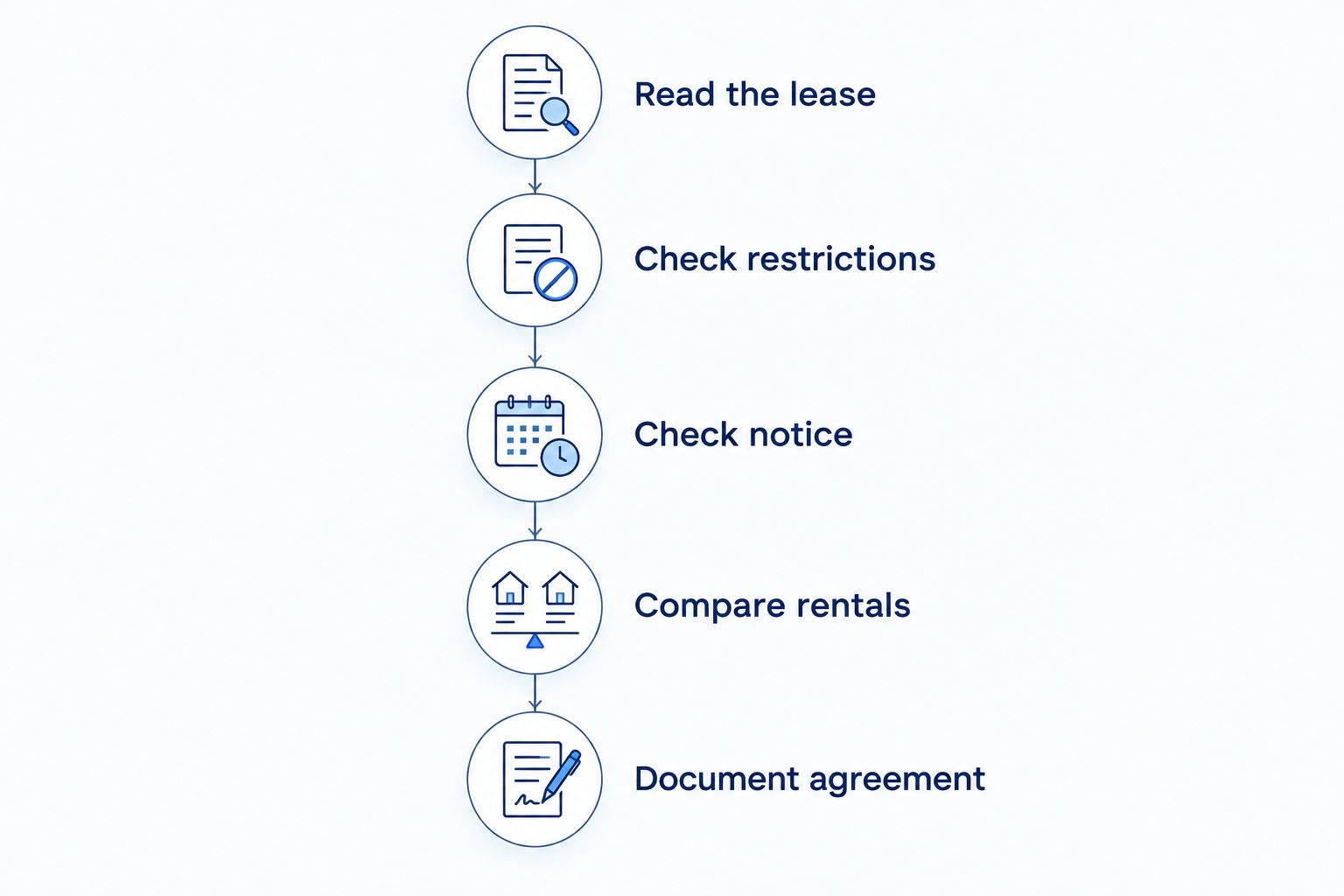
How should you handle a proposed renewal increase?
Use the same sequence whether you own the property or rent it. Establish the legal position before negotiating the market position.
- Read the lease. Identify the current term, rent clause, adjustment provisions, renewal option, and notice requirements.
- Check restrictions. Determine whether a housing program or another binding restriction affects the tenancy.
- Check notice. Identify what the communication actually does: propose terms, decline renewal, or terminate a periodic tenancy.
- Compare rentals. Evaluate genuinely comparable properties rather than a neighborhood-wide asking-rent headline.
- Document agreement. Put accepted renewal terms in a signed document and retain the notice records.
Keep the original proposal, its delivery record, and any response. A conversation about a possible increase is not the same thing as a signed amendment or a legally sufficient termination notice.
Owners planning a renewal can use the Miami rental property guide for landlords to organize the broader ownership decision. Legal notice drafting belongs with a Florida landlord-tenant attorney when the agreement or dispute is unclear.
How do you judge whether the proposed rent makes sense?
Legal permission and market support are different tests. An increase can be legally permissible without being supported by comparable rentals.
For a Brickell or Brickell Key condo, compare the building, floor plan, exposure, parking, condition, and lease terms. Separate North Brickell from South Brickell when reviewing location, then narrow the comparison further rather than treating every condo as interchangeable.
For Coconut Grove and Coral Gables properties, distinguish houses from condos and compare usable space, condition, parking, and outdoor areas. Waterfront access or a renovated interior belongs in the comparison, but neither establishes a rent premium by itself.
Ask for the status and date of each comparable. An active asking rent shows what an owner requests; it does not establish what a tenant agreed to pay. For a 2026 renewal, use current evidence instead of recycling an unsupported expectation from a previous negotiation.
Carlos Morean helps Miami landlords and renters with residential brokerage. That role supports property selection and market comparisons; a disputed notice, retaliation claim, or possession issue needs legal advice.
What should landlords and tenants avoid?
Landlords should not use an increase to punish a tenant for protected conduct. Florida Statutes section 83.64 addresses retaliation, including certain rent increases following protected tenant activity; the statute’s conditions and exceptions matter.
Tenants should not assume that an objection freezes the rent or extends a lease. Keep paying what is lawfully due and obtain advice before withholding money or remaining after a termination deadline.
Neither party should confuse association charges with an automatic amendment to the lease. An owner’s expenses do not rewrite the tenant’s obligations without a contractual basis.
Fair housing protections also remain relevant. A landlord cannot use renewal pricing to discriminate unlawfully against a protected class. Document objective rental criteria and apply them consistently.
FAQ
Can my Miami landlord raise the rent every year?
Yes, a Miami landlord can generally propose higher rent at each annual renewal for an ordinary private residential rental. The existing lease, applicable restrictions, and laws against retaliation and discrimination still apply.
Is there a maximum rent increase in Miami in 2026?
Florida does not impose a general annual rent-increase percentage cap on ordinary private residential rentals in Miami in 2026. Subsidized or income-restricted housing can follow separate rules.
Can my landlord raise my rent before my lease ends?
A landlord generally cannot change the agreed rent during a fixed term unless the lease permits the adjustment or the parties agree to amend it. Read the rent and adjustment clauses before accepting a midterm demand.
Does my landlord have to give me 30 days’ notice?
At least 30 days’ written notice before the end of the monthly period is required to terminate an ordinary month-to-month residential tenancy under Florida Statutes section 83.57. That termination deadline is not a universal notice rule for every rent increase.
Does a large Miami rent increase require a special local notice?
Do not rely on older summaries of Miami-Dade local rent-increase notice rules. Florida Statutes section 83.425 preempts local regulation of residential tenancy matters, so review the current state requirements and your lease.
Can I negotiate a rent increase at renewal?
Yes, you can propose different renewal terms, but the landlord does not have to accept them unless an existing contractual right controls. Support your proposal with comparable rentals and document any agreement.
Can my landlord raise the rent because I requested repairs?
A rent increase imposed as prohibited retaliation can violate Florida law. Section 83.64 addresses protected tenant conduct and retaliation; preserve repair requests and notices, and have an attorney assess the facts.
One last thing
Annual renewal does not mean an annual increase is mandatory. A landlord can choose to retain the existing rent, and a tenant can request that outcome without claiming a legal entitlement to it.
Before signing a 2026 renewal, resolve the expiration date, effective date, notice obligations, and complete rental terms in writing. Carlos Morean provides Miami residential brokerage services for landlords and renters; obtain legal advice when the disagreement concerns enforceability rather than market value.
This guide provides general information, not legal advice. A Florida attorney should assess your agreement and circumstances.