
Neither renting nor buying is automatically cheaper in Miami in 2026: renting wins when its total cost is lower over your expected stay, while buying wins when ownership costs, purchase expenses, and eventual sale proceeds produce the better result. A mortgage payment alone leaves out taxes, insurance, association charges, maintenance, and transaction costs.
- Is it cheaper to rent or buy in Miami? Compare equivalent properties over the same holding period.
- Renting preserves flexibility; buying adds equity potential but exposes you to maintenance and resale risk.
- Miami condo comparisons need association budgets, insurance details, and assessment information—not just mortgage estimates.
- Carlos Morean helps Miami buyers and renters compare residential properties before committing.
Why this matters
The cheaper monthly payment does not necessarily produce the cheaper housing decision. Rent is a housing expense. A mortgage payment combines interest expense with principal repayment, while ownership introduces other expenses that do not build equity.
Carlos Morean provides Miami real estate brokerage services for buyers, renters, sellers, landlords, and investors. For your own decision, begin with equivalent properties and a realistic move-out date—not a citywide average or an assumption that appreciation will cover every expense.
Is it cheaper to rent or buy in Miami in 2026?
Renting is cheaper when your total rental expenses are below the net cost of owning a comparable property for the same period. Buying is cheaper when the ownership calculation comes out lower after accounting for transaction expenses, financing, operating costs, and equity recovered at sale.
Use this comparison before deciding which option fits your finances:
| Decision point | Renting | Buying |
|---|---|---|
| Best for | You need flexibility or expect your housing needs to change | You want ownership and can support the full carrying costs |
| Cash committed | Deposits and other lease-related upfront requirements | Down payment, closing expenses, and operating reserves |
| Monthly obligations | Rent plus tenant-paid expenses specified in the lease | Loan payments, taxes, insurance, association charges, and maintenance |
| Main advantage | Less direct exposure to property repairs and resale | Principal repayment builds equity; ownership provides control within applicable rules |
| Main drawback | No ownership equity; renewal terms can change | Capital is tied up, and repairs or resale losses remain your responsibility |
| Exit exposure | Lease expiration, notice requirements, and early termination terms | Selling expenses, loan payoff, and the market when you sell |
For a 2026 decision, obtain current lease terms, a property-specific financing estimate, insurance quotes, and association documents. An attractive listing is not a complete financial comparison.
How do you compare renting and buying fairly?
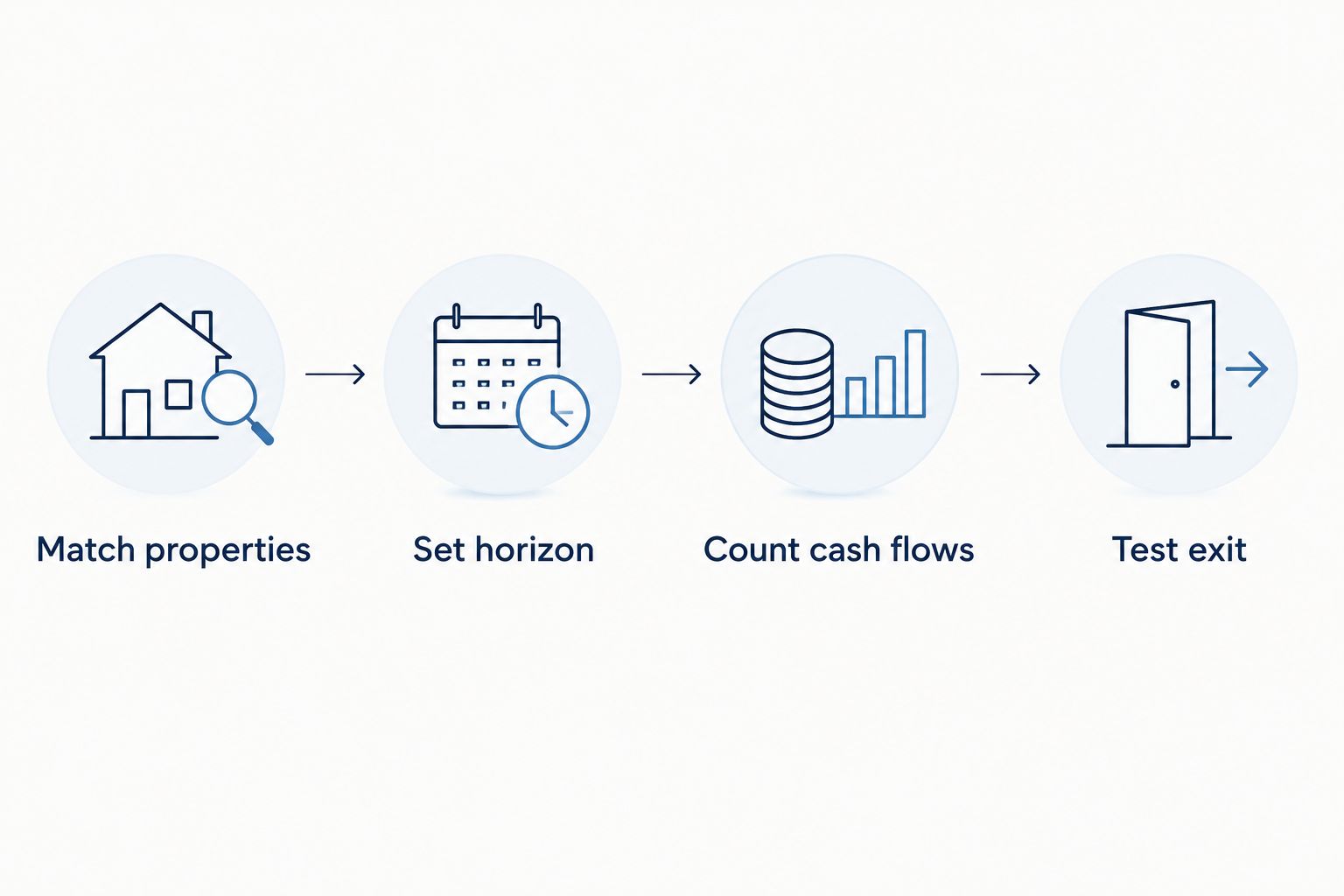
Follow the same sequence for each property. Changing the neighborhood, building quality, or property type halfway through the calculation makes the result less useful.
1. Match the properties
Compare homes with similar location, interior size, condition, parking, outdoor space, and amenities. For condos, include floor, exposure, view, and building rules.
A renovated waterfront rental and an unrenovated inland purchase are different housing choices. You can compare them as lifestyle alternatives, but do not present the result as proof that renting or buying is cheaper for equivalent housing.
2. Set the horizon
Use your expected move date, then test earlier and later departures. A job change, growing household, or relocation changes the calculation because buying and selling involve transaction expenses.
For a sensitivity check, test 12 months, 36 months, and 60 months. These are planning scenarios, not Miami break-even estimates. The purpose is to see whether your decision survives a shorter stay than expected.
3. Count cash flows
List every payment leaving your account and identify any amount you expect to recover. Keep refundable security deposits separate from nonrefundable expenses, and keep mortgage principal separate from interest.
Do not count your down payment as both a permanent expense and part of the equity recovered at sale. It is committed capital whose eventual recovery depends on the property's value, selling expenses, and outstanding debt.
4. Test the exit
Estimate the ownership result using sale proceeds after selling expenses and loan payoff. Compare that result with total rental expenses over the same period.
Use an unchanged-value case alongside any appreciation assumption. Also test a lower resale value. If buying works only because the property must appreciate, the decision depends on investment performance—not simply cheaper housing.
What belongs in your Miami rental calculation?
Start with the actual lease, not the advertised rent alone. Ask which expenses you pay directly, which are included, and which require separate approval or deposits.
Your rental worksheet should include:
- Recurring payments: Rent, tenant-paid utilities, renters insurance, parking, and other charges required by the agreement.
- Nonrefundable upfront expenses: Application, screening, association processing, or moving charges when applicable.
- Refundable funds: Security deposits and other refundable amounts, tracked separately from expenses.
- Exit obligations: Required notice, early termination terms, cleaning obligations, and potential deductions under the lease.
Renting transfers some property-level responsibilities to the owner, but it does not remove your contractual obligations. Read who handles maintenance requests and what the lease assigns to you.
For a 2026 move, confirm the approval process before committing to a start date. A lease agreement and a building's occupancy approval are separate matters when association approval is required.
What belongs in your Miami ownership calculation?
Separate the purchase into upfront cash, recurring expenses, and eventual exit costs. That keeps the comparison readable and prevents a lender's payment estimate from becoming your entire budget.
Upfront cash
Include the down payment, lender charges, title-related expenses, inspections, applicable prepaid items, and other closing requirements shown in your transaction estimates. Identify escrow funding separately so you do not count the same future tax or insurance payment twice.
A lender's estimate is a starting point. Update the worksheet as actual quotes and closing documents become available.
Recurring expenses
Include mortgage interest, property taxes, insurance, association charges, maintenance, and any financing-related insurance that applies. Track principal repayment as a cash outflow that reduces your loan balance rather than treating it as a pure housing expense.
For a condo, review the association budget and determine which services the regular charge covers. The guide to HOA fees on Miami waterfront condos explains the expense categories to investigate; the actual building documents determine your obligation.
Exit costs and equity
Use expected sale proceeds after transaction expenses and debt repayment. Do not assume your original down payment comes back intact or that every renovation adds an equal amount to resale value.
Buying needs both an affordable operating budget and a credible exit plan. A manageable mortgage payment does not offset an assessment you cannot fund or a move that forces an unfavorable sale.
Why the rent-versus-buy result varies
The same Miami property can produce different answers for different households. These factors change the calculation without changing the address:
- Holding period: Purchase and sale expenses have more time to spread across a longer stay, but a longer stay does not guarantee a gain.
- Financing terms: Interest rate, loan structure, down payment, and lender requirements change both cash flow and capital committed.
- Building obligations: Association charges, reserve funding, assessments, and insurance arrangements affect the owner's budget.
- Property condition: Inspection findings and maintenance needs change the cash required after closing.
- Alternative use of cash: Money committed to a purchase cannot simultaneously fund another investment or remain fully liquid.
- Exit conditions: Resale value, selling expenses, lease terms, and the timing of your departure affect the final result.
Run these inputs using documents available in 2026. Do not substitute an owner's old insurance bill, existing tax payment, or past loan terms for your own expected obligations.
How should you compare Miami neighborhoods?
Use neighborhood names to narrow your search, not to justify an unsupported premium. Coconut Grove, Coral Gables, Brickell, and Brickell Key each require property-level comparisons; none supplies a universal rent-versus-buy answer.
| Search area | Comparison to make | Mistake to avoid |
|---|---|---|
| Coconut Grove | Match houses with houses and condos with comparable condos; check condition and property responsibilities | Treating every property type as one interchangeable market |
| Coral Gables | Match lot, home condition, waterfront characteristics where relevant, and maintenance scope | Assuming the address alone establishes value |
| Brickell | Compare the same building where possible, then floor, exposure, parking, and association obligations | Using another tower's carrying costs as your estimate |
| Brickell Key | Compare specific buildings, units, views, and documented charges | Assuming shared neighborhood identity means identical ownership costs |
For North versus South Brickell, test your actual commute and the routes you expect to use. Decide what matters to you before attaching financial value to proximity or convenience.
Carlos Morean is a fit for Miami buyers and renters who want help comparing residential properties. Ask for matched alternatives and an explanation of the differences—not a recommendation based only on whether you qualify for financing.
Is renting better if I expect to move soon?
Renting is better for flexibility when your departure date is uncertain, provided the lease terms fit your plans. Buying creates a separate sale or landlord decision when you leave.
Choose the commitment you can exit, not just the payment you can make. Review lease termination obligations alongside the purchase-and-sale expenses that ownership introduces.
Does paying cash make buying cheaper than renting?
Paying cash removes mortgage interest and loan-related charges, but it does not remove taxes, insurance, association obligations, maintenance, or selling expenses. You also commit money that could remain liquid or serve another purpose.
Compare the cash purchase with renting while retaining that capital. Keep any assumed investment return separate from guaranteed expenses; neither property appreciation nor investment gains are assured.
Should a Miami seller rent before buying again?
Renting after a sale separates your next purchase from your selling deadline. The trade-off is another move, lease obligations, and continued exposure to future purchase conditions.
Before choosing this route in 2026, estimate your net sale proceeds and identify the next property's full ownership budget. Carlos Morean's Miami real estate brokerage services cover sellers, buyers, and renters, making this sequence relevant to the households he serves.
FAQ
Is it cheaper to rent or buy in Miami in 2026?
Neither option is automatically cheaper in Miami in 2026. Compare equivalent properties over the same holding period, including rental obligations, ownership expenses, transaction costs, and equity recovered at sale.
Is a mortgage payment enough to compare with rent?
A mortgage payment is not enough to compare with rent. Add taxes, insurance, association charges, maintenance, and transaction expenses, while distinguishing principal repayment from interest expense.
How long should I stay before buying in Miami?
There is no universal holding period that makes buying cheaper in Miami. Test your expected departure date and earlier exit scenarios using the actual property's expenses and financing terms.
Do Miami condo fees make renting cheaper?
Condo fees do not automatically make renting cheaper. Compare the owner's full carrying costs with the tenant's full lease obligations, and review what the association charge covers.
Should I include special assessments when comparing renting and buying?
Include applicable special assessments in the ownership calculation. Review association documents and the purchase contract to establish the payment obligation rather than assuming the regular association charge covers everything.
Can I use the seller's property tax bill for my budget?
The seller's tax bill is not a reliable substitute for your own ownership estimate. A change in ownership and differences in exemptions can change the property tax calculation.
Is buying with cash always better than renting?
Buying with cash is not always better than renting. Cash removes mortgage financing costs but leaves operating expenses, transaction costs, resale risk, and the cost of committing your capital.
One last thing
Ask what would make your preferred choice wrong. If you want to buy, test an earlier move, an unexpected building expense, and a lower resale value. If you want to rent, test renewal changes and the possibility that your preferred home is unavailable when the lease ends.
The useful answer is not a slogan about renting or ownership. It is a documented comparison you can still afford when your original plan changes.