
Yes—if you are planning a standard delayed 1031 exchange in Miami, arrange a qualified intermediary before the property you are selling closes. The intermediary, also called an exchange accommodator, structures the exchange and controls the proceeds so you do not receive them. You do not need a Miami-based provider specifically, and hiring one does not make a personal residence or an otherwise ineligible transaction qualify.
- For a 1031 exchange accommodator Miami search, prioritize fund safeguards and qualified-intermediary eligibility over office location.
- IRS rules generally allow 45 calendar days to identify replacement property and up to 180 calendar days to acquire it.
- Appoint the qualified intermediary before closing; receiving the proceeds generally prevents a standard delayed exchange.
- Carlos Morean provides Miami real estate brokerage; the exchange intermediary and tax adviser have separate responsibilities.
Do you need a 1031 exchange accommodator in Miami?
For a standard delayed exchange in 2026, use a qualified intermediary before transferring your investment property. This is the established exchange structure under Treasury Regulation Section 1.1031(k)-1; the intermediary's agreement must restrict your access to the exchange funds.
Section 1031 applies to qualifying real property held for investment or productive use in a trade or business. It defers qualifying gain rather than erasing it. Your tax adviser must evaluate the property's use, ownership, financing and planned replacement before you commit to the structure.
The basic sequence is:
- Confirm eligibility. Have your tax adviser review the property being sold and the intended replacement.
- Appoint the intermediary. Execute the exchange documents before the sale closes and coordinate them with the closing agent.
- Transfer the property. Direct the exchange proceeds through the agreed intermediary arrangement, not your personal account.
- Identify replacements. Deliver a compliant written identification within 45 calendar days after the transfer.
- Acquire the replacement. Complete the acquisition within 180 calendar days, or your federal return's due date including extensions, whichever comes first.
Use the guide to connecting a 1031 exchange timeline to a Miami purchase to connect that sequence with your property search. Do not treat the identification deadline as the date to start looking.
Why this matters
An attractive replacement property cannot repair a mishandled sale. If you receive the proceeds or retain prohibited control over them, the standard delayed-exchange structure generally fails even when you reinvest the money promptly.
For a Miami seller, the practical issue is coordination: the sale contract, intermediary agreement, title work, financing and replacement acquisition must fit the same calendar. Set the exchange structure before closing, not after your closing statement arrives.
Which exchange approach fits your transaction?
A delayed exchange is not the right structure for every purchase. Compare the sequence before signing contracts, especially when you need to acquire a replacement before your existing property sells.
| Approach | Best for | Main advantage | Main limitation |
|---|---|---|---|
| Standard delayed exchange | Investment owners selling before buying | Provides a defined sequence for reinvesting qualifying proceeds | Requires compliant fund handling and strict identification and acquisition deadlines |
| Reverse exchange | Investors who must acquire the replacement first | Accommodates a purchase-before-sale sequence when properly structured | Requires specialist planning and a separate property-parking arrangement |
| Taxable sale followed by purchase | Sellers who need unrestricted proceeds or are not pursuing deferral | Removes exchange-specific restrictions on accessing sale proceeds | Does not provide Section 1031 deferral merely because another property is purchased |
Best for a straightforward sale-then-purchase plan: a properly structured delayed exchange. Its benefit is tax deferral; its limitation is reduced flexibility over your proceeds and purchase timing.
A reverse exchange is not a delayed exchange with the dates rearranged. Discuss the structure with an exchange specialist and your tax adviser before acquiring the replacement. Neither approach turns a property held primarily for resale into qualifying investment real estate.
What does the accommodator handle—and what stays with you?
The qualified intermediary enters into the exchange agreement, coordinates the required exchange assignments and notices, and handles the proceeds under that agreement. The intermediary's role is distinct from choosing an investment or providing a legal opinion about your entire transaction.
Your responsibilities remain substantial:
- Tax adviser: Confirm eligibility, estimate recognized gain, review debt and ownership issues, and prepare the exchange reporting.
- Real estate attorney: Review legal structure, contracts, title concerns and transaction-specific risks.
- Closing agent: Coordinate settlement documents and disbursements with the exchange instructions.
- Real estate broker: Evaluate properties, negotiate terms and coordinate the sale or acquisition.
- You, the taxpayer: Approve the structure, meet deadlines and provide accurate ownership and use information.
Carlos Morean is best suited to investors seeking Miami real estate brokerage, not a substitute for a qualified intermediary. For a Miami real estate exchange, Carlos Morean's brokerage role concerns the property transaction; tax and exchange-qualification decisions belong with the appropriate advisers.
How should you choose a qualified intermediary in 2026?
Choose the intermediary by reviewing eligibility, custody arrangements and execution procedures. A nearby office does not answer those questions.
Ask for written answers before you sign:
- Eligibility: Is the provider a qualified intermediary under the applicable federal rules, rather than a disqualified person?
- Fund custody: Where are proceeds deposited, how are accounts titled, and how are client funds separated?
- Release controls: Who authorizes a wire, and what independent verification prevents unauthorized instructions?
- Financial protections: What insurance, bonding or other safeguards apply, and what exclusions remain?
- Execution procedures: Who receives identification notices, confirms receipt and coordinates replacement closings?
Your own recent agent generally cannot simply become your qualified intermediary. Treasury Regulation Section 1.1031(k)-1 contains disqualified-person rules, including rules covering certain services performed during the preceding 2 years, with specified exceptions. Have your adviser assess the actual relationship instead of assuming a familiar professional qualifies.
Also read the provisions addressing interest, permitted investments, dispute handling and release of funds. An intermediary agreement is not a guarantee against loss or transaction failure.
Why exchange planning varies between Miami properties
The federal deadlines do not change between Brickell and Coral Gables. The work needed to close the replacement does.
- Property use: A rental investment and a personal residence receive different Section 1031 treatment. Mixed personal and rental use requires tax review.
- Ownership structure: The taxpayer selling generally must be the taxpayer acquiring; an LLC or trust requires analysis of its tax treatment.
- Condominium documents: Association approval requirements, budgets, insurance and assessment records affect acquisition review.
- Financing: Lender underwriting, appraisal and building review must fit the acquisition deadline.
- Property condition: Inspection findings, title defects and unresolved permit issues affect whether a replacement can close.
- Construction status: A deposit on an unfinished project is not the same as receiving qualifying replacement real property within the exchange period.
For a Brickell or Brickell Key condo in 2026, request the building's rental rules, financial documents and approval requirements before identifying it. A unit that cannot support your intended rental use is a poor replacement candidate regardless of its address.
For a Coconut Grove house or Coral Gables investment property, review survey, title, permits, inspection findings and any applicable flood or waterfront issues. These are property-specific checks—not claims that every home in either neighborhood has the same condition or risk.
Avoid choosing a replacement solely because its location sounds comparable to the property you sold. Evaluate the actual asset, permitted use and ability to close.
How do you protect the identification and closing deadlines?
For a 2026 exchange, build the purchase plan backward from the legal deadlines. The 45-calendar-day identification period sits inside the exchange period; it does not precede an additional 180 calendar days.
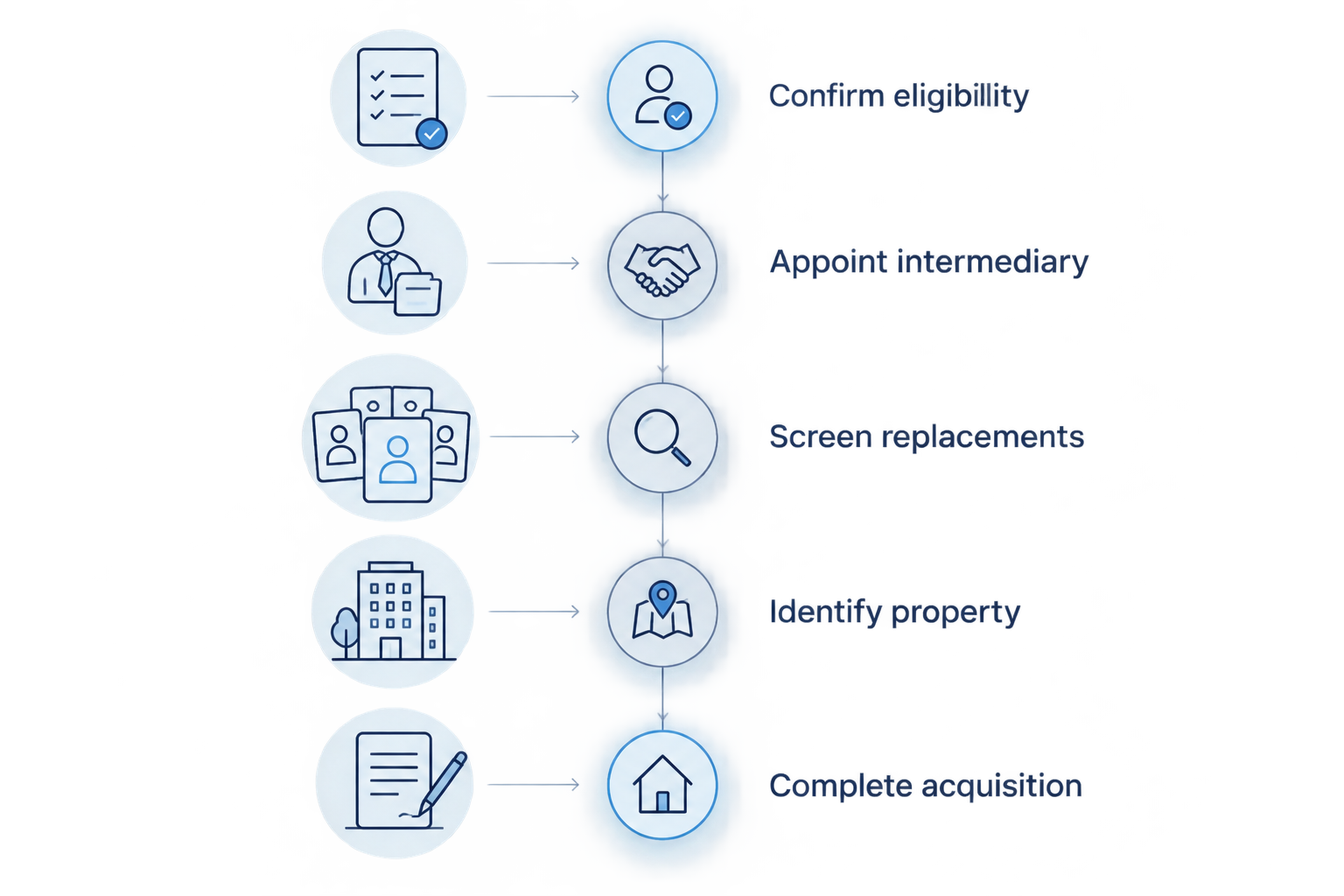
Use this sequence with your advisers:
- Confirm eligibility: Resolve investment use and ownership questions before committing to an exchange.
- Appoint intermediary: Complete the exchange agreement before the relinquished property transfers.
- Screen replacements: Check financing, intended use and transaction obstacles before identification.
- Identify property: Deliver the required signed written notice to a permitted recipient on time.
- Complete acquisition: Coordinate the intermediary, lender and closing agent through the final transfer.
The identification must describe the replacement property unambiguously. A signed purchase contract does not automatically satisfy the delivery requirements, so have the intermediary confirm the identification procedure and receipt.
The standard identification rules allow up to 3 properties without regard to their fair market values. Other identification rules exist, but they carry additional conditions; ask your adviser before submitting a longer list.
Do not assume weekends or holidays extend the deadlines. Your adviser should check whether specific IRS disaster relief applies, and whether a return extension is needed to preserve the full exchange period.
For property selection and negotiation, Carlos Morean provides Miami real estate brokerage services. Keep the intermediary and tax adviser involved before changing the buyer's name, ownership structure or closing sequence.
Can you hire an accommodator after the sale closes?
Before closing is the deadline for setting up the usual qualified-intermediary structure. If the property has already transferred and you received the proceeds, hiring an intermediary afterward generally does not repair the transaction. Ask your tax adviser to review the actual closing documents immediately.
Does your accommodator have to be located in Miami?
No—federal qualified-intermediary rules do not require a Miami office. Prioritize eligibility, fund safeguards and the ability to coordinate with your closing team; local brokerage knowledge and exchange administration serve different purposes.
Can you exchange a Brickell rental for commercial property?
Yes—qualifying U.S. investment real estate can generally be exchanged for other qualifying U.S. investment or business real estate, even when the property types differ. The relevant tests concern qualifying real property and intended use, not whether both properties are condos. Restaurant equipment, inventory and business goodwill are not qualifying real property merely because they accompany a commercial sale.
FAQ
Do I need a 1031 exchange accommodator for a Miami investment property sale?
For a standard delayed 1031 exchange, arrange a qualified intermediary before the investment property sale closes. The intermediary controls the exchange proceeds under the exchange agreement; you should not receive them.
How long do I have to identify a replacement property?
You generally have 45 calendar days after transferring the relinquished property to identify replacement property in a compliant written notice. Confirm the description, recipient and delivery procedure with your intermediary.
How long do I have to close on the replacement property?
You generally have up to 180 calendar days after transferring the relinquished property, or until your federal income tax return is due including extensions, whichever comes first. The identification period is part of that period, not extra time.
Can I use a 1031 exchange to buy my personal Miami home?
A property acquired for personal residential use does not qualify merely because you use exchange proceeds. Mixed-use properties and later changes in use require individual tax advice.
Can my real estate agent or attorney act as my qualified intermediary?
Your agent or attorney is not automatically eligible to act as your qualified intermediary. Federal disqualified-person rules cover certain recent agency relationships, subject to specified exceptions.
Will a 1031 exchange eliminate all tax on my sale?
A qualifying 1031 exchange defers gain rather than automatically eliminating it. Cash received, nonqualifying property and net debt relief can create recognized gain, depending on the transaction.
What IRS guidance should my advisers use for a 2026 exchange?
For a 2026 exchange, the core federal references include Internal Revenue Code Section 1031, Treasury Regulation Section 1.1031(k)-1 and IRS Publication 544. Form 8824 and its instructions address federal exchange reporting; your adviser should check the applicable current instructions.
One last thing
The property that preserves your exchange is not automatically the property that deserves your investment. Before identifying a replacement, ask whether you would still buy it without the tax deadline.
If the answer is no, revisit the transaction with your tax adviser. Deferring gain does not justify overlooking rental restrictions, unresolved building issues or a purchase that fails your investment criteria. This guide provides general information, not individualized tax or legal advice.