
The cost to furnish a Miami investment condo depends on the unit’s inventory, your intended rental use, and written supplier and installation quotes—not a reliable citywide allowance. For your 2026 budget, include delivery, assembly, tax, household essentials, and replacements alongside furniture; this guide shows you how to define that scope before ordering.
- How much does it cost to furnish a Miami investment condo? Build the answer from room inventories and written quotes.
- Confirm permitted rental use before choosing furniture, linens, or household equipment.
- Compare complete installed proposals, not furniture-only shopping carts.
- Carlos Morean provides Miami real estate brokerage services for investors; furnishing decisions should follow the property’s rental strategy.
How much does it cost to furnish a Miami investment condo?
Your furnishing budget should equal the complete, installed inventory needed for your permitted rental plan. A furniture subtotal is not a move-in-ready budget, and a furnished listing does not establish what remains after closing.
For property selection and rental-strategy questions, Carlos Morean works with Miami real estate investors. Keep the furniture purchasing scope separate from the brokerage decision so you can evaluate each clearly.
Use this breakdown to request comparable proposals in 2026:
| Budget category | What to include | What to verify |
|---|---|---|
| Main furniture | Beds, seating, dining furniture, storage | Dimensions, materials, included components |
| Household essentials | Linens, cookware, dishes, cleaning equipment | What your intended tenant actually needs |
| Lighting and privacy | Lamps and window coverings where needed | Existing fixtures and installation requirements |
| Delivery and installation | Transport, assembly, placement, packaging removal | Building access and exclusions |
| Transaction charges | Applicable taxes and quoted service charges | Whether the proposal includes them |
| Replacement provision | A separate allowance for damaged or worn items | Responsibility under your lease and management arrangement |
Do not fill gaps with an arbitrary contingency percentage. Identify unresolved items, request quotes, and keep those commitments visible before approving purchases.
Why this matters
Furniture belongs in your investment analysis before you commit to a rental strategy. Otherwise, you risk buying for an imagined tenant rather than the use the building permits and the property supports.
A property that photographs well is not necessarily ready for occupancy. Missing window coverings, an incomplete bed setup, or an undelivered dining table still requires attention after the main furniture arrives.
Set the rental use first, define the inventory second, and approve spending last. This sequence keeps design choices tied to the investment instead of letting the shopping list determine the business plan.
Long-term furnished rental: prioritize daily use
Best for: owners targeting tenants who want a furnished home rather than temporary accommodation. Start with comfortable sleeping, seating, dining, and storage arrangements. Add work space where the layout supports it without obstructing circulation.
The advantage is a scope built around ordinary residential use. The limitation is tenant preference: a furnished offering excludes renters who want to bring their own furniture, so do not assume furnishing automatically improves demand.
Before ordering, define what furnished means in your lease. Furniture, kitchen equipment, linens, electronics, and decorative pieces should appear in an agreed inventory rather than remain an informal promise.
For your 2026 rental analysis, compare furnished and unfurnished alternatives using relevant listings and completed rental evidence where available. Do not attribute the entire difference between dissimilar properties to furniture.
Corporate relocation rental: define the arrival-ready scope
Best for: owners targeting relocation tenants who need a usable home on arrival. Confirm the intended tenant’s requirements before adding equipment simply because another furnished listing includes it.
A complete household setup can support this positioning, but completeness creates additional purchasing and inspection work. Someone must verify that essentials are present, functioning, and consistent with the advertised inventory.
Check these details with the prospective tenant or property manager:
- Sleeping arrangements and usable storage.
- A suitable place to work, if required.
- Kitchen equipment and dining essentials.
- Laundry and cleaning equipment already included with the unit.
- Responsibility for utilities, connectivity, and household supplies.
Keep services separate from physical furnishings in your budget. An ongoing account or management task should not disappear inside a furniture package.
Short-term rental: confirm permission before buying
Best for: owners whose property and intended operation satisfy applicable rental requirements. Do not purchase a guest-ready package until you verify the association’s rules and applicable government requirements for the specific property.
Read the guide to short-term rental rules in Miami condo buildings before treating rental flexibility as an investment assumption. A marketing description is not a substitute for the governing documents.
The furnishing scope must account for guest turnover, cleaning, and inventory checks. The trade-off is operational responsibility: bedding, kitchen items, and furnishings need inspection and replacement processes, not just an attractive installation.
For a 2026 purchase, obtain current documents rather than relying on an older listing’s description. Confirm the permitted use before comparing furnishing proposals for that use.
Furnished or unfurnished: which approach fits your investment?
Neither approach wins without reference to the property and intended tenant. Compare the operational differences before deciding whether a furniture purchase belongs in your plan.
| Approach | Best for | Advantage | Trade-off |
|---|---|---|---|
| Unfurnished rental | Owners targeting tenants with their own furniture | No owner-supplied furniture inventory to maintain | Does not serve tenants seeking a furnished home |
| Owner-selected furnishings | Owners who want control over individual purchases | You choose each item and its replacement options | You coordinate orders, installation, and missing pieces |
| Coordinated furnishing package | Owners seeking a defined purchasing and installation scope | A single proposal can organize the process | Exclusions and substitutions still require close review |
| Retaining existing furnishings | Buyers considering furniture already in the condo | Avoids replacing items that remain suitable | Ownership, condition, and included items need verification |
If furniture is part of the purchase negotiation, document the agreed inventory through the appropriate transaction paperwork. Do not infer inclusion from listing photographs or a showing.
Ask your agent or attorney how to record the arrangement. Then inspect the included items before treating them as usable rental inventory.
Why Miami condo furnishing costs vary
The useful comparison is between equivalent scopes, not between unrelated condos. These factors determine what you need to quote:
- Existing inventory: Keeping suitable furniture changes the purchasing list, but only after you confirm condition and inclusion.
- Layout: Room dimensions, door swings, circulation, and storage determine what fits and what is unnecessary.
- Rental use: A long-term furnished home and a guest-turnover operation require different household inventories.
- Finish and maintenance choices: Compare materials, cleaning instructions, repair options, and replacement availability before selecting items.
- Building logistics: Confirm delivery access, elevator reservations, permitted work hours, and vendor documentation directly with management.
- Scope completeness: Tax, assembly, window coverings, household essentials, and packaging removal must be included or explicitly excluded.
A proposal that omits installation is not directly comparable with one that includes it. Resolve the difference before choosing a supplier rather than after the furniture reaches the building.
How should neighborhood affect your furnishing decisions?
Use Coconut Grove, Coral Gables, Brickell, and Brickell Key to define your comparable-property search—not to justify an automatic furnishing premium. A neighborhood name alone does not establish what your tenant expects or what your condo needs.
In Brickell, separate North Brickell and South Brickell research rather than treating every address as interchangeable. Evaluate Brickell Key separately, and compare each unit’s building, layout, condition, and permitted rental terms.
Apply the same discipline in Coconut Grove and Coral Gables. Review properties that compete for the same tenant rather than borrowing design assumptions from a different property type or rental arrangement.
A waterfront view does not tell you which sofa to buy. Let the unit’s proportions and tenant requirements determine the furnishing plan; use comparable properties to test positioning, not to copy every decorative choice.
How do you build a furnishing budget before closing?
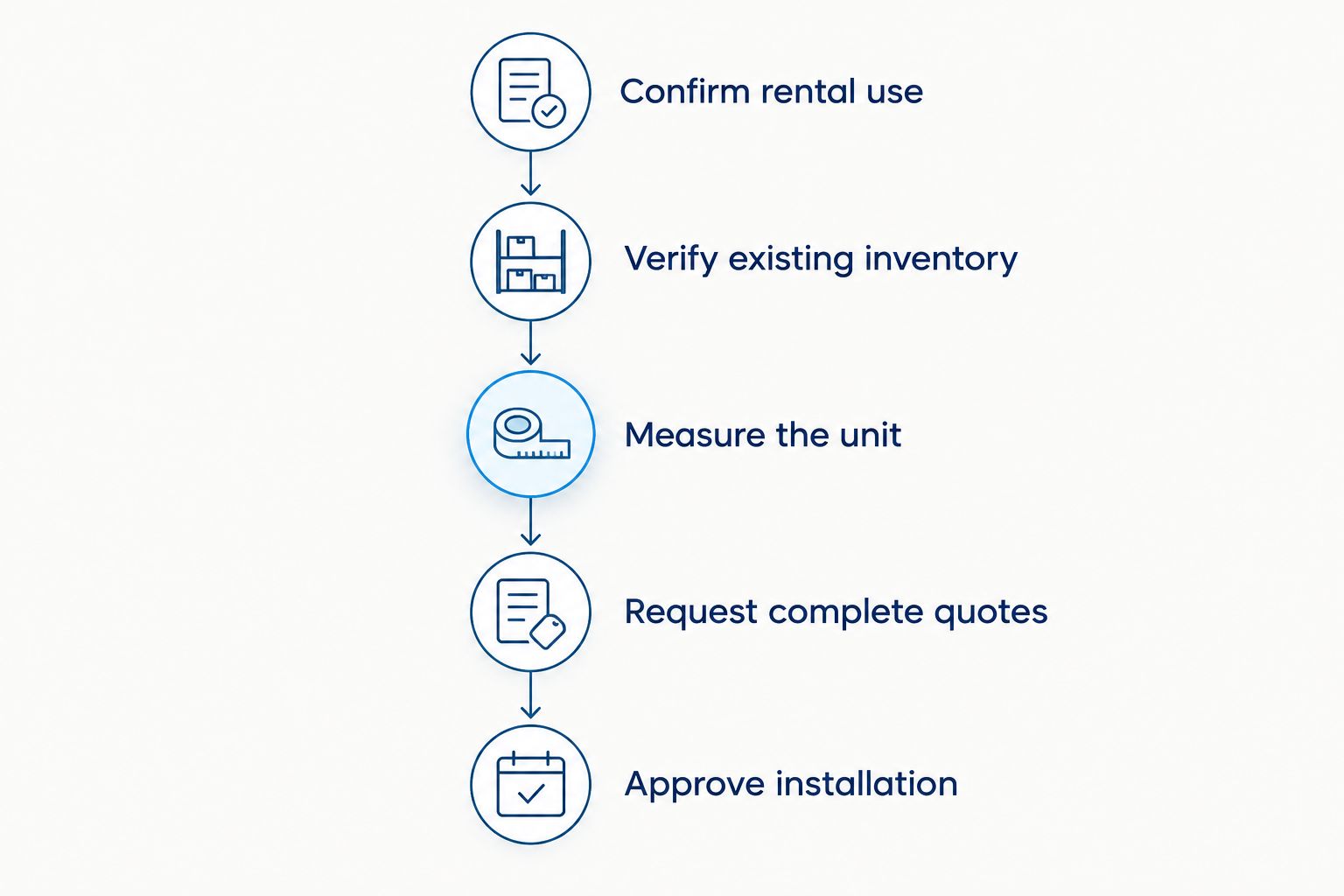
Create a room-by-room scope before requesting proposals. Your objective is a complete purchasing decision, not an appealing collection of product photographs.
- Confirm rental use. Review the intended lease arrangement against the property’s applicable rules.
- Verify existing inventory. Record what stays, what works, and what needs replacement.
- Measure the unit. Check rooms, access routes, doors, and furniture clearances before approving dimensions.
- Request complete quotes. Require item descriptions, installation scope, exclusions, and substitution terms.
- Approve installation. Coordinate building access and inspect the completed setup against the inventory.
Keep the proposal, order confirmations, and final inventory together. If a supplier substitutes an item, verify its dimensions and function rather than accepting a visual resemblance as proof of suitability.
For remote ownership, assign responsibility for receiving deliveries and documenting damage. Do not assume the delivery team, building staff, agent, and property manager share the same responsibilities.
Is buying an already furnished condo the simpler option?
An already furnished condo is simpler only when the included inventory suits your rental plan and its condition is acceptable. Treat the furniture as a separate due-diligence question, not proof that the investment is ready to operate.
Inspect beds, upholstered pieces, drawers, tables, lighting, and any included electronics. Record defects and missing components before deciding which items remain useful.
Compare the retained inventory with the setup you actually need. Keeping unsuitable pieces simply because they are present can leave you handling removal and replacement after closing.
Should you spend more to attract higher rent?
Spend more only when comparable rental evidence supports the positioning and your investment analysis accounts for the added commitment. Better-looking furniture alone does not establish a rent premium.
Separate the effects of location, building, view, floor plan, condition, and lease terms from the effects of furnishing. Otherwise, you risk crediting furniture for differences it did not create.
For 2026 decisions, document why each upgrade belongs in the plan. A durable dining table or properly fitted window covering has a defined purpose; an expensive decorative piece needs an equally clear justification.
Who should advise on the property and furnishing scope?
Carlos Morean is best suited to investors seeking Miami real estate brokerage guidance. Use property advice to establish the purchase and rental context, then obtain written furnishing and installation proposals for the physical setup.
These are connected decisions, but they require different evidence. Property selection depends on the unit and investment strategy; a furnishing commitment depends on inventory, measurements, specifications, and delivery terms.
FAQ
How much should I budget to furnish a Miami investment condo?
Build your budget from a complete room inventory and written, installed quotes. Include applicable tax, delivery, assembly, household essentials, and a separate replacement provision rather than relying on a furniture-only subtotal.
Is it better to rent my Miami condo furnished or unfurnished?
Choose the approach that matches your permitted rental use and target tenant. Furnished rentals serve tenants seeking an equipped home, while unfurnished rentals suit tenants bringing their own belongings.
Does furnished mean linens and cookware are included?
Do not assume linens and cookware are included. Define the supplied items in the lease inventory and make the rental description consistent with that inventory.
Can I furnish a Miami condo for short-term rentals?
Confirm the specific property's association rules and applicable government requirements before furnishing it for short-term rentals. Furniture does not establish permission to operate that rental use.
Should I keep the furniture included with a condo purchase?
Keep included furniture only when its ownership, condition, dimensions, and function meet your needs. Document what stays and inspect it before treating it as ready for rental use.
Can Carlos Morean help with a Miami investment condo purchase?
Carlos Morean provides Miami real estate brokerage services for investors. Discuss the property and intended rental strategy, then obtain separate written proposals for furnishings and installation.
One last thing
Before approving your final order, walk through the condo as an arriving tenant: enter, put down a bag, sit, prepare a meal, shower, and sleep. Record every missing item that interrupts those ordinary tasks.
A furnishing plan is complete when the home functions as promised—not when the shopping cart is full. Use that standard for the installation inspection and your final rental inventory.