
Closing costs on a Miami commercial property depend on the contract, financing, title work, taxes, and property-specific due diligence; there is no single percentage that accurately covers every transaction in 2026. Your closing statement also excludes some expenses paid before settlement, so budget separately for inspections, legal work, and lender-required reports. Buyers should track total acquisition cash; sellers should track net proceeds after debt payoff and transaction expenses.
- How much are closing costs on a Miami commercial property? Separate transfer taxes, financing charges, due diligence, and settlement expenses.
- Florida Department of Revenue guidance distinguishes deed taxes, mortgage documentary stamps, and nonrecurring intangible tax.
- Carlos Morean serves Miami commercial property buyers and sellers who need brokerage guidance alongside legal and lending advice.
- A seller net sheet and a buyer cash-to-close estimate answer different questions; request the correct document.
Why this matters
A seller can accept an attractive offer and still misunderstand the amount left after closing. A buyer can account for the down payment while overlooking expenses already paid to attorneys, inspectors, or the lender.
For a 2026 transaction, request an itemized estimate before negotiating who pays each charge. The Miami commercial property guide for first-time investors addresses the broader purchase decision; closing expenses belong in that decision, not just in the final settlement paperwork.
The contract determines the allocation of many expenses. A neighborhood custom is not a substitute for the signed agreement.
How much are closing costs on a Miami commercial property?
Your total consists of applicable government taxes, professional and settlement charges, financing expenses, and contract-specific adjustments. Separate those categories before comparing estimates: an estimate that excludes prepaid reports is not equivalent to one that includes them.
| Expense category | What to identify | Buyer or seller responsibility |
|---|---|---|
| Deed transfer taxes | Taxable consideration and applicable Miami-Dade surtax | Confirm in the purchase contract |
| Title and settlement | Title examination, insurance policies, endorsements, and closing services | Confirm each item separately |
| Financing | Origination, underwriting, appraisal, loan counsel, and mortgage-related taxes | Generally associated with the buyer's borrowing; verify terms |
| Property investigation | Survey, inspections, environmental review, and specialist reports | Identify who orders and pays for each report |
| Legal and brokerage | Representation agreements and transaction-specific services | Follow the applicable agreements |
| Adjustments and payoffs | Property taxes, rents, deposits, association charges, liens, and debt | Apply the contract and verified account balances |
Ask the closing attorney or title company to mark every line as estimated, quoted, paid, or pending. That distinction prevents an early worksheet from being mistaken for a final statement.
Miami-Dade deed taxes: distinguish the state tax and surtax
For a 2026 commercial conveyance, Florida Department of Revenue documentary stamp tax guidance identifies a Miami-Dade deed tax equivalent to 0.60% of taxable consideration, subject to the statutory calculation and rounding rules. Miami-Dade also imposes a surtax equivalent to 0.45% on applicable transfers; the exception for property transferred as a single-family dwelling does not describe an ordinary commercial property sale.
These are government transfer taxes, not a complete closing-cost estimate. Have the closing attorney confirm the taxable consideration, property classification, exemptions, and rounding before treating either calculation as final.
The contract must also identify who bears the charge. Do not assume the person responsible for arranging payment is necessarily the party responsible for its economic cost.
For a seller, this is a distinct line on the net sheet. For a buyer, confirm whether the negotiated agreement assigns any portion to you before approving the cash-to-close estimate.
Financed purchases: separate mortgage taxes from lender charges
Florida Department of Revenue guidance identifies documentary stamp tax on recorded mortgages at a rate equivalent to 0.35% of the secured indebtedness, subject to statutory calculation rules. Florida's nonrecurring intangible tax generally applies at 0.20% to obligations secured by Florida real property, subject to applicable exemptions and allocation rules.
Neither rate describes the lender's origination charge, legal bill, appraisal, or required reserves. Those are separate items and require transaction-specific estimates.
| Purchase structure | Best for | Closing-budget advantage | Limitation |
|---|---|---|---|
| Cash purchase | Buyers choosing not to borrow for the acquisition | No acquisition-loan origination or underwriting charges | Title, transfer, inspection, and legal expenses remain |
| Financed purchase | Buyers using debt to fund the acquisition | Preserves cash otherwise committed to the purchase | Adds lender requirements, loan documents, and financing-related expenses |
A cash purchase removes borrowing expenses, not property risk. Buyers paying cash should still investigate title, permitted use, physical condition, and environmental concerns.
Before comparing loan proposals, distinguish lender charges from third-party charges and required cash reserves. The guide to getting a loan to buy commercial property in Miami addresses the financing side of that decision.
Why Miami commercial closing costs vary
The largest differences come from the transaction's structure and the work required to close it, rather than the neighborhood name alone.
- Financing structure: Loan documentation, lender counsel, required reports, and applicable mortgage taxes change the budget.
- Property condition: Deferred maintenance and unresolved building issues affect the scope of inspections and specialist review.
- Title and survey findings: Easements, boundary issues, liens, and access questions require investigation before closing.
- Occupancy and leases: Tenant deposits, rent prorations, lease assignments, and requested estoppels add reconciliation work.
- Intended use: A restaurant, bar, office, or industrial use requires different operational and regulatory checks.
- Contract allocation: Negotiated responsibility for title charges, taxes, brokerage compensation, and other expenses changes each party's total.
For a 2026 sale, require the estimate to identify the assumption behind each variable. A blank line is not confirmation that an expense does not apply.
How should a seller calculate net proceeds?
Start with the contract consideration, then subtract the seller's obligations and apply the closing adjustments. A closing-cost percentage cannot replace this calculation because debt payoff and credits depend on the property and agreement.
Ask for a seller net sheet that separates:
- Debt payoff: Obtain a written payoff statement, including any applicable release or prepayment requirements.
- Transaction expenses: Identify agreed brokerage compensation, legal services, title-related charges, and transfer taxes allocated to the seller.
- Property obligations: Reconcile liens, association balances, assessments, or other amounts required for transfer.
- Closing adjustments: Review tax prorations, rents, tenant deposits, and negotiated credits.
A mortgage payoff reduces proceeds but is not the same thing as a closing service charge. Keeping it separate helps you evaluate competing offers without confusing debt with transaction friction.
If an offer includes a seller credit, show the credit explicitly rather than hiding it inside an expense allowance. Compare offers on expected net proceeds and contractual exposure, not headline consideration alone.
How do you build a usable closing budget?
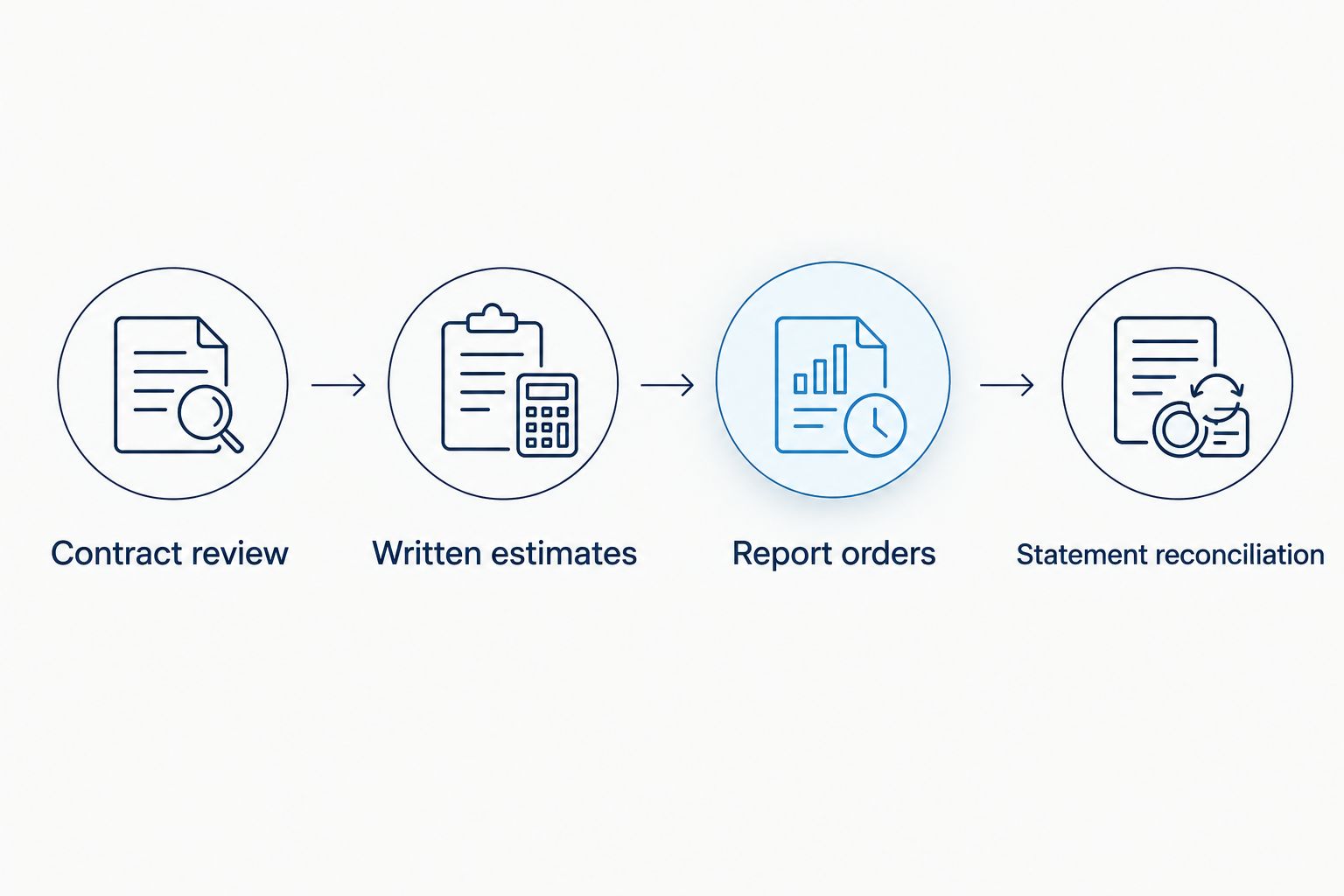
Use a sequence that identifies responsibility before money is committed.
- Contract review: Have counsel identify payment responsibilities, deadlines, deposit terms, and conditions for closing.
- Written estimates: Request itemized statements from the closing professional, lender, and other retained providers.
- Report orders: Confirm who authorizes inspections, surveys, environmental work, and appraisals before ordering them.
- Statement reconciliation: Match invoices, deposits, credits, and amounts already paid to the draft closing statement.
A buyer should maintain both a cash-to-close figure and a total acquisition-expense record. A seller should maintain a net sheet and a separate list of obligations that remain unresolved.
Update the documents when financing, credits, or closing dates change. Do not carry an old estimate into a revised transaction without checking its assumptions.
What should you check about the commercial appraisal?
For a financed commercial purchase, ask the lender who must order the appraisal, what property interest it must value, and what report scope the lender requires. Commissioning an independent report without lender approval does not establish that the lender will accept it.
The distinction between a broker's valuation discussion and the work of commercial appraisal firms for lenders matters because a lending appraisal must satisfy the lender's assignment requirements. Confirm those requirements before authorizing payment.
Ask whether the assignment addresses existing leases, owner occupancy, or another specified scenario. Also establish what happens if the appraised value does not support the proposed financing: the purchase contract, not the appraisal invoice, determines your contractual options.
For sellers, an appraisal condition belongs in the offer analysis. A seemingly attractive financed offer still requires scrutiny of financing contingencies and the buyer's obligation to address a valuation shortfall.
How do neighborhood and property use affect the review?
Use the property's actual jurisdiction, documents, and operating history rather than a broad Miami label. There is no defensible neighborhood surcharge to apply automatically to closing expenses.
- Coconut Grove: For a commercial parcel within the City of Miami, verify the applicable zoning, permitted use, access, and parking documentation.
- Coral Gables: Confirm requirements with the City of Coral Gables rather than assuming City of Miami procedures apply.
- Brickell: If the purchase is a commercial condominium, review its declaration, association obligations, access arrangements, and use restrictions.
- Brickell Key: Establish whether a space is separately conveyable and which governing documents control its intended commercial use.
These are document requests, not claims about the condition of a particular property. A seller should assemble the relevant records before marketing; a buyer should verify them during contractual due diligence.
Carlos Morean is suited to Miami commercial property buyers and sellers seeking brokerage representation, not a substitute for legal or tax advice. Select an agent who can explain the property-specific marketing plan and valuation evidence; select qualified legal, tax, and lending professionals for their respective decisions.
What changes when a restaurant or bar is involved?
First establish what is being transferred: real estate, a business, a leasehold interest, or a combination. Those transactions do not have interchangeable closing budgets.
If the transaction includes business assets, have counsel distinguish those assets from the real estate. Identify responsibility for equipment documentation, lease consent, licenses, inventory, and operational approvals where applicable.
A liquor-license transfer is not the same event as recording a deed. Likewise, ownership of a commercial space does not establish permission to operate every restaurant or bar concept there.
For a 2026 seller, separating these workstreams before accepting an offer makes the obligations clearer. Do not describe a space as ready for a buyer's intended operation without checking the supporting approvals and restrictions.
FAQ
How much are closing costs on a Miami commercial property?
Miami commercial closing costs depend on financing, applicable taxes, professional services, due diligence, and the contract's allocation of expenses. Request an itemized estimate rather than treating a single percentage as a complete budget.
Who pays closing costs on a Miami commercial sale?
The purchase contract and separate service agreements determine responsibility for many commercial closing expenses. Have the closing attorney identify each party's obligations before signing.
Are commercial closing costs lower when I pay cash?
A cash purchase avoids acquisition-loan charges but does not eliminate title, transfer, legal, or inspection expenses. Compare the same expense categories when reviewing cash and financed purchases.
Does the down payment count as a closing cost?
The down payment is purchase equity, not a closing service charge. Keep it separate from expenses while including it in the buyer's total cash requirement.
Does a commercial seller's mortgage payoff count as a closing cost?
A mortgage payoff is a debt repayment rather than a closing service charge. It still reduces seller proceeds and belongs on the net sheet.
Can Carlos Morean help with a Miami commercial property sale?
Carlos Morean provides commercial real estate brokerage services in Miami, including properties involving restaurants and bars. Legal conclusions, tax treatment, and lender requirements need review by the relevant professionals.
One last thing
Ask for a reconciliation of everything already paid before you approve the final statement. A charge shown as paid outside closing still belongs in your acquisition-expense record, but it should not be collected again without an explanation.
The best final check is not whether the total looks familiar. It is whether every charge has a purpose, an assigned payer, and supporting documentation.