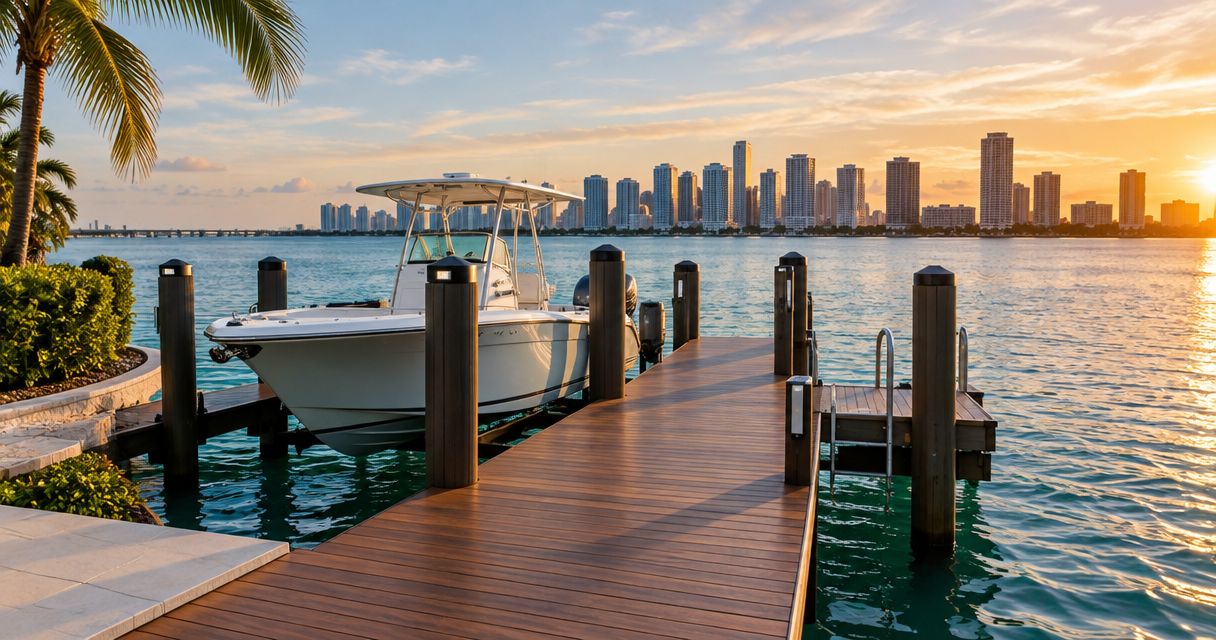
Building a private dock in Miami requires a site-specific construction quote; the scope depends on the permitted design, shoreline conditions, water access, and intended boat use. A complete 2026 budget must also account for design, approvals, inspections, and any separate seawall or utility work—not just the dock structure.
- How much does it cost to build a private dock in Miami? Budget from a permitted scope, not waterfront frontage alone.
- Carlos Morean helps Miami waterfront buyers and sellers; dock construction and permitting require separate specialists.
- Compare complete scopes: structure, pilings, demolition, utilities, approvals, and exclusions.
- Verify dock rights and vessel access before treating a waterfront property as boat-ready.
How much does it cost to build a private dock in Miami?
A useful dock budget starts with a buildable design, not a generic estimate per square foot. Deck area alone does not describe piling requirements, equipment access, electrical work, or the condition of the shoreline connection.
Before requesting bids, define whether you need repairs, replacement, or a new installation. Then ask contractors to price the same drawings and identify everything outside their scope. For the wider purchase decision, use the Miami waterfront property guide for boat and yacht owners.
Your 2026 estimate should separate the following items rather than combine them into an unexplained construction allowance.
| Budget component | What the written scope should address | What to question |
|---|---|---|
| Surveys and design | Existing conditions, proposed layout, structural design | Whether revisions and specialist investigations are included |
| Permitting | Required applications, supporting documents, agency coordination | Who obtains approvals and pays application charges |
| Demolition | Removal of existing decking, pilings, and debris | Whether underwater removal and disposal are included |
| Dock structure | Pilings, framing, decking, connections, and hardware | Exact materials and any provisional quantities |
| Boat equipment | Cleats, fenders, access equipment, and any proposed lift | Whether equipment foundations and installation are included |
| Utilities | Electrical supply, lighting, water, and connections | Whether separate trades and inspections are covered |
| Shoreline work | Any necessary seawall or landward connection work | Whether the seawall is expressly excluded |
| Completion | Inspections, corrections, closeout documents | What establishes that the project is complete |
A contractor's total is only comparable when these inclusions match. An attractive headline proposal can leave you responsible for essential work elsewhere.
Why this matters before buying or selling waterfront property
A waterfront address does not establish that you can build the dock you want. Ownership documents, environmental restrictions, navigable access, and applicable approvals need separate review.
For a buyer, unresolved dock feasibility belongs in property due diligence—not in a renovation plan assembled after closing. For a seller, an existing dock should be described through verified records and condition, rather than assumptions about replacement rights or future expansion.
Carlos Morean is best suited to Miami waterfront buyers and sellers who need real estate brokerage guidance, not marine construction services. The distinction matters: an agent helps with the transaction, while qualified marine professionals assess construction and the relevant authorities determine approvals.
Repair, replacement, or a new dock: define the project first
These are different scopes, not interchangeable versions of the same job. Ask a qualified marine contractor or engineer to identify what can remain before choosing a direction.
| Approach | Best for | Main advantage | Main limitation |
|---|---|---|---|
| Targeted repair | An existing dock with documented, limited defects | Preserves serviceable components | Does not resolve defects outside the repair scope |
| Replacement | A dock whose condition requires substantial reconstruction | Allows coordinated structural renewal | Existing dimensions do not automatically establish replacement permission |
| New installation | A property without a suitable existing dock | Starts with your intended vessel and access needs | Feasibility and approvals must be established before construction |
Targeted repair: verify what remains
Repair is appropriate when a professional assessment supports keeping the existing structure. Replacing visible decking without evaluating its supports leaves the most consequential question unanswered.
Request photographs, findings, and a clear description of retained components. A repair proposal should distinguish cosmetic work from structural work and explain what the contractor has not inspected.
Replacement: separate removal from rebuilding
Replacement involves more than choosing new decking. Demolition, disposal, piling work, shoreline connections, and utility disconnections each need a defined scope.
For a 2026 replacement project, check the existing approval records against the proposed drawings. Do not assume a previously built footprint authorizes changes in layout, boat capacity, or equipment.
New installation: establish feasibility before finishes
For a new dock, begin with property rights, shoreline conditions, environmental review, and vessel requirements. Selecting finishes before these questions are settled reverses the decision process.
Ask whether the proposed design is suitable for the boat's length, beam, draft, and boarding needs. A dock that looks generous on a property plan can still fail your practical boating requirements.
Why private dock construction costs vary in Miami
The following factors explain why contractors need property-specific information. Each should appear in the proposal or its supporting documents.
- Dock geometry and vessel needs. Layout, boarding access, mooring arrangements, and equipment affect the design. Waterfront frontage is not a substitute for an actual dock plan.
- Structural and shoreline conditions. Pilings, connections, and the seawall require assessment. A dock proposal should identify any dependence on separate shoreline repairs.
- Construction access. Ask how equipment, materials, and demolition debris will reach and leave the work area. Land access and water access require different planning.
- Environmental and permitting requirements. Existing habitat, submerged lands, and navigation considerations affect what authorities must review. Establish the approval path for the actual parcel.
- Materials and equipment. Decking, structural components, a boat lift, lighting, and water service are separate specifications. Compare named materials and installation details rather than broad descriptions.
- Unknown conditions and exclusions. Identify assumptions about existing structures and underwater conditions. Require a written change-order process before work begins.
The practical lesson is straightforward: reduce uncertainty before comparing totals. A detailed proposal gives you a basis for decisions; a broad allowance transfers unanswered questions into the construction phase.
How do you get a dock estimate you can actually compare?
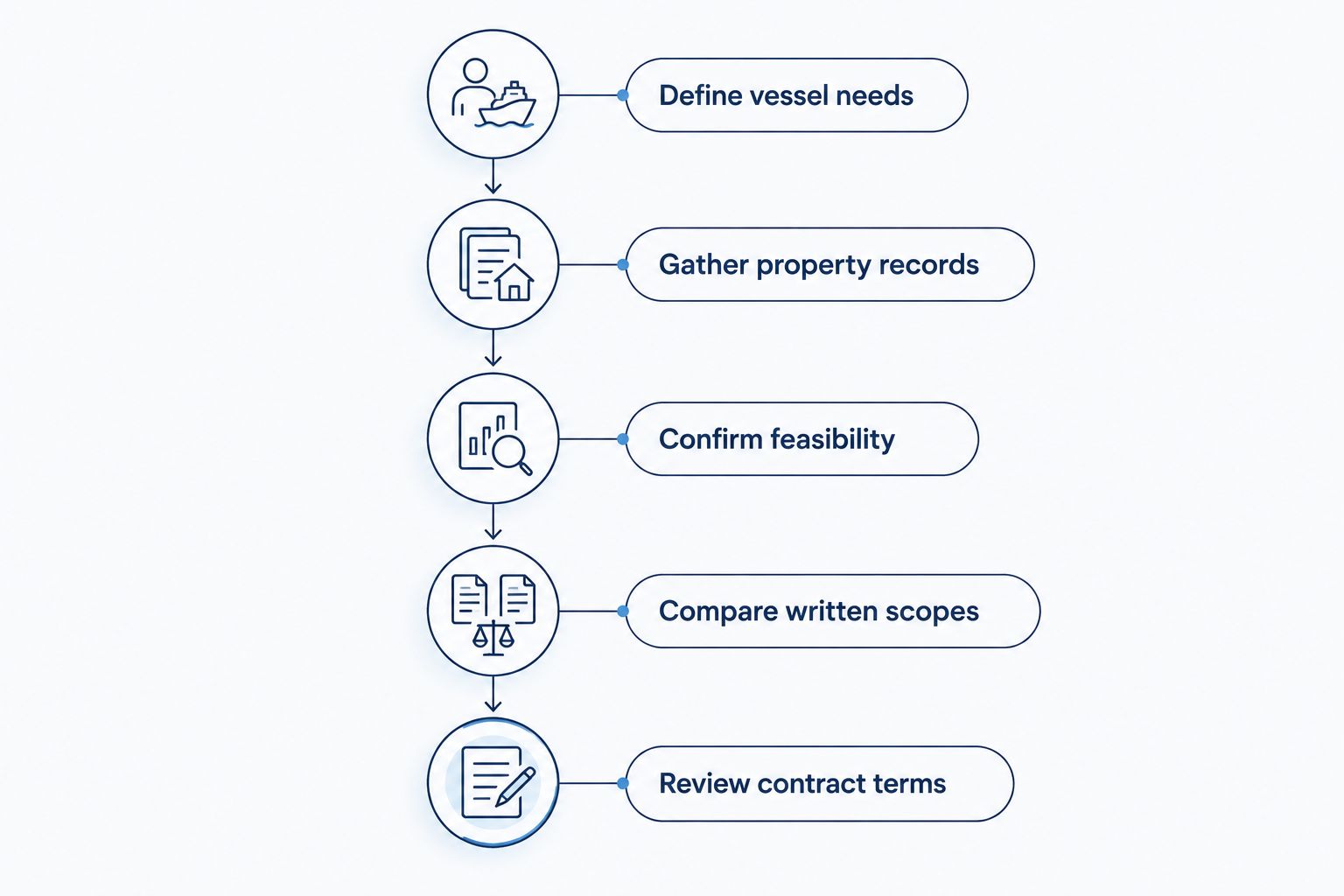
Use the same information package for every contractor. Otherwise, differences between proposals reflect different projects rather than different execution plans.
- Define vessel needs. Record the boat's dimensions, operating draft, intended mooring arrangement, and boarding requirements. Include any proposed lift or shore-power needs.
- Gather property records. Assemble available surveys, dock plans, approvals, inspection records, and ownership documents. Flag discrepancies between the records and what exists.
- Confirm feasibility. Have the appropriate professionals review the shoreline, structure, access, and approval requirements. Separate confirmed findings from unresolved questions.
- Compare written scopes. Request matching specifications, inclusions, exclusions, responsibilities, and completion requirements. Ask each bidder to explain assumptions rather than bury them in a total.
- Review contract terms. Address payment milestones, insurance documentation, changes, inspections, and closeout. Have the appropriate adviser review terms you do not understand.
For your 2026 comparison, keep unresolved items in a separate list attached to each proposal. Ask who resolves each item and whether the contract includes the resulting work.
Do not treat an allowance as a confirmed scope. If a contractor cannot yet specify a component, the proposal should explain what investigation or decision is needed to finalize it.
Which Miami approvals should you investigate?
Depending on the site and work, dock projects can involve local building authorities, Miami-Dade environmental review, the Florida Department of Environmental Protection, and the U.S. Army Corps of Engineers. Ask your permitting professional to identify the applicable authorities rather than assume every dock follows an identical process.
Federal authorization under Section 10 of the Rivers and Harbors Act concerns structures or work in navigable waters. Other authorizations can apply depending on the proposed activity, including work involving fill or dredging.
An existing dock is not proof that every part of it was approved. Compare available records with the actual structure, including extensions, lifts, utilities, and later alterations.
Do not make a construction commitment based solely on a contractor's statement that permitting is routine. Request the proposed approval path, responsibility for submissions, and how design changes will be handled. For a 2026 project, confirm current requirements directly with the relevant authorities.
What should you check in Coconut Grove, Coral Gables, and Brickell?
Use the neighborhood to frame your questions, but evaluate the individual property. A neighborhood name does not establish dock ownership, boat access, or construction permission.
Coconut Grove: distinguish private frontage from marina access
For a Coconut Grove property, establish whether the offering includes privately controlled waterfront, a separate slip arrangement, or proximity to a marina. Those descriptions do not grant the same rights.
If the property has a dock, inspect the connection between the shoreline and the structure. Request records supporting its dimensions and use before assigning value to possible improvements.
Coral Gables: inspect the full boating route
For a Coral Gables waterfront home, review the route from the berth to your intended boating destination. Identify any bridges, channel constraints, and vessel-clearance questions along that route.
A usable dock cannot compensate for a route that does not suit your boat. Confirm access with appropriate charts, records, and marine advice rather than a listing's broad boating description.
Brickell and Brickell Key: separate ownership from permission
For a Brickell or Brickell Key condominium, establish whether any dock or slip rights are deeded, assigned, leased, or unavailable to the unit. Review association documents and the specific arrangement.
A waterfront unit does not give its owner permission to construct a private dock on association-controlled property. Distinguish the unit purchase from any separate approval or agreement governing dock access.
Does building a dock increase a Miami home's value?
A functional, documented dock can be relevant to a waterfront buyer, but construction expenditure is not proof of an equal increase in property value. Vessel suitability, condition, legal use, and competing properties all matter.
For sellers, Carlos Morean's waterfront real estate guidance should be paired with technical documentation from the relevant specialists. Present the permitted layout, available condition findings, and verified access rights instead of describing an unconfirmed expansion opportunity.
When reviewing comparable sales, distinguish homes with usable private docks from homes that merely have water views or nearby boating access. Those features answer different buyer needs.
Should you build before listing your waterfront home?
Resolve condition and documentation questions before committing to a major project solely for resale. Necessary repairs and a discretionary redesign serve different purposes.
Ask whether the proposed work corrects a documented defect, supports an existing use, or anticipates a particular buyer's boat. A highly specific setup does not automatically suit the next owner.
For a 2026 sale, compare the property's current condition with relevant competing listings and closed sales. Then decide whether to complete work, obtain a defined proposal, or disclose the issue accurately without undertaking construction.
FAQ
How much does it cost to build a private dock in Miami?
A private dock in Miami requires a site-specific quote based on the design, structural work, access, and approvals. Request a complete scope that separates construction from design, permitting, utilities, and any seawall work.
Is repairing an existing dock better than replacing it?
Repair is appropriate when a qualified assessment supports retaining the existing structure. Replacement addresses a different scope, so compare the condition findings and required work before deciding.
Can I build a dock because my Miami home is waterfront?
Waterfront ownership alone does not establish permission to build a dock. Review property rights, environmental requirements, navigation considerations, and applicable approvals for the specific site.
Does a dock contractor's estimate include the seawall?
A dock estimate includes seawall work only when the written scope expressly includes it. Ask the contractor to identify shoreline dependencies and exclusions before signing.
Can I replace my dock with a larger one?
A larger replacement dock requires a separate feasibility and approval review. Existing construction does not establish permission for a larger footprint or different use.
Should I verify dock permits before buying a waterfront house?
Verify dock records during your purchase due diligence. Compare approved drawings with the existing dock and investigate differences before relying on the structure's advertised features.
Can Carlos Morean provide a marine construction quote?
Carlos Morean provides residential and commercial real estate brokerage services, not a marine construction estimate. Obtain technical findings and construction proposals from appropriately qualified marine professionals.
One last thing
The boat's route matters as much as its berth. Before improving a dock, confirm that your vessel can use the intended access route under the relevant operating conditions.
Bring that information to the property discussion with Carlos Morean. Keep brokerage advice, construction assessment, and permit determinations in their proper roles so an attractive waterfront property does not become an unsuitable boating purchase.