
Best overall: a limited-service condo with documented reserves and maintenance funding. Best for Brickell access: a smaller unit in an established building. Best budget-focused search: a low-rise condo without extensive shared amenities—provided its financial records support the fee. For Miami condos with low HOA fees in 2026, compare what the payment covers before treating a lower number as savings.
- For Miami condos with low HOA fees, prioritize documented maintenance funding over the lowest advertised payment.
- Carlos Morean helps Miami condo buyers and sellers evaluate properties against their ownership goals.
- Compare smaller Brickell units, limited-service buildings, and low-rise condos by financial records, not neighborhood reputation.
- A low HOA payment does not establish that reserves, insurance, or major repairs are adequately funded.
Why this matters
A condo association payment is a shared ownership obligation, not simply an amenity subscription. A low payment tells you little until you understand the operating budget, reserve contributions, insurance coverage, and outstanding obligations.
Carlos Morean is a fit for Miami condo buyers who want local brokerage guidance on residential and investment properties. You can start with Carlos Morean and define the ownership requirements that matter before narrowing your search by fees.
This 2026 guide ranks search profiles, not named buildings. The right recommendation depends on the specific unit and association documents; a neighborhood name alone cannot establish which condo has sustainable fees.
What makes the best low-HOA Miami condo?
Use these criteria before comparing buildings:
- Financial support: The approved budget explains how the association funds operations and reserves.
- Maintenance visibility: Inspection records, repair plans, and meeting minutes identify obligations beyond routine upkeep.
- Coverage clarity: You understand which utilities, insurance, parking, and services sit inside or outside the association payment.
- Useful amenities: Shared facilities match what you actually use rather than adding services you do not need.
- Unit-level allocation: The declaration explains the unit's share of common expenses; square footage alone is not enough.
- Resale compatibility: Financing requirements, restrictions, and unresolved building issues receive attention before you commit.
The best low-fee condo is the one whose payment matches its obligations—not the one with the smallest advertised bill. Apply that rule to waterfront towers and modest walk-up buildings alike.
Miami condo search profiles at a glance
These profiles are starting points for document review, not claims that every building in a category has low fees.
| Rank and profile | Best for | Standout feature | Key limitation |
|---|---|---|---|
| 1. Limited-service condo | Buyers who prioritize essential services | Fewer discretionary shared services to evaluate | Limited amenities do not prove adequate reserves |
| 2. Smaller unit in an established building | Buyers prioritizing Brickell access | A smaller ownership footprint within the desired location | Expense allocation and building obligations still control |
| 3. Low-rise condo without extensive amenities | Buyers comfortable with simpler facilities | A straightforward amenity checklist | Fewer owners can share substantial common repairs |
| 4. Service-rich condo with useful inclusions | Buyers who need the included services | A clearer comparison of bundled versus separate expenses | Not the default choice for the lowest association payment |
1. Limited-service condo: best for essential-service buyers
A limited-service condo is the strongest starting point when you want shared maintenance without an extensive service package. Focus on buildings whose actual operations match that description, rather than relying on listing language.
In Coconut Grove or Coral Gables, assess each candidate on its own records. An address does not establish the scope of staffing, shared facilities, insurance, or maintenance obligations.
Limited-service condo pros:
- You can focus your review on essential building functions.
- Fewer discretionary services make amenity trade-offs easier to identify.
- The profile suits buyers who do not need extensive shared recreation facilities.
Limited-service condo cons:
- A simple amenity list says nothing about reserve adequacy.
- You give up facilities or staffing that other buyers value.
- Major common repairs remain shared obligations.
Best for: Buyers who want essential services and are willing to reject a building when its finances do not support its payment.
Ask for the approved 2026 budget and an explanation of planned maintenance. Match the budget to actual services and known projects rather than accepting “low maintenance” as a financial conclusion.
Verdict: Buy only when documented funding supports the limited-service model.
2. Smaller established-building unit: best for Brickell access
A smaller condo unit lets you keep location central to the search without assuming you need the same space as a larger residence. It does not guarantee a lower payment: the declaration determines how common expenses are allocated.
For Brickell and Brickell Key, compare the actual unit obligation, service package, parking arrangement, and any additional association layer. Do not transfer assumptions from one tower to another.
Smaller established-building unit pros:
- You can prioritize location without buying unnecessary interior space.
- Existing operating records provide material for financial review.
- Unit-level comparisons help separate building expenses from layout preferences.
Smaller established-building unit cons:
- A smaller floor plan does not remove building-wide financial exposure.
- Storage, work space, or guest accommodation require trade-offs.
- A low payment remains unconvincing without supporting documents.
Best for: Buyers who place Brickell access ahead of additional interior space.
Request the expense-allocation schedule and confirm the obligations attached to the exact unit. If two listings show different payments, establish whether the difference reflects allocation, inclusions, outdated information, or another charge.
Verdict: Buy for the location only after confirming the unit's complete obligations.
3. Low-rise condo: best for buyers seeking simpler facilities
A low-rise condo without extensive amenities deserves a place on a budget-focused shortlist. Its appeal is the simpler facility package—not an automatic promise of lower long-term ownership expenses.
In Coconut Grove and Coral Gables, inspect the building rather than treating the neighborhood as a financial credential. Review roofs, exterior maintenance, drainage, and shared systems according to the property's actual construction.
Low-rise condo pros:
- A shorter amenity list helps you identify what you are paying to maintain.
- The profile suits buyers who do not need tower-style facilities.
- Building-specific inspection findings provide concrete decision points.
Low-rise condo cons:
- A smaller association spreads shared obligations across fewer owners.
- An understated exterior does not establish good maintenance.
- Facilities and accessibility require individual verification.
Best for: Buyers comfortable with simpler shared facilities who will investigate the building's repair obligations.
Ask which components the association maintains and which remain the owner's responsibility. For your 2026 shortlist, insist on the same financial scrutiny you would apply to a larger building.
Verdict: Hold until maintenance responsibilities and funding are clear.
4. Service-rich condo: best for buyers who use the inclusions
A building with extensive services belongs in this comparison only when you genuinely need what its payment includes. It is a total-ownership comparison, not the default answer to a low-HOA search.
For Brickell Key or another waterfront location, identify the exact insurance and utility inclusions before comparing payments. The guide to HOA fees on Miami waterfront condos provides a related framework for that review.
Service-rich condo pros:
- Documented inclusions make bundled expenses easier to compare.
- Shared services suit buyers who would otherwise arrange similar support separately.
- Established operating records help explain the service package.
Service-rich condo cons:
- You contribute to shared services even when you rarely use them.
- More facilities create more maintenance items to investigate.
- A bundled payment still requires separate reserve and assessment review.
Best for: Buyers whose daily needs match the documented inclusions.
List what you would otherwise arrange separately. Compare only equivalent coverage; association insurance and an owner's individual policy do not automatically serve the same purpose.
Verdict: Skip if the service package exceeds what you need.
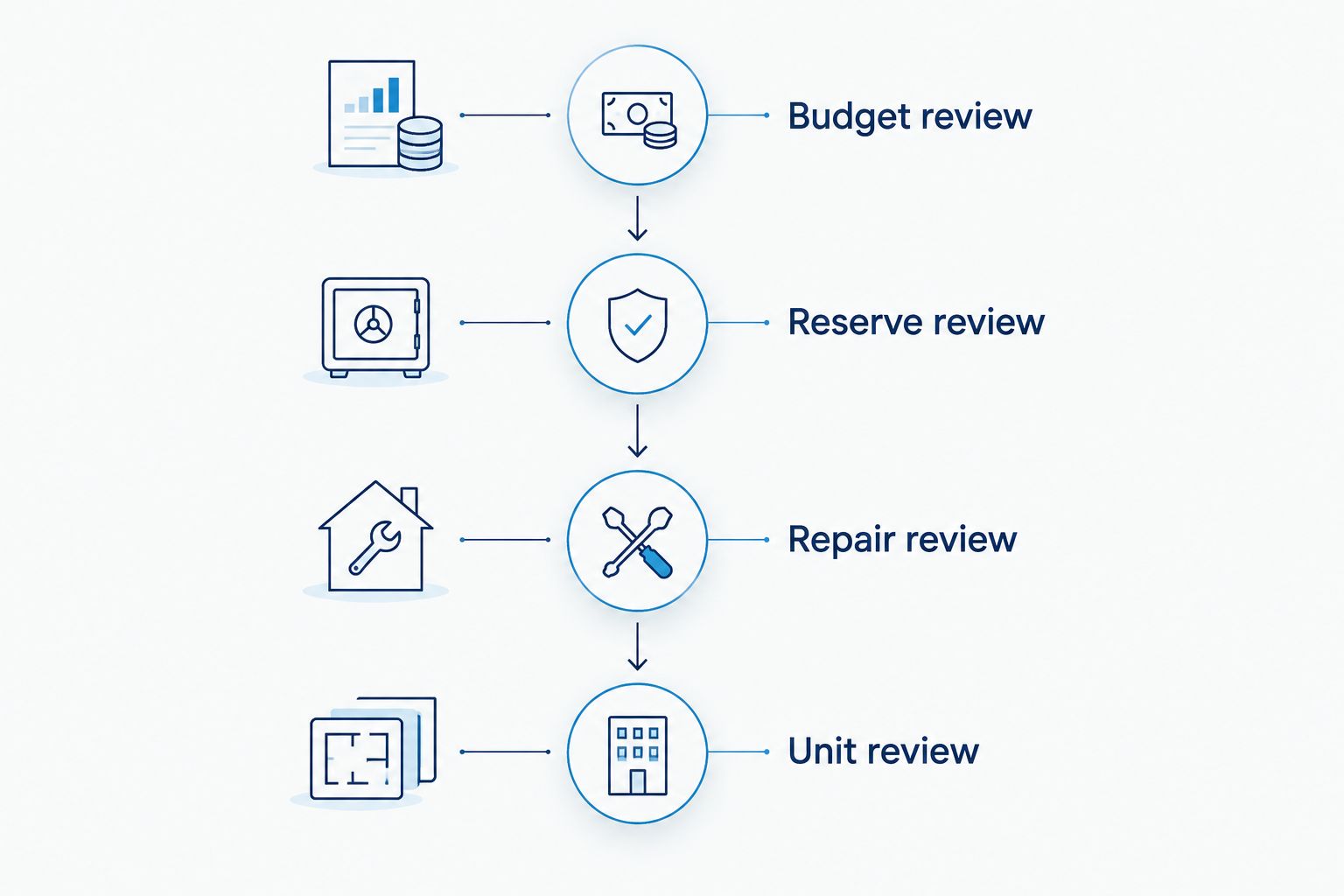
How to verify a low HOA payment before making an offer
Use this sequence for every candidate. Carlos Morean provides Miami condo brokerage guidance; association management, inspectors, lenders, and legal advisers supply their respective financial, technical, financing, and legal reviews.
Budget review
Request the approved 2026 budget and current unit payment confirmation. Identify operating expenses, reserve contributions, and any separate recurring association obligations.
Request the preceding 3 annual budgets as a comparison set. This is a review recommendation, not a rule that three budgets alone establish financial health.
Reserve review
Read the applicable reserve documentation alongside the maintenance plan. Ask management to explain any mismatch between identified work and the funding described in the records.
Do not treat the existence of a reserve account as proof that every projected obligation is funded. The underlying assumptions matter.
Repair review
Request available inspection reports, project contracts, assessment notices, and 12 months of meeting minutes. Use the minutes to identify discussions that need follow-up, not as a substitute for technical reports.
Have an appropriate professional explain unresolved structural or building-system findings. An attractive unit interior does not resolve common-property concerns.
Unit review
Confirm the exact unit's common-expense allocation, outstanding obligations, parking rights, and restrictions. Ask your closing professionals how approved assessments and outstanding amounts will be addressed in the transaction.
Compare at least 2 candidate units using the same document checklist. A consistent comparison exposes differences that a listing's monthly payment cannot explain.
What sellers should prepare before advertising low fees
For Miami sellers, a low payment is useful only when buyers can verify it. Prepare a clear document package before making the association payment a central marketing claim.
Give your agent the current payment confirmation, approved budget, known assessment notices, and the available maintenance documentation. Identify included services accurately and distinguish association coverage from owner responsibilities.
Do not use low HOA fees to justify a valuation without comparable-sale evidence. In Coconut Grove, Coral Gables, Brickell, and Brickell Key, compare the property's condition, location, building obligations, and unit characteristics—not just its payment.
Carlos Morean works with Miami condo buyers and sellers. A practical seller discussion should connect the asking strategy to the unit's documented strengths and disclose known obligations clearly.
How these profiles are ranked
This ranking prioritizes alignment between services and buyer needs, followed by financial documentation, maintenance visibility, and unit-level obligations. It does not rank buildings by advertised payments or claim that a particular neighborhood has the lowest fees.
The limited-service profile ranks first because it starts with a clear question: are you funding essentials you need? Financial evidence remains the deciding test for every profile in this 2026 guide.
Which Miami condo should you choose?
Start with a limited-service condo whose records support its payment. Choose a smaller established-building unit when Brickell access matters more than space, and consider a low-rise when simpler facilities fit your lifestyle.
Keep service-rich buildings only if their documented inclusions match your needs. Reject any candidate whose low payment cannot be reconciled with known obligations.
FAQ
What are the best Miami condos with low HOA fees?
The strongest starting point is a limited-service condo with documented maintenance funding and reserves. Compare individual associations and units rather than assuming a building type or neighborhood guarantees low fees.
Are smaller Brickell condos cheaper to maintain?
A smaller Brickell condo does not automatically have a lower association payment. Confirm the declaration's expense allocation, the unit's obligations, and the services included.
Does a low HOA fee mean a condo is financially healthy?
No. Financial health requires review of the approved budget, reserves, maintenance obligations, assessments, and relevant professional findings—not just the monthly payment.
Is a low-rise condo better than a high-rise for low HOA fees?
Neither building type wins automatically. A low-rise can have fewer amenities, but shared repairs and reserve needs still require careful review.
What should I request before buying a Miami condo in 2026?
Request the approved budget, unit payment confirmation, applicable reserve documentation, assessment notices, available inspection reports, and meeting minutes. Have the appropriate professionals review unresolved financial, technical, financing, or legal questions.
Should I compare Coconut Grove and Coral Gables by HOA fees?
Compare individual units and associations rather than neighborhood labels. Confirm maintenance responsibilities, services, and financial obligations on the same basis for each candidate.
Can sellers market a Miami condo as low maintenance?
Sellers should support any fee claim with current documentation and a clear explanation of inclusions. A low association payment does not establish that the property has limited repair needs or no future obligations.
One last thing
Ask what the association payment leaves out. A useful final check is to write down every owner responsibility beside every association responsibility, then reconcile that list with the governing documents and budget.
For 2026 buyers and sellers, that distinction is more useful than a low-fee headline. It turns an attractive payment into a decision you can actually evaluate.