
Yes. Florida condo safety requirements can raise a Miami association’s regular fees when its budget must cover structural inspections, required reserves, repairs, or repayment of association borrowing. A special assessment can create a separate owner obligation even when the advertised monthly fee stays unchanged, so review both before buying or setting your asking price.
- Miami condo safety law HOA fees depend on the building’s inspection findings, reserve funding, and repair obligations.
- Florida milestone inspections and structural integrity reserve studies serve different purposes; request both when applicable.
- A low monthly condo fee does not prove that structural repairs are funded.
- Carlos Morean provides Miami condo brokerage services for buyers and sellers who want local transaction guidance.
Can new safety laws raise a Miami condo’s HOA fees?
Yes—but Florida does not impose one standard safety-law fee increase on every Miami condo. The association’s actual obligations, existing reserves, governing documents, and approved funding decisions determine what owners pay.
For a 2026 transaction, separate the recurring association budget from special assessments and unresolved work. Owners commonly call these charges “HOA fees,” although condominium associations operate under Florida’s condominium laws rather than the separate homeowners’ association framework.
The distinction matters when comparing HOA fees on Miami waterfront condos. A listing’s monthly figure is only one part of the ownership obligation.
| Funding method | What it does | Advantage | Trade-off | Best for understanding |
|---|---|---|---|---|
| Regular assessments | Collect recurring operating and reserve contributions | Makes recurring obligations visible in the budget | A higher payment continues under the approved budget | Ongoing ownership affordability |
| Special assessment | Collects an additional amount for a stated purpose | Identifies a separate funding obligation | Creates an additional payment beyond regular dues | Immediate or scheduled owner obligations |
| Association borrowing | Finances association expenses through debt | Spreads repayment over the loan term | Adds interest and future repayment obligations | Long-term association commitments |
These are funding mechanisms, not interchangeable recommendations. Ask the association to identify which mechanisms it has approved and which remain proposals.
Why this matters before you sell
A buyer evaluates more than your unit’s finishes and view. The building’s financial obligations affect the buyer’s ownership budget, and unresolved structural issues can also affect lender review.
Price your condo against properties with comparable building obligations, not just comparable interiors. A renovated unit in an association facing unresolved repairs is not financially equivalent to a similar unit whose association has completed and funded its work.
Carlos Morean’s Miami condo brokerage services are best suited to buyers and sellers seeking local transaction guidance. Engineering conclusions belong to qualified building professionals, while legal interpretations belong to your Florida real estate attorney.
For a seller preparing in 2026, the practical move is to assemble the association documents before selecting an asking price. That makes your pricing discussion more useful than relying on a neighboring owner’s advertised fee.
Which Florida safety requirements affect condo budgets?
Florida’s milestone inspection requirements and structural integrity reserve study requirements address different questions. An inspection evaluates specified building conditions; a reserve study addresses future funding for covered components.
Milestone inspections: building condition
Florida Statutes section 553.899 establishes milestone inspections for covered condominium and cooperative buildings that are 3 stories or higher. The general initial inspection threshold is 30 years, followed by inspections every 10 years.
Local enforcement agencies can require an initial inspection at 25 years when justified by local circumstances, including environmental conditions. Do not treat proximity to water alone as proof of a particular building’s deadline; request the authority’s notice and the building’s inspection record.
An inspection does not automatically mean major repairs are necessary. Its findings determine whether further investigation or corrective work is required, and those findings—not the building’s age alone—should guide your questions.
Structural integrity reserve studies: future funding
Florida Statutes section 718.112 addresses structural integrity reserve studies for covered residential condominium buildings with 3 habitable stories or higher. These studies assess specified components and the funding needed for their future repair or replacement.
A completed reserve study is not proof that the recommended funding is already in place. Compare the study with the adopted budget, reserve balances, and the association’s documented funding decisions.
For a 2026 purchase or listing, use these statutory provisions as the starting point and have association counsel confirm applicable deadlines, exceptions, and permitted funding arrangements. A general explanation cannot establish a particular association’s compliance status.
How do safety obligations reach your monthly fee?
Safety-related work affects owners through the association’s budget and collection decisions. The connection is easiest to understand by tracing the supporting records rather than accepting a general statement that “the law raised dues.”
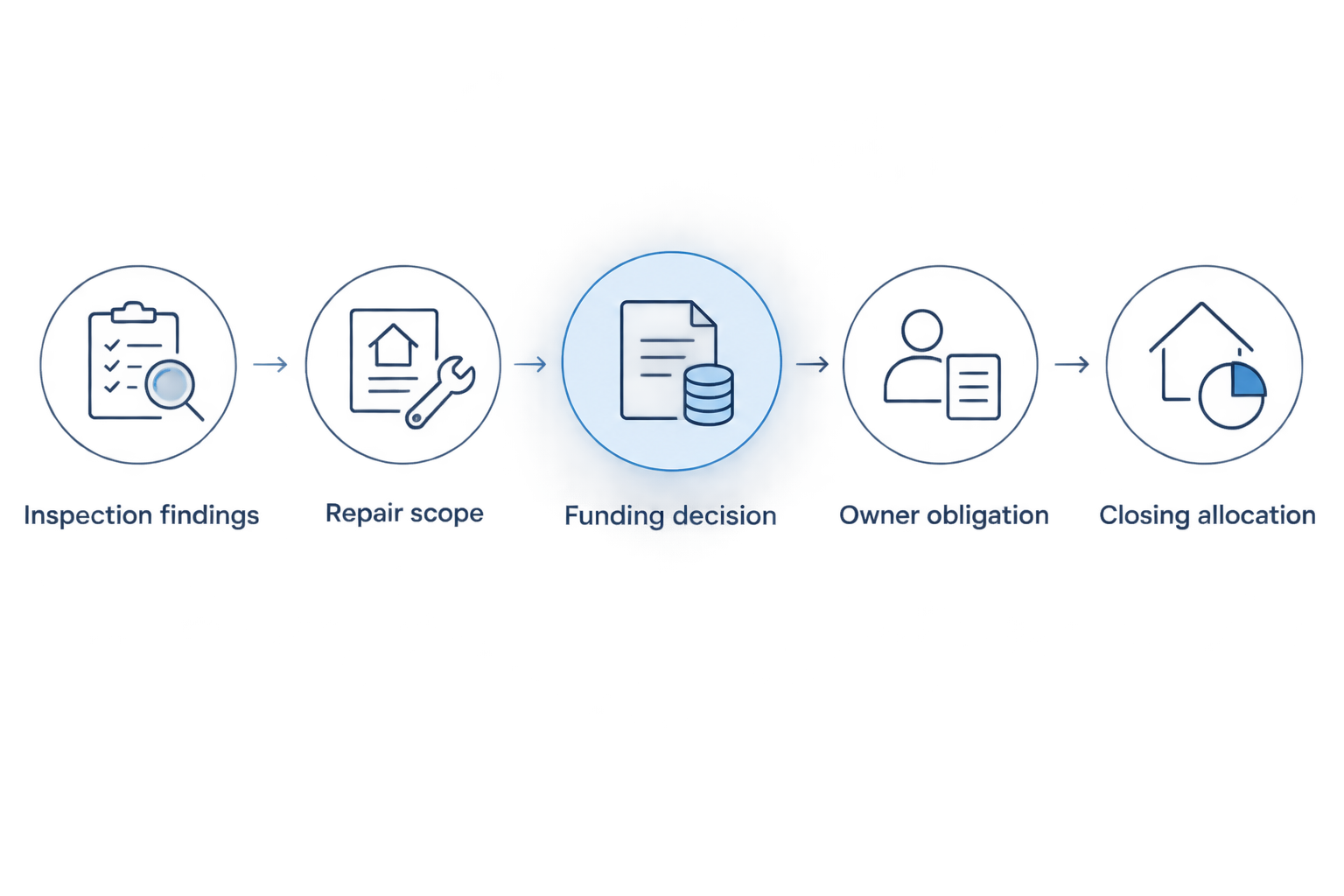
- Inspection findings: Identify what the engineer actually reported, including any additional investigation or repair recommendations.
- Repair scope: Request the defined work, professional recommendations, and available contractor proposals or executed contracts.
- Funding decision: Read the adopted budget, assessment resolution, or approved borrowing documents.
- Owner obligation: Confirm how the association allocates the expense to your unit and when payments become due.
- Closing allocation: Have your attorney address buyer and seller responsibilities in the purchase contract.
Follow the records from the technical finding to the owner’s obligation. A board discussion about possible work is not the same as an adopted assessment, and an adopted assessment is not proof that construction is complete.
Keep the supporting documents together. When an association says a project is funded, ask whether that means collected reserves, approved future collections, or borrowed funds; those arrangements have different implications for owners.
Why safety-related condo fees vary by building
Two neighboring associations can face different obligations even when their buildings look similar. Focus on these documented drivers:
- Inspection findings: The required work depends on the condition identified by qualified professionals, not the neighborhood’s reputation.
- Existing reserves: Available funds affect how much additional collection is needed for covered work.
- Repair scope: Investigation, engineering, permitting, and construction are distinct parts of a project’s financial plan.
- Allocation rules: Your unit’s responsibility follows the applicable condominium documents and assessment provisions, not an assumed equal split.
- Funding method: Regular contributions, special assessments, and association debt create different payment obligations.
- Project status: A preliminary proposal, an executed contract, and completed work provide different levels of certainty.
Insurance and ordinary operating expenses also affect association budgets. Do not attribute an entire increase to safety legislation without reviewing the budget line items and the association’s explanation.
What should a Miami condo seller request before listing?
Build the document file before you build the marketing plan. Request the current adopted budget, available financial statements, reserve study, milestone inspection reports, assessment notices, relevant meeting minutes, and updates on unresolved repair projects.
Then reconcile the documents. Check whether the budget reflects the reserve plan, whether approved assessments match the notices, and whether meeting minutes identify additional work not addressed in the listing information.
Ask for the status of permits, contracts, and completion documentation where applicable. An owner’s recollection that “the concrete work was handled” does not establish the scope, funding, or completion of the association’s project.
An HOA estoppel certificate for a Miami condo closing helps establish specified account and assessment information for the transaction. It does not replace engineering reports, reserve analysis, or review of the association’s broader financial position.
Carlos Morean helps Miami property sellers with brokerage decisions; use your attorney and the association’s professionals to resolve legal and technical questions. The limitation is clear: an agent’s market analysis cannot certify structural safety or guarantee future assessments.
How should you compare Brickell, Brickell Key, and nearby condos?
Use neighborhood detail to narrow the comparison, then verify the building records. Neither a Brickell address nor a waterfront setting on Brickell Key establishes reserve adequacy or completed repairs.
In Brickell and Brickell Key, start with comparable units in the same building when suitable transactions exist. Compare unit size, view, condition, parking rights, and documented association obligations before expanding to neighboring buildings.
For Coconut Grove and Coral Gables condos, apply the same discipline. Confirm the property is a condominium, identify the applicable association, and avoid importing fee assumptions from nearby single-family properties or a different ownership structure.
For your 2026 seller analysis, show which comparisons have known assessments or unresolved building work. If the association’s records do not establish those facts, do not present the buildings as financially equivalent.
Can a special assessment replace a monthly fee increase?
A special assessment can fund a separate association obligation, but it does not automatically eliminate the need for higher regular contributions. An association can have both an additional assessment and increased recurring dues.
Ask what each collection funds. Paying for a current repair project does not, by itself, establish that future reserve contributions or ordinary operating expenses are covered.
Can a buyer’s lender reject a condo with unresolved repairs?
A lender can decline a condominium project that fails its applicable eligibility requirements, including requirements concerning certain critical repairs or financial conditions. Approval of the individual borrower does not establish approval of the building.
Submit project documents to the lender early. Sellers should distinguish a buyer’s personal mortgage preapproval from the lender’s review of the condominium project.
Should you lower your asking price because fees increased?
A fee increase alone does not establish the correct asking-price adjustment. Your valuation should consider comparable sales, recurring ownership obligations, assessment responsibility, and the documented condition and funding of the building.
An increase supporting a documented reserve plan is different from an increase accompanied by undefined repairs and unresolved funding. Give buyers the records needed to understand that difference rather than defending the monthly fee in isolation.
FAQ
Can Miami condo safety laws raise my HOA fees in 2026?
Yes. Safety inspections, reserve funding, repairs, and association debt repayment can increase regular assessments or create separate special assessments. The amount depends on the association’s documented obligations and funding decisions.
Does every Miami condo have to raise its monthly fees?
No. Florida’s safety requirements do not establish one uniform monthly fee increase for every condominium. Review the building’s applicable requirements, existing funds, and adopted budget.
Is a milestone inspection the same as a reserve study?
No. A milestone inspection addresses specified building conditions, while a structural integrity reserve study addresses future funding for covered components. Request both when they apply to the building.
Does a low condo fee mean the building is financially healthy?
No. A low advertised fee does not establish adequate reserves, completed repairs, or the absence of special assessments. Compare the adopted budget with the reserve study and repair records.
Who pays a condo special assessment when the unit sells?
The purchase contract, applicable law, association documents, and assessment terms determine the parties’ responsibilities. Have your Florida real estate attorney address the allocation before signing rather than assuming the payment schedule settles it.
Can Carlos Morean confirm that a Miami condo is structurally safe?
Carlos Morean provides real estate brokerage services, not an engineering certification. Qualified building professionals evaluate structural conditions, and your attorney advises on legal obligations and disclosures.
What should I check first if my condo fees increase?
Start with the adopted budget and the association’s written explanation of the increase. Separate operating expenses, reserve contributions, repair funding, and debt repayment before drawing a conclusion.
One last thing
A higher monthly fee and a stronger financial position can exist together. The useful question is not simply whether dues increased, but what the association is collecting for and whether the documented plan addresses its obligations.
Before listing in 2026, ask the association to reconcile the inspection findings, reserve plan, current budget, and outstanding assessments. Clear records give your pricing and negotiation strategy a factual foundation; a low advertised fee does not.