
Yes, you can buy a Miami condo through an LLC, provided the condominium’s governing documents permit the ownership structure and your financing supports it. For a 2026 purchase, confirm association approval, title requirements, tax treatment, and insurance before signing; LLC ownership does not automatically provide anonymity, mortgage eligibility, or personal-residence tax benefits.
- Can you buy a Miami condo through an LLC? Yes, but association rules and lender requirements still apply.
- An LLC does not override condo rental restrictions, eliminate personal guarantees, or automatically qualify for Florida homestead benefits.
- Carlos Morean helps Miami residential and investment buyers; legal and tax advisers should determine the ownership structure.
- Choose the buyer’s legal name before signing, then align the contract, financing, association application, and deed.
Why this matters
Choose the ownership structure before you choose the contract’s buyer name. Changing from your individual name to an LLC later introduces questions about assignment, lender consent, association approval, and title documentation.
Treat ownership as part of the Miami condo offer-to-closing workflow, not an administrative detail saved for closing. A suitable investment structure can be unsuitable for your primary residence.
Can you buy a Miami condo through an LLC?
Yes. Florida’s Revised Limited Liability Company Act gives an LLC the power to acquire and own property. That legal capacity does not establish that a particular condo association will approve the buyer or that a particular lender will finance the purchase.
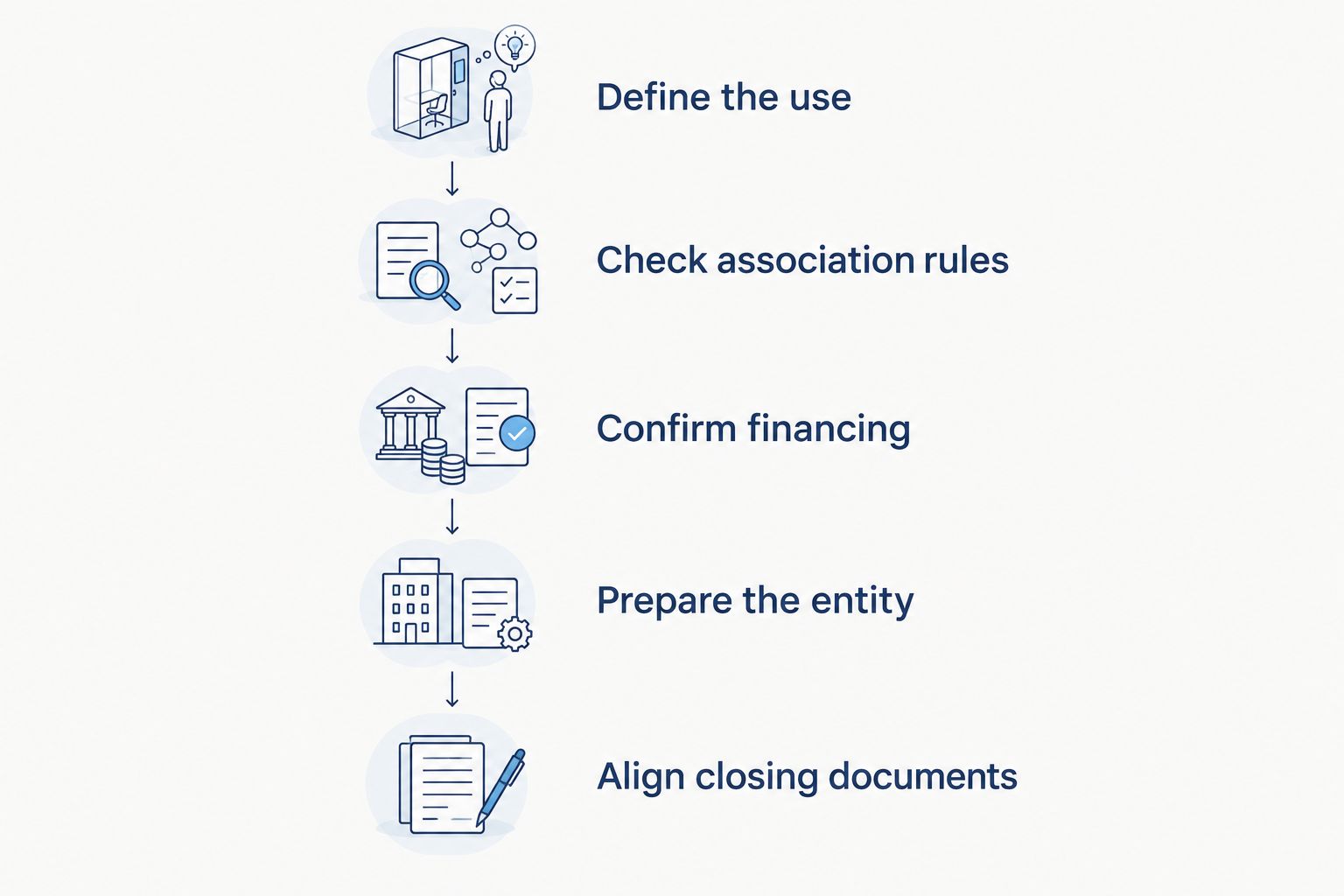
Use these steps for a 2026 purchase:
- Define the use. Tell your attorney whether the condo will be your home, a second home, or a rental investment. Identify every intended occupant and owner.
- Check association rules. Obtain the declaration, amendments, application requirements, and leasing restrictions. Ask specifically about entity ownership and occupant approval.
- Confirm financing. Give the lender the proposed ownership structure before applying. Ask who must borrow, hold title, and guarantee repayment.
- Prepare the entity. Have counsel confirm the LLC’s status, operating agreement, ownership, and signing authority. Ask the closing agent which documents are required.
- Align the closing documents. Match the approved buyer across the contract, association application, insurance, loan documents, and deed.
Florida Statutes Chapter 605 addresses LLC powers and liability; Chapter 718 governs Florida condominiums. Neither replaces a review of the specific building’s recorded documents and the proposed loan.
Individual ownership: best for evaluating a primary residence
Individual ownership is the starting point to discuss when you intend to occupy the condo as your permanent home. It avoids adding an entity between you and the property, although mortgage, estate-planning, and liability questions still require attention.
The main limitation is that the property is held personally rather than through a separate legal entity. Do not surrender potential homestead treatment merely because an LLC sounds more protective. Have a Florida attorney compare the actual consequences first.
Single-member LLC: best for evaluating a separately held investment
A single-member LLC has 1 owner. For federal income tax purposes, the IRS generally treats a domestic single-member LLC as a disregarded entity unless it elects corporate treatment; that default does not erase the LLC under state law.
This structure separates legal ownership from individual title. Its limitations include entity administration, financing restrictions, and liability protections that do not cover every claim or personal obligation.
Multi-member LLC: best for defining shared investment ownership
A multi-member LLC has 2 or more owners. The IRS generally treats a domestic multi-member LLC as a partnership for federal income tax purposes unless it elects corporate treatment.
An operating agreement can address contributions, management, distributions, and exits. Shared ownership also adds decisions about signing authority, disagreements, additional funding, and the sale of an owner’s interest.
Compare the ownership structures
| Structure | Best for | Main advantage | Main limitation |
|---|---|---|---|
| Individual ownership | Buyers evaluating a permanent residence | No separate entity to administer | Property is held personally |
| Single-member LLC | An owner evaluating a separately held investment | Separate legal ownership with default federal disregarded-entity treatment | Lender and association acceptance still require confirmation |
| Multi-member LLC | Investors buying together | Written management and ownership arrangements | Additional governance and tax administration |
These are decision categories, not automatic recommendations. Personal use, financing, residency, and ownership goals determine which structure deserves further review.
Why LLC purchase requirements vary
For a 2026 acquisition, the answer depends on the property and transaction—not simply on whether an LLC exists.
- Condominium documents: Entity ownership, approval procedures, designated occupants, and leasing restrictions require separate review.
- Loan requirements: The lender determines acceptable borrowers, title holders, guarantees, and underwriting conditions.
- Intended use: Permanent residence, occasional occupancy, and rental activity create different tax and insurance questions.
- Ownership arrangements: Additional members require clear authority to sign, fund the purchase, and manage the property.
- Owner residency: Foreign ownership introduces tax, reporting, and estate-planning issues requiring specialist advice.
- Transaction history: A direct LLC purchase differs from transferring an already financed property into an LLC.
Get written answers tied to the actual unit and proposed buyer. A general assurance that a building is investor-friendly does not resolve these questions.
Can the condo association reject an LLC buyer?
An association’s authority depends on its governing documents and applicable law. Ask counsel to identify the provisions controlling entity ownership, transfer approval, and occupancy rather than relying on a verbal statement from management.
Request the application package early. An LLC application can require information about managers, members, authorized signers, or designated occupants, depending on the building’s requirements.
Approval to own is not approval to rent. Review minimum lease terms, leasing frequency, tenant screening, and occupancy restrictions separately. An LLC cannot turn a restricted residential condo into an unrestricted rental property.
For sellers, the same distinction matters when evaluating an LLC offer. Confirm that the buyer understands the approval process instead of assuming entity formation proves readiness to close.
Can you finance a Miami condo in an LLC?
LLC financing depends on the lender and loan program. Do not assume an individual residential mortgage approval also authorizes an LLC to take title.
Ask the lender to distinguish the borrower, title holder, and guarantor. Those roles are not interchangeable, and an LLC borrower does not necessarily eliminate personal repayment responsibility.
Before submitting an offer, ask:
- Will the lender permit this LLC to hold title at closing?
- Which members or managers must provide financial information?
- Does the loan require a personal guarantee?
- Does the planned occupancy match the loan’s permitted use?
- Which condominium-project documents must the lender approve?
A cash purchase removes mortgage underwriting, not association review, title examination, or tax planning. Cash buyers still need a valid entity, authorized signer, and documented closing funds.
Does an LLC protect you from every property claim?
No. Florida Statutes Section 605.0304 generally separates an LLC’s obligations from its members solely because of their ownership status, but an LLC is not a substitute for insurance or careful management.
Personal guarantees remain personal obligations. Your own wrongful conduct, improper handling of entity affairs, and other legal exceptions require separate analysis.
Keep the LLC’s accounts, contracts, and records distinct from personal affairs. Ask an insurance professional to align the named insured, ownership, occupancy, and rental activity; do not assume a policy written for an individually owned residence fits an LLC-owned investment.
Buy the structure for a defined purpose, not an unlimited-protection promise. Counsel should explain which risks remain with you after the LLC owns the condo.
Does LLC ownership keep your identity private?
LLC ownership does not guarantee anonymity. A deed can identify the entity as owner, while public entity filings, lender checks, association applications, and closing requirements can identify people connected with it.
For a 2026 closing, ask counsel and the closing agent which ownership disclosures apply to your transaction. Do not base a purchase on an assumption that entity ownership conceals the beneficial owner.
Privacy planning and compliance are separate tasks. A structure that limits casual public exposure still must satisfy lawful requests for ownership information.
What changes for a primary residence or foreign owner?
Florida homestead benefits require special attention when an entity holds title. Do not assume an LLC-owned condo qualifies for the property-tax exemption available to an eligible individual owner. Ask counsel to distinguish property-tax treatment from creditor protection; they are different questions.
Foreign buyers also need coordinated advice on federal tax classification, rental income, estate exposure, and eventual sale. Forming a Florida LLC does not, by itself, resolve those issues.
The IRS distinction between a disregarded entity and a partnership is only the starting point. Explain personal occupancy and ownership residency to the tax adviser before choosing the structure, not after filing the deed.
What should you check in Brickell and nearby neighborhoods?
Use neighborhood names to organize your search, not to infer legal permissions. A Brickell address, a Brickell Key location, or a waterfront setting does not establish that LLC ownership or your intended rental use is permitted.
For a North Brickell versus South Brickell comparison, check each candidate building separately. Apply the same discipline to Coconut Grove and Coral Gables: compare the recorded restrictions, proposed occupancy, association finances, and unit-specific obligations rather than transferring assumptions from a nearby property.
Request the current budget, available reserve information, assessment notices, insurance information, and relevant meeting records. Entity ownership does not remove the financial obligations attached to the condo.
Carlos Morean is a Miami real estate agent for buyers comparing residential and investment properties. Use Carlos Morean for the property search and brokerage questions; use qualified legal and tax advisers for the ownership decision.
Can you move the condo into an LLC after closing?
A later transfer requires its own review. A deed from you to your LLC can raise lender-consent, transfer-tax, insurance, association, and homestead questions even when you control the entity.
Do not assume that transferring title leaves an existing mortgage unaffected. Have counsel review the loan’s transfer provisions and obtain any required lender approval before recording a deed.
The cleaner planning sequence is to decide the intended owner before contracting. If circumstances change, review the transfer as a transaction rather than treating it as a name correction.
FAQ
Can you buy a Miami condo through an LLC in 2026?
Yes, you can buy a Miami condo through an LLC in 2026, subject to the building’s governing documents and applicable financing requirements. Confirm the ownership structure before signing the purchase contract.
Does a single-member LLC automatically reduce taxes on a Miami condo?
No, a single-member LLC does not automatically reduce taxes on a Miami condo. The IRS generally disregards a domestic single-member LLC for federal income tax purposes unless it elects corporate treatment; occupancy and owner circumstances still matter.
Can my LLC get the same mortgage I qualify for personally?
Your personal mortgage qualification does not establish that the same loan permits LLC ownership. Ask the lender to approve the borrower and title structure before you make an offer.
Can I live in a condo owned by my LLC?
Personal occupancy requires review of the association rules, loan terms, insurance, and tax consequences. Do not assume LLC ownership preserves Florida homestead benefits.
Does an LLC let me rent a condo that prohibits rentals?
No, LLC ownership does not override condominium rental restrictions. Review leasing and occupancy rules independently from permission to own through an entity.
Will an LLC keep my name out of every property record?
No, an LLC does not guarantee anonymity. Public filings and disclosures to lenders, associations, and closing professionals can identify people connected with the entity.
Should I buy personally and transfer the condo to an LLC later?
Do not choose a later transfer without reviewing its consequences first. Lender consent, association requirements, taxes, insurance, and homestead treatment all need attention before a new deed is recorded.
One last thing
The most useful question is not whether an LLC can own the condo. It is whether this LLC, with these owners and this intended use, can complete this purchase without conflicting with the loan or building rules.
For your 2026 purchase, request a written ownership plan before signing. It should identify the buyer, authorized signer, intended occupants, financing structure, and advisers responsible for the legal and tax decisions.