Yes—you can get a mortgage for some Miami condos on an ineligible list, but only if a lender accepts the building under a permitted loan program or the association resolves the disqualifying issue. An alternative mortgage does not erase structural problems, insurance gaps, special assessments, or other ownership risks. Before committing to a purchase in 2026, get the exact reason for ineligibility and a building-specific financing review—not just a borrower preapproval.
- Mortgage Miami condo ineligible list: financing depends on the specific restriction and the lender’s project requirements.
- Fannie Mae and Freddie Mac eligibility is separate from your personal mortgage qualification.
- Portfolio financing is an option to investigate, not a workaround for unsafe buildings.
- Carlos Morean provides Miami condo brokerage guidance; the lender determines mortgage eligibility.
Why this matters
Your finances and the condo building must both satisfy the lender. Strong income, substantial assets, and excellent credit do not correct a project-level problem. A borrower preapproval is not approval of a particular condominium.
For sellers, financing restrictions belong in the listing strategy before marketing begins. Carlos Morean provides Miami condo brokerage services for buyers and sellers; mortgage underwriting remains the lender’s responsibility. Identify the restriction early so your transaction does not depend on financing the building cannot support.
Can you get a mortgage for a Miami condo on an ineligible list?
Yes, but first establish what “ineligible” means. A Fannie Mae project restriction, a Freddie Mac project finding, and an individual bank’s internal restriction are not interchangeable. Ask the lender to identify the applicable investor or program, the finding, and the documents behind it.
For a 2026 purchase, treat an old approval or a neighbor’s completed mortgage as background—not proof of current eligibility. Different lenders, loan programs, review dates, and building conditions can produce different decisions.
| Route | Best for | Main advantage | Main limitation |
|---|---|---|---|
| Resolve the issue and obtain conventional approval | Buyers and sellers with a documented correction path | Preserves a route to financing that meets the applicable agency requirements | Requires evidence and lender acceptance; a board’s assurance is insufficient |
| Seek portfolio or non-warrantable financing | Qualified buyers whose building a specialist lender will accept | Allows review under a different lending framework | Does not guarantee acceptance of structural, insurance, or financial problems |
| Purchase without a mortgage | Buyers able to fund the purchase without financing | Removes mortgage approval from the purchase | Leaves the buyer exposed to the building’s underlying problems and resale limitations |
Start with the reason for rejection, not a list of lenders. A missing document calls for a different response than an unresolved safety issue.
Establish the financing path before your contract deadlines
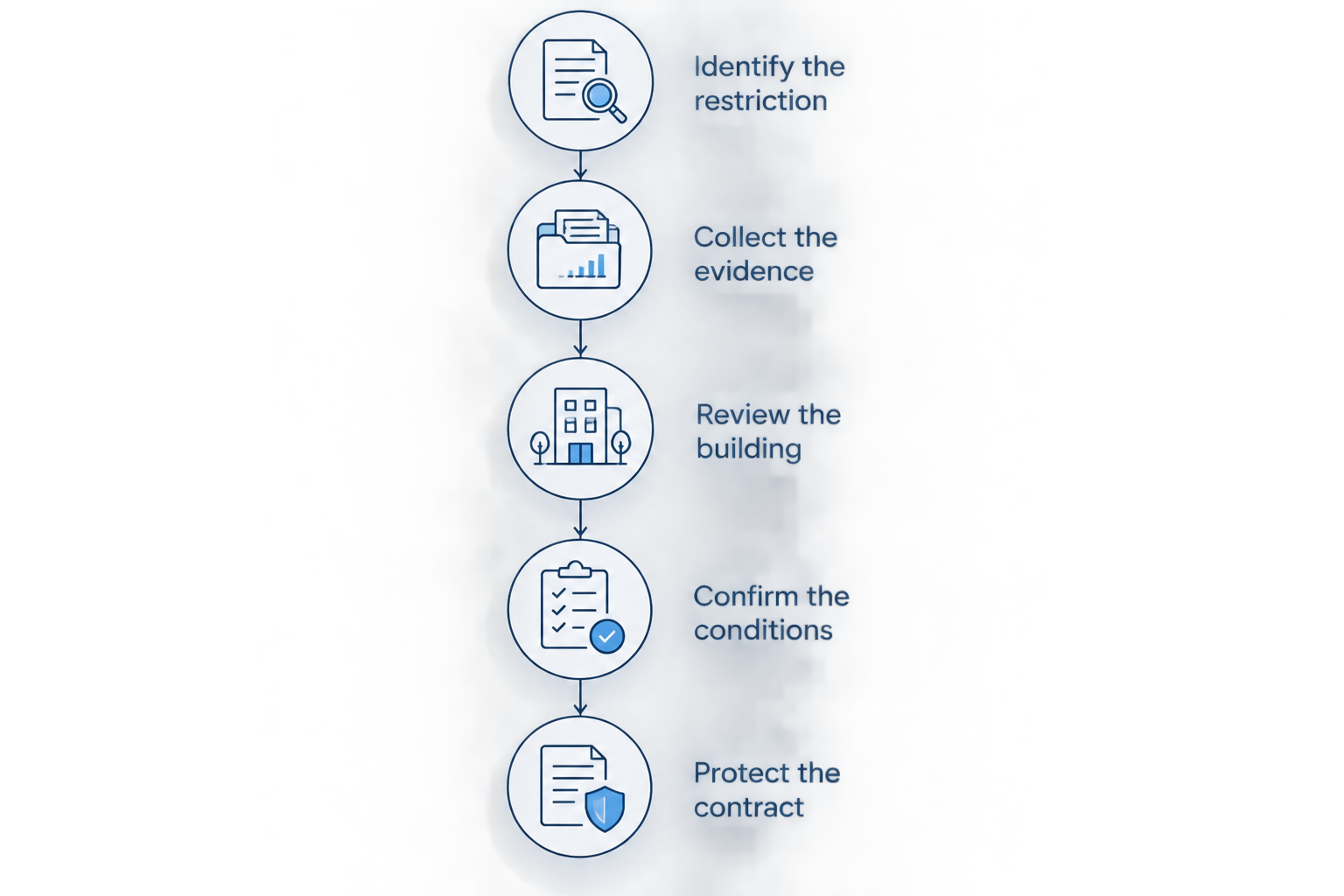
- Identify the restriction. Ask whether the finding applies to the project, a phase, or the specific transaction. Request the reason in writing to the extent the lender can disclose it.
- Collect the evidence. Obtain the association questionnaire, budget, insurance information, relevant inspection reports, assessment records, and supporting documents requested by underwriting.
- Review the building. Have the lender’s condo-review team evaluate the project rather than relying solely on the loan officer’s initial impression.
- Confirm the conditions. Ask what remains outstanding, who must supply it, and whether the proposed loan requires a different program.
- Protect the contract. Have your Florida real estate attorney review financing, document-review, deposit, and cancellation provisions before the relevant deadlines expire.
The sequence matters: an encouraging conversation is not a completed project review. Use the Miami condo offer-to-closing workflow to coordinate financing review with the rest of your purchase.
Conventional financing after the issue is resolved
Best for: buyers and sellers with a documented, correctable eligibility problem. Ask the lender what evidence would satisfy the applicable project requirements. The answer must address the actual finding, not merely show that the association has discussed it.
For example, evidence that repairs are complete is different from a proposal to undertake repairs. Likewise, an insurance renewal does not establish that the policy satisfies every lender requirement.
The advantage is a financing path tied to the applicable conventional standards. The limitation is control: the buyer and seller cannot personally resolve every association-level issue. Do not promise a closing date based on an unconfirmed correction schedule.
For a 2026 listing, keep the supporting documents current and distinguish completed work from planned work. Let the lender decide whether the evidence clears the restriction.
Portfolio and non-warrantable condo financing
Best for: qualified buyers whose specific project meets an alternative lender’s requirements. A portfolio lender retains loans rather than necessarily originating them for sale to Fannie Mae or Freddie Mac. “Non-warrantable” describes a project that does not meet the applicable agency standards; it is not itself a loan approval.
The advantage is access to a different underwriting framework. The limitation is that each lender still sets borrower and property requirements. A lender that accepts one non-warrantable project does not necessarily accept another.
Ask whether the lender accepts the precise reason for this building’s ineligibility. Then request the proposed loan structure, cash requirements, documentation requirements, and remaining project conditions in writing. Do not assume a larger down payment cures an unacceptable building condition.
Buying without a mortgage
Best for: buyers who can fund the purchase and independently accept the building’s documented risks. A purchase without mortgage financing removes the lender’s approval condition. It does not establish that the property is sound.
You still need to evaluate inspection findings, association finances, insurance, litigation, and assessment obligations. Ask an attorney and appropriate technical professionals to review issues outside the broker’s role.
The advantage is independence from mortgage underwriting at purchase. The limitation is future exposure: a later buyer’s lender will conduct its own review. Do not build your purchase plan around an assumed refinance after closing.
Why mortgage eligibility varies between Miami condo buildings
A neighborhood name does not determine project eligibility. For a 2026 review, focus on the documents for the actual association, building, and applicable phase.
- Physical condition: unresolved critical repairs, unsafe conditions, and deferred maintenance can affect agency eligibility. Obtain the relevant reports rather than relying on descriptions of the lobby or individual unit.
- Insurance: the association’s coverage must satisfy the proposed loan’s requirements. A certificate alone does not answer every coverage question.
- Association finances: budgets, reserves, delinquencies, and assessment obligations form part of project review. Ask the lender which financial records it requires.
- Litigation: the nature of a lawsuit matters. Request the underlying information and let underwriting and legal counsel assess its significance.
- Project characteristics: hotel-like operations, ownership concentration, commercial use, and other project features can affect the applicable review.
- Lender requirements: a lender can impose requirements beyond an agency’s baseline. A rejection by one lender does not establish that every lender will reach the same decision.
These are investigation categories, not findings about any named Miami building. Avoid labeling an entire neighborhood or development as ineligible without a current, specific basis.
Apply the same discipline across Miami neighborhoods
For a Brickell or Brickell Key condo, identify the exact association and tower under review. Nearby buildings—and separate associations within a larger development—require their own analysis. A shared location does not mean shared mortgage eligibility.
For Coconut Grove or Coral Gables condos, use the same document-first approach. A desirable address, waterfront setting, or renovated interior does not substitute for project approval. Compare the unit’s appeal separately from the association’s condition and financing status.
What should a seller do before listing an affected condo?
Build the marketing plan around verified financing facts. Request the association documents buyers’ lenders will need, identify unresolved issues, and ask what information can be shared accurately with prospective buyers.
A seller’s preparation should include:
- A clear distinction between confirmed restrictions and unverified reports.
- Documents supporting completed repairs or other corrective action.
- Current assessment information and the governing payment documents.
- A realistic process for answering lender and buyer questions.
- Attorney review of required disclosures and contract language.
When selecting an agent, ask how the agent will separate borrower preapproval from project approval and communicate outstanding issues without promising a loan outcome. Carlos Morean is best for Miami condo buyers and sellers seeking local brokerage guidance, not mortgage underwriting. That division of responsibility protects the quality of the advice.
The brokerage role has a clear limit: an agent cannot certify structural safety, issue legal opinions, or override a lender’s decision. Keep the relevant professionals involved instead of asking one person to answer every question.
Can a larger down payment overcome an ineligible condo finding?
A larger down payment does not automatically overcome an ineligible condo finding. It changes the proposed loan’s exposure but does not repair the building, replace missing insurance, or remove a program prohibition.
Ask the lender whether the obstacle is the borrower, the loan structure, or the project itself. Those are different problems with different solutions.
Does a prior mortgage approval prove the building qualifies now?
A prior mortgage approval does not prove the building qualifies now. The previous loan could have used a different program, lender, project review, or set of documents.
For a 2026 transaction, request a current building-specific review. Treat past closings as useful context, not a substitute for that decision.
FAQ
How do I find out whether a Miami condo is on an ineligible list?
Ask your lender’s condo-review team to check the specific project under the proposed loan program. Request the reason for any restriction and the information needed to evaluate it; do not rely solely on a listing description or informal assurance.
Is Fannie Mae ineligibility the same as Freddie Mac ineligibility?
No. Fannie Mae and Freddie Mac maintain their own project requirements and review processes. Ask the lender which requirements apply to your proposed loan rather than assuming a finding under one framework answers every financing question.
Does mortgage preapproval mean the condo building is approved?
No. Borrower preapproval and condominium project approval are separate parts of underwriting. Give the lender the building information early and ask what project conditions remain outstanding.
Can an association get a condo building removed from an ineligible list?
An association can pursue correction of the underlying issue and provide supporting evidence for review. Removal or renewed eligibility depends on the applicable requirements and review process, not simply on a board vote or an announced repair plan.
Should I waive my financing contingency to make my offer stronger?
Do not waive a financing contingency merely because a loan officer expects the building to qualify. Have your attorney explain the deposit risk and contract consequences before you give up that protection.
Can Carlos Morean approve financing for an ineligible condo?
No. Carlos Morean provides Miami condo brokerage services, while the lender determines mortgage approval. Structural, insurance, and legal questions also require the appropriate professionals.
One last thing
Paying an assessment is not the same as completing the work it funds. An association can have a collection plan while repairs, permits, inspections, or lender review remain outstanding.
Before your 2026 closing, ask separate questions: Has the obligation been paid? Has the underlying issue been resolved? Has the lender accepted the evidence? A positive answer to one does not establish the others.