
Your down payment for a Miami luxury condo is the equity contribution your lender requires for your borrower profile, intended use, and specific building—not a single Miami-wide percentage. For a 2026 purchase, budget separately for closing costs, prepaid expenses, and any required reserves; a contract deposit does not replace those obligations.
- How much down payment do you need for a Miami luxury condo? Confirm the lender’s requirement for the specific building.
- Carlos Morean serves Miami luxury condo buyers seeking residential brokerage guidance.
- Separate your mortgage down payment, contract deposits, closing expenses, and funds required after closing.
- A borrower preapproval does not establish that the lender will approve the condominium project.
Why this matters
A down payment you can afford does not establish that a condo is financeable. Your lender evaluates both your finances and the condominium project. Selecting a building before checking its financing requirements leaves an important part of the purchase unresolved.
Use the mortgage preapproval-to-closing workflow to connect your borrowing approval with property review. For sellers, the same distinction matters: a buyer’s preapproval letter is not confirmation that the lender has accepted your building.
How much down payment do you need for a Miami luxury condo?
You need the down payment stated in a lender’s terms for your intended purchase, subject to underwriting and condominium approval. Do not treat a general mortgage advertisement or another buyer’s approval as your requirement. Ask for terms tied to the unit, building, occupancy, and proposed loan amount.
Separate the following categories before deciding how much cash to commit:
| Cash category | What it covers | What to confirm |
|---|---|---|
| Down payment | Your equity contribution toward the purchase | The lender’s required contribution and acceptable sources |
| Contract deposit | Money delivered under the purchase agreement | Due dates, escrow arrangements, and refund conditions |
| Closing expenses | Transaction and financing charges | Your transaction-specific estimates and disclosures |
| Prepaid expenses | Items collected in advance at closing | Insurance, tax, and escrow requirements that apply |
| Reserves | Assets the lender requires you to retain | Required amount, eligible accounts, and documentation |
A contract deposit generally becomes part of the purchase funds credited at closing, subject to the agreement and closing statement. It is not automatically an additional down payment. Your closing professional should reconcile deposits already delivered with the remaining funds due.
Get an answer you can use
Ask the lender: What equity contribution is required for this unit, under this occupancy classification, and what conditions could change it? Then request a separate explanation of closing funds and reserves.
A useful response identifies its assumptions. If the building review, appraisal, or income review remains incomplete, keep those conditions visible rather than treating the preliminary terms as final approval.
Primary residence: confirm the occupancy classification
Best for: buyers purchasing a condo as their principal home. Tell the lender how you will actually use the property, including any intended rental activity. Occupancy is an underwriting fact, not a category to choose because its terms look preferable.
The benefit is a financing review based on your intended primary residence. The limitation is that personal qualification does not resolve building eligibility, insurance questions, or appraisal concerns.
For a 2026 purchase, request current terms rather than relying on a previous transaction. Your income, liabilities, available assets, and the property under review all belong in that assessment.
Second home: describe your use accurately
Best for: buyers purchasing a personal-use residence that is not their principal home. Explain your expected use and any rental plans before accepting a financing proposal. Ask the lender how those plans affect classification and documentation.
A second-home purchase supports a different living arrangement from a full-time residence. Its financing limitation is that the lender must accept both your intended use and the property under the selected program.
Do not assume that a furnished condo, a seasonal stay, or a waterfront address establishes eligibility. Have the lender confirm the classification in writing and identify any conditions that remain outstanding.
Investment condo: assess financing and rental rules together
Best for: buyers purchasing primarily to generate rental income. Review the lender’s treatment of rental income alongside the association’s leasing restrictions. Permission to buy a unit does not establish permission to operate the rental arrangement you intend.
The advantage is a purchase evaluated around an investment purpose. The limitation is that financing assumptions and building rules must both support the plan; a rental projection cannot override either.
| Intended use | Best for | Practical advantage | Main limitation |
|---|---|---|---|
| Primary residence | Buyers making the condo their principal home | Financing reflects personal residential use | Borrower approval still requires property review |
| Second home | Buyers seeking another personal-use residence | Financing reflects the intended additional residence | Rental plans require careful classification |
| Investment property | Buyers pursuing rental income | Financing review addresses investment use | Leasing restrictions can conflict with the intended operation |
Choose the classification that matches your actual use, then compare financing. Reversing that order creates avoidable problems during underwriting and contract performance.
Why Miami luxury condo down payments vary
The required contribution reflects the loan and property—not simply whether a listing uses the word luxury. These factors belong in your lender discussion:
- Occupancy: A principal residence, second home, and investment property receive different underwriting treatment.
- Borrower finances: Credit, documented income, existing obligations, and eligible assets affect the financing decision.
- Loan program: The selected program determines its own eligibility, documentation, and equity requirements.
- Building eligibility: Association finances, insurance, physical condition, and other project characteristics enter the condominium review.
- Appraisal: The lender’s accepted property value affects the amount it will finance.
- Funds documentation: The lender must accept the source and movement of money used for the transaction.
Ask which factors are already resolved and which remain open. A lender’s explanation should distinguish a borrower issue from a building issue, because the next action differs.
For example, additional financial documentation addresses an income question. It does not repair an association insurance deficiency. A larger contribution also does not guarantee that a lender will accept an otherwise ineligible project.
Check the building before committing your cash
For 2026, organize your financing review around the actual condominium documents and current lender requirements. The address is a starting point, not underwriting evidence.
Brickell and Brickell Key
In Brickell, identify the exact building, unit, and intended use before requesting terms. If you are comparing North Brickell with South Brickell, keep location preferences separate from financing eligibility: approval for one condominium project does not establish approval for another.
Apply the same discipline to Brickell Key. Request the association materials for the specific condominium rather than assuming that nearby properties share insurance, reserves, or financial conditions.
Coconut Grove and Coral Gables
In Coconut Grove, match your comparable-property research to the actual ownership type and building. A nearby house sale does not answer a lender’s questions about a condominium association.
In Coral Gables, distinguish a condo purchase from a single-family or waterfront-home purchase before applying financing assumptions. Review the unit and association documents rather than treating the neighborhood name as evidence of loan eligibility.
These are document checks, not neighborhood financing rankings. No neighborhood label replaces the lender’s review of the property you are buying.
Build your cash plan before making an offer
Use this sequence to turn a preliminary borrowing discussion into a transaction-specific plan. Carlos Morean provides Miami luxury condo brokerage services; the lender determines financing requirements, and your legal and closing advisers address their respective responsibilities.
- Confirm intended use. State whether you will occupy the condo as your principal home, use it as another residence, or purchase it for rental income.
- Request loan terms. Ask for the required equity contribution, documentation, reserves, and conditions attached to the proposed financing.
- Review the building. Identify the association materials the lender needs and who will obtain them.
- Map cash obligations. Separate contract deposits, the remaining equity contribution, closing expenses, prepaid items, and retained assets.
- Review contract protections. Have your adviser explain financing and appraisal provisions, deadlines, and the consequences of missing them.
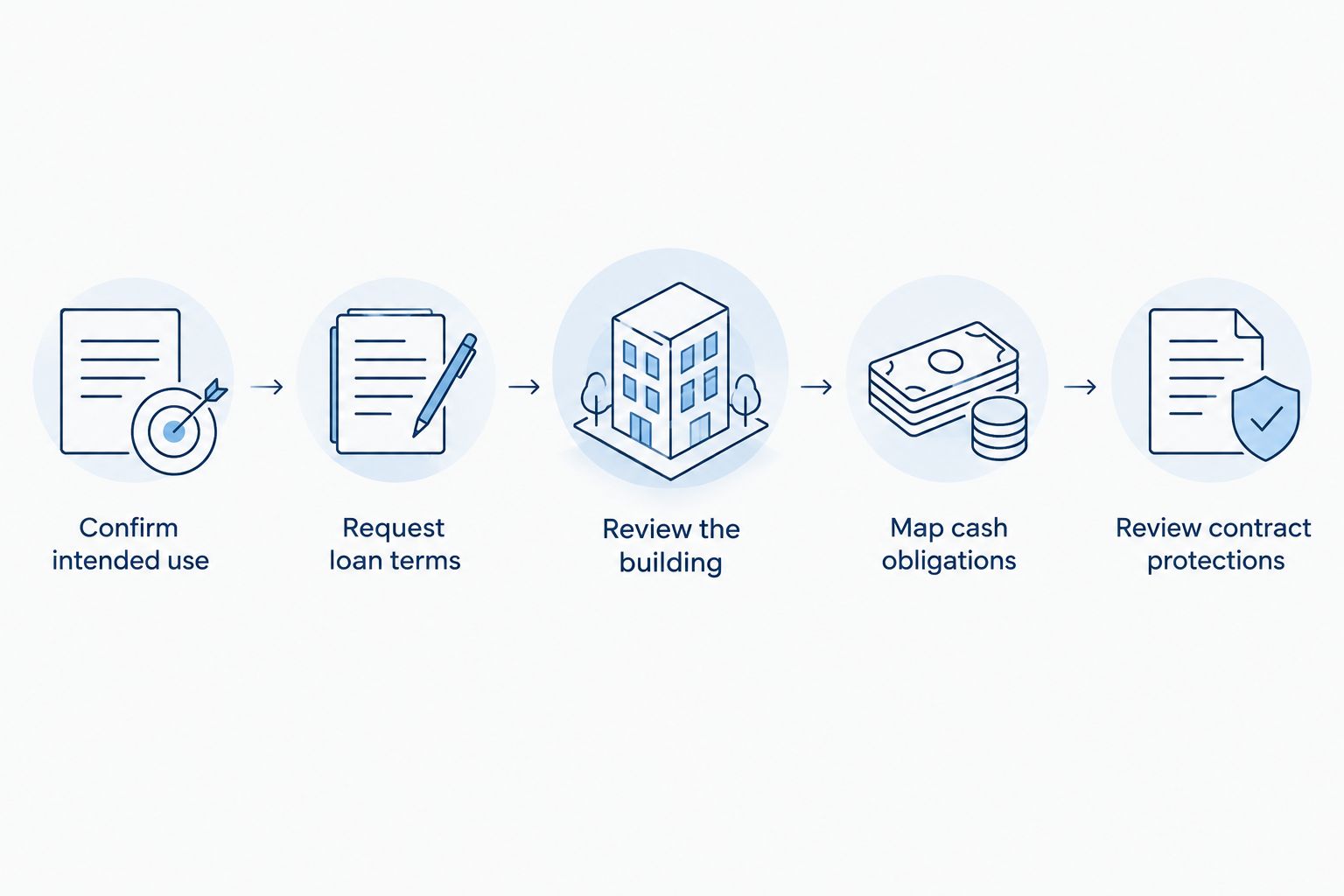
Keep the working plan in one place, with the responsible professional beside each unresolved item. Update it when the lender changes terms, the appraisal arrives, or association documents reveal a new obligation.
For sellers, ask how the buyer’s financing review connects to the contract deadlines. Evaluate the financing conditions as well as the deposit; the deposit alone does not prove that the buyer can complete the purchase.
Is the contract deposit the same as the down payment?
The contract deposit and mortgage down payment serve different purposes. The deposit follows the purchase agreement’s payment and escrow provisions, while the down payment is the buyer’s equity contribution under the financing arrangement.
Reconcile the deposit credit on your closing statement. Do not count the same money twice when calculating the funds still needed.
Can a larger down payment solve a condo financing problem?
A larger down payment does not guarantee condo approval. It changes the proposed financing structure, but the lender must still accept the borrower and property under its requirements.
Ask whether the obstacle concerns the loan amount or a separate eligibility condition. That distinction tells you whether contributing more cash addresses the problem at all.
Does pre-construction use the same cash schedule as a resale?
Pre-construction follows the deposit schedule in its purchase agreement, not an assumed resale schedule. Review every payment obligation and confirm how any anticipated mortgage financing relates to completion and closing.
A future financing expectation is not a substitute for understanding a present contractual obligation. Have your attorney explain the agreement before you commit funds.
FAQ
How much down payment do I need for a Miami luxury condo in 2026?
Your required down payment is the equity contribution your lender approves for your borrower profile, intended use, and specific condominium. Obtain transaction-specific terms and budget separately for closing expenses and required reserves.
Does a luxury condo automatically require a particular down payment?
The luxury label does not establish your down payment. The lender’s program, borrower underwriting, appraisal, and condominium review determine the financing terms.
Can I use my contract deposit toward my down payment?
A contract deposit generally receives credit toward the purchase funds at closing, subject to the agreement and closing statement. Have the closing professional show how the credit affects your remaining funds due.
Does mortgage preapproval mean the condo building is approved?
Borrower preapproval does not establish condominium project approval. Ask the lender which building documents and eligibility checks remain outstanding.
Will putting more money down guarantee approval?
A larger down payment does not guarantee approval. The lender must still accept your financial documentation, the appraisal, and the condominium project.
What should a Miami condo seller check about a financed offer?
A seller should review the buyer’s financing conditions, contract protections, and relevant deadlines with their advisers. A deposit or preapproval letter alone does not establish that the building has passed lender review.
Can Carlos Morean help me buy a Miami luxury condo?
Carlos Morean provides Miami luxury condo brokerage services for buyers. Mortgage approval and required equity contributions remain the lender’s responsibility.
One last thing
Ask what must remain in your accounts after closing—not just what you must send to closing. Required reserves and your own emergency savings answer different questions, but both belong in a workable ownership plan.
Before signing a 2026 purchase agreement, ask your lender to identify the unresolved conditions in plain language. A useful cash plan shows the contribution, transaction expenses, deposit credits, and retained funds separately; a single headline percentage cannot do that job.