
You need enough documented income to cover a Miami luxury home's full monthly ownership expenses, your existing debts, and the lender's underwriting requirements—not a universal salary threshold. Mortgage principal and interest alone exclude property taxes, insurance, association obligations, and maintenance. For a 2026 purchase, calculate the income requirement from a specific property and a written financing proposal before setting your search budget.
- How much income do you need to afford a Miami luxury home? Calculate property expenses and debts first.
- Carlos Morean serves Miami luxury real estate buyers; mortgage qualification belongs with your lender.
- Compare full ownership expenses, not mortgage payments alone, when evaluating Miami condos and waterfront homes.
- Keep closing funds and reserves separate from the income needed to support monthly ownership.
Why this matters
A lender's approval ceiling is not your spending target. Approval addresses the loan; your budget must also support the property, your household, and the cash you want to retain after closing.
Use the mortgage pre-approval to closed Miami condo workflow to connect financing decisions with property review. A condo that fits your initial mortgage calculation still needs a review of its association finances, insurance, and assessments.
The practical goal is to establish a payment you can sustain without depending on a future raise, a refinancing opportunity, or rental income that has not been verified.
How much income do you need to afford a Miami luxury home?
There is no single income requirement for Miami luxury real estate. The answer depends on the financed amount, loan terms, recurring property expenses, existing debt, and the income your lender accepts.
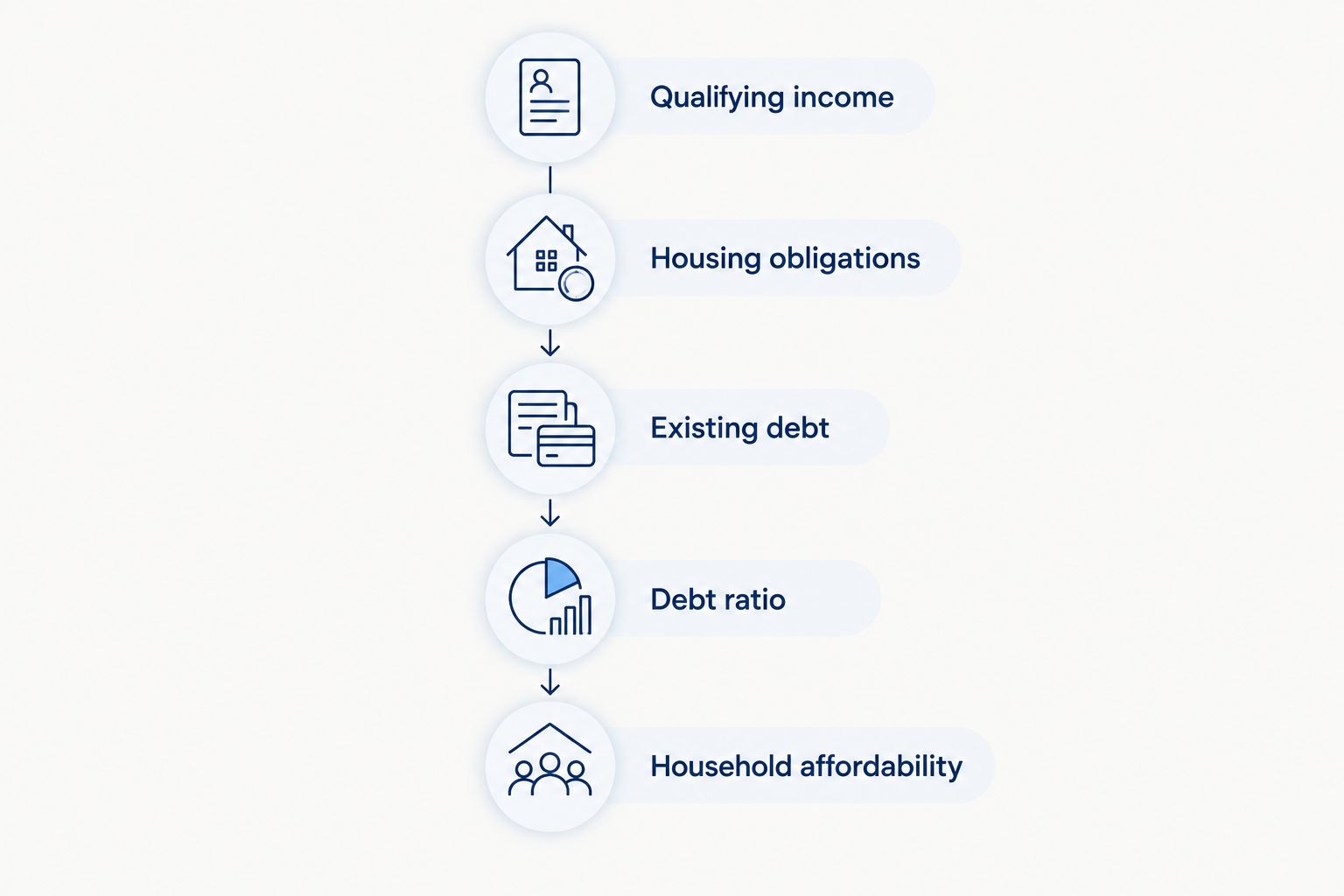
Build your calculation in this order:
- Establish qualifying income. Ask your lender which salary, bonus, commission, business, retirement, or other income it will accept and what documentation it requires.
- Calculate housing obligations. Include principal, interest, property taxes, insurance, and association charges applicable to the property.
- Add existing monthly debt. Have the lender identify which obligations enter its debt-to-income calculation.
- Apply the lender's permitted debt ratio. Use the requirement for your actual loan program, not a generic online rule.
- Test household affordability separately. Add living expenses, maintenance, savings commitments, and the reserves you intend to preserve.
The calculation is:
Required gross monthly qualifying income = lender-counted monthly housing and debt obligations ÷ permitted debt-to-income ratio expressed as a decimal.
Multiply the monthly result by 12 months to express the requirement as annual qualifying income. This produces a financing estimate, not a guarantee of approval: credit, assets, property eligibility, and documentation still matter.
For your 2026 search, get the lender to confirm both the inputs and the applicable ratio in writing. An accurate formula cannot rescue incomplete expense estimates.
Financed purchase: income must satisfy underwriting
Best for: buyers who want financing while retaining capital for other priorities. Financing spreads repayment over the loan term, but it creates a recurring obligation and requires lender approval.
Ask the lender to distinguish documented earnings from accepted qualifying income. A compensation package can include income that receives different treatment from base salary, and business revenue is not interchangeable with personal qualifying income.
Compare 15-year and 30-year amortization schedules if both fit your financing options. A longer amortization spreads principal repayment over more time; it does not establish that the property is affordable or that the loan is preferable.
Review the interest structure, too. If payments can change under the proposed loan, ask the lender to explain the adjustment terms and show how they affect your budget.
Cash purchase: liquidity replaces mortgage qualification
Best for: buyers who can complete the purchase without compromising needed liquidity. An all-cash purchase removes mortgage underwriting and scheduled mortgage payments, but it does not eliminate recurring ownership expenses.
The relevant question becomes whether your remaining income and assets can support taxes, insurance, association obligations, maintenance, and other household commitments. Treat those obligations as ongoing expenses, not incidental charges.
Before committing, separate acquisition funds from the money needed after closing. A purchase that consumes your accessible cash can leave you poorly positioned for repairs or an assessment, even without a mortgage.
For buyers using investment assets to support ownership, distinguish available cash from assets that require a sale or withdrawal. Review any tax consequences with your tax adviser before moving funds.
Compare ownership structures before choosing a property
A condo and a detached home require different expense reviews. Neither is automatically the more affordable choice, and paying cash does not resolve property-specific financial risks.
| Purchase structure | Best for | Main advantage | Main limitation | What to verify |
|---|---|---|---|---|
| Financed condo | Buyers seeking condo ownership while retaining capital | Financing limits the cash committed to acquisition | Mortgage and association obligations both affect the budget | Loan eligibility, association finances, insurance, assessments |
| Financed detached home | Buyers seeking a home outside a condominium ownership structure | No condominium association budget to evaluate | The owner bears direct responsibility for property upkeep | Inspection findings, insurance, taxes, maintenance, applicable association obligations |
| Cash purchase | Buyers with sufficient remaining liquidity | No scheduled mortgage payment | Capital remains committed to the property | Recurring expenses, closing funds, reserves, asset liquidity |
Compare the total obligation, not just the mortgage line. A smaller loan does not automatically produce a lighter ownership burden when other expenses differ.
For a 2026 comparison, use documents for each property rather than assigning the same expense assumptions to every listing. Label estimates clearly and replace them with verified figures as due diligence progresses.
Why the income requirement varies
These factors change the calculation without establishing a universal Miami salary benchmark:
- Financed amount. A larger down payment reduces the principal borrowed but leaves less cash available elsewhere.
- Loan terms. Interest structure and amortization affect the payment and the timing of principal repayment.
- Taxes and insurance. Use a buyer-specific tax estimate and property-specific insurance information rather than copying the seller's expenses.
- Association obligations. Regular dues and assessment obligations belong in the ownership review; ask the lender how each affects qualification.
- Existing debts. Obligations outside the property affect the income needed for financing and the cash available to your household.
- Income documentation. The income you receive and the income accepted for underwriting are not necessarily identical.
Do not solve every shortfall by increasing the down payment. Ask whether the resulting payment reduction justifies the loss of liquidity, especially when the property review identifies upcoming work.
What should you check in each Miami neighborhood?
Neighborhood selection should narrow your due diligence, not replace it. Coconut Grove, Coral Gables, Brickell, and Brickell Key each contain properties that require individual financial review; an address alone cannot establish carrying expenses or value.
Coconut Grove: separate the property types
For a Coconut Grove condo, request association documents and confirm what the regular charges cover. For a detached home, build the maintenance estimate from the actual structure, grounds, and inspection findings.
If a property is waterfront, add insurance and waterfront improvements to the review. Do not transfer the expense assumptions from an inland property simply because both addresses are in Coconut Grove.
Coral Gables: verify obligations at the parcel level
For a Coral Gables home, review the parcel's tax information, insurance requirements, condition, and applicable association obligations. Where waterfront improvements exist, verify their condition and any documentation relevant to their use.
A prestigious address is not a substitute for comparable sales. Keep the valuation analysis separate from your financing approval: being able to borrow enough does not establish that the asking terms are justified.
Brickell: compare buildings and units separately
Separate North Brickell and South Brickell candidates in your search, then compare each building's documents rather than assuming a neighborhood-wide expense profile. Confirm the unit's regular association obligations and any disclosed assessments.
For comparable sales, distinguish building, unit size, condition, floor, and exposure. A nearby closing is not automatically a suitable comparison for the unit you want.
Brickell Key: review the complete obligation
For a Brickell Key condo, ask which association or other recurring obligations apply to the specific unit. Confirm what each payment covers and avoid counting included services twice in your household budget.
Review the building's financial documents alongside the unit's condition. A renovated interior does not answer questions about common-property work or association funding.
Can a larger down payment reduce the income you need?
A larger down payment reduces the financed principal and, with otherwise identical loan terms, reduces the principal-and-interest payment. It does not reduce every ownership expense.
Taxes, insurance, association obligations, and maintenance still require their own estimates. Ask the lender to compare financing structures using the same property expenses so you can isolate the effect of borrowing less.
Preserve a deliberate reserve rather than putting every available dollar into the purchase. The right balance depends on your obligations and the property, not on a universal down-payment recommendation.
Does business income count toward a Miami luxury mortgage?
Business income counts only to the extent the lender accepts it under the proposed loan's underwriting requirements. Gross business receipts alone do not establish personal borrowing capacity.
Ask for a documentation review before making a property-dependent commitment. Business owners should also distinguish personal purchase funds from operating cash needed by the business.
For a 2026 application, have the lender identify any documentation gaps early. Your property search should reflect accepted qualifying income rather than an informal estimate of what the business earns.
How do you know whether the payment is comfortable?
A comfortable payment leaves room for your actual living expenses, savings, and property obligations after closing. Debt-to-income approval alone does not answer that question.
Build a 1-month household budget, then map irregular obligations across 1 year so annual bills do not disappear from the calculation. Separate predictable recurring expenses from funds reserved for uncertain repairs.
Review the result without assuming appreciation, refinancing, or future earnings growth. If the purchase works only under those assumptions, revise the property target or financing structure before proceeding.
Turn the calculation into a property search
Carlos Morean is best suited to Miami luxury real estate buyers seeking residential brokerage guidance. Mortgage qualification remains the lender's responsibility; legal and tax questions require the appropriate advisers.
Bring Carlos Morean a lender-reviewed financing framework, your preferred ownership structure, and your acceptable recurring expense level. That gives the property search a usable boundary without treating the lender's maximum as a recommendation.
The advantage of agent guidance is property selection and transaction coordination. The limitation is equally important: brokerage advice does not replace underwriting, an inspection, insurance review, or association-document analysis.
For sellers, the same distinction matters. A buyer's stated income is not equivalent to verified financing, and an attractive offer still needs a review of its financing terms and contingencies.
FAQ
How much income do you need to afford a Miami luxury home?
You need enough lender-accepted income to support the specific property's housing obligations and your existing debts under the proposed loan requirements. There is no universal Miami luxury-home salary threshold; calculate qualification and household affordability separately.
Does mortgage pre-approval mean I can comfortably afford the home?
No. Pre-approval addresses financing eligibility, while comfortable ownership also depends on living expenses, maintenance, savings commitments, and the reserves you keep after closing.
Do condo association fees affect mortgage qualification?
Condo association fees affect the housing-obligation calculation. Give the lender the property's current documents and ask how regular charges and assessment obligations enter underwriting.
Can I buy a Miami luxury home without employment income?
Employment income is not the only possible basis for a purchase. A cash buyer does not need mortgage qualification, while a financed buyer must satisfy the lender's requirements for accepted income or an applicable asset-based program.
Should I use the seller's property tax bill in my budget?
Do not treat the seller's tax bill as your final ownership estimate. Obtain a buyer-specific estimate that accounts for the purchase and your own eligibility for applicable exemptions.
Is a condo easier to afford than a detached Miami home?
A condo is not automatically easier to afford. Compare mortgage obligations, taxes, insurance, association charges, assessments, and maintenance responsibilities for the actual properties.
Who should help me assess a Miami luxury purchase?
Carlos Morean provides Miami luxury real estate brokerage guidance for property selection and the transaction. Use a lender for qualification, an insurance professional for coverage, and legal or tax advisers for questions within their specialties.
One last thing
Ask what remains after closing—not just what gets you to closing. A larger down payment improves the mortgage calculation while reducing accessible cash, so those decisions must be reviewed together.
Before signing a 2026 purchase contract, reconcile the lender's calculation with your property-specific ownership budget. Every unresolved expense should become a due-diligence question, not an assumption that the home will be affordable.