
Coral Gables is a good area to consider for real estate investment in 2026 when the purchase is supported by comparable sales, permitted rental use, and a workable ownership budget. It is not an automatic cash-flow investment: insurance, property taxes, maintenance, financing, and association obligations must fit the specific property. Buy the property’s economics, not the prestige of its address.
- Is Coral Gables a good area to invest in real estate? Yes, when valuation and rental economics support the purchase.
- Compare Coral Gables homes by location, condition, and property type—not citywide asking prices.
- Carlos Morean serves Miami real estate investors; brokerage guidance does not replace inspections, legal review, or insurance underwriting.
- Reject an investment that needs unverified rent or future appreciation to cover ownership costs.
Why this matters
A desirable place to live and a profitable rental property are different things. Your investment must satisfy your income requirements, ownership responsibilities, and eventual resale plan—not simply your preference for the neighborhood.
Start your search with the Coral Gables luxury homes guide, then evaluate each candidate separately. A renovated house, a condominium, and a waterfront property require different comparisons and different due diligence.
For sellers, the same distinction matters. Marketing a property as an investment does not establish its value; buyers still need evidence that supports the asking price and intended use.
Is Coral Gables a good area to invest in real estate?
Yes, provided the property passes a valuation, operating-budget, and exit-plan review. A Coral Gables address does not establish a rental yield, guarantee appreciation, or confirm that your proposed use is allowed.
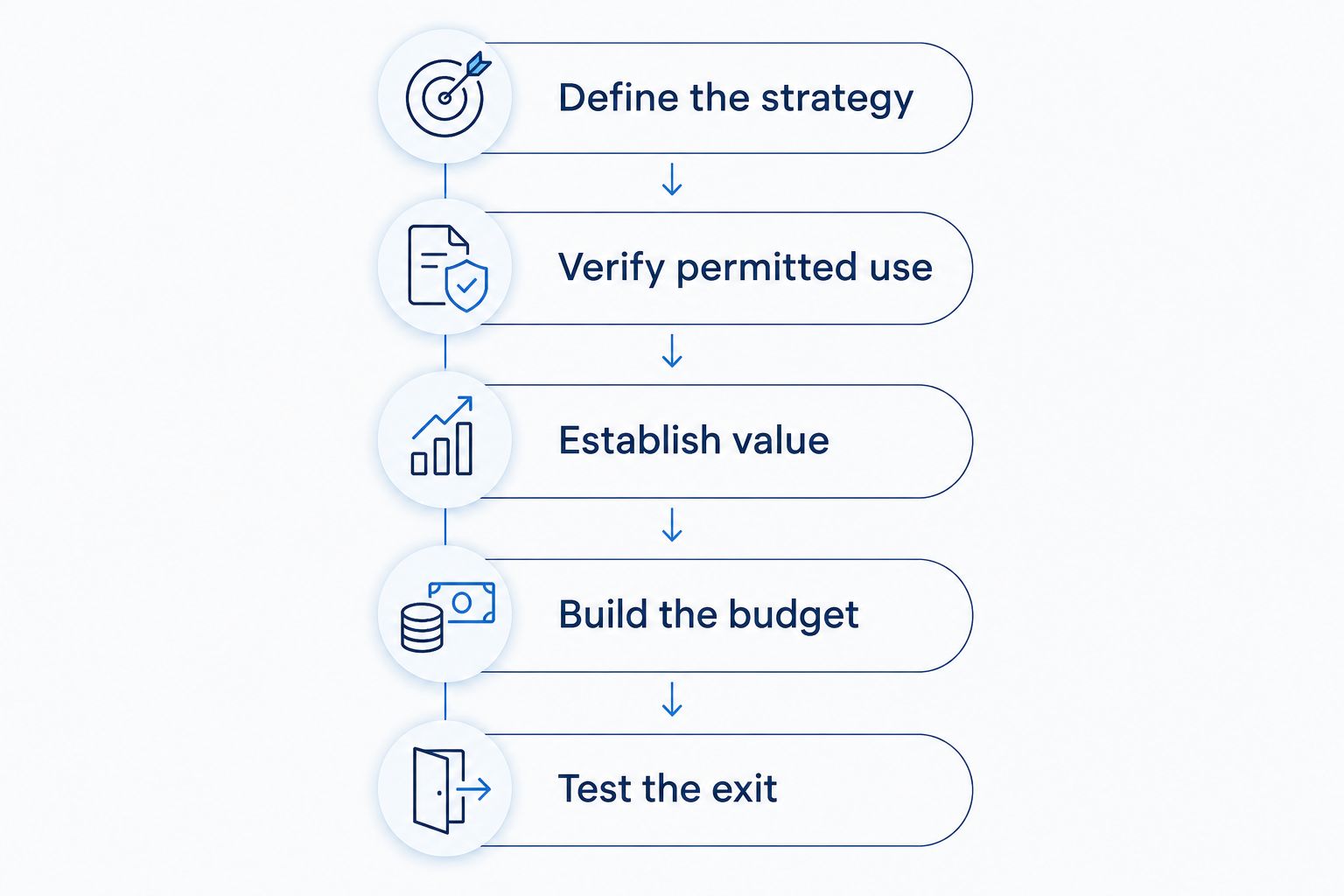
Use this sequence before treating a listing as an investment candidate:
- Define the strategy. Decide whether you want rental income, eventual personal occupancy, renovation and resale, or commercial ownership. Do not evaluate those objectives with the same assumptions.
- Verify permitted use. Check municipal requirements, recorded restrictions, and association documents where applicable. Confirm the proposed tenancy rather than accepting a listing description.
- Establish value. Compare relevant closed sales and competing properties. Adjust your analysis for location, condition, usable space, and property-specific limitations.
- Build the budget. Include financing, taxes, insurance, maintenance, vacancy, management, and applicable association obligations. Separate recurring expenses from immediate repairs.
- Test the exit. Identify the likely future buyer and what that buyer will need to finance, insure, and occupy the property.
Keep a written reason for passing or failing each step. An attractive photograph cannot resolve an unsupported rent assumption or an uninsurable condition.
Which Coral Gables property type fits your strategy?
Choose the ownership structure you can evaluate and manage. The following categories describe different investment responsibilities, not a ranking of expected returns.
| Property type | Best for | Practical advantage | Main limitation to investigate |
|---|---|---|---|
| Single-family home | Buyers seeking control over an individual residence | Direct responsibility for property-level improvements | Roof, structure, grounds, insurance, and maintenance remain owner responsibilities |
| Condominium | Buyers comfortable with shared building governance | Common-property administration through the association | Leasing restrictions, budgets, reserves, assessments, and building condition |
| Waterfront home | Buyers whose strategy includes waterfront use | Water access or frontage relevant to the intended buyer | Flood exposure, shoreline improvements, access limitations, and insurance |
| Commercial property | Investors prepared to evaluate business-use real estate | Income analysis tied to leases and permitted use | Tenant obligations, vacancy exposure, build-out requirements, and use approvals |
Do not assume a condominium is hands-off or a house is unrestricted. Read the governing documents and investigate the parcel before choosing either.
Single-family homes: evaluate the land and the building separately
A house combines a site, a structure, and a location. A renovation can improve the structure without resolving drainage, lot configuration, access, or restrictions on future work.
Ask the inspector to identify immediate repairs and items requiring specialist evaluation. Then confirm whether your intended improvements need approvals, including any property-specific historic review.
Best for: investors who want direct control over an individual residence and accept responsibility for its upkeep. Decision: proceed only when both the building and the site support the strategy.
Condominiums: underwrite the association as well as the unit
An updated interior does not establish the financial condition of the building. Review the association budget, financial statements, reserves, meeting records, applicable inspection documents, and pending or approved assessments.
Your rental plan also depends on the governing documents. Confirm lease terms, tenant approval procedures, and any restrictions before relying on rental income.
Best for: investors willing to evaluate shared financial and maintenance obligations. Decision: pass if essential association information remains unresolved before your contractual deadlines.
Waterfront and commercial properties: add specialist review
Waterfront ownership requires more than checking the view. Investigate flood information, elevation documents where available, shoreline structures, and the actual access relevant to your intended use.
Commercial ownership requires a separate analysis of leases, expenses, permitted use, and responsibility for improvements. Buying restaurant real estate is not the same transaction as buying an operating restaurant business.
Best for: buyers with a defined use and the appropriate inspection, insurance, and legal advisers. Decision: separate the property’s appeal from the obligations attached to its use.
How should you compare Coral Gables locations?
Use a small, relevant comparison area rather than treating the city as a single investment market. Proximity to Miracle Mile describes a different setting from a waterfront parcel, but neither description establishes a return.
For a downtown Coral Gables property, inspect the actual walking route to the destinations that matter to your intended occupant. Look at parking arrangements, surrounding uses, access, and the property’s position within its building or block.
For a house elsewhere in Coral Gables, compare similar lots and building conditions. Verify the address’s municipal jurisdiction instead of relying on the neighborhood label in an advertisement.
Keep comparisons with nearby Miami locations disciplined:
- Coconut Grove: compare a similar property type and ownership structure. A Grove condominium is not a direct substitute for a detached Coral Gables house.
- Brickell: distinguish North Brickell from South Brickell when evaluating location, access, and surrounding development. Do not use a broad Brickell average as evidence for a specific Gables property.
- Brickell Key: account for its island setting and building-specific obligations rather than treating it as interchangeable with mainland Brickell.
- Coral Gables: narrow the comparison by property type, setting, condition, and relevant restrictions before drawing a valuation conclusion.
These distinctions guide research; they do not prove that one location produces better investment results. For a 2026 purchase, require current property-level evidence before accepting a neighborhood premium.
Why Coral Gables investment results vary
The address stays the same while the investment outcome changes with your purchase terms and operating assumptions. Focus on these factors:
- Acquisition basis: an unsupported purchase valuation reduces room for repairs, operating surprises, and eventual selling expenses.
- Permitted rental use: municipal rules, recorded restrictions, and association documents determine whether your intended tenancy works.
- Physical condition: deferred maintenance and proposed improvements change the capital required beyond acquisition.
- Insurance and exposure: obtain property-specific underwriting rather than carrying another owner’s insurance assumptions into your budget.
- Taxes and shared obligations: confirm the applicable tax treatment and review association finances rather than copying the seller’s expenses.
- Financing and exit: loan terms affect cash flow, while property condition and documentation affect the next buyer’s transaction.
Do not substitute projected appreciation for an operating plan. If the investment requires a future buyer to overlook the same unresolved issues, the exit strategy is incomplete.
How do you evaluate rental income without guessing?
Start with comparable executed leases where available, not just advertised rents. Match the property type, location, condition, furnishing, lease terms, and included services before using a rental comparison.
For your 2026 analysis, build a 12-month operating budget. Annualize recurring expenses consistently, then separate mortgage payments and capital improvements so that you can distinguish property operations from financing and major work.
Prepare 2 operating scenarios: a supported base case and a downside case with weaker income or greater expenses. These are planning scenarios, not predictions; their purpose is to expose what would make the investment stop working.
Keep 3 evidence sets together: valuation records, rental support, and expense documentation. Ask your accountant to review the treatment of expenses and your lender to confirm financing assumptions.
If the seller provides rental history, check the underlying leases and records. A projected income statement is not proof of collected rent, and gross rent is not the amount you keep.
Is Coral Gables better for appreciation or rental income?
Coral Gables should be evaluated separately for appreciation and rental income; neither outcome follows from the city name. Rental income requires supported lease assumptions and a full expense budget, while a resale strategy requires a defensible acquisition basis and an identifiable future buyer.
Keep the two cases separate. A property that fails your income requirement does not become suitable merely because you expect its value to increase.
Can you count on short-term rentals in Coral Gables?
You should not count on short-term rental income without confirming that the specific property and proposed use comply with applicable requirements. Obtain current municipal guidance and review association or recorded restrictions before including that income in your analysis.
Treat silence in a listing as unresolved, not permission. Your purchase agreement and professional advice should address how and when you verify the intended use.
What should sellers prepare for investment buyers?
A seller’s strongest investment presentation connects the asking price to verifiable facts. For a 2026 listing, prepare current property information rather than repeating an earlier marketing package.
Organize lease records where applicable, documented improvements, known condition issues, and association materials. Separate actual expenses from estimates and identify anything the buyer must verify independently.
When selecting an agent, ask how comparable sales will be chosen, which buyer profile the marketing targets, and how investment questions will be answered. A seller marketing plan should explain the property accurately, not promise an unsupported return.
Carlos Morean is a real estate brokerage resource for Miami buyers and sellers seeking residential and commercial property guidance. His role does not replace an inspector, attorney, accountant, lender, or insurance professional; assign each question to the adviser qualified to answer it.
FAQ
Is Coral Gables a good area to invest in real estate in 2026?
Coral Gables is a good area to consider in 2026 when comparable sales, permitted use, and ownership expenses support the specific purchase. The address alone does not establish cash flow or future appreciation.
What's the best Coral Gables property type for an investor?
The best property type is the one that fits your investment strategy and management responsibilities. Compare houses, condominiums, waterfront homes, and commercial properties using their actual documents and expenses rather than assuming one category wins.
How do I check whether a Coral Gables rental will generate cash flow?
Build a 12-month operating budget using supported rent and property-specific expenses, then account for financing and capital needs separately. Test a downside scenario before relying on the base case.
Can I use the seller's tax and insurance bills for my investment budget?
Use the seller's bills as background, not confirmation of your future expenses. Verify tax treatment and obtain insurance guidance for your ownership and intended use.
Is Coral Gables a better investment than Brickell?
Neither Coral Gables nor Brickell is automatically the better investment. Compare equivalent properties, distinguish North Brickell from South Brickell, and review each building or parcel independently.
What should I review before buying a Coral Gables condo?
Review the condominium's governing documents, financial condition, applicable inspection records, assessments, and leasing restrictions. An attractive unit interior does not resolve building-level obligations.
Can Carlos Morean help with investment property in Miami?
Carlos Morean provides residential and commercial real estate brokerage services in Miami, including support for investors. Use independent legal, tax, inspection, and insurance advice for questions outside brokerage services.
One last thing
Write down your reason to walk away before you make an offer. Examples include an unsupported rental assumption, an unresolved structural concern, or restrictions that prevent your intended use.
That written rule is especially useful when you like the property personally. For a 2026 investment, the decisive question is not whether you would enjoy owning it—it is whether the documented investment case meets your requirements.