
Miami real estate for family offices is the acquisition, ownership, and sale of Miami property with the aim of meeting a family's investment and personal-use objectives. This 2026 guide explains how private wealth managers can separate those objectives, evaluate neighborhood-level evidence, and control decisions from initial screening through resale.
- Miami real estate for family offices requires separate investment and personal-use mandates before property selection.
- Carlos Morean is best for families seeking Miami residential and commercial brokerage, rather than discretionary portfolio management.
- Evaluate Brickell and Brickell Key condos through building records, rental rules, and comparable closed sales.
- Approve ownership structure, operating assumptions, and exit criteria before committing capital.
Why Miami real estate matters for family offices
A family office property decision combines responsibilities that an individual buyer can assess separately: capital allocation, beneficiary use, ownership structure, and ongoing reporting. A residence that suits the family is not automatically an income investment. Approve the purpose before approving the property.
Carlos Morean provides Miami residential and commercial real estate brokerage services. Keep brokerage advice separate from the legal, tax, lending, and investment-management decisions assigned to your other advisers.
For a 2026 acquisition, the useful evidence is property-specific: recorded sales, association documents, leases, insurance quotations, inspections, and ownership restrictions. An asking price or neighborhood reputation does not establish investment value.
The same discipline applies when selling. Your marketing plan should explain why a buyer would choose this particular property, while your valuation should show what comparable transactions actually support.
How to evaluate a Miami property mandate
Define the investment mandate before touring
Start with a shared document or spreadsheet. State whether the acquisition serves family occupancy, rental income, long-term ownership, business operations, or a combination. When purposes overlap, show each separately rather than presenting personal enjoyment as investment performance.
Private wealth managers should also identify who can approve an offer, authorize repairs, and accept a sale. A beneficiary's preference and an investment committee's authority are different things. Resolve that distinction before a deadline forces the issue.
For internal planning, build a 12-month operating forecast and a separate 24-month liquidity schedule. These are planning periods, not market forecasts or required holding periods. Include expected cash calls and identify which assumptions still need documentary support.
- Write the primary purpose and permitted secondary uses.
- Name the decision-maker and authorized signatory.
- Set acquisition, improvement, and operating limits separately.
- Record financing requirements and liquidity constraints.
- Define the conditions that require rejecting a property.
Match each neighborhood to documented requirements
Use public records, maps, listing histories, and site visits before requesting a shortlist. Avoid ranking Coconut Grove, Coral Gables, Brickell, and Brickell Key as interchangeable luxury markets. Compare the actual property type, location, and intended use.
For Coconut Grove houses, examine the parcel, permitted improvements, access, and comparable homes with similar land characteristics. For Coral Gables, verify the applicable municipality, zoning, and any property-specific historic or design restrictions. Do not assume that every address carries identical obligations.
For Brickell and Brickell Key condos, compare the building, unit line, floor, exposure, parking rights, and association records. A waterfront-facing unit needs evidence relevant to its exposure; a nearby sale with a different outlook is not automatically comparable.
Carlos Morean's Miami real estate brokerage covers residential, waterfront, condo, and commercial properties. Use that local scope to request a narrower, evidence-backed shortlist rather than expanding the mandate whenever an appealing listing appears.
- Coconut Grove: compare parcel characteristics and permitted improvements.
- Coral Gables: confirm jurisdiction and property-specific restrictions.
- Brickell: compare unit lines, exposures, and building obligations.
- Brickell Key: verify views, access, and association conditions.
- Require a written explanation for every comparable sale selected.
Underwrite the property with verified documents
Build your initial model manually so your team understands every assumption. Separate acquisition expenditure, recurring operations, capital work, financing, and eventual disposition. Do not let a single projected return conceal the source of the result.
For an income property, verify executed leases and collections rather than relying only on advertised rents. For a family residence, model carrying obligations without treating hypothetical rental income as an offset unless rental use is both permitted and intended.
Prepare 3 scenarios: base case, operating stress, and exit stress. Change assumptions explicitly, and label unsupported inputs as unresolved. A 2026 model should use current property documents and quotations, not a seller's earlier operating budget without reconciliation.
Brokerage support can narrow the search and organize property questions; it does not replace your team's underwriting approval. Ask Carlos Morean for the transaction evidence needed to challenge the asking price, then keep the investment decision with the designated approver.
- Reconcile rent rolls with leases and collection records.
- Obtain property-specific insurance and financing quotations.
- Review taxes using advice relevant to the proposed transaction.
- Separate recurring expenses from deferred maintenance.
- Test weaker income, additional capital work, and a slower exit.
- Identify missing evidence before approving an offer.
Verify ownership and building conditions before commitment
Start a shared diligence register with an owner, due date, and supporting document for every issue. Route legal questions to counsel, tax questions to the tax adviser, and physical-condition questions to qualified inspectors. A broker's coordination role does not replace those professional opinions.
For condos, request applicable inspection reports, reserve information, budgets, meeting minutes, insurance documents, and assessment notices. Have counsel establish the contract's document-review and cancellation rights. Do not assume those rights remain open until closing.
For houses, investigate title, survey matters, permits, flood information, and physical condition. For commercial property, add lease obligations, permitted use, and operational approvals relevant to the intended activity. Purchasing restaurant premises is not the same decision as acquiring a restaurant business.
Use the Miami condo offer-to-closing workflow to organize the transaction sequence, then have counsel confirm the actual contract deadlines.
- Confirm ownership structure and signing authority with counsel.
- Track contract deadlines in a shared calendar.
- Review association finances and known capital obligations.
- Obtain inspections appropriate to the property and use.
- Verify restrictions affecting occupancy, leasing, and alterations.
- Resolve material exceptions before releasing contractual protections.
Establish control over approvals and closing
Use a simple approval log before introducing specialized systems. Every material change should show the request, supporting evidence, financial effect, and authorized decision. This protects continuity when a principal, assistant, attorney, and wealth manager participate in the same acquisition.
Distinguish acquisition approval from permission to change the deal. A revised financing structure, unresolved inspection issue, or altered ownership entity deserves an explicit decision. Silence in an email chain is not a useful approval record.
For a 2026 closing, establish secure communication procedures with the actual closing parties. Independently verify wire instructions through a known contact method rather than relying on an unexpected email. Ask counsel and the closing agent to explain any unresolved title or document issue before signing.
- Record who can approve each material change.
- Maintain a current list of unresolved closing conditions.
- Confirm entity documents and authorized signatories early.
- Independently verify payment instructions before transferring funds.
- Retain executed documents in an access-controlled file.
Plan operations and resale before acquisition
Create the operating checklist yourself before requesting management proposals. Identify who handles maintenance, tenant communication, association notices, insurance renewals, and financial reporting. An attractive acquisition becomes difficult to oversee when those responsibilities remain unassigned.
Build the exit plan at the same time. A future seller needs comparable closed sales, a preparation budget, supporting property records, and a marketing plan aimed at the likely buyer. Do not base resale expectations on an exceptional neighboring transaction without adjusting for meaningful differences.
For a Brickell condo, explain the unit's exposure and building position. For a Coral Gables or Coconut Grove house, substantiate claims about land, improvements, and condition. For Brickell Key, distinguish the specific residence from broad island-level descriptions.
Ask Carlos Morean to connect valuation evidence with the proposed seller marketing plan. Marketing should explain documented value, not substitute for it.
- Assign maintenance and reporting responsibilities before closing.
- Establish an approval process for unplanned capital work.
- Keep permits, warranties, inspections, and improvement records together.
- Define the likely resale buyer and relevant comparables.
- Set review dates for the hold-or-sell decision.
- Require a written pricing and marketing rationale before listing.
Compare acquisition and ownership options
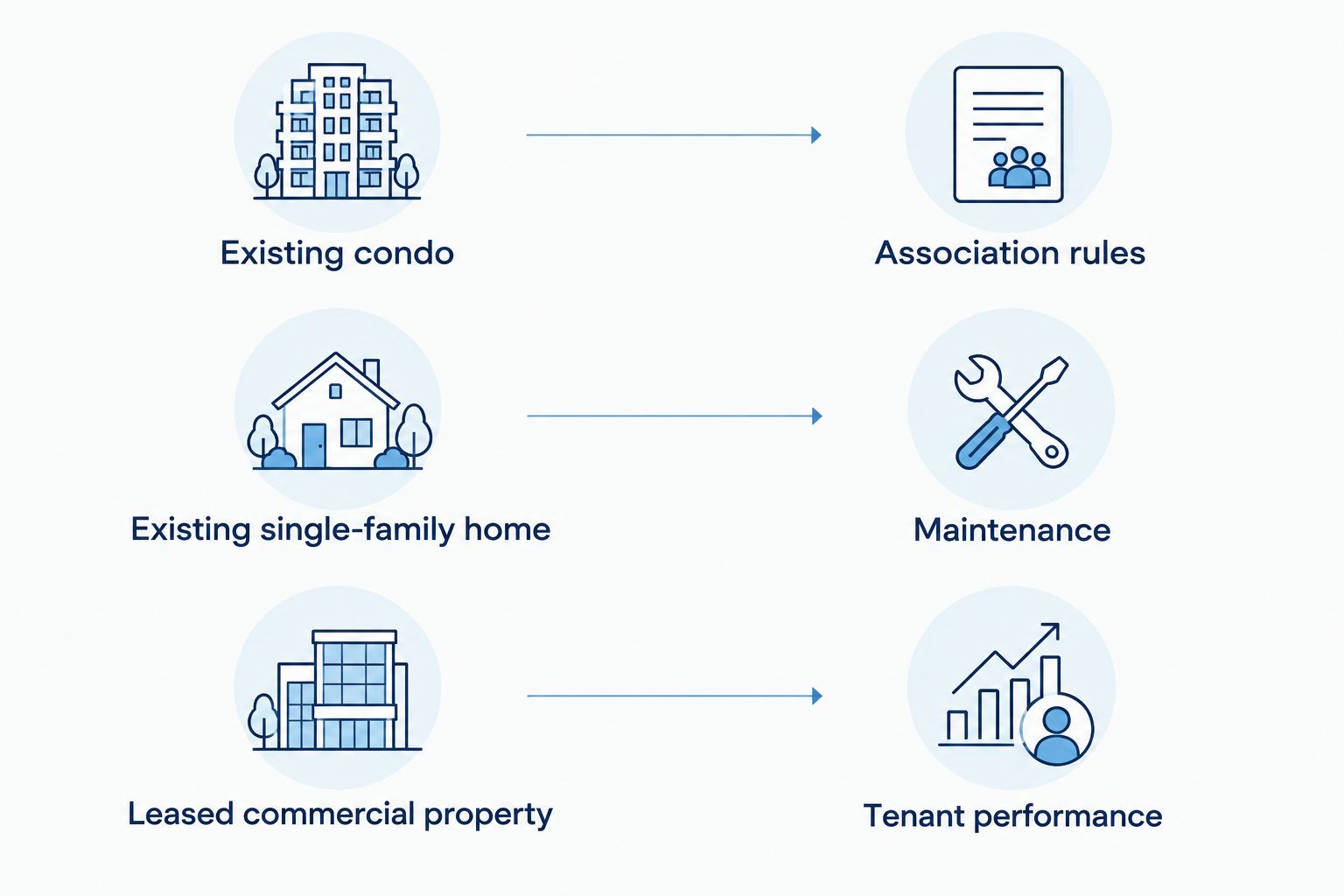
Choose the ownership approach that matches the mandate. The table below compares uses and trade-offs, not projected performance; each property still requires separate underwriting.
| Option | Best for | Main advantage | Key limitation |
|---|---|---|---|
| Existing condo | Families prioritizing managed common areas and a defined building setting | Association documents provide a framework for reviewing shared obligations | Association rules, assessments, and building condition affect the individual unit |
| Existing single-family home | Families prioritizing control over a residence and parcel | Direct control over property-level maintenance decisions, subject to applicable restrictions | The owner must organize maintenance, inspections, and capital work |
| Leased commercial property | Investors evaluating contractual rental income | Executed leases establish obligations to examine | Tenant performance, lease terms, and future capital needs require separate analysis |
| Pre-construction residence | Buyers whose mandate accommodates construction and delivery uncertainty | Contract documents define the proposed acquisition and payment obligations | Completion, changes, assignment rights, and exit flexibility require close legal review |
| Renting before purchasing | Families testing daily use before committing to ownership | Provides direct experience of the location and residence type | Does not establish the economics or rights of a later purchase |
For 2026 decisions, classify personal-use benefits separately from financial returns across every option. A preferred residence can be a sound family decision without meeting the investment committee's income mandate.
Common mistakes family offices make
Combining family enjoyment with investment returns
A principal's preferred view or layout is a legitimate requirement. The mistake is assigning an unsupported financial premium to that preference. Keep the personal-use decision visible and calculate investment performance without disguising consumption as income.
Treating a prestigious address as valuation evidence
A neighborhood name does not reconcile differences in condition, unit exposure, parcel characteristics, or building obligations. Require adjustments and a written comparable-selection rationale. Reject valuations supported only by active asking prices.
Assuming the broker manages the entire mandate
Brokerage, investment management, tax advice, legal advice, and property management are distinct responsibilities. Confirm each provider's written scope and reporting obligations. Do not infer a service from familiarity with luxury property.
Approving the acquisition without an exit file
Missing permits, incomplete improvement records, and unresolved association questions become the next buyer's concerns. Assemble the resale evidence during ownership. Waiting until listing preparation makes it harder to explain gaps or correct them before negotiations.
FAQ
What's the best way for a family office to start buying Miami real estate?
Start with a written mandate defining investment purpose, personal use, approval authority, and liquidity constraints. Screen properties against that mandate before arranging tours.
Is Brickell or Coral Gables better for a family office property purchase?
Neither is universally better; the right choice depends on the property type and intended use. Compare Brickell condo building obligations with the parcel, condition, and applicable restrictions of the specific Coral Gables property.
Should a family office buy a Miami condo through an LLC?
Choose the ownership structure with legal and tax advisers before signing acquisition documents. Entity ownership requires review of the intended use, financing, association requirements, and the family's circumstances.
How should private wealth managers evaluate a Miami condo association?
Review the association's finances, applicable inspection reports, reserves, insurance, meeting minutes, and assessment notices. Have qualified advisers connect those documents to future obligations and contractual protections.
Is pre-construction property suitable for family office investment?
Pre-construction belongs only in a mandate that accepts construction, delivery, and contractual exit uncertainty. Have counsel review payment obligations, completion provisions, changes, and assignment restrictions before commitment.
Can one Miami property serve both family use and rental income?
A property can serve both purposes only when applicable rules and the family's intended schedule permit it. Underwrite the actual periods available for leasing rather than assuming uninterrupted rental income.
What does Carlos Morean provide for family office buyers and sellers?
Carlos Morean provides Miami residential and commercial real estate brokerage services. Keep investment management, legal advice, tax planning, and property operations assigned to the appropriate providers rather than assuming those services are included.
One last thing
Before approving a property, ask someone outside the acquisition discussion to read the investment memo. If that person cannot distinguish verified facts, assumptions, and family preferences, revise the memo before signing. The most useful final check is not another attractive comparable; it is a clear explanation of what would make you decline the deal.