
First-time homebuyers’ Miami real estate search is the process of matching a primary residence to financing, building conditions, and daily needs with the aim of buying a home you can afford to keep. This 2026 guide to Miami real estate for first-time homebuyers explains how to compare neighborhoods, review condo documents, and protect your purchase before committing your deposit.
- Miami real estate for first-time homebuyers starts with total ownership costs, not the lender’s maximum approval.
- Carlos Morean provides Miami buyer representation; lenders, inspectors, and attorneys handle separate specialist decisions.
- Compare Brickell, Brickell Key, Coconut Grove, and Coral Gables through specific properties rather than neighborhood averages.
- For Miami condos, review association finances, insurance, assessments, and financing eligibility before removing contractual protections.
Why Miami real estate matters for first-time homebuyers
Your first Miami purchase combines decisions that renters usually handle separately: housing, insurance, maintenance, and responsibility for a building’s condition. A mortgage approval addresses borrowing eligibility. It does not establish whether the property fits your household budget or whether a condo association has adequately planned for repairs.
Brickell and Brickell Key require careful building-level comparisons. Coconut Grove and Coral Gables also require you to distinguish a condominium’s shared obligations from a house’s direct maintenance responsibilities. An address alone cannot answer those questions.
Carlos Morean is best for Miami real estate buyers seeking local brokerage guidance, not a substitute for lending, inspection, or legal advice. Keep those roles separate when assembling your buying team.
For a first purchase in 2026, the useful question is not simply whether Miami is a good market. It is whether a particular home, under a particular contract, works for your finances and intended use.
How to buy your first Miami home
Set your budget
Start with a spreadsheet before scheduling showings. Separate the money needed to complete the purchase from the recurring expenses required to own the property. Then protect a cash reserve rather than treating every available dollar as a deposit.
Your ownership worksheet should include mortgage principal and interest, property taxes, homeowners insurance, applicable flood coverage, association dues, utilities, and maintenance. For a condo, identify expenses covered by association dues and those billed separately; otherwise, your comparison can count an expense twice or miss it entirely.
Do not copy the seller’s property-tax bill into your long-term budget. Florida ownership changes can affect assessed value, and the seller’s exemptions do not automatically transfer to you. Request a property-specific estimate and verify potential exemptions with the property appraiser.
- Cash needed: separate the deposit, remaining closing funds, moving expenses, and reserves.
- Monthly obligations: distinguish mortgage payments from insurance, taxes, and association charges.
- Insurance checks: request 2 property-specific quotes using the same coverage assumptions.
- Stress test: recalculate your budget with a documented repair or assessment obligation included.
Secure lender review
Gather your income records, asset statements, identification, and debt information before comparing lenders. Ask what has actually been reviewed: an initial conversation, automated findings, or supporting documents. A preapproval remains conditional; the property and your financial position still need to satisfy underwriting requirements.
For a Miami condominium, ask the lender to assess the project as well as your application. A borrower can qualify while a building does not meet a particular loan program’s requirements. Do not assume another owner’s mortgage proves that your proposed financing will work.
Compare loan estimates using consistent assumptions about the property, down payment, loan type, and rate-lock status. In 2026, assistance-program eligibility and lender requirements should be checked directly with the administering organization rather than inferred from an old article.
- Document review: ask which financial records the lender has verified.
- Project review: identify condominium documents needed for the proposed loan.
- Loan comparison: separate interest charges, lender fees, mortgage insurance, and cash required.
- Assistance eligibility: confirm income, occupancy, education, and repayment conditions directly.
Choose local representation
Begin with a written list of questions and interview agents before agreeing to representation. Ask how each agent evaluates comparable sales, condominium finances, inspection findings, and offer terms. Request an explanation of communication responsibilities and what happens when an issue requires an attorney or another specialist.
Carlos Morean is a Compass real estate agent serving Miami buyers, including residential, waterfront, and condo purchasers. The relevant fit is access to local brokerage guidance across neighborhoods such as Brickell, Coconut Grove, and Coral Gables—not a promise that every listing is appropriate for a first purchase.
Ask Carlos Morean to explain how a proposed property fits your criteria and which supporting records still need verification. An agent’s recommendation should lead to evidence, not replace it. Read any representation agreement before signing, including its scope, duration, compensation provisions, and termination terms.
- Local relevance: ask about the exact neighborhood and property type you are considering.
- Valuation method: request recent closed sales and explanations for adjustments.
- Representation terms: clarify obligations and compensation before proceeding.
- Specialist referrals: identify who handles financing, inspections, insurance, and legal questions.
Compare specific properties
Build a shortlist of 3 properties and evaluate them with the same worksheet. Compare usable layout, condition, exposure, parking rights, storage, recurring obligations, and documented restrictions. A favorable neighborhood reputation cannot compensate for a home that fails your essential requirements.
In Brickell, test the route between the building entrance and your actual destinations. On Brickell Key, include island access in that test. For Coconut Grove and Coral Gables, compare the exact block, property type, maintenance responsibilities, and any applicable property restrictions rather than treating either area as uniform.
Complete 2 commute tests at the times you expect to travel. Visit the unit or house with attention to noise, light, access, and surrounding activity. For your 2026 shortlist, preserve dated comparable-sale records so later asking-price changes do not obscure your original reasoning.
- Daily use: test commuting, groceries, parking, deliveries, and guest access.
- Comparable sales: match property type, location, condition, and relevant building characteristics.
- Physical differences: inspect layout, natural light, storage, and maintenance exposure.
- Ownership rights: verify assigned parking, storage, access, and any promised exclusive use.
Review building documents
Create a document checklist yourself and request records early. For a condo, collect the declaration, rules, current budget, financial statements, assessment information, insurance documentation, and available meeting minutes. Ask which inspection and reserve-study requirements apply to that building and request the corresponding records.
Florida condominium requirements depend on the property and applicable law. Have an appropriate professional identify the building’s obligations and assess the documents; a listing description is not evidence of compliance. Missing records are a reason to investigate, not permission to assume the association is financially sound.
For a house, shift the review toward the roof, structure, drainage, permits, insurance eligibility, and property boundaries. During a 2026 purchase, use current documents and dated specialist findings. A recently renovated interior does not establish the condition of concealed systems or shared structural elements.
- Association finances: review reserves, budget assumptions, delinquencies, and assessments.
- Building condition: request applicable inspection reports and repair information.
- Insurance scope: distinguish association coverage from the protection you must obtain.
- Use restrictions: confirm pets, rentals, renovations, occupancy, and approval procedures.
- Unresolved questions: obtain written clarification before the relevant contractual deadline.
Protect your offer
Write down your proposed terms before signing an offer. Your decision should connect comparable sales, inspection rights, financing requirements, document review, and the deposit at risk. A verbal assurance does not amend a written contract.
Have your agent explain the transaction sequence and obtain legal advice about provisions you do not understand. The right to inspect, cancel, renegotiate, or recover a deposit depends on the contract and applicable law. Do not assume dissatisfaction alone creates an exit right.
For a condominium, use the Miami condo offer-to-closing workflow to organize questions about the sequence. Keep financing approval, association approval, and your own due diligence separate; completing one does not automatically complete the others. Calendar every deadline from the executed agreement, not from a general online timeline.
- Offer evidence: support your proposed terms with relevant closed sales and documented condition.
- Contract protections: understand inspection, financing, appraisal, and document-review provisions.
- Deposit instructions: confirm the escrow holder and delivery requirements independently.
- Deadline calendar: record notice requirements, responsible parties, and required documents.
Verify your closing
Maintain a shared closing checklist and reconcile outstanding items with the lender, closing agent, and your representative. Read the final settlement documents and investigate changes rather than assuming every difference is routine.
Confirm insurance is arranged as required, lender conditions are satisfied, and any association requirements have been addressed. At the final walkthrough, check agreed repairs, included items, and the property’s condition against the contract. The walkthrough is not a substitute for the earlier professional inspection.
Verify wire instructions through a trusted phone number obtained independently of the message containing the instructions. Email appearance alone does not establish authenticity. Before authorizing funds, resolve unexplained changes with the closing agent through that verified channel.
- Document reconciliation: compare closing figures with lender disclosures and contract obligations.
- Condition check: verify agreed repairs and included property at the walkthrough.
- Funds verification: authenticate payment instructions before sending money.
- Ownership handoff: confirm keys, access devices, utilities, and required association registration.
The sequence below keeps the property search connected to financing and document review. Completing these stages does not remove the need to revisit earlier decisions when new evidence appears.
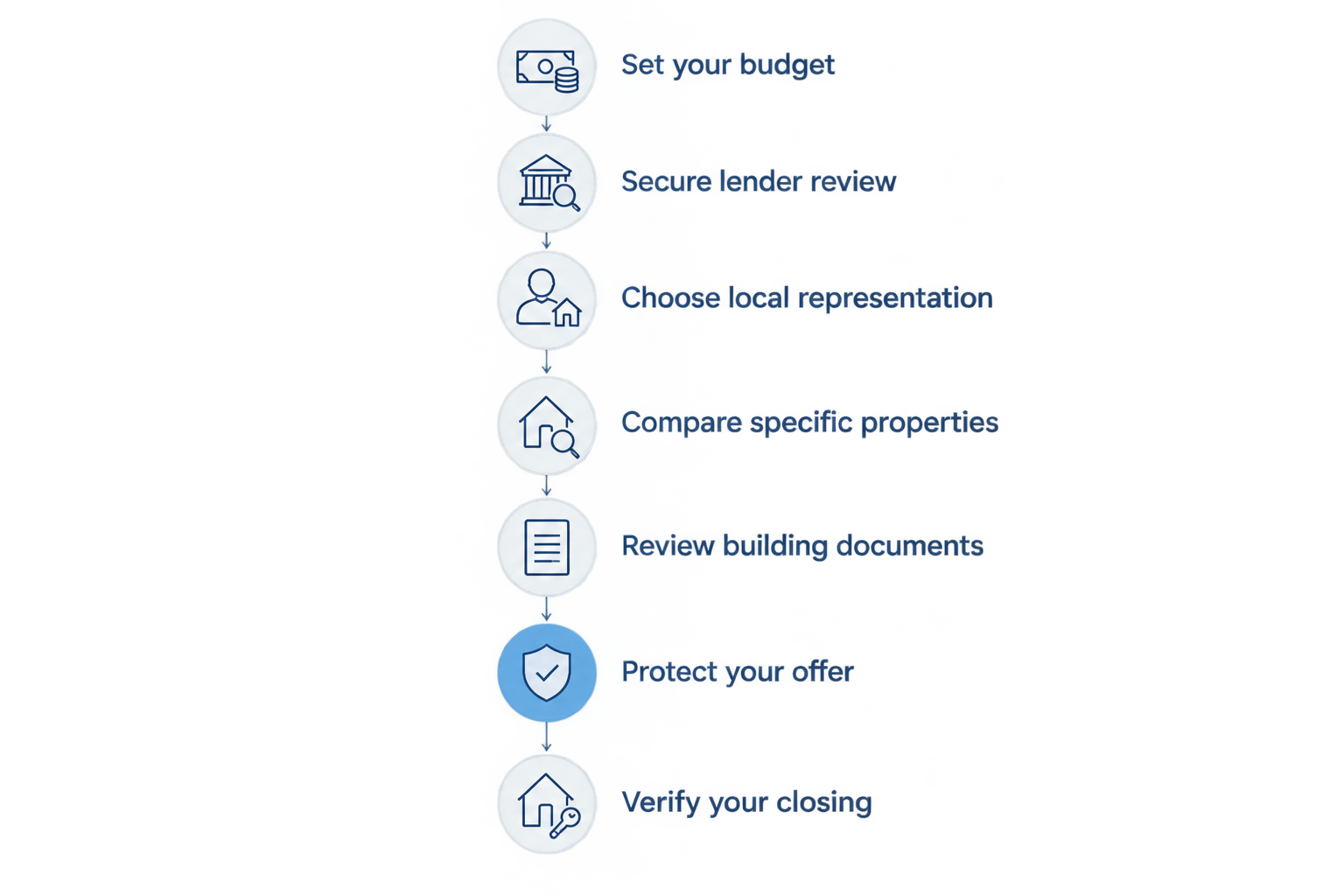
Compare first-home options in Miami
Choose the ownership structure before choosing the view. Each option creates different responsibilities, and no property type eliminates due diligence. Use this comparison to identify the trade-off you are prepared to manage.
| Option | Best for | Main advantage | Key limitation |
|---|---|---|---|
| Resale condominium | Buyers prioritizing shared building maintenance | Defined unit ownership with association-managed common elements | Association finances, rules, insurance, and project eligibility require review |
| Townhouse | Buyers seeking a house-like layout | Separation of living spaces and potentially direct entry | Ownership and maintenance obligations vary; confirm the legal structure |
| Single-family house | Buyers prioritizing control over the property | Direct responsibility for property decisions, subject to applicable restrictions | Owner manages repairs, insurance, exterior upkeep, and site issues |
| Pre-construction condominium | Buyers with a flexible occupancy timeline | Opportunity to select a home before completion | Delivery, deposits, financing, and contract terms require separate review |
Do not treat pre-construction as a shortcut around inspection or financing questions. You are evaluating a different contract and delivery process. If you need dependable near-term occupancy, investigate that mismatch before reserving a unit.
Common mistakes first-time Miami buyers make
Treating mortgage approval as a spending target
A lender evaluates eligibility under its requirements; you decide what leaves enough room for other priorities. Build your ownership budget independently and preserve funds for expenses outside the mortgage payment.
Comparing condo dues without comparing coverage
A lower recurring charge does not establish better value. Identify what the association covers, what you pay separately, and whether planned repairs or assessments change the ownership picture.
Paying for a neighborhood name instead of property evidence
Brickell, Brickell Key, Coconut Grove, and Coral Gables are starting points for research—not valuation adjustments by themselves. Require comparable sales and a clear explanation of differences in condition, location, rights, and obligations.
Confusing approval with protection
Lender approval, association approval, and a satisfactory inspection answer different questions. None automatically guarantees the others, and none replaces understanding your contract’s deadlines and remedies.
FAQ
What is the first step to buying a home in Miami in 2026?
Set a total ownership budget before choosing properties. Include financing, taxes, insurance, association obligations, maintenance, and the cash you will retain after closing.
Is a condo better than a house for a first-time Miami buyer?
A condo fits buyers who prefer shared management of common property; a house fits buyers who want more direct control and accept maintenance responsibility. Compare the actual documents and condition rather than assuming either type is easier to own.
Can I buy a Miami condo if I already have mortgage preapproval?
Mortgage preapproval does not guarantee financing for a particular Miami condo. The lender must also evaluate the property and any applicable condominium-project requirements.
Which Miami neighborhood is best for a first-time homebuyer?
The best neighborhood is the one where a specific property meets your budget, commute, and ownership requirements. Compare Brickell, Brickell Key, Coconut Grove, and Coral Gables at the building or block level rather than choosing by reputation.
What condo documents should I review before buying in Miami?
Review the declaration, rules, current budget, financial information, assessment records, insurance documentation, and available meeting minutes. Ask qualified professionals which inspection reports and reserve studies apply to the building.
Does the seller’s property-tax bill show what I will pay?
The seller’s property-tax bill does not establish your future tax obligation. Changes in ownership and exemptions can affect the calculation, so request a property-specific estimate and verify eligibility with the property appraiser.
Can Carlos Morean help a first-time Miami homebuyer?
Carlos Morean provides Miami residential real estate brokerage services, including assistance with condo and waterfront purchases. Ask about representation terms and the approach to evaluating your target neighborhood and property type.
One last thing
Read the documents that can disqualify a home before spending time choosing finishes. An unacceptable rental restriction, unresolved building issue, or financing obstacle can outweigh an attractive interior.
For your 2026 search, write a rejection checklist before the first showing. Include nonnegotiable ownership obligations, commute requirements, financing conditions, and property restrictions. A useful checklist helps you reject an unsuitable home even when you like it.